How Much Does a Maple Butcher Block Countertop Cost?
This budget matrix uses the cited maple ranges as anchors, then separates thickness, grain orientation, and maintenance into distinct budget lines. It is a planning tool, not a fixed quote. Hard maple often sits in the budget-friendly hardwood tier for kitchen butcher block, but end-grain and thicker tops move quickly into premium pricing.
Maple butcher block budget matrix
| Top style | Thickness | Material-only cost per sq. ft. | Installed cost per sq. ft. | Annual maintenance allowance per sq. ft. |
|---|---|---|---|---|
| Face-grain | 1.5 in. | $25 to $35 | $50 to $70 | $2 to $4 |
| Face-grain | 2.0 in. | $30 to $40 | $58 to $78 | $2 to $4 |
| Face-grain | 2.25 in. | $33 to $45 | $62 to $85 | $2 to $5 |
| Edge-grain | 1.5 in. | $35 to $38 | $55 to $75 | $3 to $5 |
| Edge-grain | 2.0 in. | $40 to $48 | $63 to $83 | $3 to $5 |
| Edge-grain | 2.25 in. | $44 to $52 | $68 to $90 | $3 to $6 |
| End-grain | 1.5 in. | $55 to $90 | $75 to $110 | $4 to $7 |
| End-grain | 2.0 in. | $62 to $98 | $85 to $120 | $4 to $7 |
| End-grain | 2.25 in. | $70 to $110 | $92 to $135 | $5 to $8 |
| Face-grain kitchen run | 1.5 in. | $25 to $35 | $1,100 to $2,200 typical sale price | $40 to $90 per year for resealing and spot repair |
| Edge-grain island top | 1.5 in. | $35 to $38 | $50 to $100 installed planning range | $45 to $100 per year for oil maintenance or refinishing reserve |
| End-grain premium top | 2.25 in. | $55 to $90 | $75 to $100+ installed planning range | $60 to $120 per year for higher finish and repair reserve |
The first nine rows show how thickness and grain orientation change the bill while keeping maintenance visible. The last three rows translate the same material into the kinds of project quotes homeowners actually see: a standard kitchen run, a typical island top, and a premium end-grain build.
How much does a maple butcher block countertop cost?
A maple butcher block countertop is commonly priced at roughly $50 to $150 per square foot installed, or about $300 to $1,500 for a typical 5-by-3-foot top, with thicker, end-grain, and custom cutouts often raising the total. Skip edge details and your budget can jump on sink cutouts, finishing, delivery, and installation. This guide breaks down price by construction, thickness, and install scenario so you can compare real project costs.
Per-square-foot price ranges
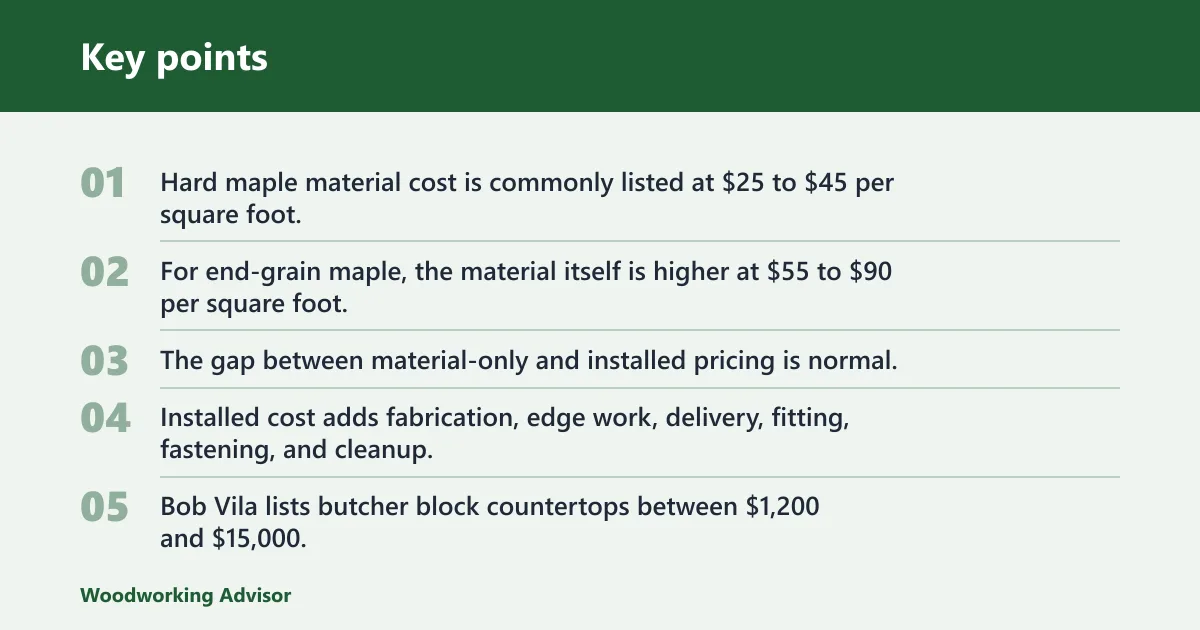
Hard maple material cost is commonly listed at $25 to $45 per square foot, while Bob Vila gives homeowners a broader installed planning range of $50 to $100 per square foot. For end-grain maple, the material itself is higher at $55 to $90 per square foot, and some market quotes reach well above that when the build includes more labor or custom sizing.
The gap between material-only and installed pricing is normal. Material cost covers the slab or panel. Installed cost adds fabrication, edge work, delivery, fitting, fastening, and cleanup.
Typical project totals for islands and perimeter runs
Bob Vila lists butcher block countertops between $1,200 and $15,000, with a national average of $3,500. That wide spread is why square footage matters so much. A 5-by-3-foot island top has 15 square feet; a 10-foot perimeter run at 25 inches deep is roughly 21 square feet before cutouts.
Say your island is 30 inches by 60 inches and you choose edge-grain maple with a basic eased edge. The same top can stay near the lower end of the installed range. Add a farmhouse sink opening, a thicker slab, and a hard film finish, and the quote changes fast.
Why square footage drives the bill
Every extra square foot adds wood, shop time, finish, and handling. The price does not climb in a straight line, though. Large tops may need more seams, stronger support, and tighter site fitting, especially around appliances and sinks.
That is why a small peninsula can sometimes land close to a square-foot quote, while a long perimeter run gets hit with extra labor even if the wood choice stays the same.
What changes the price most?
Thickness, grain orientation, finish type, and install complexity drive maple butcher block pricing more than the wood name alone. Hard maple stays in the budget-friendly hardwood category, but extra thickness, end-grain construction, cutouts, and hard-to-reach sites can move the project from basic to premium quickly.
Thickness and board count
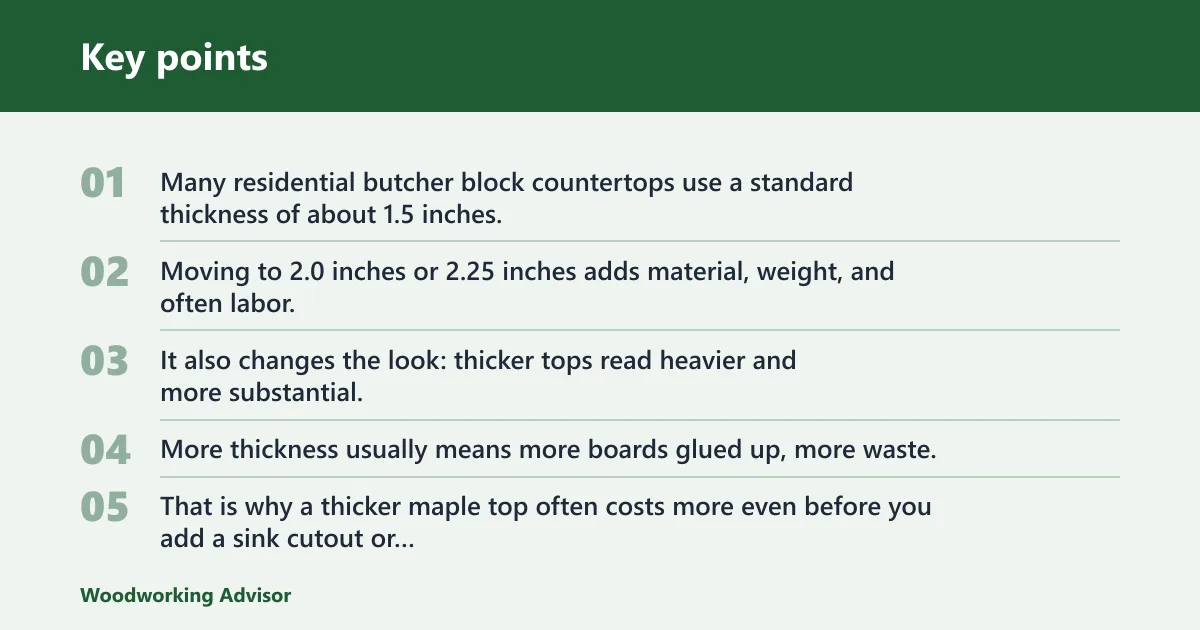
Many residential butcher block countertops use a standard thickness of about 1.5 inches. Moving to 2.0 inches or 2.25 inches adds material, weight, and often labor. It also changes the look: thicker tops read heavier and more substantial, which is useful on islands and peninsulas.
More thickness usually means more boards glued up, more waste, and more time in machining and sanding. That is why a thicker maple top often costs more even before you add a sink cutout or specialty edge.
Grain orientation and labor
Face-grain is usually the lower-cost residential option because the boards are arranged with the broad face up, which can reduce waste and simplify construction. Edge-grain sits in the middle and is common for kitchen countertops and islands. End-grain costs more because it uses more material and more labor, which is why it commands a higher price per square foot.
Hard maple works well in both face-grain and end-grain builds. Face-grain is often chosen when price and a smoother visual pattern matter most. End-grain is chosen when the buyer wants the classic checkerboard butcher-block look and accepts the higher cost.
Finish choice and cleanup
A food-safe oil finish lowers the entry cost, but it needs more regular maintenance and offers less stain resistance than a hard film finish. A hard film finish costs more up front and can better resist spills, but once damaged, it is harder to repair invisibly.
That maintenance difference matters over time. A lower purchase price can become a higher ownership cost if the finish needs frequent renewal or if water exposure forces sanding and refinishing sooner than expected.
Site access and install complexity
Stairs, narrow hallways, out-of-square walls, and tight appliance clearances all add labor. So does cleanup after fabrication dust and finish work. Even a straightforward top can cost more if installers must scribe against uneven walls or remove an old countertop first.
Face-grain, edge-grain, and end-grain pricing
Face-grain usually saves the most money. Edge-grain is the common middle option. End-grain costs the most because it uses more wood and more labor, and the finished surface takes more work to produce. Those three categories are the core price decisions for maple butcher block.
Where face-grain saves money
Face-grain maple often starts at the lowest material cost because the boards are arranged with the broad face up, which can reduce waste and simplify construction. It is a good fit for a perimeter counter where the top is used for light prep, serving, or staging rather than constant heavy chopping.
Standard face-grain pricing is also easier to compare with broad market data. One source lists a standard kitchen run in face-grain maple at $1,100 to $2,200 typical sale price.
Why edge-grain is the common middle option
Edge-grain maple gives a striped look and a stronger sense of depth than face-grain, without the full premium of end-grain. Country Living lists a standard edge-grain maple island top at around $35 to $38 per square foot, which sits below many installed planning ranges once labor is added.
For many kitchens, edge-grain is the practical middle. It looks more substantial than face-grain, costs less than end-grain, and still fits well on islands and perimeter counters.
Why end-grain costs more
End-grain maple is priced higher because the build uses more material and more labor. The cited material cost is $55 to $90 per square foot, and Bob Vila lists end-grain prices from $75 to $350 per square foot depending on the job. That spread reflects custom size, thickness, finish, and fabrication differences.
End-grain is often selected when the buyer wants the classic butcher-block block pattern and is willing to pay for it. It is not the default residential choice.
How much extra does a thicker maple butcher block countertop cost?
A thicker maple butcher block top usually adds a modest but real premium over 1.5-inch stock. The jump to 2.0 inches or 2.25 inches increases material use, weight, and fabrication time, so the extra cost shows up in both the wood and the install. The visual payoff is a heavier, more furniture-like counter.
1.5-inch standard thickness
The 1.5-inch top is the common baseline. It works well for most kitchens and keeps weight lower for cabinets and brackets. If the budget is tight, this is usually the thickness to price first.
2.0-inch and 2.25-inch upgrades
Moving from 1.5 inches to 2.0 inches often adds a small percentage to the material bill and can add more if the maker charges for heavier handling or special machining. A 2.25-inch top can add a bit more again, especially on longer runs where extra material multiplies quickly.
Picture a 7-foot island in edge-grain maple. At 1.5 inches, the top may fit the midrange installed budget. At 2.25 inches, the same island can move into a higher bracket even before sink cutouts or delivery are added.
Visual payoff versus added material cost
Thicker tops create a stronger profile at the room edge and often read as more permanent. That is useful on islands that face the living area. The question is whether the visual effect justifies the extra material and labor, especially if the top will need a lot of maintenance or will live near a sink.
What do installation and cutouts add?
Installation can add a meaningful share of the final cost. The same source lists labor to install a butcher block kitchen at $500 to $3,000 per 100 square feet, which means labor becomes more important as the project gets larger or more complex. Cutouts, site prep, and cleanup are usually priced separately.
Linear-foot and hourly labor
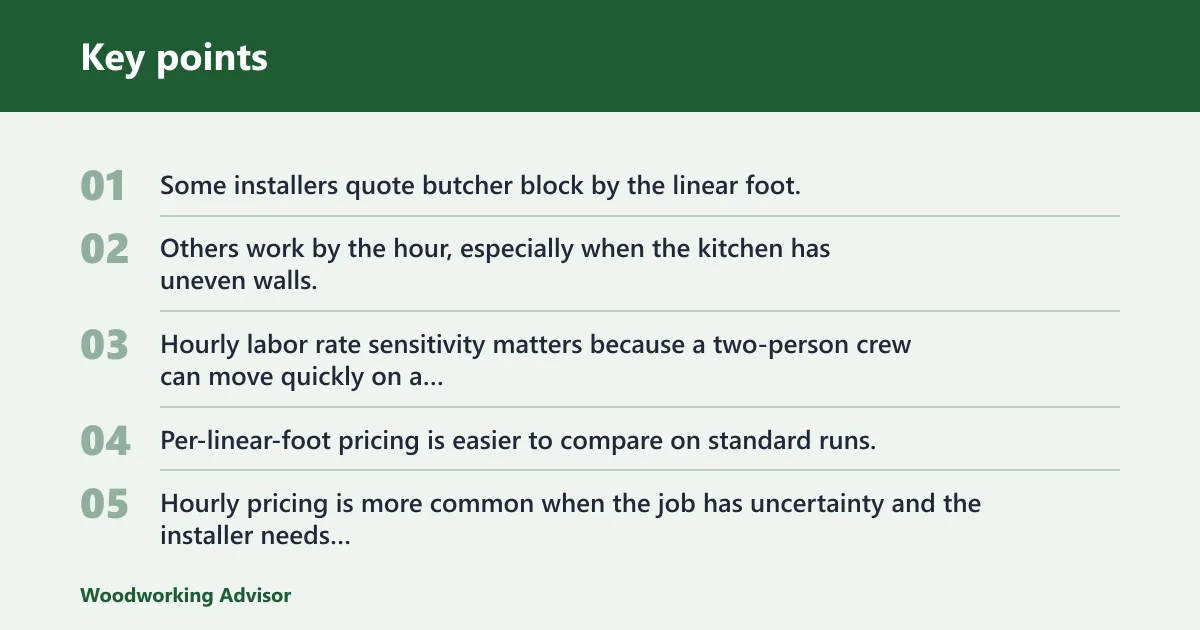
Some installers quote butcher block by the linear foot. Others work by the hour, especially when the kitchen has uneven walls, tricky appliance clearances, or a need for onsite scribing. Hourly labor rate sensitivity matters because a two-person crew can move quickly on a simple island but spend much longer on a perimeter run with obstacles.
Per-linear-foot pricing is easier to compare on standard runs. Hourly pricing is more common when the job has uncertainty and the installer needs flexibility for fitting and adjustments.
Sink and appliance cutouts
Sink cutouts add labor because the opening must be measured, cut, sealed, and often reinforced. Undermount sink cutouts usually cost more than a simple drop-in opening because the edge must be cleaner and better supported. Farmhouse sink cutouts are usually more involved still, because the front reveal and cabinet fit demand more careful work. Cooktop cutouts also add cost because of heat clearance and precise sizing.
| Add-on | Typical budget impact | Why it costs more |
|---|---|---|
| Undermount sink cutout | $150 to $350 | Cleaner cut, support prep, sealing |
| Farmhouse sink cutout | $250 to $500 | Front reveal, cabinet fitting, extra labor |
| Cooktop cutout | $125 to $300 | Precise sizing and heat-related fit work |
| Eased edge | $0 to $75 | Simple profile, low machining time |
| Bullnose edge | $75 to $175 | More routing and sanding |
| Live edge | $100 to $250 | Irregular shaping and more finishing time |
| Waterfall edge | $300 to $900+ | Extra material, mitering, and installation labor |
| Food-safe oil finish | $50 to $150 | Lower upfront cost, higher upkeep |
| Hard film finish | $150 to $400 | More labor and materials, stronger stain resistance |
Prep, delivery, and cleanup
Delivery matters because butcher block is heavy and vulnerable to damage if it is handled badly. Site prep may include removing the old top, leveling cabinet runs, and checking wall straightness. Cleanup should be included in the budget because sanding dust and finish residue are part of the job, not an optional extra.
Maple versus walnut pricing
Maple usually costs less than walnut for butcher block countertops. That difference often makes maple the better value when the buyer wants a light, durable hardwood without the premium color and material price of walnut. If the kitchen design depends on a dark wood tone, walnut may still be worth the jump.
Where maple usually costs less
Hard maple is listed at $25 to $45 per square foot for butcher block countertops, while walnut is commonly quoted higher in the market. That lower entry price is why maple is a standard budget-friendly choice for kitchens, islands, and prep areas.
Maple also tends to fit better when the goal is a bright, neutral surface that will not visually darken a small kitchen.
Walnut can justify its price when the countertop is a visible design feature and the darker tone is part of the room plan. For buyers who want a statement island more than a utility surface, the premium can make sense. For most functional kitchen budgets, maple gives more square footage for the money.
How maintenance changes lifetime value
The finish matters as much as the species. A cheaper maple top with a finish that needs frequent renewal can close the gap with a more expensive species that holds up better in the planned use. That is why the low bid is not always the best value over several years.
Suppose a 36-inch by 72-inch island is finished with food-safe oil and gets heavy sink-side use. If the owner wants the top looking fresh year after year, the maintenance line can become more important than the original quote.
Frequently asked questions
How much does a maple butcher block countertop cost per square foot?
Hard maple material is listed at $25 to $45 per square foot, while Bob Vila gives homeowners a broader installed range of $50 to $100 per square foot. End-grain maple materials are higher at $55 to $90 per square foot, and custom fabrication can move the final number well above that.
How much does hard maple butcher block cost installed?
A small island can stay near the low end, but thicker tops, sink cutouts, and hard-to-fit rooms push the quote upward.
Is maple cheaper than walnut for butcher block countertops?
Yes, maple is usually cheaper than walnut. Maple is a standard budget-friendly hardwood for butcher block, while walnut usually carries a higher material price and is chosen more often for appearance than savings. If cost per square foot is the main concern, maple usually wins.
What drives the price of a maple butcher block countertop?
Thickness, grain orientation, cutouts, finish type, and install complexity drive the price most. A 1.5-inch face-grain top usually costs less than a 2.25-inch end-grain top. Sink cutouts, delivery, and difficult site fitting can add more than buyers expect.
How much does edge-grain maple cost versus end-grain maple?
The same source lists a standard edge-grain maple island top at around $35 to $38 per square foot, while end-grain maple is listed at $55 to $90 per square foot in material cost. End-grain is the more expensive option because it uses more wood and more labor.
Is a maple butcher block countertop worth it for a kitchen island?
It often is, especially if you want a warm wood work surface without the price of more premium hardwoods. Maple works well on islands where the surface will be used for prep, serving, or casual dining. Edge-grain gives a strong value balance, while end-grain suits buyers who want the premium look.
What is the labor cost to install a butcher block countertop?
Simple island installs often stay near the lower end, while perimeter runs, cutouts, and tricky room layouts push labor higher. Hourly quotes usually rise when site conditions are unpredictable.
Sponsored / affiliate links. As an Amazon Associate I earn from qualifying purchases. I may earn additional commission from eligible campaigns.