Chair Rollers for Wood Floors: Soft vs Hard Casters That Will Not Scratch
An office chair puts a lot of weight on five small wheels, and if those wheels are hard plastic, your hardwood floor takes the abuse. The fix is usually not a new chair or a big rug. It is a set of soft, floor-safe casters that press into the chair in a few minutes. This guide explains which caster materials protect wood, how to tell whether your current wheels are the risky kind, how to measure for a replacement, and where casters fit next to mats and pads.
Which Chair Casters Are Safe for Hardwood Floors?
Best Hardwood-Safe Caster Set
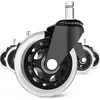 |
3-Inch Polyurethane Office Chair Caster Wheels, Set of 5
|
Office chair wheels fall into two broad groups. Hard casters, usually nylon, are designed for carpet, where they roll easily. Soft casters have a polyurethane or similar rubbery outer layer that cushions the floor. Sources that sell casters agree on the split: CasterHQ says hard nylon wheels roll easier on carpet but can damage hardwood, and recommends polyurethane or soft TPR rubber for hard floors. The Caster Guy warns that nylon may leave permanent dents in real wood such as oak, maple or cherry.
| Wheel type | Typical material | Best surface | Risk on hardwood |
|---|---|---|---|
| Hard (carpet) caster | Hard nylon | Carpet | Highest: can scratch or dent the finish |
| Hard floor caster | Soft polyurethane outer layer over a hard core | Hardwood, tile, laminate | Low: designed to be non-marking |
| Soft rubber (TPR) caster | Soft rubber-like tire | Hardwood, tile, laminate | Low: soft and quiet |
Materials summarized from CasterHQ, The Caster Guy and the Interior Insider comparison of Herman Miller casters. Manufacturers do not publish one shared hardness rating for these wheels, so treat the categories as a guide, not a lab measurement.
The fingernail test
You do not need a catalog to identify what is on your chair. Press a fingernail into the tire. A hard floor caster has a slightly soft, almost rubbery surface you can indent. A carpet caster feels like rock-hard plastic with no give at all. If yours pass the hard-plastic test and your chair sits on hardwood, they are the wheels to replace first.
The myth: the wheels that came with the chair must be fine
Many chairs ship with carpet-style casters. Herman Miller lists a standard carpet caster and a separate hard floor caster, and Interior Insider reports both cost the same for a set of five. So the caster that shipped on your chair can be the wrong one for a wood floor, even on a premium chair. Checking takes ten seconds.
How to Measure and Fit Replacement Casters
Fit matters more than brand. Most replacements are friction-fit, so a wrong stem will either fall out or refuse to seat. CasterHQ says about 90 percent of U.S. office chairs use a 7/16 inch grip-neck stem, which is a smooth shaft with a small ring near the top. The listing for our pick gives the stem as 7/16 inch by 7/8 inch and says it does not fit IKEA chairs.
| What to check | What to look for |
|---|---|
| Stem diameter | 7/16 inch is the common size; measure your old caster to confirm |
| Stem length | The listing for our pick states 7/8 inch; a stem that is too short may not stay seated |
| Wheel diameter | Our pick is 3 inch; CasterHQ lists 2 inch to 3 inch wheels for chair casters, in materials from hard nylon to polyurethane |
| Weight rating | The seller of our pick states 650 lbs for the full set of five; check the rating on any set you buy |
| Chair brand | Some brands, including IKEA, use non-standard stems |

How to Swap Office Chair Casters
- Tip the chair over onto a padded surface or rug so the seat and the floor are not damaged.
- Pull the old caster straight out. Most are held by friction. If one is stuck, grip the wheel and pull firmly, or use pliers on the stem ring.
- Compare stems before you push anything in: the new stem should match the old one in diameter and length.
- Push the new caster in until the stem is firmly seated, then repeat for all five.
- Set the chair upright and roll it in a small area to confirm the wheels spin freely and the chair does not wobble.
What the Listing for Our Pick Says
Our pick is a 3 inch set of five with polyurethane tires. According to the Amazon listing, it uses steel brackets, precision ball bearings, a 7/16 inch by 7/8 inch stem and tool-free installation, and it carries a one-year warranty. The seller claims the tires will not scratch or leave marks on any surface and says the set can replace a floor mat. Those are seller claims and we have not tested the set ourselves, so check the current listing and reviews, especially for your chair model. Price and availability change; it was in stock at $17.98 when we checked on the day of this update.
Casters vs Chair Mats, Glides and Pads
Casters only apply to wheeled chairs. The right protection depends on what is under the chair.
| Option | Best for | Limitation |
|---|---|---|
| Soft casters | Office chairs that roll | You must match the stem size |
| Chair mat | Heavy daily use or an already worn spot | Can slide on a smooth floor |
| Felt or rubber glides | Chairs without wheels | Do not solve rolling |
| Furniture coasters | Heavy pieces that rarely move | Not for rolling chairs |
For non-wheeled chairs, see our guides to chair glides for hardwood floors and chair coasters. If the chair slides too easily, read how to keep chairs from sliding on hardwood floors, and if a mat is the problem, see how to keep a chair mat from sliding. For heavy furniture, furniture coasters for wood floors cover that case.
Keeping Soft Casters From Scratching Anyway
- Sweep or vacuum the chair area regularly. Grit trapped between any wheel and the finish can scuff it, even with a soft tire.
- Check the wheels now and then for hair, thread and debris wrapped around the axle, which can stop a wheel spinning and make it drag.
- Replace cracked or flattened wheels. A damaged tire may expose the harder core underneath.
- Do not drag the chair when a wheel is jammed; fix the wheel first.
Already see marks? Our guide to removing scuff marks on wood floors covers how to treat them.
Conclusion
For a rolling chair on hardwood, the reliable move is to replace hard nylon wheels with soft polyurethane or rubber ones, after confirming the stem size. Check your wheels with the fingernail test, measure one old caster, and keep the floor free of grit.
Frequently Asked Questions
Can I use the wheels that came with my office chair on hardwood?
Only if they are the soft type. Many chairs ship with hard nylon wheels made for carpet, and Herman Miller, for example, sells carpet casters and hard floor casters as separate parts. If the wheel feels like rock-hard plastic, it is a carpet caster and it can scratch or dent a wood floor over time.
Are polyurethane casters really safe for wood floors?
Polyurethane casters are the standard recommendation for hardwood because the soft tire spreads the load and does not scratch the way hard nylon can. They are safer, not maintenance-free: grit stuck to any wheel can still scuff a finish, so keep the floor and the wheels clean.
What stem size do most office chair casters use?
CasterHQ says about 90 percent of U.S. office chairs use a 7/16 inch grip-neck stem. The listing for our pick gives 7/16 inch by 7/8 inch. Pull one old caster and measure it before ordering, because some chairs, including IKEA models, use different stems.
Do I still need a chair mat if I switch casters?
Not necessarily. Soft casters are meant to protect the floor on their own, and some sellers position them as a replacement for a mat. A mat is still useful if the floor already has damaged finish or the chair gets heavy daily use, and it also stops the chair from tracking dirt across the room.
How do I tell a hard floor caster from a carpet caster?
Press a fingernail into the tire. A hard floor caster has a slightly soft, rubbery surface you can indent, while a carpet caster feels like rock-hard plastic with no give.
What should I do if my chair already scratched the floor?
Stop using the hard wheels first, then assess the damage. Light surface marks are often finish scuffs that can be treated, while deep gouges need filling or refinishing. See our guides to fixing scuffed hardwood floors and repairing a scratched hardwood floor.
Sponsored / affiliate links. As an Amazon Associate I earn from qualifying purchases. I may earn additional commission from eligible campaigns.