Does Elmer’s Wood Glue Go Bad?
Yes, Elmer’s wood glue can go bad; if it has chunks, stringy gel, a sour odor, or has frozen and thawed, treat it as unreliable. Bad glue can leave weak joints that fail after clamp-up, wasting stock and time. This guide shows the visible signs of spoilage, when old glue is still usable, and how cold storage changes the risk.
Why storage matters more than the calendar for PVA wood glue
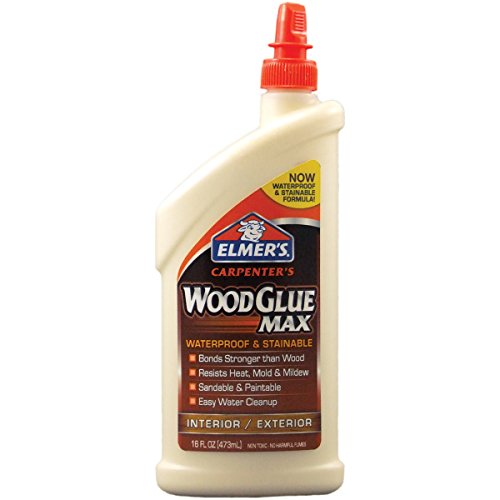
Yes. With PVA wood glue, age alone is not the whole story, but storage conditions can turn a usable bottle into a risky one. Elmer’s Carpenter’s Wood Glue Max is a premium PVA wood glue with a Type II water-resistant claim, so it is meant for clean wood-to-wood joints and normal water cleanup while wet. If the glue has separated badly, skinned over, or changed texture, trust drops fast.
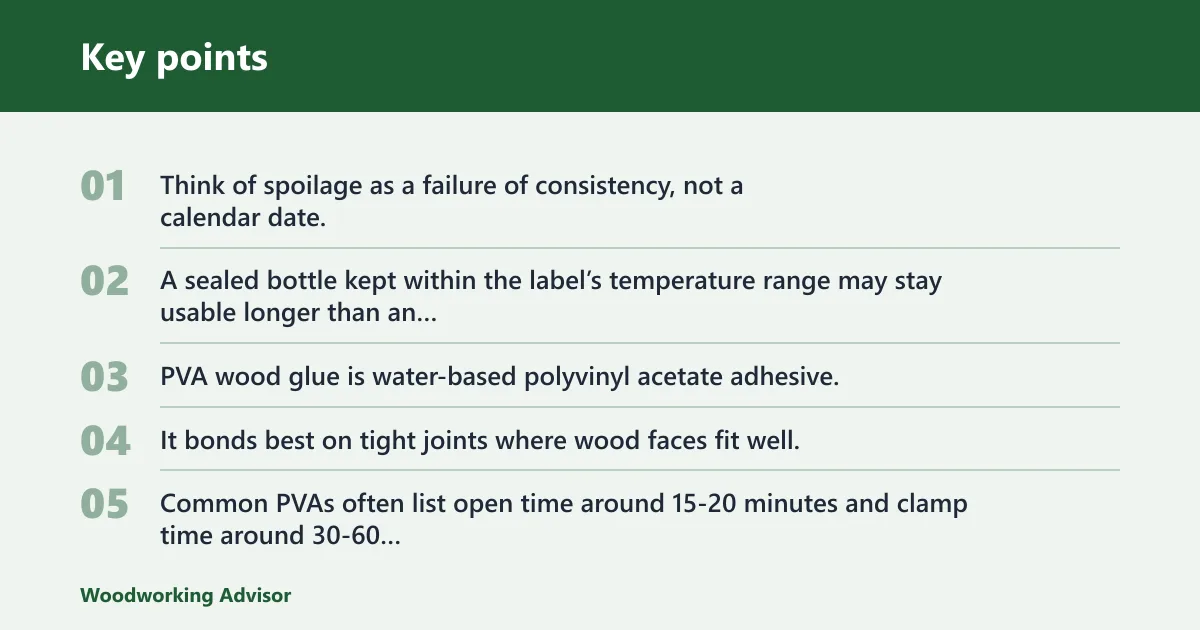
Think of spoilage as a failure of consistency, not a calendar date. A sealed bottle kept within the label’s temperature range may stay usable longer than an opened bottle that has seen freeze-thaw swings or contamination from dried glue on the nozzle.
What “bad” means for PVA glue
PVA wood glue is water-based polyvinyl acetate adhesive. It bonds best on tight joints where wood faces fit well, because the glue line should be thin and continuous. Common PVAs often list open time around 15-20 minutes and clamp time around 30-60 minutes, but those numbers assume normal shop conditions and sound glue. If the adhesive itself has broken down, those times do not matter.
“Bad” usually means the glue no longer flows or wets the wood evenly. That can show up as lumps, rubbery bits, skin floating in the bottle, or a stringy pull when you squeeze it out.
Why storage matters more than age alone
Storage matters because PVA glue is sensitive to temperature and contamination. Freezing can destabilize the emulsion, while excessive heat can thicken or shorten shelf life. A bottle that sat sealed in a stable cabinet may still be fine, while a newer bottle stored in a hot shed or freezing garage may fail sooner.
Moisture content in the wood also matters. Roughly 12% moisture content is often cited as a point where glue performance concerns start to appear, and some indoor-wood guidance targets 6-8%. Old glue plus damp wood is a poor combination.
How to tell if wood glue is still good
Start with the bottle, then check the glue itself. Good PVA glue should look uniform, smell like a normal water-based adhesive, and squeeze out in a smooth bead. If it has obvious separation, skinning, clumps, or a sour odor, the risk goes up. For a critical joint, that is enough reason to discard it.
Visual signs: separation, clumps, skinning, and stringiness
Separation alone is not always a death sentence. Some older glues settle a little and recover after thorough mixing. The red flags are hard lumps, thick jelly, dried skin pieces, or glue that stretches into threads instead of forming a smooth bead.
Suppose a half-full bottle has a yellowed crust around the cap and the glue comes out in ropes rather than a clean stream. That is more than normal aging. It points to moisture loss, contamination, or partial curing inside the container.
Smell checks and what sour odor can mean
Fresh PVA glue should not have a sharp sour smell. A sour, off, or fermented odor can mean the bottle has degraded or picked up contamination. Smell is not a lab test, but it is a fast warning sign when paired with lumps or bad flow.
If the odor is off and the glue has also thickened, do not trust it for anything structural. For small noncritical work, you can still move to a scrap test if the bottle is otherwise only mildly aged.
The squeeze test for viscosity and flow
A simple squeeze test helps separate harmless thickening from real failure. Good glue should move with steady pressure and level out after it hits a scrap board. If it blobs, breaks into clumps, or refuses to spread, the viscosity has likely shifted too far.
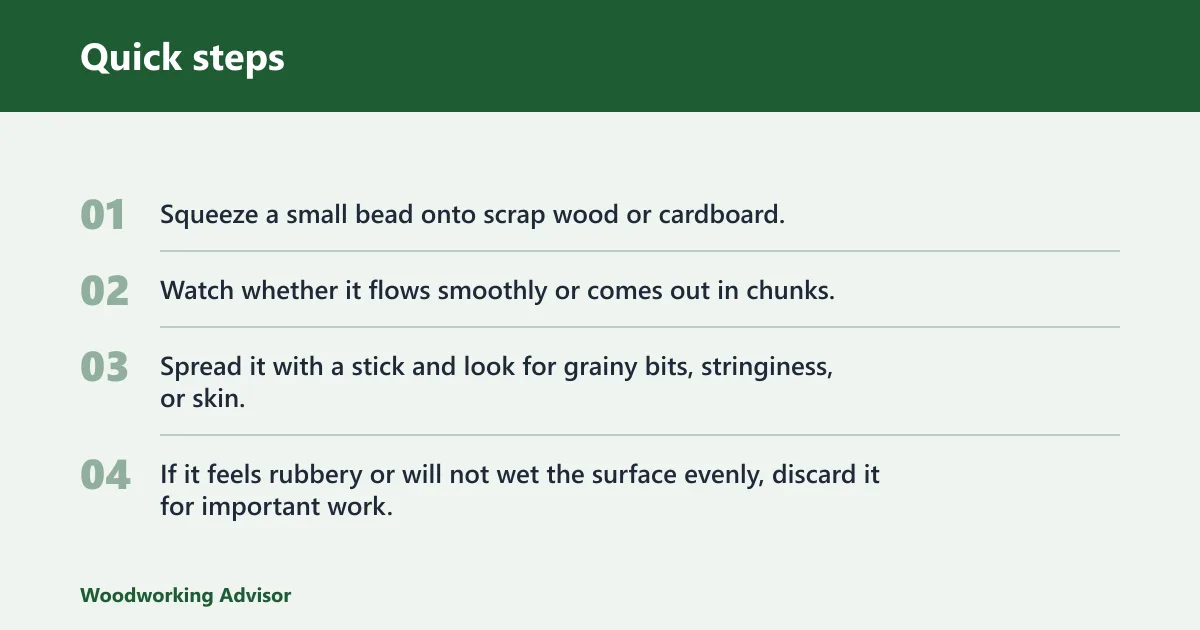
- Squeeze a small bead onto scrap wood or cardboard.
- Watch whether it flows smoothly or comes out in chunks.
- Spread it with a stick and look for grainy bits, stringiness, or skin.
- If it feels rubbery or will not wet the surface evenly, discard it for important work.
Wood glue shelf life decision table
Use the condition of the bottle, not just the purchase date. This table gives a practical triage rule for old glue, including storage condition, warning signs, and what to do next.
| Storage condition | Visual or odor signs | Squeeze-test behavior | Likely risk level | Recommended action |
|---|---|---|---|---|
| Sealed, cool indoor cabinet | No skin, no clumps, normal smell | Smooth bead, even spread | Low | Use |
| Opened bottle, cap cleaned, stored indoors | Minor settling, no odor change | Slightly thicker but still flows | Low to moderate | Use for noncritical work or test on scrap |
| Opened bottle with dried nozzle or dried film inside cap | Skinning, small flakes, slight thickening | Mostly smooth, but small bits appear | Moderate | Test on scrap first |
| Stored in a freezing garage or shed | Separation, grainy look, possible sour odor | Rough, lumpy, stringy, or watery-then-gel behavior | High | Discard for structural joints; discard if the texture stays unstable |
| Heat-exposed summer shed | Thickened body, crust, cap residue, off smell possible | Slow flow, poor leveling, gummy bead | High | Test only if the project is noncritical; otherwise discard |
| Freeze-thaw history unknown | Any chunking, separation, or skinning | Unpredictable flow | High | Discard for furniture repairs and load-bearing joints |
Can cold storage ruin wood glue?
Cold storage can ruin wood glue, especially if the bottle freezes or cycles between freezing and thawing. It does not always destroy a sealed bottle, but it raises the odds of separation, weak flow, and poor bond performance. Heat is harmful too. A bottle in a hot shed can thicken, skin over, or age faster than the label expects.
Freezing risk in garages and sheds
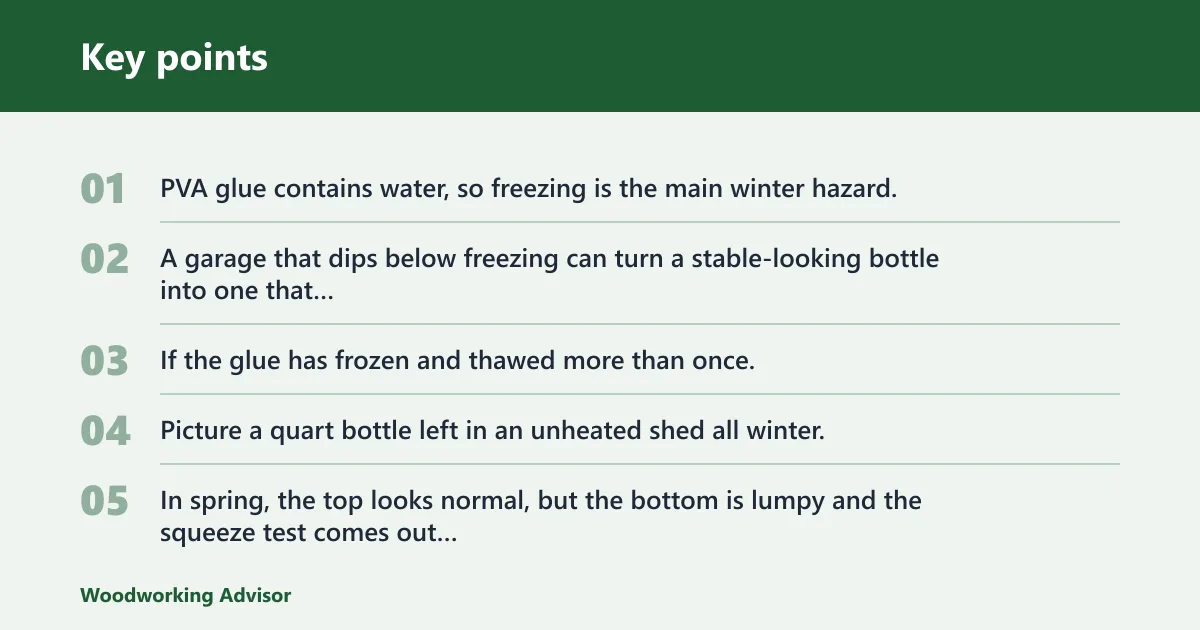
PVA glue contains water, so freezing is the main winter hazard. A garage that dips below freezing can turn a stable-looking bottle into one that separates or gels. If the glue has frozen and thawed more than once, treat it as suspect even if it still pours.
Picture a quart bottle left in an unheated shed all winter. In spring, the top looks normal, but the bottom is lumpy and the squeeze test comes out uneven. That bottle is not a good candidate for a chair repair or table apron joint.
Heat damage in summer storage
High heat is slower damage, but it matters. Hot storage can shorten useful life, encourage skinning, and make the glue thicker than it should be. If a bottle sat in a closed shed through summer, inspect it with more caution than a bottle kept indoors.
What the Technical Data Sheet should tell you
Check the Technical Data Sheet for storage temperature, shelf-life guidance, and any warning about freezing or overheating. Manufacturer guidance should outrank guesswork. If the label or data sheet says a sealed container must be stored within a certain temperature range, follow that range before you trust the glue on a good board.
When is old glue still usable?
Old glue can still be usable when the bottle is only mildly aged, the texture is still uniform, and the smell is normal. Use it first on noncritical work, then move to structural joints only if it passes a scrap test. If the glue has chunks, sour odor, or freeze-thaw damage, do not trust it for furniture repairs.
Acceptable use for noncritical repairs
Noncritical jobs include small trim work, shop jigs, test assemblies, and scrap practice. If the glue flows normally and cures without soft spots on scrap, it may still be fine for light-duty work. That is the place to spend your risk, not on a load-bearing chair rung or a tabletop edge joint.
When to test on scrap first
Test on scrap when the glue is old but not obviously bad. Put it on two clean wood pieces, clamp them with normal pressure, and let them cure. After 24 hours, check bond strength and look for rubbery glue lines, brittle failure, or weak grab. The goal is not perfection; it is to see whether the glue still behaves like a normal PVA.
When to discard it for structural joints
Discard the glue if you see chunks, persistent separation, sour odor, or bad squeeze behavior. That is the right call for chairs, tables, cabinets, and any joint that must hold weight or resist seasonal movement. A weak bottle is cheaper to replace than a failed repair.
What elmer’s carpenter’s wood glue Max is made
Elmer’s Carpenter’s Wood Glue Max is described as a premium polyvinyl acetate wood glue designed for strong, water-resistant bonds. It carries a Type II rating, which is water resistant, and that puts it in the group used for indoor-outdoor furniture. It cleans up with water while wet, which is normal for PVA glue.
PVA chemistry and water cleanup
PVA wood glue is the standard choice for clean wood-to-wood joints. It is commonly used for furniture, cabinets, trim, and cutting boards. It works best on tight-fitting joints, because the bond depends on intimate contact between the wood surfaces and a thin glue line.
Type II water resistance and indoor-outdoor use
ANSI/HPVA Type I means waterproof under the industry test, which is the class for exterior furniture and wet service. Type II is commonly described as water resistant, which makes it suited to kitchens, bathrooms, and occasional outdoor exposure. Elmer’s Max is rated Type II, so it fits indoor-outdoor furniture better than everyday interior-only glue.
Open time, clamp time, and full cure in a cold shop
Open time is the assembly window. Common PVAs often list 10-20 minutes, and the Elmer’s Max comparison table lists 10-minute open time. Clamp time is the minimum pressure period, often 30-60 minutes for standard PVA; the same comparison table lists 30-minute clamp time for Elmer’s Max. Full cure is different. Common wood glues are usually around 24 hours, and a cold shop slows that down.
Do not confuse “hard enough to unclamp” with “fully cured.” If the shop is cold, give the joint more time before sanding, machining, or loading it.
Winter storage checklist for wood glue
Cold-weather storage needs simple habits. A bottle that survives winter in good shape is usually the bottle that stayed sealed, stayed out of freeze-thaw swings, and got checked before a real repair started.
- Keep the cap clean and fully closed after every use.
- Store the bottle indoors if the garage drops below freezing.
- Avoid sheds that swing from freezing nights to warm afternoons.
- Keep glue away from heaters, direct sun, and hot attic spaces.
- Read the Technical Data Sheet for the storage range and shelf-life guidance.
- Before a furniture repair, squeeze out a small bead and inspect the flow.
- If the glue has lumps, skinning, or a sour odor, do not risk a critical joint.
Frequently asked questions
Does Elmer’s wood glue go bad?
Yes. Elmer’s wood glue can go bad when it separates, skins over, develops clumps, or smells sour. Freeze-thaw cycles and hot storage raise the risk. If the glue no longer squeezes out smoothly, do not trust it for furniture joints or any repair that needs dependable strength.
Can wood glue expire?
Yes. Wood glue can expire or become unreliable before the bottle looks obviously empty. Shelf life depends on whether the container stayed sealed, whether it was contaminated with dried residue, and whether it saw freezing or high heat. The Technical Data Sheet is the best place to confirm storage limits.
What is the shelf life of wood glue?
There is no single shelf life for all wood glues. A sealed bottle kept in stable indoor storage may last longer than an opened bottle stored in a cold garage. Age matters, but condition matters more. If the glue is lumpy, stringy, or sour, treat it as past its useful life.
How can you tell if wood glue is still good?
Check the appearance, smell, and flow. Good glue is usually uniform, has no strong off odor, and squeezes out in a smooth bead. Separation, skinning, chunks, and rubbery flow are warning signs. If you are unsure, test it on scrap before using it on a real project.
Does unopened wood glue last longer than opened glue?
Usually, yes. An unopened bottle is less exposed to air, contamination, and dried residue around the cap, so it often lasts longer than an opened bottle. That said, an unopened bottle stored in freezing or very hot conditions can still degrade. Packaging helps, but temperature still matters.
Will cold storage ruin wood glue?
It can. Cold storage is risky if the glue freezes or goes through repeated freeze-thaw cycles. Some bottles survive a cold season, but you should not assume that a garage-stored bottle is fine just because it still pours. Inspect it closely and test on scrap if the project is not critical.
Sponsored / affiliate links. As an Amazon Associate I earn from qualifying purchases. I may earn additional commission from eligible campaigns.