Best Temps for Polyurethane Application (2026): Research Shows
Apply polyurethane only when the room, wood, and product label all agree. A practical planning target is about 70°F to 75°F, with 60°F as a cautious floor only if the specific product allows it. Cool wood slows drying even when the air feels warm. Below that, flow suffers, cure time stretches, and a soft or cloudy finish becomes more likely.
This guide is part of our Cold Weather Wood Finishing: What Works Below 50°F series.
Polyurethane temperature range
The safe application range starts with the exact label, then the project conditions around it. For planning only, many guides place application somewhere between 60°F and 85°F, with a tighter sweet spot around 70°F to 75°F for smoother flow and more predictable cure.
Do not treat that as one universal minimum. 60°F to 80°F for best finish, another says 65°F to 85°F, and another recommends 70°F to 80°F. That spread is why the label matters more than any general chart.
Cold-edge minimum and hot-edge maximum
At the cold edge, viscosity rises and the film levels more slowly. Brush marks stay visible longer, dust sticks more easily, and dry-to-touch time stretches out. At the hot edge, open time shortens, which can leave lap marks and bubbles if you move too slowly.
The same source gives a common service range of about -40°F to 93°C. That is a service range, not a finishing target. Application is much narrower than long-term service.
Water-based versus oil-based differences
Water-based polyurethane often gives you a bit more practical room for timing and cleanup, but that does not make it safe at any cool temperature. Oil-based polyurethane usually dries slower and is more sensitive to solvent release, so it tends to need steadier warmth and stricter ventilation during cure.
Some specialized formulations can endure 500°F for short periods, and high-temperature variants are typically around 300°F for continuous exposure. Those numbers describe heat resistance after cure, not a green light for cold-room finishing.
Quick comparison
| Product | Badge | Best for | Price | ||
|---|---|---|---|---|---|
 |
TempPro TP50 Digital Hygrometer Indoor Thermometer RoomTempPro | Our pick | Digital hygrometer/thermometer · Indoor use · +/-1°F accuracy | $10.49
Price as of 24 Oct 2026
|
View |
 |
BLACK+DECKER Personal Ceramic Heater, 1500 Watts, BHDC201,BLACK+DECKER | Pair with it | 1500W personal ceramic heater · Adjustable thermostat · 2.8 lbs | $22.99
Price as of 24 Oct 2026
|
View |
 |
Rubber Liquid Waterproof Sealant, TUFINEIN 53oz/1.5kgTufinein | Also great | $32.29
Price as of 24 Oct 2026
|
View |
Use the room, the wood, and the humidity together. If one of those three is outside the product label or changing fast, stop and correct the condition before you coat.
How we chose
The guidance below stays label-first. It separates application temperature from cure temperature, and it treats room air, surface temperature, and humidity as separate checks.
It also weighs drying behavior, recoat timing, and ventilation safety. That matters most in winter, when a finish can feel dry on top while solvents or water are still moving out of the film.
Surface preparation matters too. Proper surface preparation can extend effective temperature range by up to 15%, but that is not a substitute for meeting the label minimum.
Can you apply polyurethane in 50 degree weather?
Sometimes, but 50°F is the edge of the conversation, not a comfortable target. At that temperature, many products level poorly, dry slowly, and trap dust or solvent longer than you want. Unless the label explicitly allows it, 50°F is usually a pause point rather than a go signal.
What usually goes wrong at 50°F
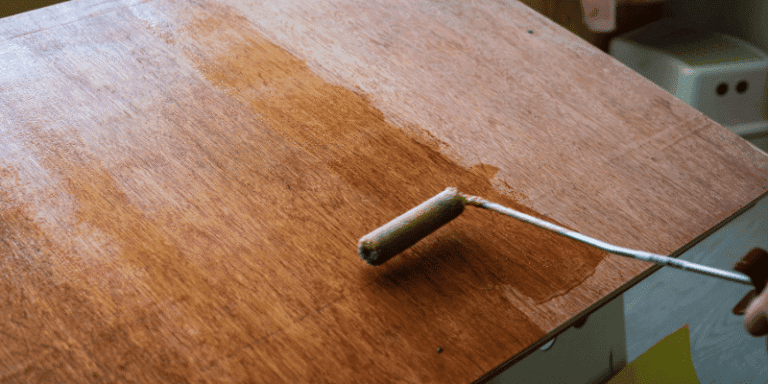
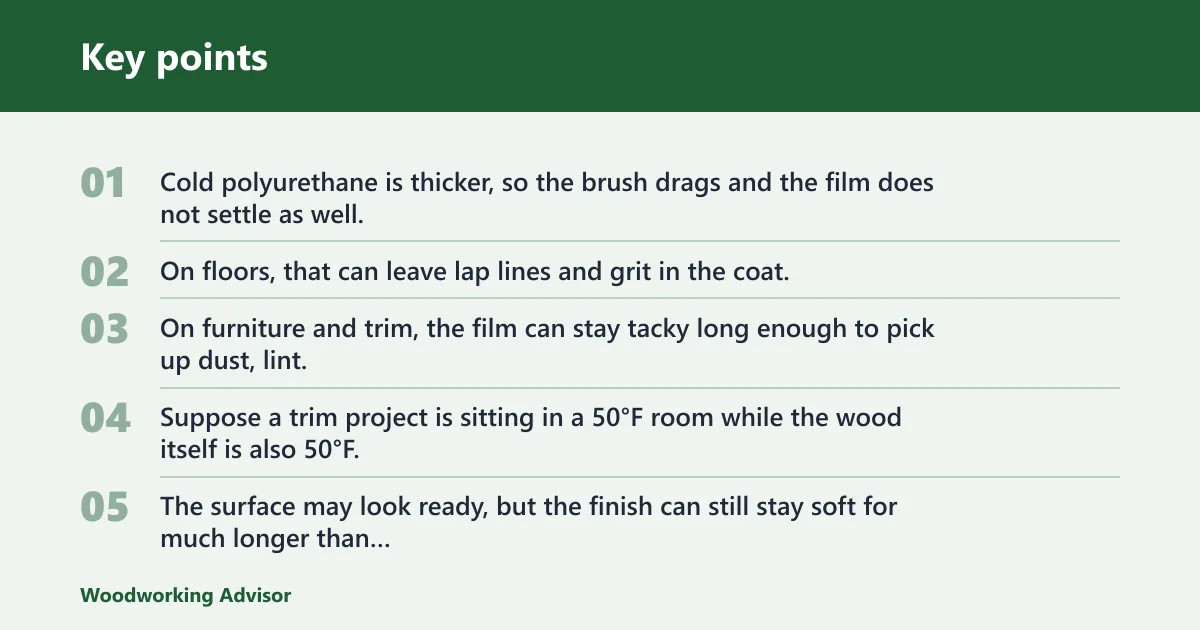
Cold polyurethane is thicker, so the brush drags and the film does not settle as well. On floors, that can leave lap lines and grit in the coat. On furniture and trim, the film can stay tacky long enough to pick up dust, lint, and fingerprints.
Suppose a trim project is sitting in a 50°F room while the wood itself is also 50°F. The surface may look ready, but the finish can still stay soft for much longer than expected. That extra open time often leads to visible brush marks and a longer wait before recoating.
When pre-warming helps
Pre-warming helps only when you can raise the room and the wood into the product’s allowed range and hold them there through application and cure. A small safe heater can help bring a room up gradually. Keep heat away from wet finish and do not force the surface hot.
For oil-based polyurethane, ordinary fans need caution because solvent vapors can be ignited by electrical equipment. Use fresh air carefully and follow the product label and safety data directions. For water-based products, gentle air movement is usually less risky, but strong drafts can still raise dust and disturb leveling.
When to stop and wait
Stop when the wood cannot stay in range, when the room keeps dropping after you coat, or when humidity is high enough to slow release and leave a cloudy look. If the label minimum is above your conditions, waiting is the correct call.
Can you apply polyurethane in 60 degree weather?
Yes, often, but only if the specific product label allows 60°F and the wood surface is actually at that temperature or within the same approved band. Sixty degrees can work for many products, yet it is still close enough to the edge that small changes in humidity, airflow, or substrate temperature matter.
Why 60°F is often workable but not automatic
At 60°F, many coatings still flow and cure, but they usually do so more slowly than they would at 70°F to 75°F. That slower drying time increases dust pickup risk and can lengthen the interval before a safe recoat. If the room swings downward overnight, cure may stall further.
A common first-timer mistake is warming the room air to 60°F while the floor boards remain colder. The top layer may seem fine at first, then show drag or a dull, uneven look as the colder wood slows leveling from below.
How stable temperature matters during cure
Cure temperature is not the same as dry-to-touch temperature. A coat can feel dry enough to move past in a few hours and still need steady warmth for the film to harden fully. If the room cools sharply after application, the cure slows and the recoat schedule can stretch.
What to check before coating
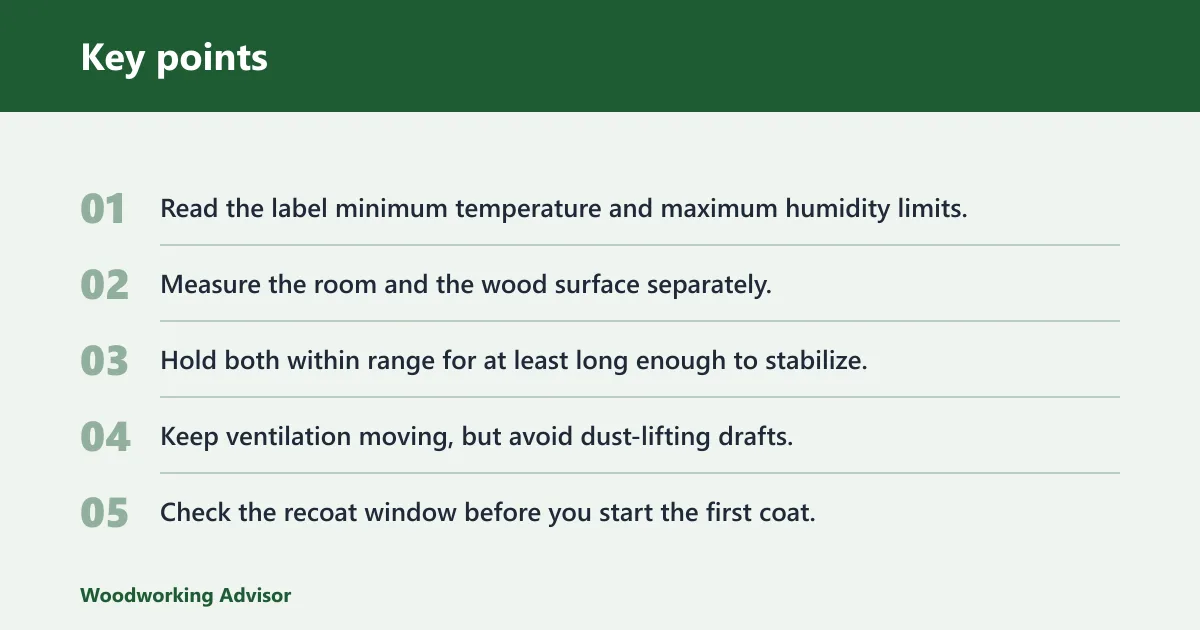
- Read the label minimum temperature and maximum humidity limits.
- Measure the room and the wood surface separately.
- Hold both within range for at least long enough to stabilize.
- Keep ventilation moving, but avoid dust-lifting drafts.
- Check the recoat window before you start the first coat.
Temperature decision table
This table separates room temperature, wood temperature, and humidity. Use it as a planning tool only. If the product label is stricter, the label wins.
| Room temp | Wood temp | Humidity | Action |
|---|---|---|---|
| 70°F to 75°F | 70°F to 75°F | 35% to 55% | Apply now |
| 65°F to 69°F | 65°F to 69°F | 35% to 60% | Apply now if the label allows and conditions stay steady |
| 60°F to 64°F | 60°F to 64°F | 35% to 55% | Pre-warm and hold until both surfaces are stable |
| 60°F to 64°F | Below 60°F | 35% to 55% | Pre-warm and hold |
| Below 60°F | Below 60°F | Any reading | Do not apply |
| Any room temp | Any wood temp | Above the product’s max humidity or about 60% and rising | Do not apply |
| Any room temp | Any wood temp | Below 35% with strong heat and fast drying | Pre-warm and hold with gentler conditions |
Water-based polyurethane: best for cooler rooms
Water-based polyurethane is often the better candidate when you need shorter recoat times and lower odor, but only within the label’s temperature and humidity limits. It can tolerate a slightly wider practical range on some products, yet it still needs a stable room and wood surface to level cleanly.
Application behavior in marginal temperatures
In cool rooms, water-based polyurethane can thicken and stop flowing well. That can show up as brush drag or a pebbly surface if you move too slowly. In warm rooms, it can set quickly enough to leave lap marks if you overwork it.
Humidity matters here in a different way than with oil-based products. High humidity usually slows drying and can leave a milky or hazy look in some water-based finishes if conditions are poor. That is not the same as solvent blushing, which belongs more to solvent-based systems.
Drying and recoat timing
Water-based coatings often become ready for recoating sooner than oil-based coatings, but the label still controls the window. Do not assume a later recoat is safer. Some products require sanding before recoating once you pass the normal window.
Oil-based polyurethane: best for stable warm rooms
Oil-based polyurethane usually asks for steadier warmth and more patience. It dries more slowly, which can help leveling, but that slower cure also means more time for dust, odors, and solvent vapors to linger in the work area.
Why the margin is tighter in cold weather
Cold air thickens the material and slows solvent release. That can leave the surface sticky longer and make the next coat arrive too early or too late relative to the label window. On trim and furniture, the result is often a soft film or visible brush lines.
Oil-based finishes are more sensitive to ventilation choices. An ordinary fan can move fumes around or create ignition risk near solvent vapors. Use only the ventilation method the product safety guidance allows, and keep ignition sources far from the area.
Slower cure and solvent concerns
A finish that is dry to the touch is not cured. For oil-based polyurethane, the full cure can take much longer than the first dry stage, especially in cool conditions. That slower finish hardening is one reason winter jobs often need more time before furniture use or floor traffic.
Which one should you buy?
Choose water-based polyurethane if you need a lower-odor option, faster recoat timing, or a finish schedule that can be managed in a stable but cooler room. Choose oil-based polyurethane if you can keep the room warm, control vapors safely, and wait for a slower cure.
For floors, stable temperature matters more than the label on the can. A floor has more surface area, more draft exposure, and more dust risk than a small furniture panel, so winter floor finishing should be more conservative. For trim, the smaller area lets you control conditions more easily. For furniture, the issue is usually dust and brush marks on smaller but more visible surfaces.
Say your basement shop is 62°F, the boards are 58°F, and the humidity is 58%. That is not a good coating setup yet. Warming the room alone will not fix the cold wood or the damp air. Raise the surface temperature first, then coat only when both numbers sit in range.
Picture a dining table in a spare room at 72°F with the top also at 72°F, but humidity at 68% after a rainy day. The finish may still go on, but drying slows and the risk of a cloudy look rises, especially with water-based product. Lower the humidity before you start.
Troubleshooting fixes
| Symptom | Likely cause | What to do |
|---|---|---|
| Sticky film | Too cold, heavy coat, or slow solvent release | Warm the space into range, improve safe ventilation, and wait for full cure before recoating |
| Brush drag | High viscosity from cold product or surface | Bring product and wood to the approved temperature band before the next coat |
| Bubbles | Fast dry, overbrushing, or heat-driven solvent release | Lower heat, apply thinner coats, and stop agitating the film once it starts to set |
| Cloudy finish | High humidity, moisture in the wood, or trapped water-based haze | Reduce humidity, dry the wood longer, and avoid coating until the surface is stable |
| Slow cure | Room too cold or humidity too high | Hold the space at the label temperature, keep airflow gentle, and give the film more time |
Check the label before every coat
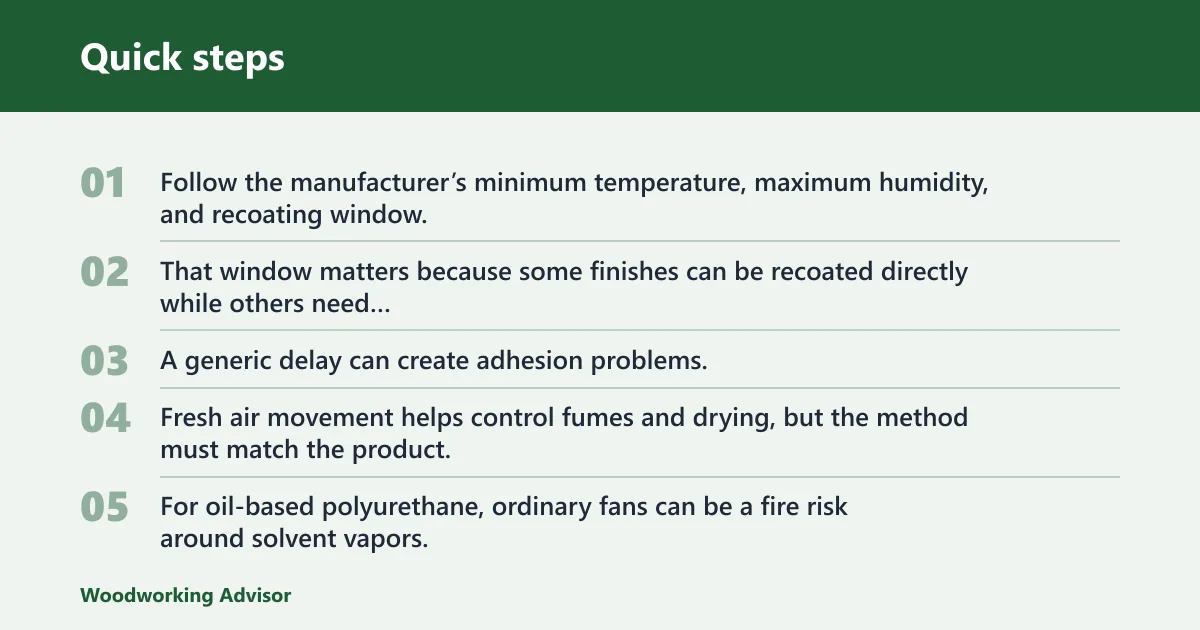
Follow the manufacturer’s minimum temperature, maximum humidity, and recoating window. That window matters because some finishes can be recoated directly while others need sanding after the normal interval passes. A generic delay can create adhesion problems.
Use ventilation without creating a hazard
Fresh air movement helps control fumes and drying, but the method must match the product. For oil-based polyurethane, ordinary fans can be a fire risk around solvent vapors. For water-based polyurethane, a fan can help if it does not raise dust or blow directly across the wet film.
Keep the surface clean and dry
Temperature is only part of the job. Dust, oil, and moisture on the substrate can ruin flow even when the room is warm enough. Good surface prep can also widen the effective temperature window somewhat, but it does not replace the label’s minimum.
Frequently asked questions
What temperature should you apply polyurethane at?
Use the product label first, then treat 70°F to 75°F as a practical target for many jobs. Some guides allow a wider window, such as 60°F to 85°F, but the safest plan is to keep both the room and the wood within the manufacturer’s approved range and stable during cure.
What temperature can you apply polyurethane to wood?
The wood surface should be within the same approved band as the room, not just close enough to feel comfortable. A cold board can slow drying even when the air is warm. Aim for surface and room temperatures that are both stable and within the label’s minimum.
Will urethane cure in cold weather?
It may cure, but much more slowly, and only if it stays above the product’s minimum application and cure conditions. Cold slows chemical reaction and solvent release, so dry-to-touch can arrive long before full cure. That gap is where dust pickup and soft-film problems show up.
What temperature does polyurethane dry at?
There is no single temperature for every product. Drying begins only after the coating is applied, and it speeds up as the room and wood move into the product’s preferred range. Many guides place that range somewhere between 60°F and 85°F, with 70°F to 75°F a common working target.
How does humidity affect polyurethane application?
Humidity slows drying and can cause cloudy results, especially when it stays high while temperature is already marginal. A practical planning range is about 35% to 55% for many jobs, with caution above that and a stop point around 60% and rising unless the label says otherwise.
Should the room and the wood be the same temperature before applying polyurethane?
- Measures temperature and humidity for poly application readiness
- Displays high/low records to track conditions over time
- Dry/comfort/wet wellness indicator for quick reading
They do not need to match exactly, but both should be within the product’s safe range and stable. A warm room with a cold surface can still cause slow drying and poor flow. The best results come when the wood and the air are both close to the same target band.
Sponsored / affiliate links. As an Amazon Associate I earn from qualifying purchases. I may earn additional commission from eligible campaigns.