Gorilla Glue vs Titebond for Outdoor Furniture Guide
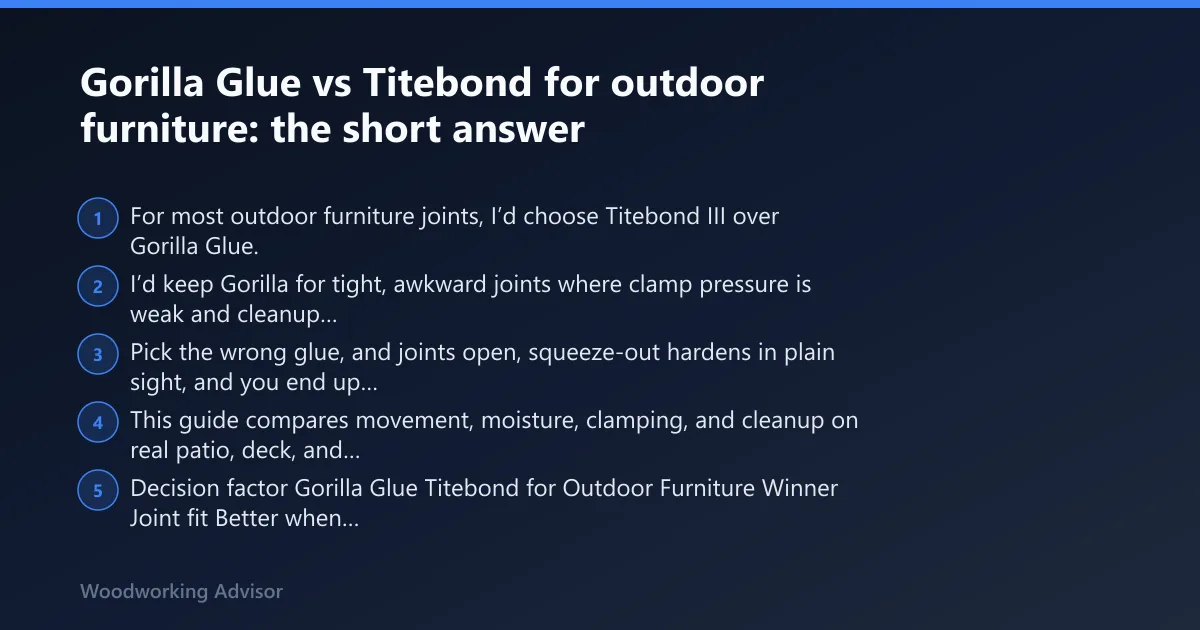
For most outdoor furniture joints, I’d choose Titebond III over Gorilla Glue. I’d keep Gorilla for tight, awkward joints where clamp pressure is weak and cleanup matters less. Pick the wrong glue, and joints open, squeeze-out hardens in plain sight, and you end up repairing the piece after one wet season. This guide compares movement, moisture, clamping, and cleanup on real patio, deck, and garden builds.
This guide is part of our Wood glue essentials: types, uses, and cure times series.
Gorilla Glue vs Titebond for outdoor furniture: the short answer


| Decision factor | Gorilla Glue | Titebond for Outdoor Furniture | Winner |
|---|---|---|---|
| Joint fit | Better when the fit is imperfect and small gaps need some tolerance. | Better on tight wood-to-wood joints that close fully under clamp pressure. | Gorilla Glue for loose joints; Titebond for tight joints |
| Cleanup and finish work | Foam squeeze-out can be messy, and cured residue is harder to remove cleanly. | PVA squeeze-out is easier to wipe while wet, and the cured glue line sands more predictably. | Titebond for Outdoor Furniture |
| Clamp behavior | Needs controlled clamping so the foaming does not push parts apart or leave voids. | Works well with firm clamping on furniture parts that can be pulled flat and held in place. | Titebond for Outdoor Furniture |
| Outdoor durability in real use | Handles moisture well when the joint is fit correctly, but movement and foam can become the weak point. | Better match for most painted, stained, or covered exterior furniture assemblies. | Titebond for Outdoor Furniture |
| Best fit for visible furniture parts | Risk of visible foam and dark residue on exposed edges. | Cleaner result on aprons, tabletops, slats, and chair rails. | Titebond for Outdoor Furniture |
Joint fit decides more than the label
The real split is not “waterproof versus water-resistant.” It comes down to whether the joint closes tight and stays tight while the wood moves. On patio furniture, I’ve had tight PVA joints outlast gap-filling polyurethane joints that were chosen because the fit was already bad.
Cleanup changes the whole project
Gorilla Glue’s foaming can waste material and leave cured residue where a finish should stay clean. Titebond’s PVA behavior is easier to manage on visible furniture, because squeeze-out wipes off early and the dry line sands in a more predictable way.
Clamps matter on both, but for different reasons
Titebond wants even pressure so a close-fitting joint stays closed while it sets. Gorilla Glue needs the joint held back so expansion does not lift parts, which means clamps still matter even though the chemistry is different.
According to TITEBOND lepidla na dřevo – Různé druhy a objemy — Titebond III Ultimate is labeled D4 in the product listing.
What each glue does at the bench
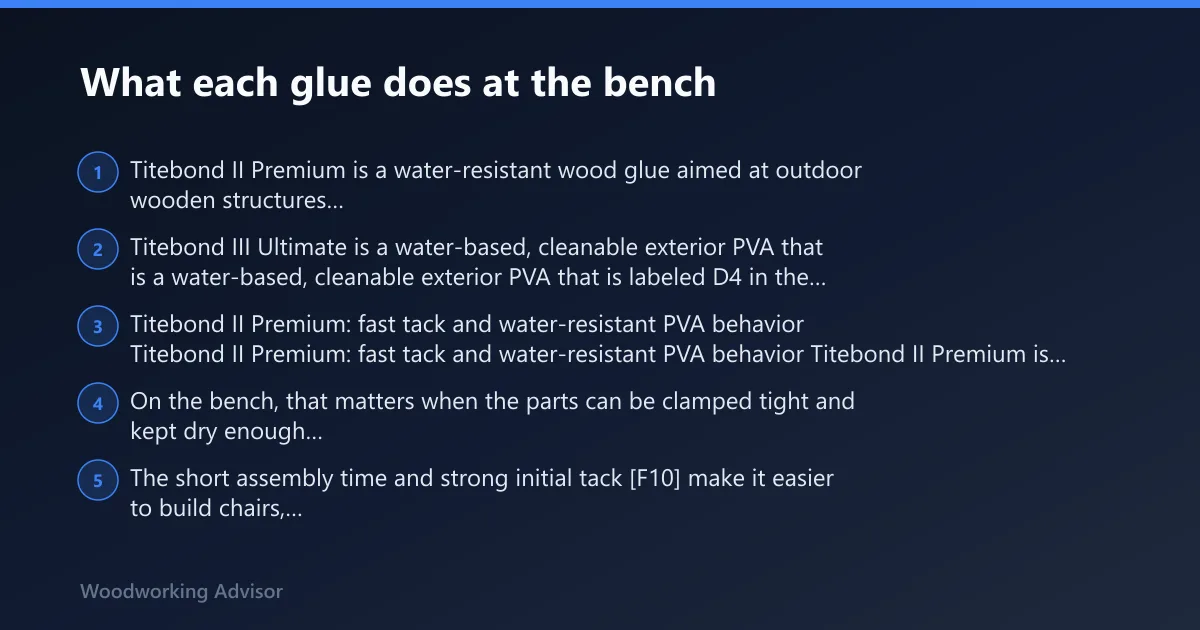
Titebond II Premium is a water-resistant wood glue aimed at outdoor wooden structures and furniture. Titebond III Ultimate is a water-based, cleanable exterior PVA that is labeled D4 in the product listing, while Titebond II Premium is labeled D3 and described as a high-strength waterproof glue with strong initial tack and quick set.
Titebond II Premium: fast tack and water-resistant PVA behavior
Titebond II Premium is suitable for outdoor wooden structures or furniture. On the bench, that matters when the parts can be clamped tight and kept dry enough during cure. The short assembly time and strong initial tack make it easier to build chairs, tables, and benches without fighting the clock.
Titebond III Ultimate: exterior PVA with better wet-weather tolerance
Titebond III Ultimate is a water-based, cleanable exterior glue option, and it is also sandable. The D4 label in the product listing points to a higher exterior-use tier than Titebond II’s D3 listing, which is why many woodworkers pick it for furniture that may see more weather exposure or less protected service.
Gorilla Glue: moisture-reactive polyurethane and foam expansion
Gorilla Glue behaves differently from PVA glues because it is moisture-reactive and can expand as it cures. That foaming can help where the joint is imperfect, but it can also mean more clamp control, more cleanup, and a greater chance of a visible glue line on exposed furniture parts.
How do they handle outdoor stress?
Outdoor furniture fails from movement as much as from water. Seasonal swelling and shrinkage, temperature swings, and repeated wet-dry cycles can open a joint even when the glue itself holds, so the safer choice is the one that fits the wood movement and the joint geometry.
Moisture exposure and seasonal wood movement
PVA glues such as Titebond II and III do best when the joint is tight and the wood fibers are well matched. Gorilla Glue tolerates some gap, but that does not make it a cure for movement; if the parts keep flexing, the cured foam can become the weak layer.
Heat, sun, and freeze-thaw wear on furniture joints
Heat softens marginal joints, and freeze-thaw cycling pushes water into every small opening. On a covered patio, both systems can last well if the fit is good. On a fully exposed deck, the glue line is only one part of the failure story, and end grain or sloppy joinery becomes the real problem.
Why joint geometry matters more than brand name
Aprons, slats, tabletops, and chair rails all load differently. End grain drinks adhesive and weakens the bond area, while long grain-to-long grain joints usually give the best result, especially with Titebond where a tight fit and full clamp contact matter more than foam filling.
Compare clamp time, open time, and cure time
Clamping time is not the same as open time or full cure, and that difference matters on larger furniture builds. A small repair may tolerate a short assembly window, while a table or chair frame can turn into a race against glue set, part creep, and clamp layout.
Assembly window on small repairs versus full chairs and tables
On a chair repair, a fast tack can help because the parts can be aligned and clamped before they drift. On a full table or bench, the assembly order must be planned so the first joints do not start setting before the last clamp is on.
How Titebond’s short setup differs from Gorilla Glue’s clamp needs
Titebond II Premium’s relatively quick set and strong initial tack can help when the joint is close and the parts need to hold position quickly. Gorilla Glue needs enough clamp pressure to keep foaming from opening the seam, so it can be more forgiving on fit and less forgiving on handling.
When a long glue-up turns risky
Long assemblies raise the chance of squeeze-out in the wrong place, skipped clamps, or joints that begin to move before the glue reaches a stable set. That is why large outdoor furniture projects usually favor a PVA that wipes clean and grabs quickly, unless the joint is poor enough to justify polyurethane.
Comparison table: best glue by outdoor furniture scenario
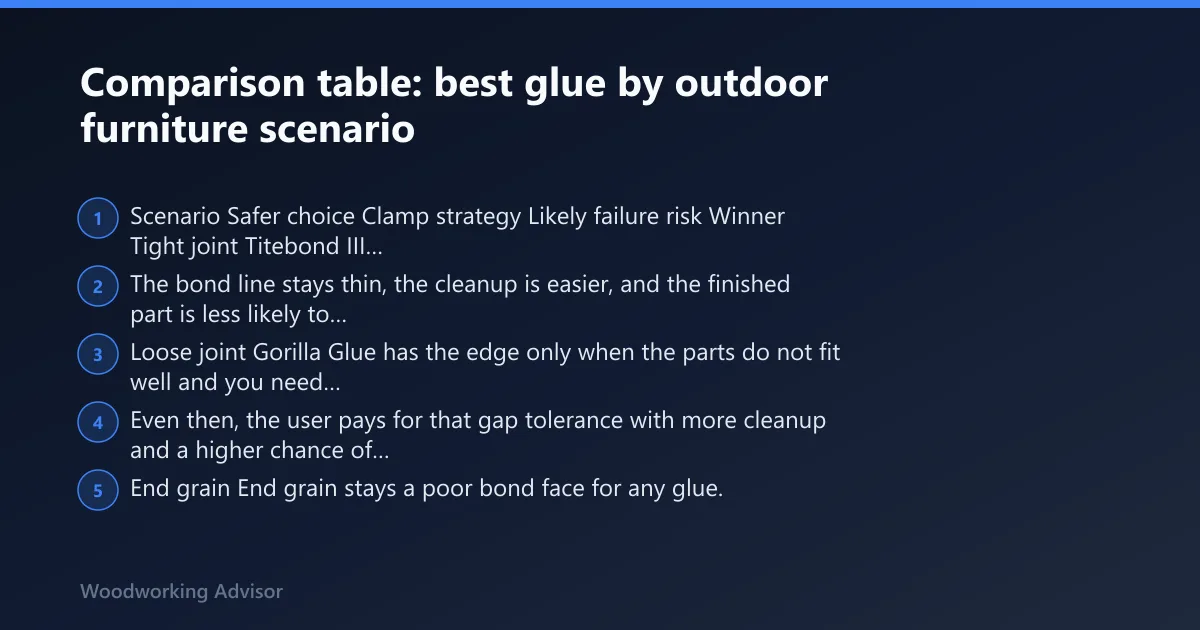
| Scenario | Safer choice | Clamp strategy | Likely failure risk | Winner |
|---|---|---|---|---|
| Tight joint | Titebond III or Titebond II | Firm, even pressure across the seam | Low if the joint closes fully and stays aligned | Titebond for Outdoor Furniture |
| Loose joint | Gorilla Glue | Clamp hard enough to restrain foam expansion | Medium if the foam lifts the joint or leaves residue | Gorilla Glue |
| End grain | Gorilla Glue only when no better joint repair is possible | Restrained clamping and careful fit check | High either way; end grain is a weak bond face | Gorilla Glue |
| Repair work | Titebond III for clean, close repairs; Gorilla for poor-fitting break lines | Use enough pressure to hold the break shut, not crush fibers | Medium from old finish, hidden rot, or imperfect mating surfaces | Tie |
| Fully exposed use | Titebond III if the joint fit is sound and the piece is maintained | Full, even clamp coverage during set | Medium to high from weather cycling and movement | Titebond for Outdoor Furniture |
| Partially covered use | Titebond II or III depending on exposure level | Moderate clamp pressure with dry assembly conditions | Lower than fully exposed furniture, but water can still attack weak joints | Titebond for Outdoor Furniture |
Tight joint
A tight joint is where Titebond usually wins. The bond line stays thin, the cleanup is easier, and the finished part is less likely to telegraph glue foam through stain or clear finish.
Loose joint
Gorilla Glue has the edge only when the parts do not fit well and you need some expansion to fill the void. Even then, the user pays for that gap tolerance with more cleanup and a higher chance of ugly squeeze-out.
End grain
End grain stays a poor bond face for any glue. Gorilla may help a damaged repair where the surface is irregular, but a better fix is usually a mechanical repair, a new tenon, or a re-cut joint rather than trusting foam to fill the problem.
Repair work
For repairs, the safer pick depends on how clean the break is. A neat break with good mating surfaces favors Titebond III; a warped or chipped break can push the decision toward Gorilla, provided the clamps can control the expansion.
Fully exposed use
For furniture that sits in rain, sun, and seasonal temperature swings, Titebond III is usually the cleaner choice because the bond line is easier to finish and maintain. The glue still needs sound joinery, because no adhesive fixes a joint that moves constantly.
Partially covered use
A covered patio piece gives both glues a friendlier environment, but Titebond II or III is still easier to live with on visible furniture. The more the piece is protected, the more the decision shifts from moisture resistance alone to appearance and cleanup.
Choose Gorilla Glue if… / Choose Titebond if…
Choose Gorilla Glue when the joint is imperfect, gap tolerance matters, and the part can be clamped so the foam does not push the seam open. Choose Titebond II or III when the joint is tight, the piece is visible, and the goal is a cleaner bond line with less post-cure cleanup.
Choose Gorilla Glue if the joint is a poor fit and cleanup is secondary
Use Gorilla Glue for awkward chair repairs, rough outdoor fixups, and joints that need a little expansion to stay together. It is the better bet when the alternative is a hollow seam that would fail even with strong clamping.
Choose Titebond II or III if the joint is tight, visible, and needs cleaner finishing
Titebond II Premium fits outdoor wooden structures and furniture, and its strong initial tack and quick set help on fast assembly work. Titebond III is the better pick when the piece will see more weather or when cleanup and sanding matter more than gap filling.
Which Titebond to pick for outdoor furniture: II versus III
Pick Titebond II Premium for outdoor furniture that is protected, tightly fitted, and assembled efficiently. Pick Titebond III when the furniture will live closer to the weather, when the part needs better wet-weather tolerance, or when water-based cleanup and sanding are worth the extra margin.
Frequently asked questions
Is Gorilla Glue or Titebond better for outdoor furniture?
Titebond is usually better for most outdoor furniture because the joints are tighter, the finish work is cleaner, and the clamp behavior is easier to manage. Gorilla Glue is the better rescue choice when the fit is poor, but its foaming makes visible furniture harder to finish neatly.
Is Titebond III waterproof enough for outdoor furniture?
Titebond III is often treated as the more outdoor-oriented choice in the Titebond PVA line because it is described as water-based, cleanable, and sandable. For covered or regularly maintained furniture, that is usually enough, provided the joint fit is solid and the design does not trap water.
Can Gorilla Glue be used on outdoor wood joints?
Yes, Gorilla Glue can be used on outdoor wood joints, especially when the fit is imperfect and gap filling matters. The catch is that the foam expansion changes clamp behavior and cleanup, so it is less friendly on visible parts and cleaner joinery usually performs better with Titebond.
Which glue holds better in heat and moisture outdoors?
The better holder is the glue that matches the joint and the exposure, not the one with the boldest label. In tight outdoor furniture joints, Titebond III usually gives the cleaner long-term result, while Gorilla Glue can help when moisture-reactive expansion helps a damaged or uneven joint close.
Do I need clamps when using Gorilla Glue or Titebond?
Yes. Titebond needs clamps to hold a tight seam while it sets, and Gorilla Glue needs clamps to restrain foam expansion and keep the parts from drifting apart. Without clamps, both products can leave weak, ugly, or misaligned joints on furniture.
What is the difference between Titebond II and Titebond III for exterior furniture?
Titebond II Premium is suitable for outdoor wooden structures or furniture, is labeled D3, and is described as having strong initial tack and quick set. Titebond III Ultimate is labeled D4, is water-based and cleanable, and is sandable, which makes it the better pick for harsher exposure or cleaner finishing.
Can I use polyurethane glue for chair repairs outside?
Yes, but only when the repair joint can be clamped well and the cleanup risk is acceptable. Polyurethane glue works best when the break is awkward or slightly open, yet chair repairs often look better and last longer with a tight PVA bond if the parts can be pulled together cleanly.
Which glue is easiest to sand and clean up on outdoor furniture?
Titebond is easier to clean and sand, especially Titebond III because it is described as water-based and cleanable and sandable. Gorilla Glue’s cured foam and residue are harder to deal with, which matters a lot on tabletops, arms, aprons, and any part that stays visible after finishing.
Sponsored / affiliate links. As an Amazon Associate I earn from qualifying purchases. I may earn additional commission from eligible campaigns.