Hemlock Wood for Outdoor Use: Is It a Good Choice?
Use hemlock outdoors only in sheltered, above-grade spots. For ground contact or steady wetting, choose pressure-treated or naturally durable wood. If you ignore exposure level, hemlock can rot, split, and fail early, which drives repair costs up and shortens service life. This guide explains where hemlock works, where it fails, and how treatment and maintenance change the answer.
What hemlock wood
Hemlock lumber is generally a softwood with straight grain, medium-to-fine texture, and moderate density. That mix makes it workable for framing, trim, joinery, and cabinetry, but outdoor durability depends heavily on keeping moisture out and letting the wood dry after rain or condensation.
For outdoor decisions, grain and density matter because they affect how quickly water enters and leaves the board. Hemlock is not naturally rot-resistant like cedar or redwood, so the question is never only whether it is “good outside.” The real question is how much weather the part will take.
Why grain and density matter outdoors
Straight grain can help with milling and a cleaner finish, but outdoor performance still comes down to water movement. Moderate density gives hemlock a solid feel without making it as decay-resistant as more durable species. That is why a finish schedule matters so much.
End grain is the weak point. It absorbs water faster than face grain, so cut ends, fastener holes, and joint lines need extra attention if the project will see rain, snow, or regular wash-downs.
Eastern vs western hemlock
Eastern hemlock is native to North America and is the version more often described as suitable for outdoor projects like decks and fences. Western hemlock is lighter in color and less dense than eastern hemlock, and it is often better suited to indoor work unless it is treated and carefully detailed for exterior use.
That difference matters. Many comparisons blur the two species, but outdoor performance is not the same. Eastern hemlock has the edge in some sources for exterior use, while western hemlock is usually the less forgiving choice when exposure rises.
Native range and common uses
Eastern hemlock is common in the eastern U.S. and Canada. Western hemlock is associated with the Pacific Northwest. Both show up in construction, and both can appear in joinery, cabinetry, flooring, and ceiling applications, but that does not make them equal outdoors.
For exterior projects, the species name should stay attached to the exposure level. If a supplier only says “hemlock,” ask whether it is eastern or western and whether the stock has been treated for exterior service.
When eastern hemlock has the edge
Eastern hemlock is the safer bet when you are choosing between the two for a sheltered deck detail, a protected fence component, or a pergola part that will be sealed on all sides. Even then, it should be kept above grade and out of constant wetting.
Suppose you are building a bench under a roof overhang with good airflow beneath the seat. Eastern hemlock can be reasonable if you seal cut ends and maintain the finish. The same design placed in full sun and rain would need a different species or pressure treatment.
Is hemlock good for outdoor use?
Yes, but only in the right exposure class. Hemlock can work in covered or carefully maintained exterior uses, especially where roof protection, drainage, and ventilation are part of the design. It is a poor fit for ground contact, constant wetting, or fully exposed parts that stay wet and bake in sun.
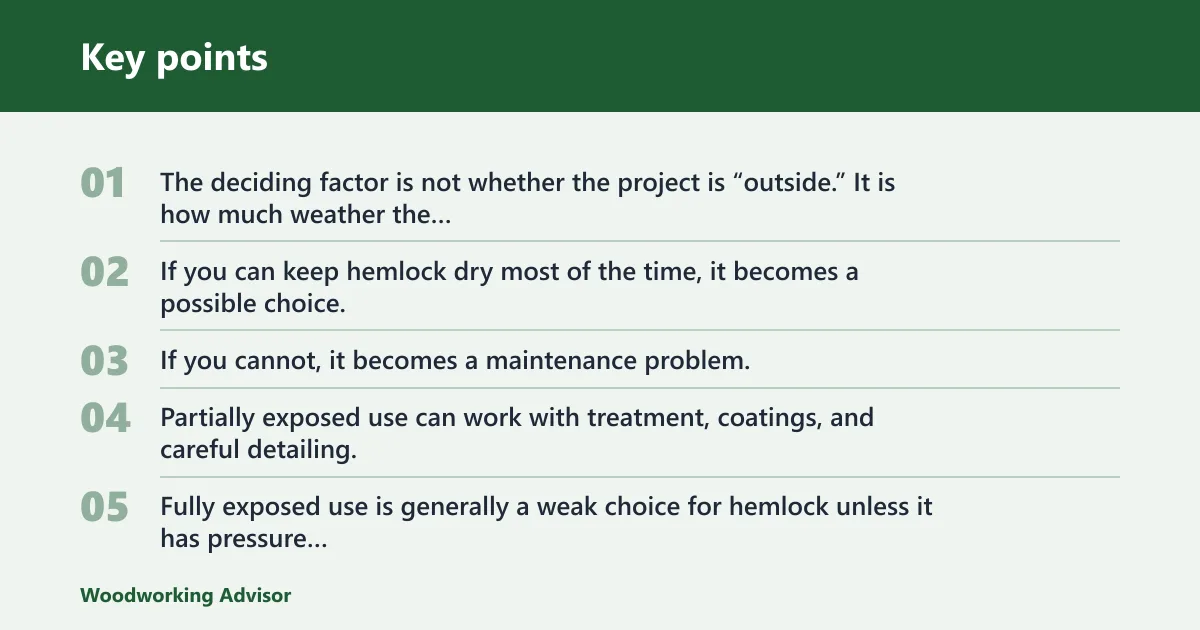
The deciding factor is not whether the project is “outside.” It is how much weather the wood will actually take. If you can keep hemlock dry most of the time, it becomes a possible choice. If you cannot, it becomes a maintenance problem.
The short answer by exposure level
Covered use is the best case. Partially exposed use can work with treatment, coatings, and careful detailing. Fully exposed use is generally a weak choice for hemlock unless it has pressure treatment and a maintenance plan from the start.
Direct weathering changes everything. A board under an overhang may stay serviceable far longer than the same board in an open deck field, because wetting and drying cycles are less severe.
Where hemlock works and where it does not
Hemlock generally performs best where it stays above grade, sheds water quickly, and can dry after rain. It does not belong in soil contact, on flat surfaces that hold water, or in details that trap moisture behind trim, at joints, or inside post bases.
That means the design matters as much as the species. Good ventilation, sloped surfaces, drip edges, and sealed end grain can make a real difference. Poor detailing can ruin even treated stock.
Why full weather exposure is the deciding factor
Sun and water work together. Sun breaks down coatings, and water finds the weak spots. Once finish failure starts, hemlock can take up moisture faster, which leads to checking, swelling, and eventually decay if the piece stays wet long enough.
The exposure rule is simple: the more weather the wood sees, the less suitable untreated hemlock becomes. Full exposure pushes you toward pressure-treated lumber or a naturally durable species instead.
Hemlock outdoor use matrix
This matrix is the practical shortcut. Match the project, then match the exposure. If the answer lands in the “fully exposed” column, hemlock is only a reasonable pick when it is treated, detailed for drainage, and kept on a strict maintenance schedule.
| Project | Covered use | Partially exposed use | Fully exposed use | Mandatory notes |
|---|---|---|---|---|
| Decks | Possible for protected trim, rail parts, or porch-like areas | Use only with treatment and good drainage | Poor fit for open decks unless pressure treated | Seal cut ends; ventilate beneath boards; inspect fasteners for corrosion |
| Fences | Good for panels under cover or in dry microclimates | Possible for top rails and sheltered pickets | Weak choice for soil-adjacent parts without treatment | Keep posts above grade if possible; avoid moisture traps at rail joints |
| Pergolas | Best-case outdoor use for hemlock | Works if joints drain and finish is maintained | Not ideal for open, unprotected spans | Use a UV-resistant coating; check tops and end grain each season |
| Furniture | Reasonable for sheltered seating or porch furniture | Only with frequent sealing and covered storage | Poor fit for unsheltered chairs, tables, or benches | Keep feet off wet ground; reseal high-wear surfaces often |
What makes hemlock fail outside?
Hemlock fails outside for the same reasons many softwoods do: repeated wetting, slow drying, sun damage to the finish, and trapped moisture in joints or against hardware. Once the surface breaks down, decay can follow quickly if the wood stays damp.
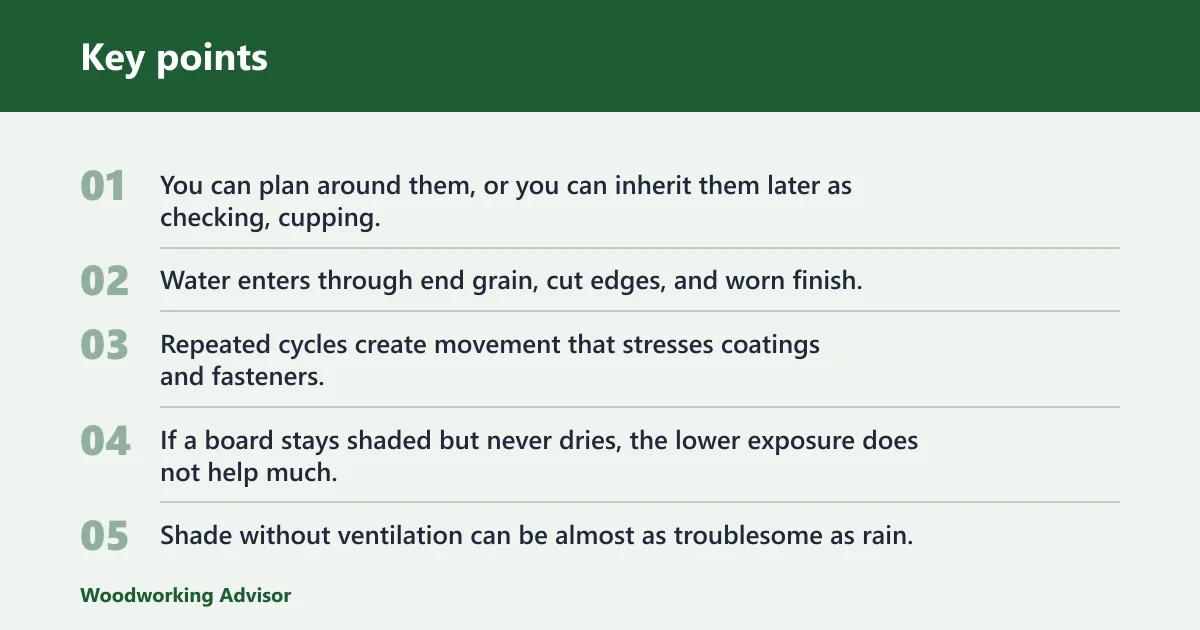
The common failure modes are predictable. You can plan around them, or you can inherit them later as checking, cupping, loose fasteners, and staining around joints.
Moisture absorption and drying cycles
Water enters through end grain, cut edges, and worn finish. Then the wood dries and shrinks. Repeated cycles create movement that stresses coatings and fasteners, especially on horizontal surfaces and open edges that take full weather.
A covered project still needs airflow. If a board stays shaded but never dries, the lower exposure does not help much. Shade without ventilation can be almost as troublesome as rain.
End grain, checking, and cupping
End grain checking is a common early problem because the ends dry faster than the rest of the board. That can open cracks that carry water deeper into the wood. Cupping follows when one face stays wetter than the other.
A common first-timer mistake is leaving sawn ends bare on a pergola beam. The beam may look fine for a while, then the ends split first while the rest of the piece still seems sound.
Fastener and finish problems
Wet hemlock can also create problems around screws, nails, and brackets. If you use the wrong hardware, moisture and tannins in exposed wood can stain metal or speed corrosion. Once fasteners corrode, joints loosen and water enters even more easily.
Finishes fail in stages. The surface loses gloss, then water stops beading, then the coating cracks or peels. At that point, the wood below sees more ultraviolet exposure and more moisture cycling.
Ground contact and trapped moisture
Ground contact is where hemlock tends to perform worst. Soil keeps wood damp, blocks drying, and feeds decay fungi. Trapped moisture under caps, in post bases, behind trim, or where boards are tight together causes similar trouble.
Ventilation is not optional. If air cannot move around the wood, a coating alone will not save it.
Do you need pressure treatment?
Yes, for exterior exposure you should treat pressure treatment as the default choice, not an optional upgrade. It improves decay and insect resistance and extends service life when hemlock will face weather. Untreated hemlock is much better reserved for sheltered, dry locations.
Pressure treatment does not make hemlock invincible, but it changes the margin of error. It is the best path when the wood will see repeated rain, splashback, or long periods of dampness.
What treatment changes
Treatment pushes preservative into the wood, which improves resistance to decay and insects. It does not erase movement, finish wear, or the need for drainage, but it buys time in places where untreated wood would fail sooner.
That matters most for decks, fence posts, and other parts that are hard to replace later. The less accessible the piece, the more sensible treatment becomes.
When treatment is strongly recommended
Use pressure-treated hemlock whenever the part will be outdoors for long periods, especially if it will sit near grade or see regular rain. It is also the better choice for any structural or semi-structural exterior piece that you do not want to rebuild soon.
Pressure-treated hemlock can last 25–40 years in ground contact according to one supplier, but that figure depends on the treatment level, detailing, drainage, and service conditions. It is not a promise for every project.
How sealants and coatings fit
Sealants and coatings help with water resistance and UV protection, but they are maintenance items, not permanent shields. They should be reapplied on a schedule, especially on horizontal surfaces, cut ends, and sun-facing faces.
- Seal all cut ends before installation.
- Use exterior-grade finish or water repellent on exposed faces.
- Leave drainage gaps where water could pool.
- Check the finish after winter and again after peak sun exposure.
- Recoat when water stops beading or the surface looks dry and faded.
Best outdoor uses for hemlock
Hemlock is best outdoors when the part is sheltered, above grade, and easy to maintain. That makes it more useful for pergolas, benches, fences in drier settings, and protected trim than for open decks or anything touching soil.
Think in terms of exposure, not project name alone. A deck can be partly covered or fully exposed. A bench can sit under a roof or in open sun. The same species can be reasonable in one setting and a bad buy in the next.
Decking and stairs
Use hemlock here only in protected or partially exposed areas, and preferably in treated stock. Open decking and stair treads take heavy weather and traffic, so they punish finish failures fast. Good drainage and periodic inspection are essential.
Fencing and privacy panels
Hemlock can work for fence boards and privacy panels when the lower edges are kept clear of soil and splashback. Posts and base details need the most caution. If the fence sits in an exposed yard with strong sun and rain, choose a more durable species or treated lumber.
Pergolas, benches, and sheltered details
Pergolas are one of the better uses for hemlock because they often include partial cover and can be detailed for airflow. Benches also work when they are under a roof or moved to storage during harsh weather. A sealed, shaded bench has a much easier life than one left in open exposure.
Picture a 6-foot bench under a deep porch roof. The seat and arms stay dry most of the year, but the feet sit on damp concrete. Without spacers and periodic resealing, the lower parts will fail first.
Siding and trim in protected locations
Hemlock siding or trim makes more sense in protected locations where rain is limited and the assembly can dry. It still needs end sealing, flashing, and ventilation behind the assembly. Without those details, even a sheltered wall can trap moisture.
Hemlock vs cedar, redwood, and cypress
Cedar, redwood, and cypress usually have the edge for natural durability outdoors. Hemlock can still be useful when cost, availability, or appearance matter, but it needs more help from treatment and maintenance than those species do.
Choose hemlock when the exposure is mild and you can maintain it. Choose the more durable species when the part will live in sun, rain, or near-grade conditions.
Durability comparison
Cedar and redwood are favored because they resist decay better in many outdoor settings. Cypress is also a stronger exterior option in many cases. Hemlock is the less durable choice unless it is pressure treated and kept out of the worst weather.
Cost and maintenance tradeoffs
Hemlock is often selected because it can be easier to source than premium exterior species. That lower upfront cost can disappear if you need more finish coats, more inspection time, and earlier replacement of exposed parts.
If you want lower maintenance, a naturally durable species is usually the better buy. If you want hemlock, plan for regular upkeep.
When to choose a different species
Choose cedar, redwood, or cypress when the project is fully exposed, difficult to inspect, or close to grade. Also choose a different species when you want the best chance of long service with less frequent recoating.
Maintenance is what separates a usable sheltered project from a short-lived one. The wood should be inspected seasonally, especially after the wet season and again after peak summer sun. Look for finish wear, end grain cracks, rust at fasteners, and soft spots near joints.
If you catch problems early, you can stop moisture from getting deeper into the board. If you wait until the surface is peeling or the ends are split, the repair gets harder.
Seasonal inspection points
Check horizontal surfaces, cut ends, fastener heads, and any joint that can hold water. Look under benches, at the bottoms of fence boards, and at the top edges of pergola members where rain and sun hit hardest.
Inspect after winter thaw, after heavy rain, and at the end of summer. Those are the times when moisture damage and finish breakdown show up most clearly.
Frequently asked questions
What is hemlock wood used for outdoors?
Outdoors, hemlock is used for decks, fences, pergolas, benches, siding, and trim when the exposure is controlled. It is most practical in covered or partially covered spots where water drains well and the finish can be maintained over time.
Can hemlock be used outside without treatment?
Yes, but only in limited sheltered uses where rain and standing moisture are unlikely. Untreated hemlock is a poor choice for open exposure, ground contact, or places that stay damp. If the part will see regular weather, pressure treatment is the safer route.
Is hemlock good for outdoor furniture?
Hemlock can work for outdoor furniture only if the piece is sheltered and maintained. Porch benches and covered seating are the best candidates. Uncovered tables and chairs take too much sun and rain, so the finish tends to fail sooner and the wood follows.
How does hemlock compare with cedar for outdoor use?
Cedar is usually the better outdoor choice because it has stronger natural durability and less demanding maintenance. Hemlock can still work at a lower price point, but it needs more protection from moisture and UV exposure. For harsher conditions, cedar is the easier species to live with.
Does hemlock need pressure treatment for exterior use?
Yes, pressure treatment is strongly recommended for exterior hemlock whenever the wood will face weather. It improves decay and insect resistance and extends service life. For sheltered, dry, above-grade uses, untreated hemlock may be acceptable if you keep up with sealing and inspection.
Sponsored / affiliate links. As an Amazon Associate I earn from qualifying purchases. I may earn additional commission from eligible campaigns.