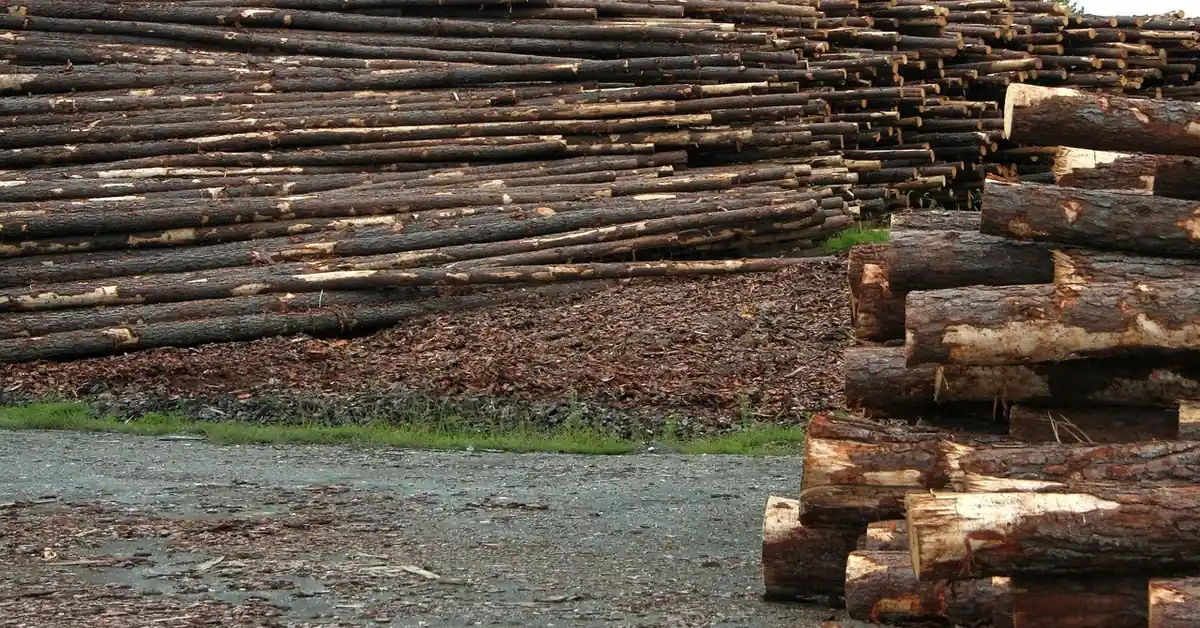
How Is Plywood Made? 7 Steps, Temperatures and Times
Plywood is made by peeling a heated log into thin veneer, drying it, gluing the sheets with the grain of each layer turned 90 degrees, and hot pressing the stack at roughly 270-330°F for softwood until the resin cures. That cross-grain layup is what keeps a panel flat. This guide walks through the seven mill steps with real EPA process numbers, explains why the layers alternate, and shows how softwood, hardwood and marine plywood differ.
Quick Answer: How Plywood Is Made in 7 Steps
| # | Step | What happens | Typical number |
|---|---|---|---|
| 1 | Debark and buck | Outer bark removed, logs cut to length into “blocks” | Veneer is later clipped to about 54 in. wide |
| 2 | Heat the blocks | Hot water bath, steam or spray softens the wood | About 200°F (93°C) |
| 3 | Peel or slice veneer | Lathe for most panels, slicer for some decorative faces | Veneer about 1/8 in. (3 mm) thick |
| 4 | Dry and grade | Jet or longitudinal dryer, then sorted by defects | 300-400°F air; under 1% to 15% moisture |
| 5 | Glue and lay up | Resin on alternate layers, each layer turned 90 degrees | Phenol-formaldehyde or urea-formaldehyde |
| 6 | Hot press | Heat and pressure cure the resin | 270-330°F softwood, 225-275°F hardwood, 2-7 min |
| 7 | Trim, sand, patch | Edges trimmed, faces sanded or left unsanded | Common sheet size 4×8 ft |
Temperatures, times and moisture ranges: EPA AP-42, Section 10.5 Plywood Manufacturing.
The Plywood Manufacturing Process in 7 Steps
Best Plywood Edge Banding Pick | |
 |
Edge Supply Birch Plywood Edge Banding, 3/4 in x 50 ft – $15.99 A cut panel shows every veneer layer described in this guide along its raw edge. This pre-glued birch veneer tape covers those layers with one pass of a household iron.
|
As an Amazon Associate we earn from qualifying purchases.
Every plywood mill follows the same seven-stage flow, from log yard to finished sheet. The numbers below come from the EPA’s plywood manufacturing profile and are typical values; individual mills tune them by species, glue and press.
Step 1: Debarking and Bucking
Logs first pass through a debarking machine that strips the outer bark without badly damaging the wood. They are then cut to length in a step called bucking, and from here on the pieces are called blocks. The sizing matters later: the veneer is clipped to about 54 inches wide so that, after drying shrinkage and edge trim, it still covers a standard 48-inch panel width (EPA AP-42).
Step 2: Heating the Blocks
Blocks are heated to around 200°F (93°C) in a hot water bath, with steam, with a hot water spray, or with a combination of the three. Heat makes the lathe cut more cleanly and leaves a better surface finish on the veneer.
Step 3: Peeling or Slicing the Veneer
Most plywood veneer comes off a rotary lathe. The block spins against a long knife while a nosebar presses on the wood, and a continuous ribbon of veneer unrolls from the log. A veneer slicer works on the same principle but is mostly used for decorative, high-quality face veneer. Typical veneer thickness is about 1/8 inch (3 mm), and the ribbon is clipped into usable sheets afterward.
Step 4: Drying and Grading the Veneer
Clipped veneer travels through a longitudinal dryer, which moves air parallel to the sheet, or a jet dryer, which blasts hot air at the surface for faster drying. Air temperatures typically run 300-400°F. The target moisture content changes with the resin, anywhere from under 1% to 15%, because the glue line has to bond and cure properly in the press.

After drying, sheets are sorted by visible defects and moisture. Grades run from A at the top down to D. According to APA, C-grade veneer is the minimum allowed in Exterior plywood, and D-grade veneer is limited to panels protected from long-term weather exposure.
Step 5: Gluing and Cross-Grain Lay-Up
Mills use two main thermosetting resins. Phenol-formaldehyde goes into softwood plywood and exterior-grade hardwood plywood, while urea-formaldehyde is used for interior-grade hardwood. Spreaders with grooved rubber rolls, curtain coaters or spray systems put the glue on. The detail most guides skip: not every layer gets glue. In the EPA’s five-ply example, only the two cross-band veneers are coated, on both sides, and the back, center and face go on dry.
| Layer | Role | Grain direction | Glue applied |
|---|---|---|---|
| 1 (bottom) | Back | Parallel to the long edge | None |
| 2 | Cross-band | Perpendicular to the layer below | Both sides |
| 3 (middle) | Center | Parallel to the long edge | None |
| 4 | Cross-band | Parallel to the short edge | Both sides |
| 5 (top) | Face | Parallel to the long edge | None |
Source for the layer sequence: EPA AP-42, Section 10.5. The assembly has to be symmetrical about the center layer, or the panel warps.
Step 6: Pressing the Panel
Some lines run a cold press first to flatten the stack and hold it together, and the lay-up then goes into a heated hydraulic press. The hot press has two jobs: squeeze the glue into a thin film across each veneer, and activate the thermosetting resin. Press temperature runs 270-330°F (132-165°C) for softwood plywood and 225-275°F (107-135°C) for hardwood plywood, with press times of 2 to 7 minutes. Species, resin and press design all shift those settings, and one lumber distributor describes roughly 10 minutes, so treat the numbers as typical ranges rather than a fixed recipe.
Step 7: Trimming, Sanding and Patching
The pressed panel is trimmed on all four edges to its final size, most often 4×8 feet (see our standard plywood sheet size chart for the nominal and actual dimensions). Faces may or may not be sanded smooth, depending on the end product, so a sanded cabinet panel and a rough sheathing panel come off the same line with different finishing. Defects in the face are repaired with football-shaped patches or with putty or epoxy, which is why you sometimes see oval plugs on a sheet.
Why Cross-Grain Layers Make Plywood Strong and Stable
APA describes plywood as cross-laminated veneer, with alternating grain directions that spread strength in both directions and improve dimensional stability compared with solid wood. Each layer holds back the movement of its neighbors: wood moves far more across its grain than along it, so a layer that wants to swell sideways is pinned by the layers glued at right angles to it.

Symmetry is the second half of the trick. The layup must mirror itself around a neutral center, as in the five-layer table above, or the stresses are unbalanced and the sheet bows. That is also why panels are normally built with an odd count of layers (3, 5, 7 and up). When a panel does cup after getting wet, our guide on how to straighten warped plywood covers the fixes, and veneer core versus MDF and lumber core shows what changes when the core is not made of veneer. For the thin-veneer side of the craft, see how to veneer wood.
Softwood, Hardwood and Marine Plywood: What Changes in the Mill
The seven steps stay the same across plywood types. What changes is the species, the glue and the press settings, and those choices decide where a panel can safely be used.
| Type | Typical resin | Hot press range | What to know |
|---|---|---|---|
| Softwood plywood | Phenol-formaldehyde | 270-330°F (132-165°C) | Construction sheathing and subfloor; APA Rated Sheathing is made with phenolic adhesive, not urea-formaldehyde |
| Hardwood plywood, exterior grade | Phenol-formaldehyde | 225-275°F (107-135°C) | Water-resistant bond for panels that see moisture |
| Hardwood plywood, interior grade | Urea-formaldehyde | 225-275°F (107-135°C) | Cabinet and furniture panels; the EPA limit of 0.05 ppm formaldehyde applies to hardwood plywood |
| Marine plywood | Waterproof structural adhesive | Not covered in the EPA profile | Exterior bond with B-grade or better veneer in every ply, per APA marine-grade description |
One myth worth correcting: CDX is not exterior plywood. APA classes CDX panels as Exposure 1, which means the glue bond is built to survive moisture during construction, not long-term weather. Only panels bonded as Exterior are designed for repeated wetting and drying. If you are choosing between the two for a roof or floor, our CDX plywood vs OSB comparison and the plywood subfloor types guide cover thickness and span ratings.
Hardwood plywood must meet a 0.05 ppm formaldehyde emission limit in the United States. Source: 40 CFR 770.10, EPA formaldehyde standards for composite wood. For how that compares with MDF and particleboard, see our engineered wood guide.
Frequently Asked Questions
How Is Plywood Made Step By Step?
Plywood is made by peeling and drying wood veneers, gluing them together, and pressing them in a hot press. The process includes log storage, debarking, peeling, drying, gluing, pressing, cutting, and finishing. Commonly used species for plywood include hardwood trees like birch and softwood species like Douglas fir.
What Is The Raw Material For Plywood?
The raw material for plywood is wood veneer. Hardwood trees like birch, blackbutt, oak, okoume, poplar, spotted gum, and walnut, as well as softwood species like Hoop pine, Monterey pine, Radiata pine, and Douglas fir, are commonly used to make plywood.
How Is Wood Turned Into Plywood?
To make plywood, logs are first felled and debarked to create a smooth surface for cutting. The logs are then peeled into thin sheets of veneer, which are sorted by size and quality before being dried. Glue is applied to the veneers, and they are stacked and pressed together under heat and pressure.
Is Plywood 100% Wood?
No, plywood is not 100% wood. It is made by pressing and bonding several sheets of wood veneer together, with each layer alternating the direction of the wood fiber to increase the panel’s strength. Plywood is a composite material consisting of wood veneer and adhesive.
What Temperature Is Plywood Pressed At?
In the hot press, softwood plywood typically sees 270-330°F (132-165°C) and hardwood plywood 225-275°F (107-135°C), for about 2 to 7 minutes, according to the EPA’s plywood process description. The exact time and temperature depend on the wood species, the resin and the press design.
Is CDX Plywood Exterior Grade?
No. APA classes CDX panels as Exposure 1, meaning the bond withstands moisture during construction but not long-term weather exposure. Only panels bonded as Exterior, which require C-grade veneer or better, are designed for repeated wetting and drying.
Is Formaldehyde in Plywood Regulated?
Yes. Under 40 CFR 770.10, hardwood plywood sold in the United States must meet a 0.05 ppm formaldehyde emission limit. APA-trademarked structural panels such as Rated Sheathing are made with phenolic adhesives, not urea-formaldehyde.
What Is Plywood Made Of?
Plywood is made from three components: wood veneers, adhesive, and sometimes surface treatments. Understanding each component explains why different plywood types have different properties.
| Component | Details | Affects |
|---|---|---|
| Wood veneers | Douglas fir, pine, birch, maple, or poplar; typically about 1/8 inch (3 mm) thick | Strength, weight, cost |
| Adhesive (glue) | Phenol-formaldehyde (exterior/structural), urea-formaldehyde (interior) | Water resistance, exposure rating |
| Number of plies | Typically an odd number of layers (3, 5, 7, 9) to keep the panel balanced | Thickness, strength, stability |
| Face veneer grade | A (sanded smooth), B (minor repairs), C (knots allowed), D (only in panels protected from long-term weather) | Appearance, paintability |
Sponsored / affiliate links. As an Amazon Associate I earn from qualifying purchases. I may earn additional commission from eligible campaigns.