How Much Does a Marble Inlay Wood Floor Border Cost?
A marble inlay wood floor border usually costs about $75 to $250 per linear foot installed, with simpler layouts often at the lower end and more complex corners, borders, or premium stone tending to push totals higher. Poor pricing can leave you short on budget, create awkward transitions, and make the border look cheap beside the wood field. This guide covers the main cost drivers, typical price ranges, and how to budget a custom border before you ask for quotes.
How border scope and layout geometry affect inlay pricing
A marble inlay border is a perimeter accent set around a wood or marble field. It is usually priced as a custom project rather than a fixed catalog item, because the shop has to account for drawing, cutting, assembly, and installation details that change with the layout.
Border work sits below a medallion or a full inlay floor in both material use and labor. That is why a border can cost far less than a fully inlaid floral field, even when the same stone is used.
Border versus medallion versus full inlay floor
A border traces an edge. A medallion concentrates the design in one central feature. A full inlay floor covers the field with repeated patterning. Those three scopes do not share the same labor profile, so they should not be priced from the same rate card.
In a wood-floor layout, border work is often the most practical way to add stone detail without committing to a room-wide inlay. It uses fewer pieces, fewer cuts, and less assembly time than a full field.
Where border accents are used in wood-floor layouts
Border accents are common in foyers, corridors, and room edges. They are also used to frame a plank field, define an entry, or mark a transition between rooms. The room name matters less than the layout geometry.
Say your foyer is a clean rectangle with four straight sides and one doorway. That border is simpler to fabricate than a corridor with returns, jogs, and multiple thresholds, even if the floor area is smaller.
How much does it cost per linear foot?
Most custom marble inlay borders fall around $75 to $250 per linear foot installed. Simple rectilinear borders with standard stone tend to sit near the low end, while wide borders, tight corner work, and premium stone move the price upward fast.
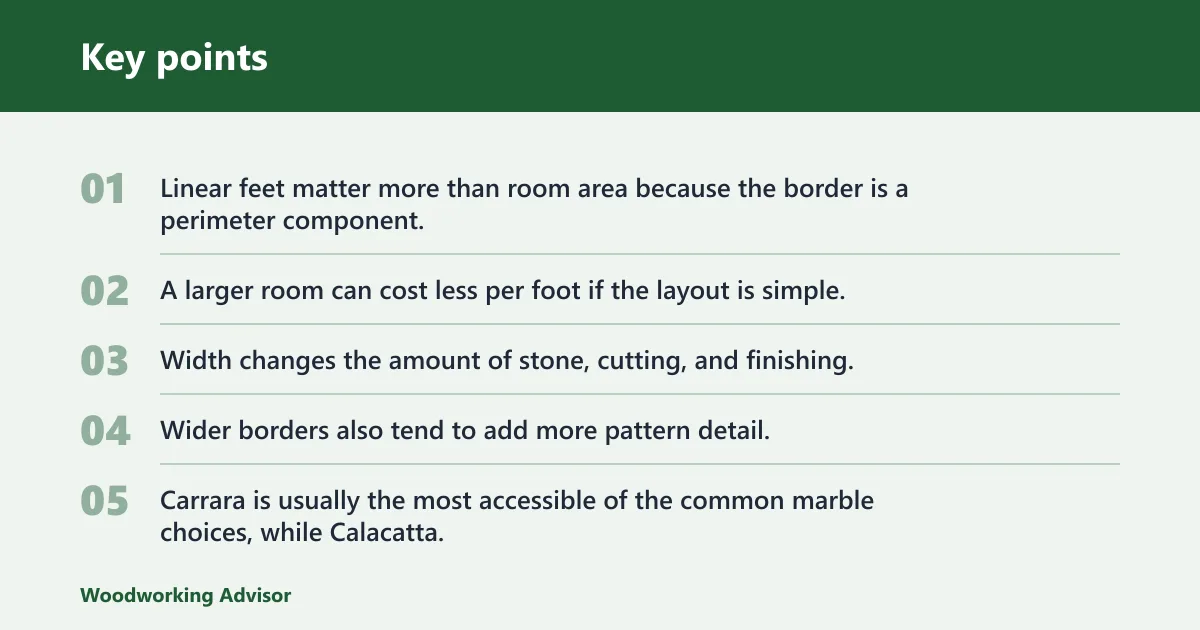
Linear feet matter more than room area because the border is a perimeter component. A larger room can cost less per foot if the layout is simple, while a smaller room can cost more per foot if the border turns often or needs careful termination at doors.
Typical price bands by border width
Width changes the amount of stone, cutting, and finishing. Wider borders also tend to add more pattern detail, especially if the design includes repeated motifs or a contrasting inner and outer edge.
| Border width | Simple stone tier | Mid-range stone tier | Premium stone tier |
|---|---|---|---|
| 2 in | $75-$110 per linear foot | $95-$140 per linear foot | $130-$190 per linear foot |
| 4 in | $90-$130 per linear foot | $115-$165 per linear foot | $155-$220 per linear foot |
| 6 in | $110-$155 per linear foot | $140-$195 per linear foot | $185-$250 per linear foot |
| 8 in | $125-$175 per linear foot | $160-$220 per linear foot | $210-$300 per linear foot |
Stone tier and finish effects
Stone selection changes raw cost and waste. Carrara is usually the most accessible of the common marble choices, while Calacatta, Nero Marquina, and Emperador Dark push higher because of selection pressure, color consistency, or visual demand. Premium stone tiers raise raw-block costs and waste.
Polished finishes are standard for many inlay projects. Honed finishes can soften glare, but the finish itself is usually less important to price than stone grade and the number of cuts.
Marble inlay cost matrix
This matrix shows how width, stone tier, and complexity affect the border as a custom perimeter component. The ranges are estimates for fabricated border work before project-specific add-ons such as corners, thresholds, and substrate prep.
| Width | Stone tier | Simple rectilinear | Moderate pattern density | Complex pattern density |
|---|---|---|---|---|
| 2 in | Simple marble | $75-$95/lf | $90-$115/lf | $110-$140/lf |
| 2 in | Mid-range marble | $90-$115/lf | $110-$140/lf | $135-$170/lf |
| 2 in | Premium marble | $125-$160/lf | $145-$185/lf | $175-$225/lf |
| 4 in | Simple marble | $90-$110/lf | $105-$135/lf | $130-$160/lf |
| 4 in | Mid-range marble | $110-$140/lf | $130-$165/lf | $155-$195/lf |
| 4 in | Premium marble | $150-$190/lf | $175-$215/lf | $205-$265/lf |
| 6 in | Simple marble | $110-$135/lf | $130-$160/lf | $150-$190/lf |
| 6 in | Mid-range marble | $135-$170/lf | $160-$195/lf | $185-$235/lf |
| 6 in | Premium marble | $180-$225/lf | $210-$255/lf | $240-$300/lf |
| 8 in | Simple marble | $125-$155/lf | $145-$180/lf | $170-$210/lf |
| 8 in | Mid-range marble | $155-$195/lf | $180-$220/lf | $210-$260/lf |
| 8 in | Premium marble | $210-$260/lf | $240-$290/lf | $275-$340/lf |
Use that table to budget, not to price the job. Marble inlay flooring is quoted per project, not at a fixed rate, because actual fabrication depends on the drawing set, the stone package, and the site conditions.
Example adders for corners, thresholds, and prep
- Corners: add $25-$75 each for simple mitered corners, more if the corner includes a decorative return or a tight radius.
- Thresholds: add $75-$200 per doorway transition when the border stops and restarts at a door or adjoining room.
- Subfloor prep: add $3-$8 per square foot of affected area when leveling, patching, or moisture correction is needed.
- Old floor removal: add demolition and disposal charges when an existing finish must come out first.
What drives the price up?
Pattern density is a primary cost driver. Clean rectilinear borders cut faster than detailed motifs, so the more pieces you add per metre of border, the more labor, layout time, and waste you create.
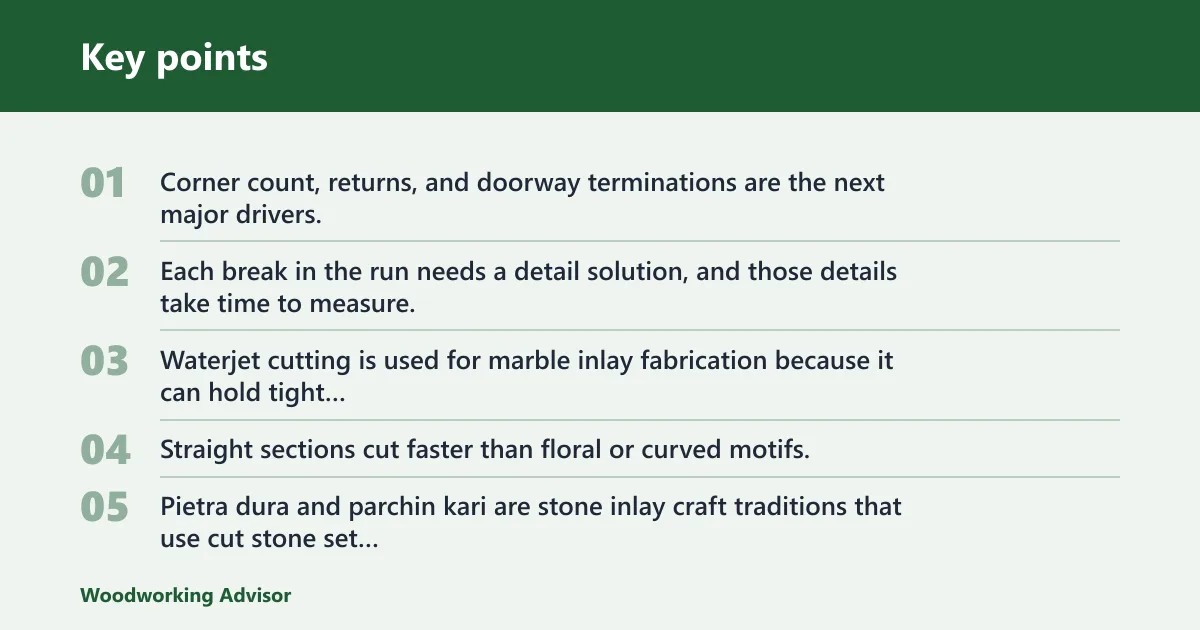
Corner count, returns, and doorway terminations are the next major drivers. Each break in the run needs a detail solution, and those details take time to measure, cut, dry-fit, and finish.
Waterjet cutting and fabrication time
Waterjet cutting is used for marble inlay fabrication because it can hold tight tolerances and repeatable shapes. Geometry changes the time needed. Straight sections cut faster than floral or curved motifs, and tight radius pieces can slow production because the shop must manage waste and fit.
Pietra dura and parchin kari are stone inlay craft traditions that use cut stone set flush into a base. That tight fitting is part of why labor matters so much: each piece has to register cleanly with its neighbors or the border reads unevenly at the seam.
Substrate thickness and core engineering
Substrate and core engineering affect weight, handling, and shipping. A solid stone build is heavier and more demanding to move. Lightweight honeycomb cores reduce shipping weight and can help on large panels, but they still need careful detailing at transitions and edges.
Thickness also changes how the border meets the wood field. If the marble and wood do not share a compatible build-up, the installer may need a reducer, a threshold, or a custom transition strip.
A common first-timer mistake is budgeting the same border price for a four-sided room and a room with three door openings. The second layout usually costs more, even if the linear footage is similar, because each termination needs a separate detail.
Can a marble border work with wood flooring?
Yes. A marble border can be combined with a wood floor field, and that is one of the most common ways to use it. The key is matching thickness, leaving room for wood movement, and planning the transition so the stone edge and wood finish meet cleanly.
The border should not trap the wood. A proper detail allows movement gaps where needed and uses a reducer or threshold when the finished heights do not align. That coordination is a design issue, not an afterthought.
Movement gaps and transition detailing
Wood expands and contracts with humidity. Marble does not move the same way. The junction has to account for that difference, especially in long runs or at exterior doors where temperature and moisture change faster.
If the border is set too tight to the wood, the joint can fail early or telegraph movement at the edge. If it is too loose, the transition looks unfinished. That balance belongs in the shop drawing.
Worked 12×16 room example
A 12 x 16 room has a perimeter of 56 linear feet. That figure gives you the border run to price. The room area matters less here than the perimeter shape, because border work is measured along the edges.
For a rectangular room, the calculation is simple: 12 + 16 + 12 + 16 = 56 linear feet. If the room has a doorway break, a hearth cutout, or a hallway return, the actual billed footage may change after the shop drawing is complete.
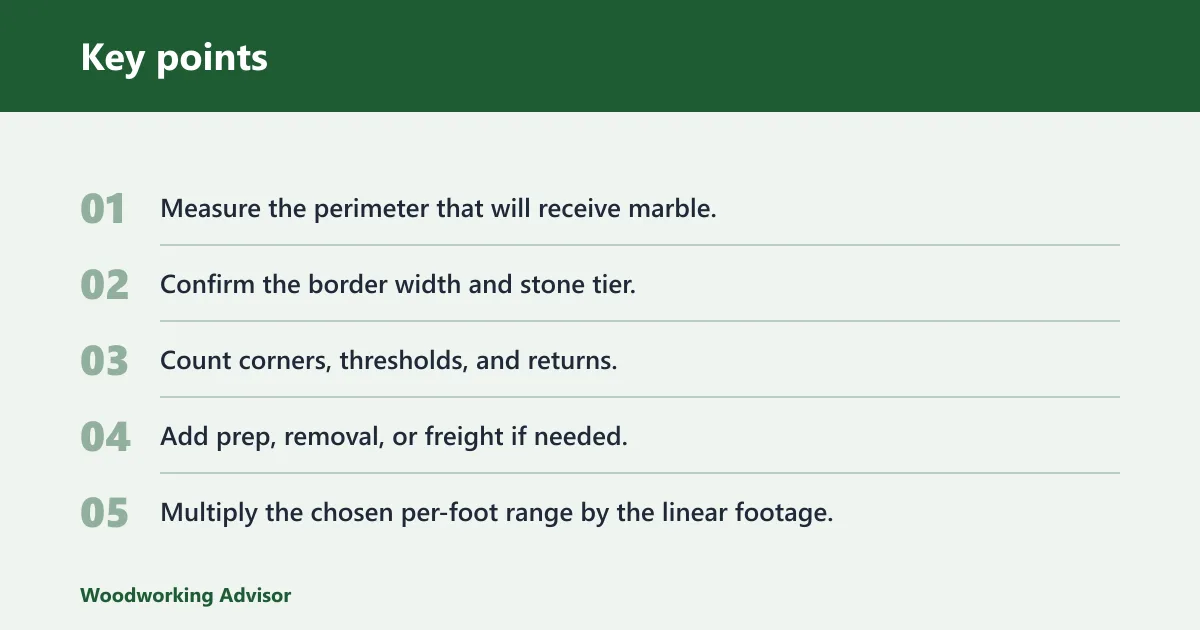
- Measure the perimeter that will receive marble.
- Confirm the border width and stone tier.
- Count corners, thresholds, and returns.
- Add prep, removal, or freight if needed.
- Multiply the chosen per-foot range by the linear footage.
Border-width scenarios
For a 56-foot perimeter, a 2-inch simple border might land around $4,200 to $5,320 before adders. The same room with an 8-inch premium border can move into a much higher band because both width and stone tier increase the fabrication load.
Suppose the room uses a 4-inch mid-range border with four mitered corners and one threshold. Using the matrix, a planning range could sit around $6,160 to $9,240 before subfloor work. Add prep only if the slab or subfloor needs correction.
Installed cost estimate with common adders
The guide’s listed estimated factory-direct range is $5,900-$8,100 USD, and the cited inlay surface area example is 4.52 m². Those figures fit a controlled custom scope, but installation extras can move the total higher.
A 4m² powder room can cost more per unit than a 200m² lobby because project scale lowers the per-square-metre rate. That is why a small room with a high-detail border can cost more than a larger, simpler job, even before site conditions are added in.
Stone choices and fabrication methods
Carrara, Calacatta, Nero Marquina, and Emperador Dark are common choices for borders and inlay accents. Premium stone tiers raise raw-block costs and waste, and semi-precious stones raise cost sharply because sourcing, cutting, and selection become far more demanding.
Stone selection should be tied to the border’s visual role. A restrained perimeter can work well in Carrara or Nero Marquina, while a high-contrast design may justify Calacatta or a darker stone if the rest of the room can support it.
Pietra dura, parchin kari, and waterjet cutting
Pietra dura and parchin kari describe the long craft tradition behind cut-stone inlay. Modern production often uses waterjet cutting to produce the parts, then finishes the assembly by hand so the pieces sit flush in the base.
That mix of machine and handwork is why geometry matters. Waterjet cutting speeds up repeatable straight elements, but the more complex the motif, the more the shop must manage fitting, waste, and assembly time.
Installation extras and maintenance
Installation extras often matter as much as the stone itself. Subfloor prep, old floor removal, furniture moving, crating, and freight can change the total enough to alter the budget conversation. Shipped panels add handling and packaging costs that smaller local jobs may not face.
Maintenance is straightforward. Use a pH-neutral cleaner and avoid acidic chemicals. Acidic cleaners can etch marble and dull the border edge faster than a neutral product would.
Picture a corridor border with frequent doors. If the layout includes three thresholds and two returns, the border may need separate termination pieces at each break. That adds fabrication and installation time even when the linear footage stays modest.
What to avoid in day-to-day care
Do not use vinegar, lemon-based cleaners, or other acidic products on the marble. Do not scrub with abrasive pads. Keep grit off the floor, wipe spills promptly, and use a cleaner made for natural stone.
If the border spans into a wood field, keep the wood care routine separate from the stone care routine. Use products that are safe for each material rather than one cleaner for both.
Frequently asked questions
How much does a marble inlay wood floor border cost per linear foot?
A typical installed range is about $75 to $250 per linear foot. Simple rectilinear borders with common marble sit near the low end, while wider borders, tighter corner work, premium stone, and detailed patterning push the rate higher.
What factors make a marble inlay border more expensive?
Pattern density, stone tier, border width, corner count, doorway terminations, and threshold details all raise cost. Subfloor prep, removal, freight, and crating can add more. Room area matters, but the geometry and finish work usually matter more.
Is a marble border cheaper than a full inlay floor?
Yes. A border is usually less expensive than a full inlay floor because it uses less stone and far fewer pieces. Full fields require more cutting, more assembly, and more installation time, especially when floral or geometric motifs repeat across the room.
How much does installation add to a marble inlay floor border?
Installation can add a meaningful share of the total, especially when the floor needs prep, removal, or complex transitions. A simple border in a clean opening costs less to install than one with multiple thresholds, returns, or height changes at the wood field.
Which marble types are cheapest for inlay borders?
Carrara is often among the more accessible marble choices for borders. Calacatta, Nero Marquina, and Emperador Dark usually cost more, and semi-precious stones raise cost sharply. Selection quality and waste rate matter as much as the named stone type.
Can a marble border be combined with a wood floor field?
Yes, and it is a common design choice. The key is matching thickness, allowing movement gaps for the wood, and detailing the transition carefully. A reducer or threshold may be needed when the finished heights differ or the doorway needs a clean break.
Sponsored / affiliate links. As an Amazon Associate I earn from qualifying purchases. I may earn additional commission from eligible campaigns.