How Much Does It Cost to Refinish Hardwood Floors?
Hardwood floor refinishing usually costs $3 to $8 per square foot professionally, or about $1 to $3 per square foot for DIY materials alone. Stairs, repairs, stains, and water damage raise the total. If you skip proper sanding or moisture checks, expect scratches, dull spots, finish failure, and the cost of doing the floor again. This guide breaks down cost drivers, contractor pricing, and where DIY can save money without creating a bad result.
Typical cost range
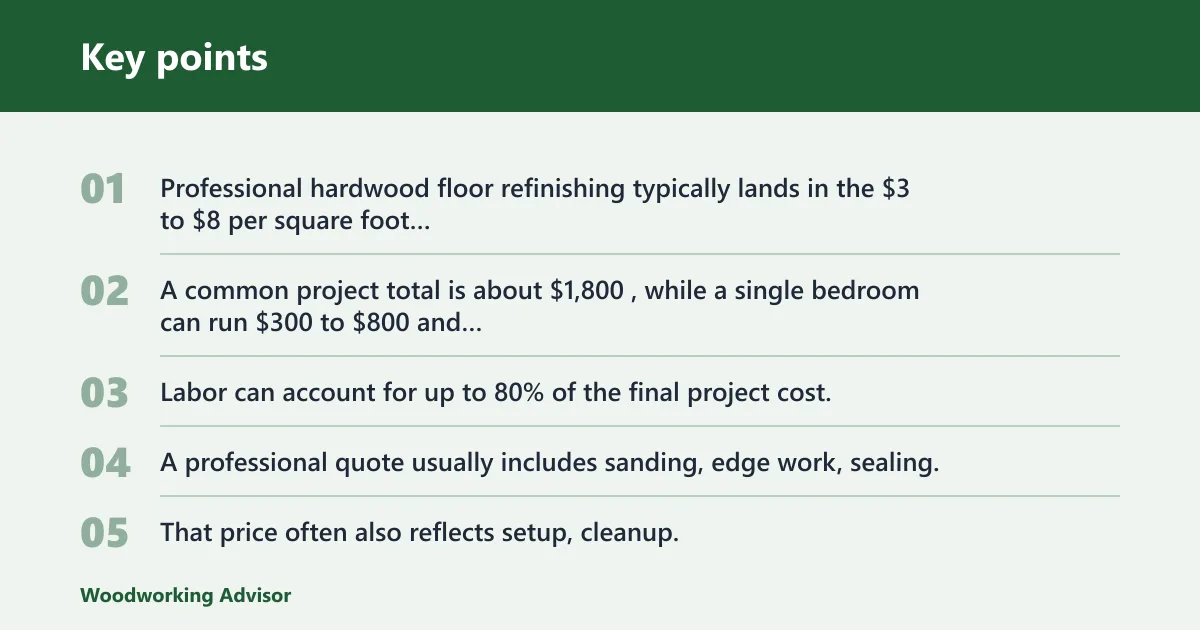



Professional hardwood floor refinishing typically lands in the $3 to $8 per square foot range. A common project total is about $1,800, while a single bedroom can run $300 to $800 and a whole home can range from $2,400 to $6,000. Labor can account for up to 80% of the final project cost.
A professional quote usually includes sanding, edge work, sealing, staining if you choose it, and topcoats. That price often also reflects setup, cleanup, and the crew time needed to keep dust under control. If a bid looks low, check whether those items are missing rather than discounted.
What a pro quote usually includes
Most full refinishing bids cover the work needed to take a floor from worn to ready for finish. That means sanding the field, hand sanding the edges, scraping corners, and applying sealer and finish coats. If the floor needs stain, the quote should say whether stain is included or billed separately.
Hidden items matter. Furniture moving, trim removal, patching damaged boards, dust containment, and lead testing can all add cost. Older homes often need more prep because crews have to work around existing finishes, transitions, and fragile trim.
📊 This Old House says the average professional project cost is $1,800. Source: Thisoldhouse.
What changes the price?
The main price drivers are square footage, floor condition, finish system, and prep time. A quote for a clean, open room is not the same as a quote for a damaged older floor with stains, repairs, and tight corners. Labor rises fast when the job needs extra passes or more hand work.
Square footage and room layout
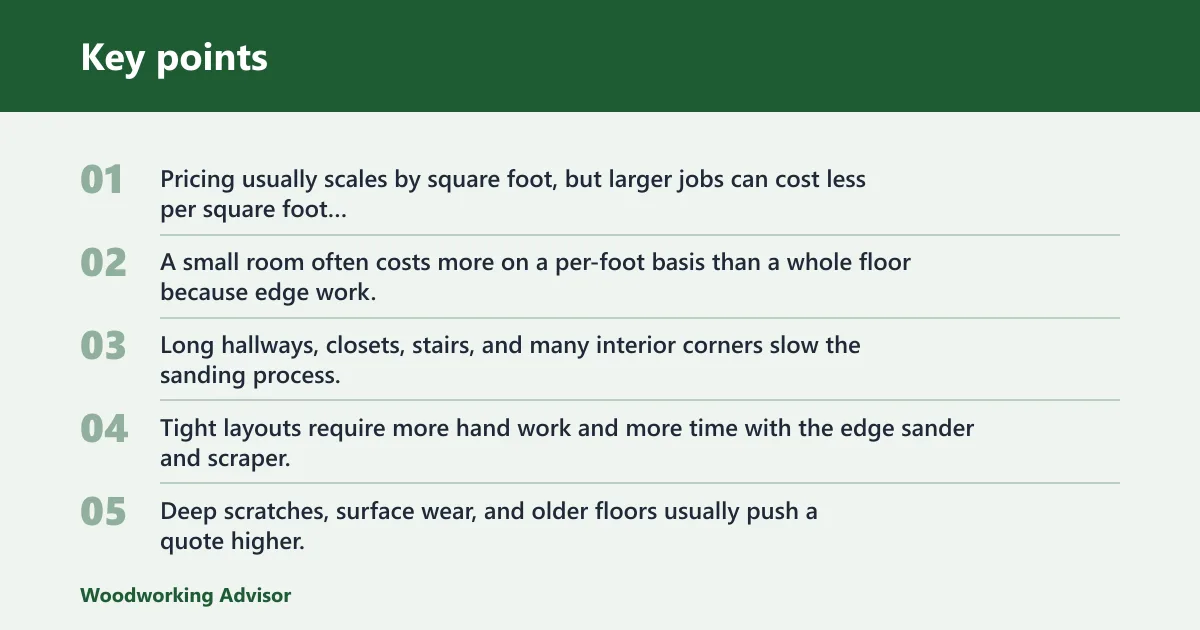
Pricing usually scales by square foot, but larger jobs can cost less per square foot because setup and mobilization spread across more area. A small room often costs more on a per-foot basis than a whole floor because edge work, masking, and travel time take a larger share of the total.
Room shape matters too. Long hallways, closets, stairs, and many interior corners slow the sanding process. Open plans are faster. Tight layouts require more hand work and more time with the edge sander and scraper.
Floor condition and repair needs
Deep scratches, surface wear, and older floors usually push a quote higher. If the boards have gaps, cupping, loose planks, or water damage, the contractor may need to repair them before sanding starts. Floors that are too thin to sand again may need a different approach entirely.
That is where screening, spot repair, or board replacement may be discussed instead of a full refinish. A floor with thin wear layers can be a poor candidate for aggressive sanding, and that risk should show up in the bid before work starts.
Finish type and coat count
Finish choice changes both material cost and labor time. Oil-based polyurethane often costs more to apply on the project side because it can require longer dry time between coats. Water-based finishes may cost differently, but the real quote change usually comes from the number of coats, drying windows, and the prep needed between them.
Stain and sealer are separate line items on many bids. A clear refinish is cheaper than a stain-and-refinish job because staining adds labor, decision points, and an extra chance for mismatch. More coats also increase time, especially when each coat must dry before the next pass.
Dust control and prep work
Dust containment matters on any careful job. Crews may mask doorways, protect nearby rooms, and set up vacuums or dust collection on sanding equipment. If a bid includes heavier containment, that usually means more setup time and more cleanup time.
Trim removal, furniture moving, and hallway protection also raise the price. Some contractors include these items; others list them separately. Ask how the crew handles baseboards, vents, and transitions so you can compare bids on the same basis.
Refinishing cost by project size
Cost by size is the fastest way to sanity-check a quote. A small room can fall near the low end of the range, while a whole-home project moves toward the upper end because labor, sanding, and finish time scale with area. For a 2,000-square-foot house, This Old House gives a cost estimate of $11,227 to $13,481. (Thisoldhouse)
One room examples
A single bedroom can cost $300 to $800 to refinish. That range is wide because the same room may need only light sanding or may require edge work, stain, and repair. The smaller the room, the more a fixed setup charge affects the final number.
1,000 square feet
For 1,000 square feet, a professional bid often sits in the several-thousand-dollar range once labor, materials, and finish coats are included. The exact total depends on whether the quote includes stain, how much edge work is needed, and whether the floor needs repair before sanding starts.
2,000 square foot house
A 2,000-square-foot house can range from $11,227 to $13,481 in This Old House’s estimate, and Bob Vila estimates about $8,000 for a similar-size home when hiring a pro to sand, seal, stain, and apply oil-based polyurethane. Those numbers show how finish system, prep, and local labor can move the total sharply.
Say your 1,000-square-foot main floor is mostly open, with light wear and no repairs. That quote should usually land below a tighter, older floor of the same size that needs stain matching, board replacement, and extra masking around stairs and built-ins.
DIY hardwood floor refinishing costs
DIY hardwood floor refinishing usually costs far less in cash than hiring a crew, but the job still needs rented tools, consumables, and several days of work. Family Handyman estimates around $500 for DIY materials and tools, and says the project takes multiple days. The savings shrink fast if you need to rent equipment longer or fix sanding mistakes. (Familyhandyman)
Materials and rented tools
Family Handyman lists a drum sander, edge sander, and floor maintainer as required tools. It also lists sanding belts in 40, 60, and 100 grit. Those costs are only part of the bill; you also need finish, applicators, masking materials, and dust control supplies.
For sanding progression, Family Handyman recommends moving from 40 grit to 60 grit to 100 grit. This Old House shows a three-step sanding progression of 36, 60, and 80 grits. The exact sequence varies by system, but the point is the same: you do not jump straight to a fine grit and expect old finish to disappear cleanly.
Time required
DIY takes time because each step depends on the last. You sand, edge-sand, clean, apply finish, wait for drying, then repeat as needed. That time commitment is why many homeowners underestimate the labor even when the material bill looks manageable.
A common first-timer mistake is treating sanding like a single pass. In practice, multiple passes and repeated cleanup are normal. If a floor needs extra leveling or more hand work at the perimeter, the time cost grows quickly.
Safety gear and dust control
At minimum, plan on a respirator, ear protection, and eye protection. Sanding creates fine dust and noise, and finish products can add fumes that call for good ventilation. The room should be empty, nearby areas protected, and dust paths sealed as well as possible before the first pass.
DIY savings disappear if dust spreads through the house or if a sanding mistake forces a contractor to fix the floor later. The cheapest floor is not the one with the lowest materials bill; it is the one you do not have to redo.
What your bid should itemize
Compare bids line by line, not as a single total. A fair quote should separate sanding, edge work, repairs, stain, sealer, finish coats, furniture moving, trim removal, and dust containment. If those items are bundled, ask for a written breakdown before you accept the price.
Sanding and edge work
Good bids explain the sanding sequence and how many passes are included. This Old House notes the use of 36, 60, and 80 grits and says edge work requires hand sanding where the drum sander cannot reach. If a contractor skips edge work in the description, the perimeter may be left rough or mismatched.
Stain, sealer, and finish coats
Ask whether stain is included, how many topcoats are planned, and whether the finish is oil-based or water-based. More coats mean more labor and more drying time. If the quote only says “refinish” without naming the finish system, it is hard to compare against other bids.
Furniture moving and trim removal
Furniture moving can be a separate charge, especially if the crew has to clear large rooms or protect valuable items. Trim removal may also appear as an added line if baseboards, quarter-round, or transitions must come off before sanding. Those are normal costs, not surprises, if they are listed up front.
Repairs and dust containment
Repair work can include replacing damaged boards, filling gaps, or addressing water-damaged sections. Dust containment may cover plastic walls, floor protection in nearby rooms, and cleanup after sanding. A quote that looks unusually low often leaves out one or both of those items.
Screen and recoat vs refinishing
Screen and recoat is cheaper than full refinishing when the floor only has worn finish and no deep scratches or stain damage. It lightly abrades the surface and adds a new topcoat without sanding down to bare wood. Full refinishing is needed when scratches, discoloration, or uneven wear have gone too far for a topcoat alone.
When screening is enough
If the finish is dull but intact, screening can be the better value. It is faster, less dusty, and usually less expensive because it avoids full sanding. It works best on floors that are structurally sound and still have a finish layer worth preserving.
When full sanding is needed
Full sanding becomes necessary when the surface has deep scratches, uneven wear, or a failed finish. It also becomes the better option if you want to change stain color or remove old damage. Screening will not erase those problems because it does not remove enough material.
Failure cases that call for repairs first
Severe damage changes the order of work. Loose boards, water stains, and thin wear layers need evaluation before anyone starts sanding. If the contractor ignores those issues, the floor can end up with drum marks, edge burn, stain mismatch, or a finish that fails early.
Hardwood floor refinishing quote comparison table
Use this table to compare bids on the same job, not just the same floor size. A low quote may leave out prep, while a high quote may include more repair or containment. The fair number depends on how much work is actually included.
| Line item | Typical range | What changes the price | Fair quote check |
|---|---|---|---|
| Sanding | $1.50 to $4 per sq. ft. | More passes, tighter layout, rougher wear layer | Should name grit sequence and number of passes |
| Edge work | $0.50 to $1.50 per sq. ft. | Many corners, closets, baseboards, stair edges | Should state hand sanding at edges and transitions |
| Repairs | $100 to $1,000+ | Loose boards, gaps, water damage, board replacement | Should list repair type and board count |
| Stain | $0.50 to $2 per sq. ft. | Color change, test samples, extra labor | Should say whether stain is included or optional |
| Finish coats | $1 to $3 per sq. ft. | Oil-based vs water-based, number of coats | Should name finish product and coat count |
| Dust containment | $100 to $500+ | Masking, vacuums, room isolation, cleanup | Should describe protection for adjacent spaces |
| Furniture moving | $50 to $300+ | Room size, heavy items, multiple rooms | Should say whether moving is included |
- Confirm the square footage and room count match the bid.
- Check whether sanding, edge work, stain, and finish coats are all included.
- Look for repair, dust containment, furniture moving, and trim removal charges.
- Compare finish type and number of coats across all quotes.
- Ask whether lead testing is included if the home is old enough to need it.
- Reject bids that skip edge work, repairs, or cleanup without explanation.
Suppose one contractor quotes a low price for a 900-square-foot floor but leaves out furniture moving, dust containment, and repairs. Another bid is higher, but it includes all three plus three finish coats. The higher bid may be the fairer price because it reflects the real scope.
Frequently asked questions
How much does it cost to refinish hardwood floors per square foot?
Professional hardwood floor refinishing typically costs $3 to $8 per square foot. The lower end usually fits simpler jobs with light prep, while the upper end reflects repairs, stain work, more finish coats, or tougher layouts that need more hand sanding and cleanup.
How much does it cost to refinish hardwood floors professionally?
The final number depends on square footage, floor condition, finish choice, and whether repairs or heavy dust control are part of the job.
How much does it cost to refinish hardwood floors yourself?
DIY refinishing materials and tools cost around $500 according to Family Handyman, but the real cost also includes your time, rental days, sanding belts, finish products, and safety gear. DIY is cheaper in cash, but it is dusty, noisy, and labor-heavy.
How much does it cost to refinish hardwood floors in a 2000 square foot house?
The gap shows how finish system and labor market can move the total.
What factors increase hardwood floor refinishing cost
Costs rise with larger square footage, tight room layouts, deep scratches, repairs, stain changes, more finish coats, dust containment, furniture moving, and trim removal. Regional labor rates also matter. Older floors can cost more because they need extra care, and some floors are too thin to sand again.
Is it cheaper to screen and recoat than refinish hardwood floors?
Yes. Screen and recoat is usually cheaper because it avoids full sanding and only renews the top layer. It works when the finish is worn but the wood is still in good condition. If the floor has deep damage, staining, or finish failure, full refinishing is the better choice.
How much does it cost to refinish hardwood floors in canada?
Canada pricing often runs higher than many U.S. quotes because labor and material costs can be higher in some markets. Use the same checklist on every bid: square footage, finish type, repairs, dust control, and furniture moving. Local pricing can vary a lot by city and contractor capacity.
How much does it cost to refinish hardwood floors in calgary?
Calgary bids can be higher or lower depending on labor demand, access, and the condition of the floor. A fair comparison still starts with line items, not a single number. Ask for sanding, edge work, repairs, finish coats, and cleanup to be listed separately so you can compare quotes correctly.
Sponsored / affiliate links. As an Amazon Associate I earn from qualifying purchases. I may earn additional commission from eligible campaigns.