Is MDF Good for Soundproofing? It Helps, But Isn’t a Standalone Fix
MDF helps a little with soundproofing and does almost nothing for echo. A sheet of MDF is dense and heavy, so it blocks some of the sound passing through a wall, but its hard flat face reflects sound instead of absorbing it. That is the opposite of what many guides claim.
If you want to keep a TV, a drum kit or a neighbor out of a room, MDF can be one layer of the fix, as long as you seal the gaps and do not screw it rigidly to everything. If you want a room to sound less boomy, bare MDF will not do it. Below is what a sheet really adds, which jobs it cannot do, and how to build with it. If you are still choosing a panel material in general, our comparison of plywood and MDF covers the trade-offs.
The Short Answer: MDF Blocks a Little, Absorbs Almost Nothing
Best Damping Compound Pick
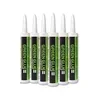 |
Green Glue Noiseproofing Compound, 6 Tubes, $174.49 A damping compound that goes between two rigid sheets, such as MDF over drywall. It is the layer that turns plain extra weight into a damped assembly, which is the gap a bare MDF sheet leaves open.
|
Soundproofing is two separate jobs, and mixing them up is why so many DIY builds disappoint. Blocking (the acoustics term is transmission loss) keeps sound from passing through a wall, floor or ceiling. Absorption soaks up sound inside a room so it stops bouncing around as echo. MDF is a modest blocker because it is heavy and a poor absorber because its surface is hard and sealed.
You will often see a single “decibel rating” quoted for MDF. Building acousticians do not rate a loose sheet that way. The standard figure is STC, Sound Transmission Class, which the Acoustical Society of America standards site defines as a single-number rating of airborne sound insulation of a building partition, fitted to lab transmission-loss data measured under ASTM E90 and classified under ASTM E413 (see the ASA definition). It rates a whole tested wall, floor or door with its edges sealed, not a board on its own. Any number quoted for “MDF alone” is a rough guide at best.
What Actually Makes a Wall Block Sound?
Most MDF articles stop at weight. Real walls get their rating from five levers working together, and a sheet of MDF only pulls one of them. The four classic principles (mass, decoupling, damping, absorption) and the importance of sealing gaps and outlet boxes are laid out in this general soundproofing overview.
| Lever | What it does | Does an MDF sheet supply it? |
|---|---|---|
| Mass | Heavier partitions block more sound | Yes: this is where MDF helps |
| Decoupling | Breaks the solid path so vibration cannot ride through the studs | No: you add it with channel, clips or a separate stud frame |
| Damping | Turns vibration between layers into a tiny amount of heat | No: a stiff board does very little by itself, so a compound between layers is added |
| Cavity absorption | Insulation in the stud bays cuts resonance inside the wall | No: that is mineral wool or fiberglass batts |
| Sealing | Stops sound leaking through gaps, outlet boxes and edges | No: acoustical caulk does this, not the board |
That table is the real answer to the question in the title. MDF is a cheap, heavy, paintable way to add mass, and it needs four other things to turn that mass into a quiet wall.
Blocking vs Absorbing: Which Job Does Each Material Do?
Pick materials by the job, not by the word “soundproofing” on the label.
| Material | Main job | What to know |
|---|---|---|
| MDF | Blocking (mass) | Dense and cheap, but reflects sound inside the room and does not absorb echo |
| Drywall | Blocking (mass) | The usual base layer in most wall assemblies |
| Mass-loaded vinyl (MLV) | Blocking (mass) | Flexible sheet that adds mass without much thickness |
| Mineral wool or fiberglass batts | Absorption | Fills wall cavities and cuts cavity resonance, which helps a wall perform better |
| Acoustic foam or fabric-wrapped panels | Absorption | Tames echo inside the room; blocks very little transmission |
| Rugs, curtains, soft furniture | Absorption | Cheap echo control; little effect on sound passing through walls |
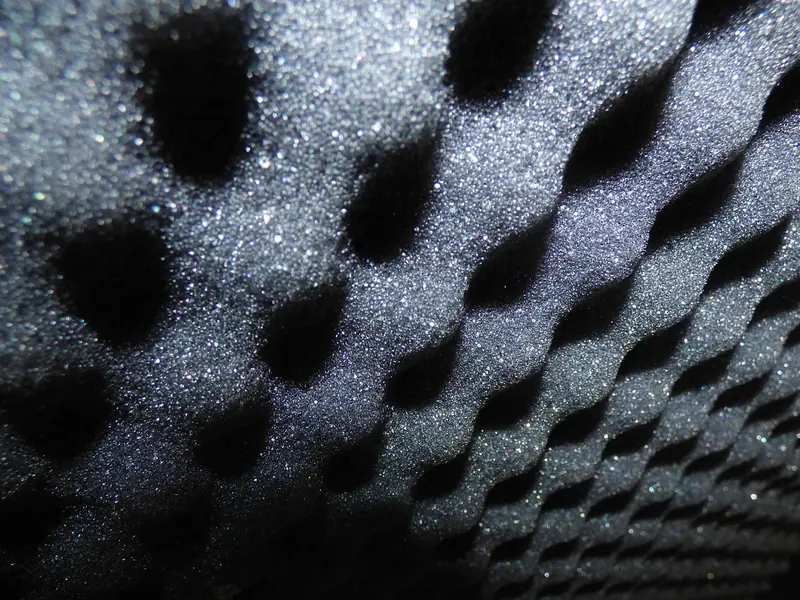
The close-up below is open-cell acoustic foam. Porous surfaces like this are what stop a room from sounding harsh, and they are a separate purchase from anything that blocks sound. For more echo fixes that do not involve the walls, see our guide on reducing echo in a room with hard floors.
The Mass Math: What a Sheet of MDF Really Adds
For a simple single-layer barrier, the mass law says transmission loss rises about 6 dB each time the mass per unit area doubles, as Acta Acoustics explains. The same source adds the catch: the law is only a basic guide, because stiffness effects and edge losses pull single layers below the theory, and the most common fix is multiple layers.
For weight, the Composite Panel Association’s MDF environmental product declaration (EPD 639) reports a production-weighted average density of 727 kg/m3 for 3/4 inch (19.05 mm) MDF, with reported densities across the industry ranging from 640 to 916 kg/m3. The table converts that average into weight per square foot. These weights are my own arithmetic from the CPA average, so check the label on the board you buy.
| MDF thickness | Weight per sq ft (at 727 kg/m3) | Theory: change vs 1/2 inch |
|---|---|---|
| 1/2 inch | about 1.9 lb | baseline |
| 5/8 inch | about 2.4 lb | about +2 dB |
| 3/4 inch | about 2.8 lb (about 91 lb per 4×8 sheet) | about +3.5 dB |
| Two layers of 3/4 inch | about 5.7 lb | about +9.5 dB |
Those dB figures come straight from the mass-law relationship (20 times the log of the mass ratio), so they are theory for a single idealized panel, not a lab result for a real wall. They do show why more thickness is a slow way to buy quiet: going from 1/2 inch to 3/4 inch is only about 3.5 dB on paper, and you need to double the weight again for each further 6 dB.
For scale, the STC article gives this speech-privacy guide: at STC 25 normal speech can be understood, at 35 loud speech is audible but not intelligible, at 45 loud speech is heard but not audible, and at 50 and above most sounds do not disturb neighbors. It also notes that one or two STC points between similar walls is subjectively insignificant.
Where MDF Falls Short
- Bass passes right through. STC only scores 125 Hz to 4000 Hz, and the rating suits speech better than music or machinery because those carry more low-frequency energy. A subwoofer, a kick drum or a bass line can travel through MDF far more easily than voices do.
- Gaps beat mass. A tiny unsealed crack around a panel, an outlet box or a door lets sound leak past the whole assembly. Outlets, switches and electrical boxes are weak points in any treatment, so sealing the perimeter is often worth more than another layer.
- Rigid contact carries vibration. Screwing MDF straight to the studs lets vibration travel into the framing, and sound then flanks around the panel through the floor, ceiling and neighboring walls.
- It reflects echo. Bare MDF on the inside walls of a room can make it sound harsher because nothing absorbs the reflections.
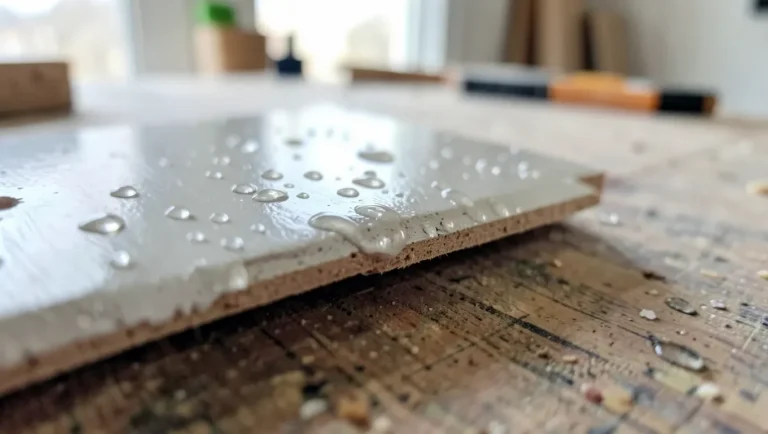
- Moisture. Standard MDF swells and crumbles at the edges when wet, so it is a poor choice for a damp basement wall. See our guide to the properties of MDF for how it behaves in damp conditions.
How to Build With MDF So It Actually Works
The goal is to turn a plain mass layer into a decoupled, damped assembly. This is the order that gets the most from each step.
- Seal every gap first. Run acoustical caulk (a permanently flexible sealant) around the perimeter of each panel, around electrical boxes, and at the floor and ceiling lines.
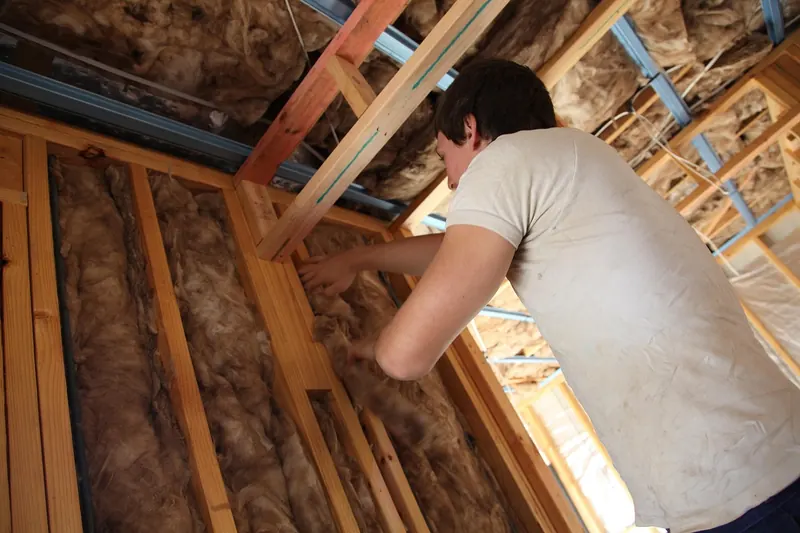
- Fill the wall cavity. Put mineral wool or fiberglass batts in the stud bays to cut cavity resonance. This helps the wall regardless of what you put on the face.
- Add a second, different layer. Two layers of different thickness and material, such as 5/8 inch drywall and 3/4 inch MDF, cover a wider range of frequencies than one thick layer. Our look at plywood instead of drywall covers the same layering logic.
- Damp between the layers. A damping compound such as Green Glue goes between two rigid sheets. Follow the coverage guidance printed on the tube, because it depends on sheet size.
- Decouple where you can. Resilient channel or a staggered or double stud wall keeps the panel off the studs. The compound maker warns that channel is frequently installed with screws reaching into the studs, which removes its flexibility and creates a short circuit, so follow the channel maker’s instructions exactly.
- Finish with absorption. Add rugs, curtains or absorber panels on the room side for echo. MDF cannot do this part.
What does damping add in numbers? The compound maker’s own comparison sheet (hosted by the reseller TM Soundproofing) reports that, against walls of the same weight, Green Glue added 10 STC points to a wood-stud wall, 9 to a staggered-stud wall and 9 to a steel-stud wall, with low-frequency gains of up to 12 dB on the wood-stud wall. Treat that as a manufacturer claim from its own test set, not independent data, and note that the tested walls used drywall and plywood layers rather than MDF.
If you only want MDF as decorative wall paneling, our guides to installing MDF wall panels, MDF wall panel ideas and joining MDF cover the finishing side. Treat any noise benefit from decorative panels as a bonus, not a plan.
Safety and Code Notes Before You Start
- Dust and formaldehyde. Cutting MDF makes very fine dust. The CPA’s EPD lists urea-formaldehyde resin at about 6.3 percent of the average MDF product by mass, and reports that 81.9 percent of North American producers are certified for formaldehyde emissions while 18.1 percent are exempt (no-added-formaldehyde or ultra-low-emitting). Cut outdoors or with dust collection, wear a well-fitted respirator rated for fine dust, and ask for no-added-formaldehyde board if you want a low-emission panel. Our page on whether to avoid MDF goes deeper.
- Weight. A 3/4 inch sheet is roughly 90 pounds by the CPA-average arithmetic above. Get a second person, and never hang sheets overhead on drywall anchors. A ceiling layer must be fastened into the joists.
- Fire. MDF burns, and it is not a substitute for fire-rated Type X drywall where a fire-rated wall or ceiling is required, for example between a garage and living space. Check your local code before layering anything over a rated assembly.
When MDF Is the Right Pick, and When It Is Not
| Your goal | Does MDF help? | Better approach |
|---|---|---|
| Quieter TV or voices from the next room | Somewhat, as one layer | Seal gaps, add cavity insulation, then a second layer with damping |
| Stop bass or a subwoofer leaking | Very little | Decoupled walls and a lot more mass; there is no cheap fix |
| Reduce echo inside a room | No | Rugs, curtains or absorber panels |
| Quiet a speaker cabinet or enclosure | Yes, it is a common cabinet material | Braced MDF or plywood; see our note on birch plywood for speaker cabinets |
| Quiet an interior door | Barely on its own | A solid-core door, door seals and a drop seal; see MDF doors |
Conclusion
MDF is a decent, budget-friendly mass layer and a poor absorber. Use it as one part of a wall or ceiling that is sealed, filled and ideally decoupled and damped, and add real absorbers if the room needs to sound better as well as quieter. On its own it is a modest improvement, not a soundproofing solution. For the wider pros and cons of the board, see MDF advantages and disadvantages.
Frequently Asked Questions
Is MDF good for soundproofing?
MDF helps a little because it is dense and heavy, so it adds mass that blocks some sound. On its own it is a modest improvement, and it works best as one layer in a sealed, insulated and ideally decoupled assembly.
Does MDF absorb sound?
Not meaningfully. MDF has a hard, sealed surface that reflects sound, so bare MDF on a room’s walls can even add echo. Absorption comes from porous materials such as mineral wool, fiberglass, foam or thick fabric.
What is the STC rating of MDF?
There is no single STC for a bare sheet of MDF, because STC rates a complete tested assembly in a lab under ASTM E90 and E413. Adding an MDF layer raises a wall’s rating by an amount that depends on the rest of the wall and how well it is sealed.
Why can I still hear bass through an MDF wall?
Low frequencies pass through light single layers much more easily than speech does. STC only scores 125 Hz and above, so a wall with a decent STC can still leak a subwoofer or kick drum. Bass needs far more mass and real decoupling.
Is MDF better than plywood or drywall for soundproofing?
Per thickness, MDF is heavier than plywood because it is denser, so it adds a bit more mass. Drywall is cheaper and usually the base layer. Two different layers together generally beat one thicker layer of a single material.
Should I use MDF or mass-loaded vinyl?
Use MDF when you want a rigid, paintable layer for the money. Use mass-loaded vinyl when you need to add mass in a thin flexible sheet. Neither replaces sealing gaps and adding cavity insulation.
Sponsored / affiliate links. As an Amazon Associate I earn from qualifying purchases. I may earn additional commission from eligible campaigns.