Cherry vs Oak Firewood: Which Burns Better for Stoves?
Choose Cherry for easier splitting, faster seasoning, and a lighter indoor burn. Choose Oak Firewood when you want longer heat, a denser coal bed, and fewer reloads before morning. Pick the wrong wood and you get shorter burns, more smoke at startup, or a stove that cools too soon. This guide compares Cherry and Oak Firewood for heat output, seasoning time, splitting, and indoor burning so you can match the wood to the job.
Cherry vs oak firewood at a glance
Cherry is the better pick when you want easier handling, quicker seasoning, and a milder indoor burn. Oak Firewood wins when you care more about longer heat retention, a stronger coal bed, and fewer reloads through the night. For most stove owners, the decision comes down to burn length, not aroma.
| Factor | Cherry | Oak Firewood | Winner |
|---|---|---|---|
| Heat output | About 20.4 million BTUs per dry cord | Higher than Cherry; red oak is commonly listed around 24.0 to 24.6 million BTUs per cord, and white oak around 29.1 million BTUs per cord | Oak Firewood |
| Burn length | Good, but shorter than oak | Longer burns and longer heat retention | Oak Firewood |
| Coal bed | Useful coal bed, but typically less enduring | Stronger, longer-lasting coal bed | Oak Firewood |
| Seasoning speed | Often 6 to 12 months; one guide lists 8-10 months and another says 9 to 12 months | Usually slower than Cherry because of density | Cherry |
| Splitting ease | Easy to split | Harder to split than Cherry in many cases | Cherry |
| Indoor handling | Lighter handling, lower smoke when properly seasoned, pleasant fruity smell | Heavier, longer-burning, better for stretch heat than aroma | Cherry |
Heat output
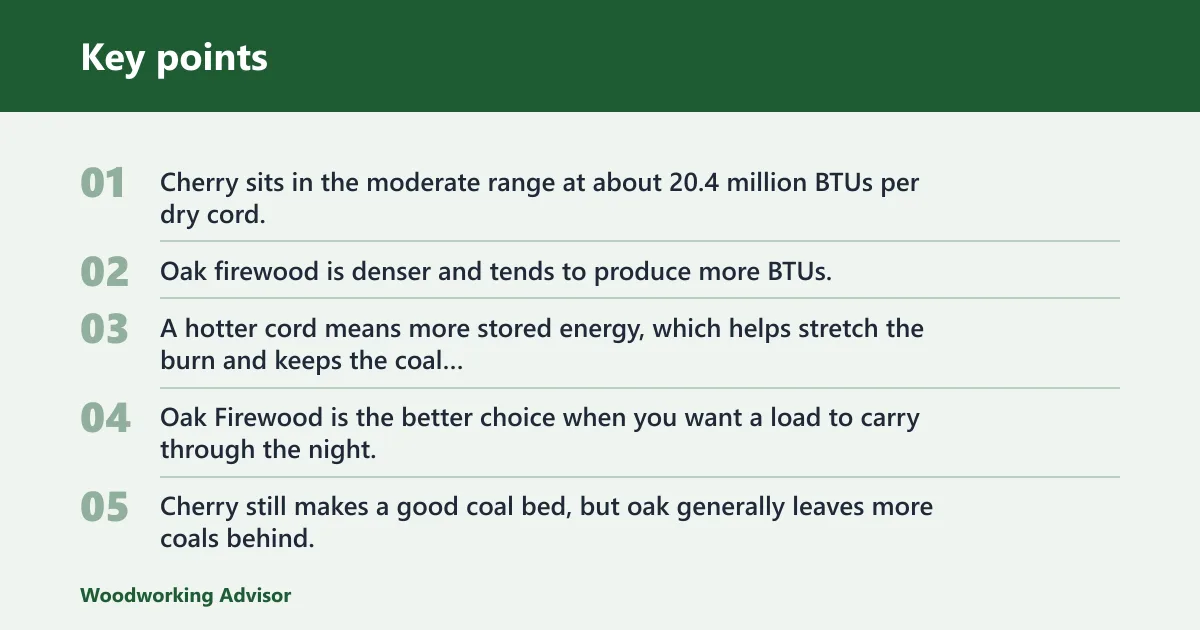
Cherry sits in the moderate range at about 20.4 million BTUs per dry cord. Oak firewood is denser and tends to produce more BTUs, with red oak often cited at roughly 24 million BTUs per cord and white oak at about 29 million BTUs per cord.
That gap matters in a stove load. A hotter cord means more stored energy, which helps stretch the burn and keeps the coal bed alive longer.
Burn length and coal bed
Oak Firewood is the better choice when you want a load to carry through the night. Cherry still makes a good coal bed, but oak generally leaves more coals behind, and those coals help the next reload catch faster.
Say your stove is packed at 9 p.m. for an overnight burn. Cherry can still work well if the house only needs moderate heat, but oak is the safer choice when you want usable coals waiting in the morning.
How do heat and burn length compare?
Oak Firewood beats Cherry on heat output and burn duration. Cherry gives moderate heat and a pleasant indoor burn, but oak’s higher density means more BTUs per cord, more coals, and a longer time before the load burns down.
BTU per cord: cherry, red oak, white oak, and post oak
For a practical comparison, BTU per cord is the main number to watch. Cherry averages about 20.4 million BTUs per dry cord; red oak is commonly cited around 24.0 to 24.6 million BTUs per cord; white oak is often listed around 29.1 million BTUs per cord; and post oak is usually grouped with the stronger, longer-burning oaks.
That spread is why “oak” needs species-level guidance. Red oak and white oak are not equal, and white oak usually gives you the highest heat of the three named oak types here.
Why oak holds heat longer in real stove loads
Oak’s density slows the burn, so the load gives off heat for a longer stretch instead of flashing through quickly. That makes it a better fit for overnight runs, long cold snaps, and stoves that need a stable coal base before the next reload.
Cherry is still useful when you want a quicker, easier burn. It is simply not the wood to reach for when the main goal is long heat retention with fewer trips back to the stove.
Which wood seasons faster?
Cherry usually seasons faster than oak firewood. Black cherry is often given a seasoning window of about 6 to 12 months, with some guides listing shorter or similar ranges. Oak commonly needs more time because its density slows moisture loss.
Seasoning time by species and split size
Split size changes drying speed. Smaller splits dry faster because they expose more surface area, while large rounds hold moisture longer, especially in a cool or humid climate.
Cherry still needs proper airflow. If you stack it tightly or leave bark-heavy pieces in shade, the drying clock stretches, and the final burn can be smoky even if the wood looks dry on the outside.
Airflow, top cover, and moisture below 20 percent
Seasoned firewood should be below 20 percent moisture. Stack it off the ground, leave space between rows, and cover the top only so rain stays off while air can move through the sides.
Green wood smokes more, burns less efficiently, and raises creosote risk. That applies to Cherry and Oak Firewood alike, and you notice it fastest in a stove that already drafts weakly.
Smoke, sparks, and creosote
Properly seasoned Cherry burns with low smoke and few sparks, and many users value its mild, fruity smell indoors. Oak Firewood also burns cleanly when dry, but any wet or unseasoned hardwood creates more smoke, more soot, and more creosote risk.
What seasoned cherry smells like indoors
Cherry is often chosen for its gentle aroma rather than for a strong fragrance. That smell matters most in a fireplace room or a stove sitting near living space, where a cleaner burn is easier on the nose.
Cherry is not the wood to reach for if you need to cover up wet fuel. If the wood is not properly seasoned, the smell turns harsh and smoky instead of pleasant.
Why wet wood raises smoke and creosote
Creosote forms more readily when combustion is incomplete. Wet wood steals heat to drive off moisture, which leaves cooler flue gases and more tar-like residue in the chimney.
Properly seasoned hardwoods lower the risk, but they do not remove it. Chimney cleaning is still required, and a poor draft makes the problem worse by slowing the exhaust path.
Open fireplace use and spark control
Cherry can be a good fireplace wood when dry because it tends to produce little smoke and few sparks. That said, open fireplaces still need a screen, because spark control is part of safe indoor burning regardless of species.
Oak Firewood is also suitable for fireplaces, but its longer burn can mean a more persistent coal bed. That helps heat output, yet it also means you should pay attention to the fire after the flames settle.
Cherry oak decision table
This table ranks the main choices by the factors that matter in real loads. Use it to decide whether Cherry, red oak, white oak, or post oak fits your stove, fireplace, or mixed-stack plan.
| Species | BTU | Burn length | Coal bed quality | Seasoning speed | Splitting ease | Best use case |
|---|---|---|---|---|---|---|
| Cherry | About 20.4 million BTUs per dry cord | Moderate | Good, but not the longest | Faster than oak; often 6 to 12 months | Easy to split | Fireplaces, stoves, and mixed loads when you want easier handling and moderate heat |
| Red oak | About 24.0 to 24.6 million BTUs per cord | Long | Strong | Slower than Cherry | Moderate to hard | Stoves and all-night loads where longer heat matters more than aroma |
| White oak | About 29.1 million BTUs per cord | Very long | Very strong | Slower than Cherry and often slower than red oak | Moderate to hard | Long burns, high heat demand, and overnight heating |
| Post oak | High, in the oak range | Long | Strong | Slow | Harder | Heavy heat demand and long cook cycles |
Why the table favors cherry for handling
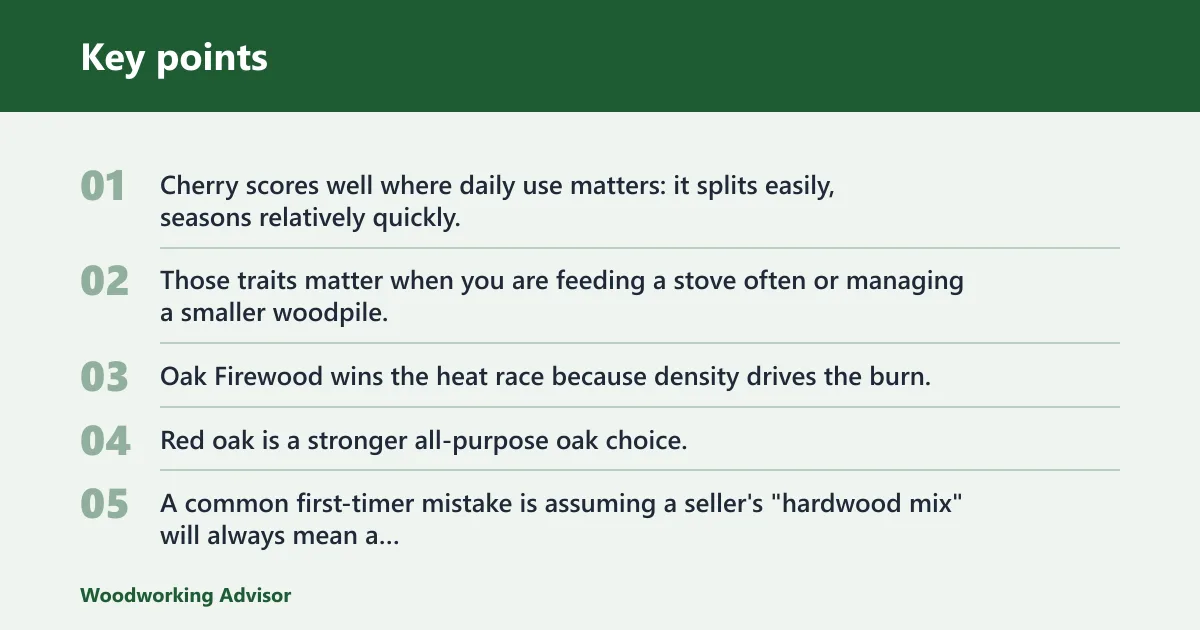
Cherry scores well where daily use matters: it splits easily, seasons relatively quickly, and is simpler to move, stack, and light. Those traits matter when you are feeding a stove often or managing a smaller woodpile.
Why the table favors oak for heat jobs
Oak Firewood wins the heat race because density drives the burn. Red oak is a stronger all-purpose oak choice, while white oak is the best fit when you want the highest heat and longest burn of the group.
A common first-timer mistake is assuming a seller’s “hardwood mix” will always mean a clean split of cherry and oak logs. If the pile is mostly oak with a few Cherry pieces, the burn will behave like oak; if the pile is mostly Cherry with a few oak pieces, the load lights faster but will not hold heat as long.
Choose Cherry if… / Choose Oak Firewood if…
Choose Cherry if you want easier handling, faster seasoning, and a cleaner, milder indoor burn. Choose Oak Firewood if you want longer overnight heat, a stronger coal bed, and fewer reloads. The better pick is the one that matches the burn cycle you actually need.
Choose Cherry if you want easier handling and shorter burns
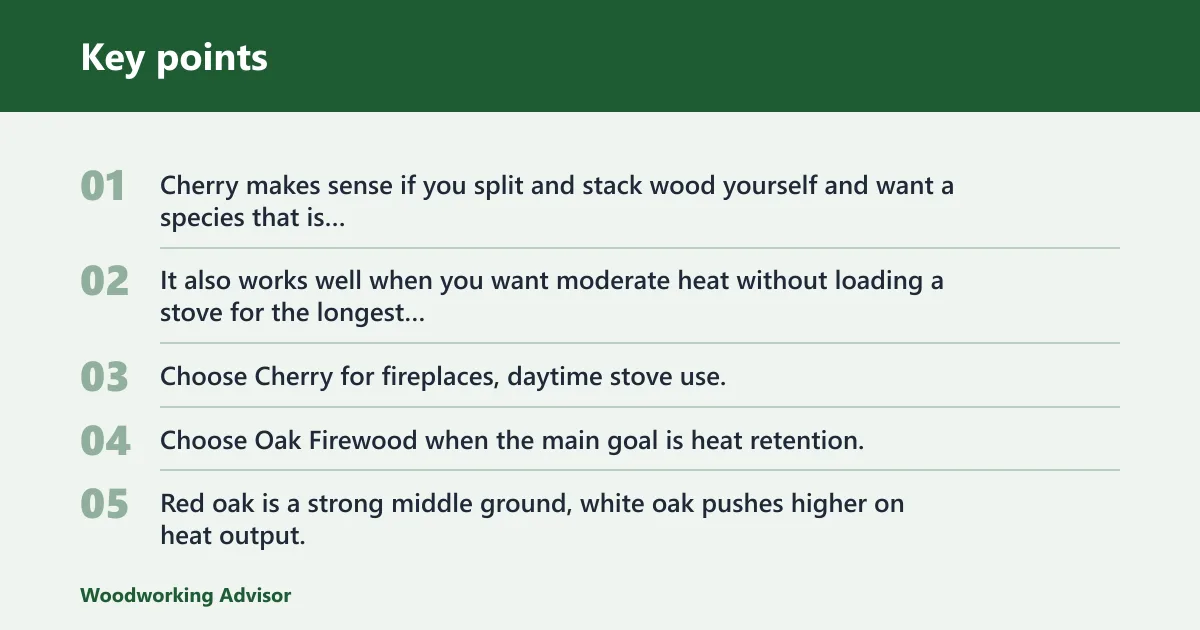
Cherry makes sense if you split and stack wood yourself and want a species that is easier to process. It also works well when you want moderate heat without loading a stove for the longest possible burn.
Choose Cherry for fireplaces, daytime stove use, or mixed loads where faster ignition and a lighter split matter more than maximum heat.
Choose Oak Firewood if you want longer overnight heat and a stronger coal bed
Choose Oak Firewood when the main goal is heat retention. Red oak is a strong middle ground, white oak pushes higher on heat output, and both are better than Cherry when your stove must coast through the night.
Choose oak for overnight burns, cold-weather heating, and long cooks where a stable coal bed matters more than quick light-up.
When a mixed load makes sense
Mixed loads solve a practical problem: oak gives the base, and Cherry helps the fire catch faster or adds a lighter aroma at the start. That works well in stoves that need a dependable coal bed but also benefit from easier ignition.
Picture a 2-cubic-foot stove on a cold evening. Start with oak splits for the base, add a few Cherry pieces on top, and you get a load that lights more easily than all-oak while still holding heat better than all-Cherry.
Is cherry wood good for firewood?
Yes. Cherry is good firewood when it is properly seasoned, especially if you want easy splitting, moderate heat, low smoke, and a pleasant indoor smell. It is not the longest-burning option, but it is far from a poor choice for stoves and fireplaces.
When cherry works well in a stove or fireplace
Cherry works well for regular indoor burning when the wood is dry and the stove is drafted properly. It is also a solid fit for smaller loads, shoulder-season fires, and homes that do not need the longest possible burn.
If you want a balanced wood rather than a maximum-heat wood, Cherry fits that role well. Its coal bed is useful, and its lighter splits can simplify daily fire building.
When cherry is better kept for smoking or lumber value
Cherry is also popular for smoking meat because it gives a mild, sweet smoke and can help produce mahogany color. That makes it a useful secondary crop, not only a firewood stack.
When logs are straight and clear enough for lumber, cutting them into firewood can give up more value than necessary. Good cherry logs may be worth sorting before they are bucked for the stove.
Frequently asked questions
Red oak vs cherry firewood
Red oak beats Cherry on heat and burn duration. Cherry is easier to split and seasons faster, but red oak usually delivers more BTUs, a stronger coal bed, and a better overnight burn. If you need faster handling and moderate heat, Cherry fits; if you want longer heat, red oak is the stronger pick.
Oak vs cherry vs hickory firewood
Cherry is the easiest of the three to handle and gives a milder burn. Oak usually gives the longest heat and strongest coal bed, while hickory is often used when high heat and strong flavor are both wanted. For pure home heating, oak usually leads; for easier splitting and a lighter burn, Cherry is simpler.
Cherry wood vs oak wood
Cherry wood burns cleaner and is easier to split, but Oak Firewood lasts longer and gives more heat per cord. Cherry suits shorter, easier loads and mild indoor aroma. Oak suits overnight burns, larger stoves, and colder weather when fewer reloads matter more than quick light-up.
Is cherry wood good firewood?
Yes, Cherry is good firewood when it is seasoned to below 20 percent moisture. It gives moderate heat, low smoke when dry, and a useful coal bed. It is especially attractive for fireplace use, smaller stove loads, and owners who want easier splitting than many dense hardwoods.
Is oak harder than cherry?
Yes. Oak is denser than Cherry, and that density is one reason it burns longer and gives more BTUs per cord. Cherry generally splits more easily, while oak often takes more effort at the splitter or with a maul, especially in larger rounds or knottier pieces.
Cherry or oak which is better
Neither is universally better. Cherry is better if you want easier handling, quicker seasoning, and a milder indoor burn. Oak Firewood is better if your real goal is longer heat retention, a stronger coal bed, and fewer reloads. The best choice depends on whether you value convenience or burn time more.
Sponsored / affiliate links. As an Amazon Associate I earn from qualifying purchases. I may earn additional commission from eligible campaigns.