Mahogany Wood Properties: Species, Hardness & How to ID Real Mahogany
“Mahogany” is one of the most loosely used names in the lumber trade. Genuine mahogany (genus Swietenia) has a Janka hardness of about 900 lbf and moves less with humidity than its look-alikes, but the board you actually find at a lumberyard is often African mahogany (Khaya) or even an unrelated Southeast Asian wood sold as “Philippine mahogany.” This guide compares the real numbers side by side, shows where the species differ in ways that matter, and explains how to tell what you are buying.
Definition
Mahogany strictly means wood from the genus Swietenia (family Meliaceae), with Honduran mahogany (S. macrophylla) and Cuban mahogany (S. mahogani) being the species that matter commercially. Both are listed under CITES Appendix II. “African mahogany” (Khaya) is a related but separate genus, and “Philippine mahogany” is not related at all.
What Counts as Mahogany Wood?
Best Wood ID Loupe Pick |
|
 |
10x Triplet LED Loupe with Leather Pouch A pocket loupe is the cheapest way to check end grain and texture before you pay mahogany prices, which is the identification step this guide walks through.
|
As an Amazon Associate we earn from qualifying purchases.
Botanically, only Swietenia trees produce genuine mahogany. Honduran (big-leaf) mahogany grows from southern Mexico into central South America and is also grown on plantations, which is why it is the version you can still buy. Cuban mahogany (Swietenia mahogani) comes from southern Florida and the Caribbean, but the Wood Database notes it is no longer commercially available in meaningful quantities, so it is rare and expensive when it turns up, usually as reclaimed or antique stock.
That leaves three common impostors on the market, and each one is a different story:
- African mahogany (Khaya ivorensis, K. anthotheca and relatives): a close botanical cousin, the most common substitute, and a legitimate furniture wood in its own right.
- Spanish cedar (Cedrela odorata): also in the mahogany family (Meliaceae) but not a true cedar. It is much lighter and softer, and it is the wood behind cigar boxes. See our cedar wood types guide for how it compares with true cedars.
- Philippine mahogany: a trade name covering many Shorea species such as the red meranti and balau groups. The Wood Database is blunt that it bears no relation to true mahogany.
Mahogany Properties by Species
Here are the published figures for the four woods people most often mean when they say mahogany. All values are from the Wood Database; shrinkage is measured from green to oven-dry.
| Property | Honduran (Swietenia macrophylla) | Cuban (S. mahogani) | African (Khaya spp.) | Spanish cedar (Cedrela odorata) |
|---|---|---|---|---|
| Janka hardness | 900 lbf | 930 lbf | 850 lbf | 600 lbf |
| Density (12% MC) | 590 kg/m3 | 600 kg/m3 | 545 kg/m3 | 470 kg/m3 |
| Bending strength (MOR) | 11,710 psi | 10,790 psi | 11,730 psi | 10,260 psi |
| Stiffness (MOE) | 1,458,000 psi | 1,351,000 psi | 1,410,000 psi | 1,323,000 psi |
| Tangential shrinkage | 4.3% | 4.6% | 5.7% | 6.2% |
| Volumetric shrinkage | 7.5% | 8.0% | 9.3% | 10.2% |
| Texture | Medium, uniform | Medium, uniform | Medium to coarse | Fuzzy without sharp cutters |
| Conservation status | CITES II, IUCN endangered | CITES II, IUCN endangered | CITES II, IUCN vulnerable | CITES II, IUCN vulnerable |
What the numbers actually say
Two things stand out that most mahogany guides gloss over. First, African mahogany is not meaningfully softer or weaker. Its 850 lbf Janka rating is only about 6% below Honduran, and its bending strength (11,730 psi) is essentially identical to Honduran (11,710 psi). If you read that Khaya is “much softer,” the table says otherwise. Our mahogany hardness breakdown goes deeper on the Janka side, and the density by species page covers weight.
Second, the real difference is movement. Khaya shrinks 5.7% tangentially against 4.3% for Honduran, which is about a third more. Volumetric shrinkage is roughly 24% higher (9.3% against 7.5%), and Spanish cedar is around 36% higher still (10.2%). To make that concrete, if a 12-inch-wide flat-sawn board went through the full green-to-dry range, the width change would be about 0.52 inch in Honduran, 0.68 inch in African and 0.74 inch in Spanish cedar. Real seasonal swings in a heated house are a small fraction of that, but the ratio holds: for wide tabletops, doors and boat trim, Honduran stays flatter.
A third, quieter myth: mahogany is a medium-hard wood, not a hard one. At 900 lbf it sits well below red oak, and a dropped pan will dent it. It earned its reputation for workability and stability, not for toughness.
How to Identify Real Mahogany
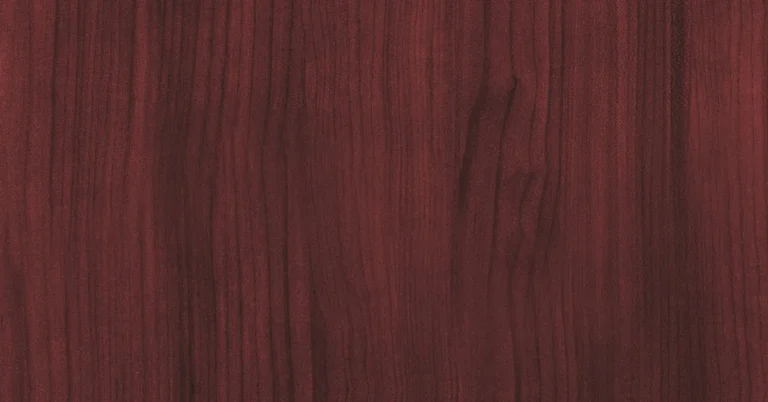
Color alone will not tell you. Both Honduran and African heartwood run from pale pink to deep reddish brown and darken with age, and both show chatoyancy, a shimmering light-and-dark effect as you tilt the board. These checks work better:
- Ask for the botanical name, not the trade name. “Mahogany” on an invoice with no Latin name could be Swietenia, Khaya or Shorea. A reputable dealer will state it.
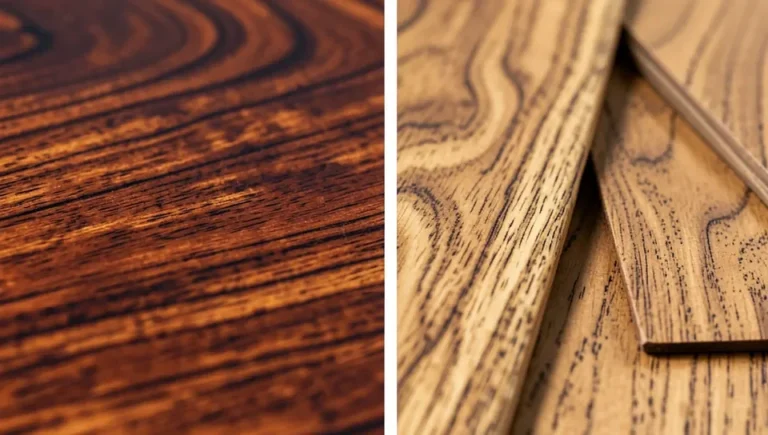
- Look at texture. Honduran has a medium, uniform texture. Khaya reads as medium to coarse, so the surface looks a little more open, particularly after planing.
- Check the weight. A dry Honduran board runs around 590 kg/m3, African closer to 545 kg/m3. A kitchen scale and a measured board will separate 590 from 470 (Spanish cedar) easily, though not 590 from 545.
- Smell it. Spanish cedar has a distinct, lingering cedar scent that genuine mahogany lacks.
- Be suspicious of a low price. Honduran is priced mid-range and above African mahogany. A bargain “mahogany” is probably not Swietenia.
- Magnify the end grain. A 10x loupe shows pore size and grain structure on a freshly cut surface far better than the naked eye.
Is “Philippine mahogany” the same thing?
No. It is a marketing name for Shorea lumber, so its properties vary by group and it does not follow the mahogany numbers above. It can look similar from a distance, but it is a different wood with different working and finishing behavior. Treat it as its own species, and do not substitute it into a project specified for genuine or African mahogany.
Working Mahogany: Tools, Tearout and Dust
Honduran mahogany is typically very easy to work with both hand and machine tools, and it sands readily. The exception is figured stock: wavy or interlocked grain, which makes mahogany so attractive, is also what causes tearout on a planer or jointer. Take light passes, keep knives sharp, and use a card scraper rather than aggressive sanding on figured boards. Spanish cedar, by contrast, can leave fuzzy surfaces unless the cutters are sharp, and its natural gum pockets can complicate finishing.
Safety note: the Wood Database lists Honduran mahogany as a sensitizer that can cause eye, skin and respiratory irritation, and less commonly asthma-like symptoms. Use dust collection and a respirator when sanding or machining it, and wear gloves if you notice skin reactions.
For finishing, mahogany takes oil, shellac and varnish well. If the piece is going outdoors, the finish matters far more than the species, so read our dedicated guide to finishing mahogany for outdoor use, and see how to darken wood furniture with wax if you want a deeper tone indoors.
Durability, CITES Status and Sourcing
Honduran and Cuban heartwood are rated moderately to very durable and resist termites, though both can be vulnerable to other insects. African mahogany is rated moderately durable, with moderate-to-poor insect resistance, and Spanish cedar ranges from durable to moderately durable with good termite resistance.
On conservation, Honduran mahogany is CITES Appendix II and IUCN endangered. Cuban mahogany carries the same listings, and the Wood Database cites a population reduction of over 50% across three generations. Appendix II means international trade is regulated rather than banned, so legal lumber usually arrives with documentation. Practical choices for a woodworker:
- Buy from dealers who can state the species, country of origin and whether the stock is plantation-grown.
- Consider reclaimed mahogany from old furniture or architectural salvage, which avoids new harvest.
- Consider African mahogany as a lower-cost option, but note that it is also CITES Appendix II listed, and Spanish cedar is vulnerable on the IUCN list, so none of the look-alikes is a free pass.
Which Mahogany for Which Project?
- Fine furniture and cabinetry: Honduran, for stability and uniform texture across wide panels.
- Guitar bodies and necks: mahogany is a classic tonewood. See is mahogany good for guitars for tone and weight.
- Budget furniture and millwork: African mahogany, with extra attention to acclimation because it moves more.
- Choosing between look-alikes: our mahogany vs sapele comparison covers another common substitute.
- Lining boxes and drawers: Spanish cedar, for its scent and light weight.
Frequently Asked Questions
What are the key properties of mahogany wood?
Genuine Honduran mahogany has a Janka hardness of about 900 lbf, a density of about 590 kg/m3, low tangential shrinkage of 4.3%, a straight to interlocked grain, and a very workable medium texture. It is moderately to very durable.
Is African mahogany the same as real mahogany?
No. African mahogany is the genus Khaya, while real mahogany is the genus Swietenia. Hardness (850 vs 900 lbf) and bending strength are very close, but Khaya has a coarser texture and shrinks more (5.7% tangential vs 4.3%).
How hard is mahogany wood?
Honduran mahogany measures 900 lbf on the Janka scale, Cuban mahogany 930 lbf and African mahogany 850 lbf. That is medium hardness, softer than red oak.
Is mahogany endangered?
Honduran and Cuban mahogany are both CITES Appendix II and listed as endangered on the IUCN Red List. Honduran is also grown on plantations, and Cuban mahogany is no longer commercially available in meaningful quantities.
Is Philippine mahogany real mahogany?
No. Philippine mahogany is a trade name for Shorea species such as meranti and balau. It is not related to Swietenia or Khaya.
Conclusion
Mahogany is a medium-hard, stable, easy-to-work wood, and the useful way to compare the “mahoganies” is by botanical name and movement rather than by color or by the word on the invoice. Honduran gives you the flattest, most uniform stock. African mahogany is a close match in hardness and strength but moves about a third more. Spanish cedar and Philippine mahogany are different woods entirely. Check the species, handle the dust safely, and pick the finish for the job.
Sponsored / affiliate links. As an Amazon Associate I earn from qualifying purchases. I may earn additional commission from eligible campaigns.