PureBond vs Columbia Forest Products Plywood Review
Purebond is Columbia Forest Products’ no-added-formaldehyde hardwood plywood line; choose it when adhesive chemistry and indoor-air paperwork matter most, then match veneer species, core, and certification to the job. Columbia Forest Products Plywood can include hardwood plywood builds that use different core types and glue systems. This comparison comes down to project fit, not brand names.
| Decision factor | Purebond | Columbia Forest Products Plywood | Winner |
|---|---|---|---|
| Indoor-air priority | No-added-formaldehyde adhesive system; best when project specs call for that chemistry | Depends on the exact build and adhesive system; not every Columbia hardwood plywood spec is the same | Purebond |
| Core choice | Available within Columbia’s plywood lineup, but the core still has to be specified | Broader set of core options, including veneer core, MDF core, particleboard core, and pMDI composite cores | Columbia Forest Products Plywood |
| Painted finish quality | Good when the face grade and core are matched to painted work; edge sealing still matters | Can be better when you choose an MDF core or another flatter panel build for paint | Columbia Forest Products Plywood |
| Cabinet and millwork fit | Strong fit for cabinets, furniture carcasses, and low-VOC interiors | Strong fit when you need a different core, a different price point, or a different face-grade target | Tie |
| Certification paperwork | Can support TSCA Title VI / CARB ATCM documentation and project-level green building submittals | May also meet emissions and chain-of-custody needs if the exact SKU carries them | Tie |
Purebond vs Columbia plywood: the real trade-off
Purebond is a Columbia Forest Products plywood specification, not a separate company. The real choice is whether you need Columbia’s no-added-formaldehyde adhesive system, or whether another Columbia hardwood plywood build gives you a better core, finish surface, or budget match.
That matters because hardwood plywood is not one thing. For cabinetry, furniture, architectural millwork, and commercial interiors, the panel’s adhesive, core, and face grade affect emissions, machining, screw holding, edge sealing, and paint behavior.
When adhesive chemistry matters more than brand name
Choose Purebond when the project spec calls for no-added-formaldehyde adhesive coverage and you need a Columbia option built around that requirement. Choose another Columbia hardwood plywood spec when the bigger issue is panel flatness, a smoother paint surface, or a different core construction that better fits the job.
Say your client wants a vanity carcass in a guest bath and the submittal package asks for low-emission materials. Purebond fits that brief well, but you still need the right face grade and edge treatment, because the finish system and room moisture will affect the result.
Which Columbia plywood spec should you buy?
This table is the quickest way to separate project needs from marketing language. The best choice changes with indoor-air priority, core type, and how visible the edges will be after fabrication.
| Project type | Indoor-air priority | Core type | Certification need | Edge-finish risk | Recommended choice |
|---|---|---|---|---|---|
| Cabinet boxes | High | Veneer core or pMDI composite core | TSCA Title VI / CARB ATCM, plus project paperwork if required | Medium | Purebond |
| Painted built-ins | Medium to high | MDF core when paint smoothness matters most | LEED documentation support if the job is green-building driven | High | Columbia Forest Products Plywood |
| Furniture carcasses | High | Veneer core for screw holding and stiffness | TSCA Title VI / CARB ATCM | Medium | Purebond |
| Architectural millwork | Medium | Veneer core or MDF core, depending on finish plan | Chain-of-custody or FSC Mix if the spec asks for it | Medium to high | Columbia Forest Products Plywood |
| Shop fixtures and jigs | Low | Particleboard core for cost control, or veneer core for screw retention | Usually none beyond general emissions compliance | Low | Columbia Forest Products Plywood |
| Low-VOC interiors | Very high | Veneer core or pMDI composite core | TSCA Title VI / CARB ATCM and third-party documentation | Medium | Purebond |
What is PureBond, and how is it different?
Purebond is Columbia Forest Products’ no-added-formaldehyde adhesive system for hardwood plywood. It uses soy, PVA white glue, and pMDI components, and Columbia places it in ANSI HP-1 voluntary plywood grades. The point is not a different company; the point is a different adhesive path inside Columbia’s plywood lineup.
No-added-formaldehyde adhesive system
Purebond is described as a formaldehyde-free assembly process in the sense that it avoids added formaldehyde in the adhesive system. That is the claim buyers should rely on, because it is more precise than saying every finished panel has zero formaldehyde in every condition.
That distinction matters for submittals and for the real world. The panel is only one part of the assembly; site adhesives, edge treatments, sealers, and finishes can affect the final indoor-air picture.
Soy, PVA white glue, and pMDI components
Columbia describes Purebond as using soy, white glue, and pMDI in manufacturing. Ecohome also describes it as soy-based technology. For buyers, the practical takeaway is that the adhesive system is built to avoid added formaldehyde while still serving cabinetry and furniture applications.
Purebond technology has been in place since 2006, and Columbia says over 200 million panels have been manufactured and placed in service. That long run matters because it shows the system is not experimental, but it does not remove the need to specify the right core and face grade.
Introduced in 2006 and used in ANSI HP-1 grades
The same source says Purebond is used in ANSI HP-1 voluntary plywood grades. It is also described as TSCA Title VI and CARB compliant, which places it in the composite wood emissions framework that many cabinet and millwork jobs now ask for.
If you need paperwork, ask for the exact SKU, emissions documentation, and the chain-of-custody or FSC statement only if the purchase order calls for it. Do not assume every Columbia panel in the warehouse carries the same paperwork.
How Columbia Forest Products builds and supports its plywood
Columbia Forest Products is an employee-owned hardwood plywood and veneer manufacturer founded in 1957. It operates seven networked plants across the U.S. and Canada, and Columbia markets hardwood plywood for cabinetry, fine furniture, and architectural millwork. (Wikipedia)
North American manufacturing footprint
Panels made in Canada and the United States can help simplify sourcing for North American jobs, especially when the spec calls for domestic or regional manufacturing. The practical value is also logistical: fewer unknowns when you need repeatable panel supply for a cabinet run or millwork package.
Customer support and specification guidance
Columbia’s support matters because the decision is rarely just “Purebond or not.” You still need to choose the face species, core, thickness, and certification path, and the supplier can help align those details with cabinet, furniture, or commercial-interior requirements.
Which core type fits your project?
Core choice often decides whether a panel feels right in the shop. Veneer core, MDF core, particleboard core, and pMDI composite cores each change stiffness, screw holding, weight, and surface behavior.
Veneer core for stiffness and screw holding
Veneer core is the usual pick when you need better screw retention and a more traditional plywood feel. It is a common fit for cabinet boxes and furniture carcasses, especially when you expect hardware to be driven into the edge.
A common first-timer mistake is choosing a panel for its low-emission claim and ignoring the core. A veneered sheet can still move, telegraph, or chip at the edge if the build does not match the job.
MDF core for flatter paint surfaces
MDF core can be the better choice for painted built-ins and other finish-heavy work because it helps reduce surface telegraphing and gives you a more uniform substrate. The trade-off is that edges need more care, and screw holding is different from veneer core.
Particleboard core and pMDI composite cores
Particleboard core can make sense where cost matters and the panel will be heavily covered or framed. pMDI composite cores may be chosen when a specific balance of stability, emissions profile, and fabrication behavior is needed.
For any of these cores, moisture sensitivity still matters. If the panel will see damp rooms, unsealed edges, or repeated humidity swings, you need to treat it as a substrate that must be protected, not as a waterproof material.
Do the indoor-air claims hold up?
Purebond’s indoor-air story is strongest when you treat it as a no-added-formaldehyde adhesive system that also carries emissions compliance claims. The same source describes it as TSCA Title VI and CARB compliant, and it says the panels are certified by Capital Testing and Certification Services, TPC-08.
TSCA Title VI and CARB ATCM compliance
Those programs are the right place to start if your buyer, architect, or inspector is checking composite wood emissions compliance. Compliance is useful, but it is not the same thing as a finished room being low-emitting in every respect.
Third-party testing and audits
Third-party testing and audits matter because they give the buyer something to file. If a project manager, cabinet shop, or GC needs proof, ask for the emissions certificate, the product data sheet, and the exact invoice description that matches the submittal.
What to request from the seller
- Ask for the exact Columbia SKU, not just “Purebond.”
- Confirm the core type: veneer core, MDF core, particleboard core, or pMDI composite core.
- Request TSCA Title VI / CARB ATCM documentation for the shipment.
- Ask whether FSC Mix is available for that order and whether chain-of-custody documentation follows the delivery.
- Check whether the panel is intended for cabinets, millwork, or painted furniture, since face grade affects the result.
Where PureBond makes the most sense
Purebond is the strongest fit when you want Columbia hardwood plywood with no-added-formaldehyde adhesive coverage and a clear compliance paper trail. It is a practical choice for cabinets, furniture carcasses, painted built-ins, architectural millwork, shop fixtures, and low-VOC interiors.
Cabinet boxes and furniture carcasses
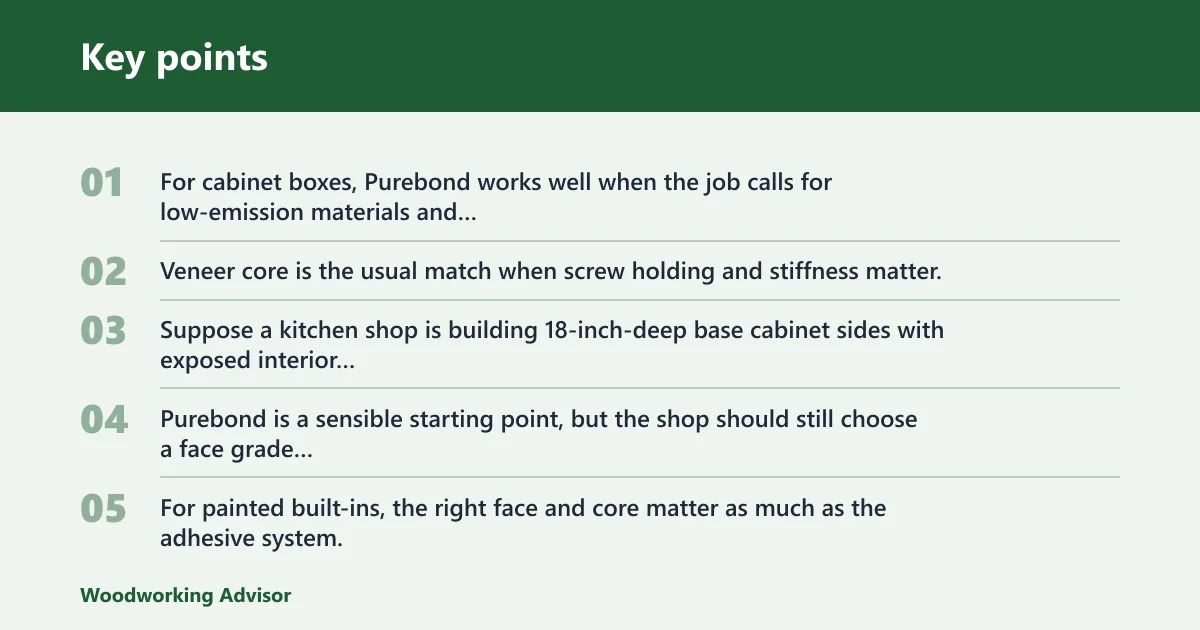
For cabinet boxes, Purebond works well when the job calls for low-emission materials and you still want the supply chain and support of a major domestic manufacturer. Veneer core is the usual match when screw holding and stiffness matter.
Suppose a kitchen shop is building 18-inch-deep base cabinet sides with exposed interior ends and a homeowner asks for low-VOC materials. Purebond is a sensible starting point, but the shop should still choose a face grade that sands and edges cleanly.
Painted built-ins and architectural millwork
For painted built-ins, the right face and core matter as much as the adhesive system. If the visible surfaces need a very smooth finish, another Columbia plywood build with an MDF core may fit better than a veneer-core Purebond panel.
Shop fixtures and low-VOC interiors
For shop fixtures, jigs, and temporary built-ins, cost and core behavior often outrank adhesive chemistry. For low-VOC interiors, the chemistry moves back to the front, and Purebond becomes more attractive because it aligns with the no-added-formaldehyde specification goal.
Choose Purebond if… / Choose Columbia Forest Products Plywood if…
Choose Purebond if you need no-added-formaldehyde adhesive coverage, want TSCA Title VI / CARB ATCM documentation on a Columbia hardwood plywood order, or are building cabinet boxes, furniture carcasses, or low-VOC interiors where the adhesive spec is part of the contract.
Choose Columbia Forest Products Plywood if the job is driven more by core type, paint performance, face-grade selection, or cost. It is often the better pick for painted built-ins, shop fixtures, or any project where an MDF core, particleboard core, or another Columbia build gives you a better fit than Purebond alone.
If you are comparing sheet prices, compare the exact SKU, core, face species, and certification line on the invoice. The value per sheet can shift fast when one panel has a better paint surface or a paper trail the other does not.
Frequently asked questions
Is PureBond better than Columbia Forest Products plywood?
Not by default. Purebond is better when you need Columbia’s no-added-formaldehyde adhesive system and the project values indoor-air documentation. Another Columbia hardwood plywood spec can be better when core type, paint surface, or cost matters more than adhesive chemistry.
What is the difference between PureBond and Columbia Forest Products plywood?
Purebond is a Columbia adhesive specification within the Columbia Forest Products plywood lineup. Columbia Forest Products Plywood is the broader set of hardwood plywood builds, which can differ by core, face grade, and certification. The difference is specification detail, not manufacturer identity.
Is PureBond plywood formaldehyde free?
It is safer to call it no-added-formaldehyde rather than absolute formaldehyde-free. The same source describes Purebond as a formaldehyde-free assembly process and says it uses soy, white glue, and pMDI components. The finished project still depends on adhesives, finishes, and other materials used during installation.
Is Columbia Forest Products plywood good for cabinets?
Yes, especially when you choose the right core and face grade. Columbia markets hardwood plywood for cabinetry, and Purebond is a strong fit for cabinet boxes when low-emission adhesive chemistry matters. Veneer core is usually the first core to consider for screw holding and stiffness.
Which plywood is better for indoor furniture and millwork?
Purebond is often the better starting point for indoor furniture when low-emission adhesive coverage is part of the spec. For millwork, the answer depends on the finish plan: MDF core may be better for painted work, while veneer core can be better for structural stability and joinery.
Does Columbia Forest Products make FSC certified plywood?
Yes, but not every sheet is FSC certified. The same source says FSC Mix is available upon request, and distribution can be chain-of-custody certified. Ask for the exact FSC statement on the order, because certification depends on the SKU and the supplied paperwork.
Where can I buy PureBond plywood?
Buy it through Columbia Forest Products dealers, lumberyards, and distributors that stock the exact panel build you need. Before ordering, confirm the face species, core type, thickness, and emissions paperwork. If your project needs FSC or project-level documentation, request that on the quote and invoice.
Sponsored / affiliate links. As an Amazon Associate I earn from qualifying purchases. I may earn additional commission from eligible campaigns.
 Baltic Birch Plywood 1/8'' x 12'' x 18'', 6 Pack, B/BB Grade, Void-Free Core, Laser Cutting Ready, Flat Sheets for CNC, Engraving, DIY Crafts, Art Painting, Wood Burning, Staining
 Baltic Birch Plywood Sheets Box of 45 - Laser Engraving Cutting, Scroll Saw Nature Veneer Color, Stronger Than Basswood, A/A Grade,12 x 12 x 1/8”, 3mm Thickness Perfect for Wood Burning