What Is 19/32 Plywood? Actual vs. Nominal Thickness
19/32 plywood is a Performance Category, the structural panel size sold as "5/8-inch," and it measures 0.563 to 0.625 inch thick when unsanded under PS 1-22. A "5/8" category panel is a separate size that measures 0.594 to 0.656 inch, so the label alone does not tell you the real thickness. This guide covers the thickness table, 40/20 span rating, nailing schedule and how to measure your own sheet.
Why “5/8-Inch” Plywood Isn’t Actually 5/8 Inch
Best Plywood Thickness Check Pick
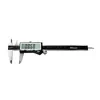 |
iGaging IP54 Electronic Digital Caliper (0-6 inch), $37.99 The caliper reads inches, millimeters or fractions down to 1/128″, so you can check whether a “19/32″ sheet really measures near 0.594” before you cut a dado or buy fasteners.
|
As an Amazon Associate we earn from qualifying purchases.
The common explanation is that sanding shaves a little off a 5/8-inch panel, leaving 19/32. That is only part of the story, and for most subfloor and roof sheathing it is wrong, because those C-D panels are not sanded at all. The standard that governs structural plywood, the U.S. Department of Commerce’s Voluntary Product Standard PS 1-22 (administered by NIST), labels panels by Performance Category. It defines the category as a designation tied to a thickness range that is linked to the nominal sizes used in the International Building Code and International Residential Code.
In other words, 19/32 is not 5/8 minus a sanding loss. It is the name of a thickness window. 19/32 inch is 0.59375 inch, and PS 1-22 allows unsanded panels a tolerance of 1/32 inch either way, which gives a window of 0.563 to 0.625 inch. The top of that window is exactly 5/8 inch, so a panel labeled 19/32 can legitimately measure a full 5/8. Sanded panels are held tighter, to 1/64 inch either way, or 0.578 to 0.609 inch.
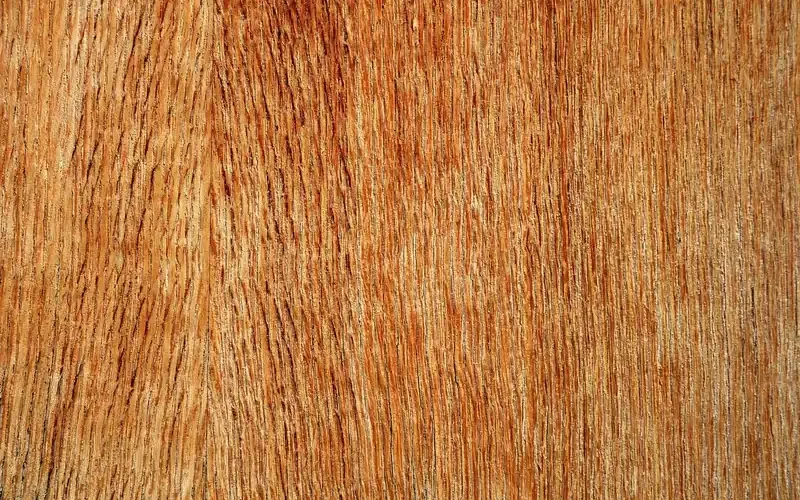
A 19/32 Performance Category panel measures 0.563 to 0.625 inch (14.29 to 15.88 mm) unsanded, and 0.578 to 0.609 inch sanded. Source: NIST, Voluntary Product Standard PS 1-22, Table 10 (2023)
Metric sizes land in the same window. A 15 mm panel is 0.591 inch, which falls inside the unsanded 19/32 range, while 18 mm (0.709 inch) falls in the 23/32 range. That is arithmetic from the standard’s table, not a code-approved substitution, so confirm with your inspector before swapping metric panels into a structural job.
Nominal vs. Actual Thickness, Side by Side
Here is the thickness table from PS 1-22. The last column is the label the standard recommends manufacturers print on unsanded panels, which is where the decimal number on a stamp comes from.
| Performance Category | Unsanded (in) | Sanded (in) | Recommended unsanded label |
|---|---|---|---|
| 3/8 | 0.344 to 0.406 | 0.359 to 0.391 | .354 in |
| 15/32 | 0.438 to 0.500 | 0.453 to 0.484 | .451 in |
| 1/2 | 0.469 to 0.531 | 0.484 to 0.516 | .483 in |
| 19/32 | 0.563 to 0.625 | 0.578 to 0.609 | .578 in |
| 5/8 | 0.594 to 0.656 | 0.609 to 0.641 | .609 in |
| 23/32 | 0.688 to 0.750 | 0.703 to 0.734 | .703 in |
| 3/4 | 0.719 to 0.781 | 0.734 to 0.766 | .734 in |
Two things stand out. First, the 19/32 and 5/8 windows overlap between 0.594 and 0.625 inch, so you cannot tell which category a panel belongs to from a caliper reading alone; the stamp has to say. Second, the recommended label for an unsanded 19/32 panel is .578 inch, about 1/64 inch under the 19/32 fraction itself. We cover how to read the rest of the stamp in our guide to what APA Rated plywood means.
The full veneer-grade tables and bond classes behind these numbers are in our DOC PS 1 plywood guide, so we will not repeat them here.
19/32 vs 1/2, 5/8 and 3/4 Plywood: Which Do You Need?
Searchers often ask how 19/32 compares with the neighboring sizes. Using the unsanded windows above: a 19/32 panel is at least 0.032 inch thicker than the thickest 1/2-category panel (0.563 versus 0.531), so the step up from 1/2 is real. Against 23/32, the thinnest 23/32 panel (0.688) is at least 0.063 inch thicker than the thickest 19/32 panel (0.625). Against 5/8, the two overlap, so treat them as the same trade size unless a span rating or code table calls out one category.
The number that matters in practice is the span rating stamped beside the category. APA’s Rated Sheathing table pairs each category with the farthest apart its supports can sit:
| Span rating | Performance Category | Max roof span, edge support (in) | Max roof span, no edge support (in) | Floor joist spacing (in) |
|---|---|---|---|---|
| 24/0 | 3/8 | 24 | 19.2 | not rated |
| 32/16 | 15/32 | 32 | 28 | 16 |
| 40/20 | 19/32 | 40 | 32 | 20 (19.2 actual) |
| 48/24 | 23/32 | 48 | 36 | 24 |
These figures come from the APA Engineered Wood Construction Guide, Form E30, roof excerpt (Rated Sheathing, Exposure 1 or Exterior), and from the standard’s definition that a span rating of 20 is designated for 19.2-inch spans. They are recommended maximums, and your local building code sets the actual allowed span. If you are deciding whether a thinner panel can work overhead, see our guide to using 1/2 plywood on a roof, and for a head-to-head of the two sizes sold as 5/8 and 3/4, see 5/8 vs 3/4 plywood.
Where 19/32″ Plywood Is Actually Used
19/32 panels show up most often as subflooring and single-floor sheathing (often tongue-and-groove), and as roof or wall sheathing. APA’s floor guide lists 19/32 as the minimum Performance Category for rated sheathing or Sturd-I-Floor over joists spaced 16 inches on center, and it lists a Sturd-I-Floor 20 oc panel as 19/32. For the ceramic tile assemblies it shows, it also calls for a minimum 19/32 panel at 16-inch joists and 23/32 at 19.2 inches, so a tile job on wider joist spacing needs the thicker panel.
Span rating depends on the engineered layup, not just thickness, which is also why APA notes that panels in the same category can be made in more than one span rating. Read the stamp rather than assuming from the fraction. When a floor has to carry tile or a 3/4-inch hardwood layer, step up to 23/32 where the table says so; our 3/4 plywood price guide covers what that thicker panel costs.
Why the Fraction Matters When Buying Fasteners and Trim
If you are matching an existing floor height, setting a threshold flush to a panel edge or cutting a dado for a shelf, the actual dimension decides the fit, not the label on the price tag. PS 1-22 requires the Performance Category and the thickness in thousandths of an inch to be marked on the panel, so look for that decimal figure on the stamp first.
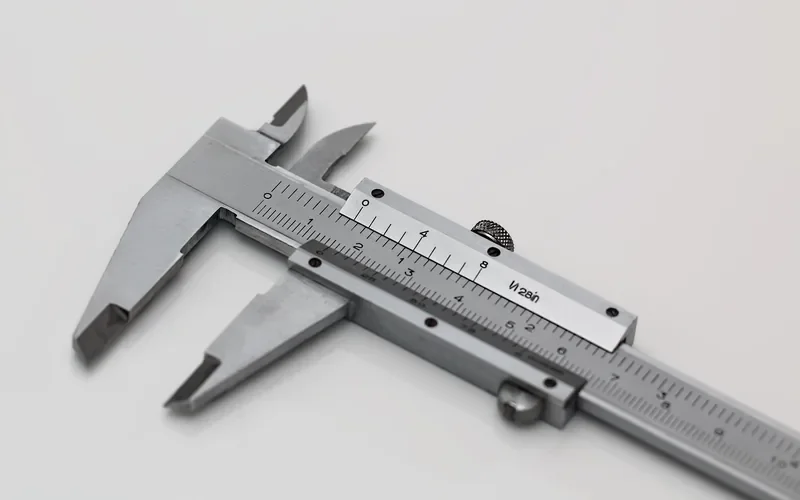
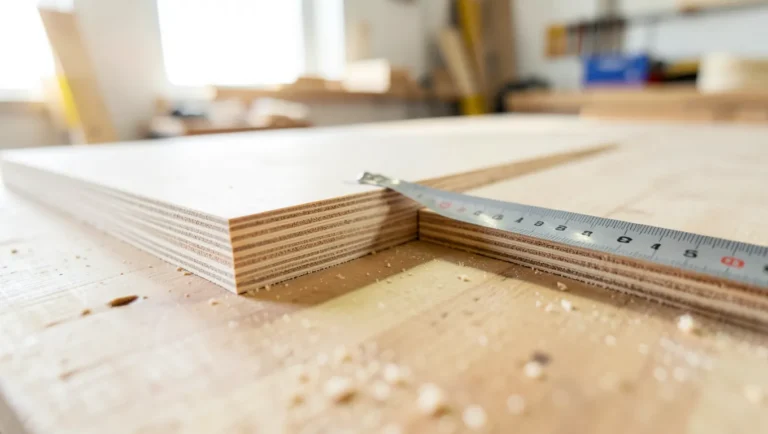
PS 1-22 itself measures thickness at four points: mid-length, within about 2 inches of each long edge, with the average taken as the panel’s thickness. You can copy that routine at home. Take two readings per long edge, away from the corners, average them, and compare the result to the table above. A reading of 0.60 inch is a normal 19/32 or 5/8 panel; a reading of 0.55 inch is under the 19/32 minimum and worth a conversation with the yard.
Do that check at pickup, especially for fit-sensitive work. Our guide on whether Home Depot will cut plywood for you is worth a read before you buy full sheets, and for sheet dimensions and metric sizes see standard plywood sizes.
Does OSB Follow the Same Sizing Rule?
OSB sheathing is also sold by Performance Category, so a 19/32 OSB panel and a 19/32 plywood panel are nominally the same size and can carry the same 40/20 span rating. The difference is the standard on the stamp: plywood is made to PS 1, while span-rated sheathing of either material is commonly made to PS 2, a performance standard covering both plywood and OSB.
Because span rating comes from tested strength and stiffness rather than a fixed recipe, do not assume two 19/32 panels of different materials are interchangeable in every detail. Check that each stamp shows the same category and span rating, then measure both before mixing them in one floor. Our CDX plywood vs OSB comparison covers how the two behave once they are installed.
How Many Plies Are in 19/32 Plywood?
The ply count depends on the grade. PS 1-22 sets minimum constructions: C-D, C-D Plugged, D-D and C-C panels through the 5/8 category need at least 3 plies in 3 layers, while underlayment and C-C Plugged single-floor panels over 1/2 inch through 3/4 inch need at least 4 plies in 3 layers. For 19/32 and 5/8 panels in 3-, 4- and 5-ply, 3-layer builds of those grades, face and back veneers must be at least 1/8 inch thick.
Those are minimums. A thicker-veneer 3-ply panel and a thinner-veneer 5-ply panel can share a stamp, so count the layers on the edge if ply count matters for your project, such as edge screws or a visible edge on a shelf.
Fastener Length for 19/32″ Subfloor
APA’s floor guide gives a specific schedule for 19/32 and 5/8 subfloor panels, and it is more precise than a rule of thumb:
| Detail | APA recommendation for 19/32 and 5/8 floor panels |
|---|---|
| Nail type | 6d ring-shank or screw-shank nail (or other code-approved fastener) |
| Spacing at panel edges | 6 in |
| Spacing at intermediate supports | 12 in |
| Glue | Construction adhesive meeting APA AFG-01 or ASTM D3498 on the joists (glue-nailed floor) |
| Edge and end gaps | 1/8 in between all end joints and edges, including tongue-and-groove |
A 6d nail is about 2 inches long, so through a 19/32 panel (0.594 inch) it leaves roughly 1.4 inches in the joist. Check your local code and the fastener maker’s data if you use screws or a different nail, since the required schedule can change with the fastener and the application.
The gap matters as much as the nail. PS 1-22 lets a panel marked Sized for Spacing come up to 1/8 inch short of its stated length and width, which builds in part of that expansion gap, so use a spacer to keep the 1/8 inch rather than pushing sheets tight against each other.
Frequently Asked Questions
Is 19/32 plywood the same as 5/8 plywood?
For shopping, usually yes: 19/32 panels are the ones sold as “5/8-inch.” Technically, PS 1-22 lists 19/32 and 5/8 as two separate Performance Categories. A 19/32 panel measures 0.563 to 0.625 inch unsanded, while a 5/8 category panel measures 0.594 to 0.656 inch, so the ranges overlap but are not identical.
Why isn’t plywood the exact thickness printed on the label?
Structural panels are sold by Performance Category, a thickness range linked to the nominal sizes in the building codes, not a single exact dimension. PS 1-22 allows unsanded panels a tolerance of plus or minus 1/32 inch and sanded panels plus or minus 1/64 inch around the category, so the label is a trade name and the decimal thickness stamped on the panel is the real number.
What is 19/32 plywood used for?
Most commonly subfloor and single-floor sheathing, plus roof and wall sheathing. In APA’s tables a 19/32 Rated Sheathing panel carries a 40/20 span rating, which allows up to 40 inches between roof supports with edge support or about 20 inches between floor joists. Always read the span rating on the stamp and check your local code.
How thick is 19/32 plywood in mm?
A 19/32 inch panel is nominally 15.08 mm (0.594 inch). PS 1-22 allows 14.29 to 15.88 mm for unsanded panels and 14.68 to 15.48 mm for sanded panels, so a real sheet can land anywhere in that range.
How many plies are in 19/32 plywood?
It depends on the grade. PS 1-22 requires at least 3 plies in 3 layers for C-D and C-C panels up to the 5/8 category, and at least 4 plies in 3 layers for single-floor underlayment panels in the 19/32 category. Count the veneer layers on the edge of your sheet, since many panels use more than the minimum.
Is 19/32 plywood strong enough for a subfloor?
Yes, at the right joist spacing. APA’s floor guide lists 19/32 as the minimum Performance Category for rated sheathing or Sturd-I-Floor over joists 16 inches on center, and a 40/20 panel is rated for floor spans up to 20 inches (19.2 inches actual). For the tile assemblies APA shows over 19.2-inch joists, it calls for 23/32 instead.
Bottom Line
19/32 plywood is not an odd size and not a defect. It is the Performance Category sold as 5/8-inch, with an unsanded window of 0.563 to 0.625 inch and a usual 40/20 span rating. Shop by the category and span rating, then measure the actual sheet whenever a fit, a fastener length or a flush edge depends on it.
Sponsored / affiliate links. As an Amazon Associate I earn from qualifying purchases. I may earn additional commission from eligible campaigns.