Small Curved Decking Ideas That Transform Any Outdoor Space
Dreaming of a deck that feels special? You might think decks need lots of room. But even small yards can have amazing curved decks.
These designs add charm and a cozy feel. They make your outdoor space feel bigger and more inviting. Let’s explore how to make a small curved deck work wonders for you.
A small curved deck can make a big impact on your outdoor living area. It adds beauty, flow, and a unique touch to any yard. Even with limited space, smart design can create a functional and stylish deck that feels custom-built.
Understanding Small Curved Deck Design
A curved deck is one with a rounded edge. It’s not a straight line. This shape makes your outdoor area feel softer.
It breaks up sharp corners. For small spaces, this is super helpful. It can make a tiny yard feel more open.
It also guides people around the deck smoothly. Think of it like a gentle wave.
Why choose curves? They add visual interest. Straight lines can feel boxy.
Curves feel more natural. They blend better with plants and garden beds. This is key for small yards.
You want everything to feel harmonious. A small curved deck does just that. It becomes a gentle focal point.
The shape also affects how you use the space. A curved edge can create a natural seating area. Or it can lead guests towards a garden path.
It’s more than just looks. It’s about how the space flows. For a small yard, good flow is everything.
It makes the area feel much larger than it is.
Building a curved deck can be a bit more work than a straight one. The wood needs to be bent or cut in special ways. This means you might need a skilled builder.
But the result is totally worth it. It’s a feature that stands out. It shows you’ve put thought into your outdoor oasis.
When planning, think about the overall style of your home. Do you have modern lines? Or is it more of a cottage feel?
A curved deck can fit both. For modern homes, a sleek, minimalist curve works well. For older homes, a gentler, more organic curve can match the charm.
Another thing to consider is scale. A small yard needs a deck that fits. You don’t want it to overwhelm the space.
A compact curved deck is perfect. It gives you that outdoor living area without taking over. It’s about balance.
You want it to feel like part of the yard, not an addition.

My Own Small Deck Adventure
I remember staring at my tiny backyard. It felt like a postage stamp. I wanted a place to sit outside.
I loved the idea of a deck. But every design I saw was for huge yards. I felt stuck.
Then, I saw a picture of a small curved deck. It was just a gentle sweep of wood.
My heart leaped. This could work! I called a contractor.
I showed him the picture. He was a bit hesitant. He said curves in small spaces can be tricky.
But he saw my vision. We worked together. We sketched out a design.
It was a simple half-moon shape.
It extended just enough from the house for two chairs and a small table. The edge gently swept outwards. It didn’t feel bulky at all.
It actually made the yard feel more interesting. The contractor said bending the wood was the hardest part. He had to steam it carefully.
When it was done, I was thrilled. It was exactly what I hoped for. It was my little outdoor nook.
I’d put my morning coffee out there. Or read a book in the evening. It felt so peaceful.
The curve made it feel special. It was my little secret garden spot. It proved that size doesn’t matter as much as smart design.
Key Curved Deck Benefits for Small Yards
Enhanced Aesthetics: Curves add visual softness and elegance.
Improved Flow: Natural pathways reduce cramped feelings.
Space Maximization: Curves can feel larger than their actual size.
Unique Charm: A distinctive feature for your home.
Better Integration: Melds well with landscaping.
Materials Matter for Curves
Choosing the right materials is vital. For curved decks, some materials work better than others. Wood is a classic choice.
It can be bent or cut to shape. It gives a warm, natural look. But some woods are more flexible than others.
Pressure-treated pine is common. It’s affordable and durable. It can be steamed and bent.
Cedar and redwood are also good options. They look beautiful and resist rot and insects. They can be more expensive.
But their natural beauty is hard to beat for a special feature like a curved deck.
Composite decking is another option. It’s made from wood fibers and plastic. It’s very low maintenance.
It doesn’t need staining or sealing. Some composite materials can be heated and bent into curves. Check with the manufacturer.
Not all composites are flexible enough for tight curves.
Another way to achieve a curve is by using many small, straight pieces. These are cut at slight angles. When put together, they form a curve.
This technique works with most decking materials. It’s called “kerfing” or “laminating.” It can be a bit more labor-intensive.
Think about the color and finish too. A lighter color can make a small deck feel bigger. A dark color can feel more intimate and cozy.
For a curved deck, you want something that complements your home and garden. Natural wood tones are always a safe bet. But you could also go for a painted finish.
Consider the joists and framing underneath. These also need to follow the curve. This is where good planning and a skilled builder are essential.
They need to ensure the structure is sound and safe, no matter the shape.
Material Quick Scan for Curved Decks
Wood (Pine, Cedar, Redwood): Bendable with steam/heat. Natural look. Requires maintenance.
Composite Decking: Low maintenance. Some types are bendable or can be shaped. Check flexibility.
PVC Decking: Durable, low maintenance. Often rigid, harder to curve without special techniques.
Tile/Pavers: Can be laid on a curved base. Offers a patio-like feel.
Small Deck Shapes and Layouts
The curve itself can take many forms. A simple arc is popular. It’s a smooth, gentle bend.
This is great for wrapping around a corner or edge of a patio.
A more dramatic sweep is also possible. This can feel like a wave. It’s more eye-catching.
It’s best for yards with a bit more width, even if the deck is small. It creates a dynamic look.
Consider a semi-circle. This offers a nice, rounded seating area. It’s perfect if you want to place a small round table or a couple of chairs.
It feels very inviting.
What about an oval shape? This is like a stretched semi-circle. It can offer more linear space along the curve.
This might be good if you want to fit a small grill or a bench.
Think about where the deck meets the house. Does it come straight out? Or does it have a curve right at the doorway?
A curved entry can feel very elegant. It’s a subtle detail that makes a big difference.
Also, consider how the deck relates to the rest of your yard. Does it connect to a garden path? Does it lead to a specific feature, like a small water garden?
The curve can act as a natural transition.
For a really small yard, a deck that’s just a gentle quarter-circle might be enough. It can tuck into a corner. It provides a dedicated spot to relax without taking up too much space.
It feels like a built-in feature.
Shape Ideas for Tiny Decks
Gentle Arc: A simple, smooth curve. Works anywhere.
Dramatic Sweep: A more pronounced, flowing curve. Adds flair.
Semi-Circle: Creates a cozy, rounded seating zone.
Quarter-Circle: Perfect for tucking into corners.
Custom Organic: Unique, free-flowing shapes that mimic nature.
Integrating Small Curved Decks with Landscaping
This is where small curved decks truly shine. They blend so well with plants. A curved edge naturally mirrors the shape of garden beds.
This creates a seamless look. Your deck feels like it grew out of the garden.
Imagine a deck with a gentle outward curve. Around that curve, you have low-growing flowers. Maybe some ornamental grasses.
This softens the deck’s edge. It makes the whole area feel more lush. It hides the structural elements of the deck too.
You can also use plants to guide people to or from the deck. A small pathway lined with hostas could lead to your curved deck. Or a small rose bush could mark the entrance.
Think about lighting. Small uplights placed in nearby plants can illuminate the curve at night. This adds a magical touch.
It makes the deck a destination, even after dark.
Vertical elements can also enhance the design. A small trellis with climbing vines placed near the deck can add height. It creates a sense of enclosure.
It makes the small space feel more intimate.
Consider planters. Placing a few attractive planters on or around the deck can add color and life. You can choose planters that echo the curve of the deck.
Or you can use them to break up the lines.
The goal is to make the deck feel like a natural extension of your yard. It shouldn’t look like an add-on. The curves help this connection.
They make the transition from grass or soil to wood feel very smooth.
Even small trees can be integrated. If you have a lovely small tree in your yard, you could design the deck to wrap gently around it. This creates a beautiful focal point.
It’s a way to incorporate nature directly into your deck space.
Landscaping Synergy Tips
Mimic Curves: Use plants to echo the deck’s shape.
Guide the Eye: Plants can lead guests to the deck.
Create Enclosure: Use taller plants or trellises near the deck.
Add Softness: Low-growing flowers and grasses soften edges.
Incorporate Trees: Design around existing small trees if possible.
Adding Seating and Furniture
Furnishing a small curved deck requires thoughtful choices. You want furniture that fits the scale. Bulky pieces will overwhelm the space.
This is where the curve can actually help.
Built-in seating is a fantastic option for small curved decks. You can have a bench built right into the curve of the deck. This saves space.
It also looks very cohesive. A custom-built curved bench can be a real showstopper.
If you prefer movable furniture, choose smaller items. A bistro set is perfect. It has a small table and two chairs.
It fits neatly into the curve. Look for chairs with slender profiles. Avoid chairs with wide arms.
Round tables also work well on curved decks. They follow the flow of the deck. A small coffee table can be placed in front of a bench.
Or you can have a couple of small side tables for drinks.
Consider multi-functional furniture. Ottomans that can serve as extra seating or a footrest are great. Storage benches are also useful.
They give you a place to keep cushions or gardening tools.
Think about the arrangement. Place furniture so it doesn’t block the flow. You want to be able to walk around it easily.
On a curved deck, you can arrange chairs to face a particular view. Or you can have them facing each other for conversation.
Don’t forget decorative touches. Cushions and throw pillows add comfort and color. A small outdoor rug can define the seating area.
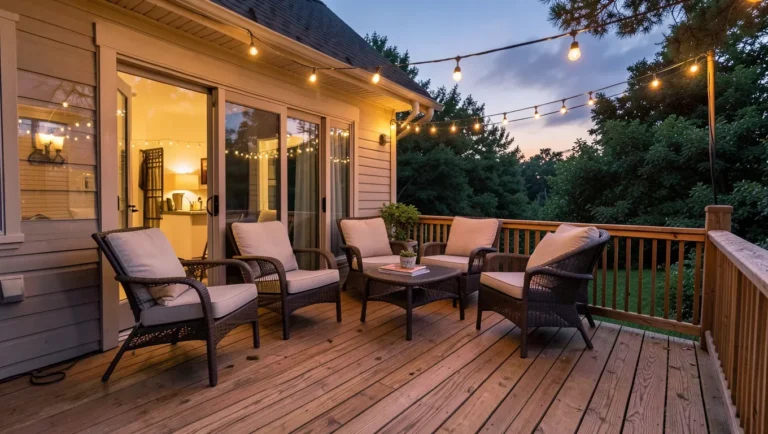
String lights hung above can create a cozy atmosphere at night.
For very limited space, you might only have room for two comfortable chairs. This is perfectly fine! The goal is to create a usable, enjoyable outdoor space.
Even a small deck can offer a moment of peace and relaxation.
Furniture Selection Guide
Built-in Benches: Space-saving and integrated look.
Bistro Sets: Compact table and chairs for two.
Round Tables: Complement the deck’s curve.
Slender Chairs: Avoid bulky designs.
Multi-functional Items: Ottomans, storage benches.
Lighting Your Small Curved Deck
Good lighting is key for making a small deck feel inviting. It extends its use into the evening. It also adds safety and ambiance.
For curved decks, lighting can highlight the beautiful shape.
LED strip lights are excellent for curved edges. You can install them along the underside of the deck railing. Or you can run them along the curved edge of the deck itself.
This creates a soft glow that outlines the curve. It looks very sophisticated.
Post cap lights are another good choice. These fit on top of the deck posts. They provide a downward light.
They illuminate the deck surface. They can be solar-powered or hardwired.
Downlights can be installed in overhead structures, if you have them. These point downwards. They create pools of light.
They are good for task lighting, like for a small grill or table.
Uplighting from nearby plants can highlight landscaping around the deck. This draws the eye outwards. It makes the whole outdoor area feel larger.
Consider string lights or fairy lights. These can be draped above the deck. They create a magical, festive atmosphere.
They are easy to install. They are perfect for adding a touch of charm.
Think about dimmers. Dimmers allow you to control the light level. You can set a bright light for entertaining.
Or a soft, dim light for a quiet evening. This adds versatility to your deck space.
Safety lighting is also important. Make sure pathways to and from the deck are lit. This prevents trips and falls.
Especially if you have steps leading up to the deck.
For a small deck, you don’t need a lot of lights. A few well-placed fixtures can make a big difference. The goal is to create a warm, welcoming glow.
It should enhance the deck’s beauty and usability.
Smart Lighting Strategies
Edge Lighting: LED strips define the curve.
Post Cap Lights: Illuminate the deck surface.
Uplighting: Highlight surrounding plants.
String Lights: Add ambiance and charm.
Dimmers: Control light intensity.
What This Means For You
Having a small curved deck can change how you feel about your yard. It gives you a dedicated outdoor space. Even if it’s just for one or two people.
It’s a place to escape. It’s a place to connect with nature.
When is a small curved deck normal? It’s normal when it fits your yard. It’s normal when it enhances your outdoor living.
It’s normal when it feels like a natural part of your home. It doesn’t have to be huge to be functional.
When should you worry? You should worry if the deck feels unsafe. Or if it’s too big for your yard.
It shouldn’t make your yard feel cramped. It should add to its appeal. If the building process seemed rushed or done poorly, that’s a worry too.
Simple checks: Look at the deck’s surface. Are the boards level? Is the railing sturdy?
Walk around the edges. Do you feel secure? If you hired a professional, ask for their plans.
Make sure they followed building codes.
For small yards, a curved design is often a very smart choice. It avoids the harshness of straight lines. It creates a softer, more inviting atmosphere.
It can make your yard feel more expansive. It’s a design element that offers both beauty and function.
So, don’t let a small yard discourage you. A well-designed small curved deck can be the highlight of your home. It’s an investment in your outdoor enjoyment.
It’s a way to bring more beauty and usability to your everyday life.
Quick Tips for Your Small Curved Deck
Think about the radius of your curve. A tighter curve is harder to build. A gentler curve is easier and often looks more elegant in small spaces.
Consider railings. For a small curved deck, a simple cable railing can feel less imposing. Glass panels also work well.
They don’t block views. They keep the space feeling open.
Maintenance is key. Whatever material you choose, follow the cleaning and care instructions. This will keep your curved deck looking beautiful for years.
Plan for drainage. Make sure water can run off the deck. This prevents pooling and keeps the wood healthy.
Your builder should ensure proper slope.
Don’t over-furnish. Less is more in small spaces. Choose a few key pieces that serve your needs.
Enjoy the process! Designing a curved deck is exciting. It’s a chance to create something truly unique.
It’s your personal outdoor sanctuary.

Frequently Asked Questions
Is a curved deck more expensive than a straight one?
Often, yes. Building curves requires more labor and special techniques to bend or cut materials. The complexity of the curve also plays a role.
However, for small decks, the difference might be less significant than for larger projects. The unique aesthetic can be well worth the extra cost.
Can I build a small curved deck myself?
Building a curved deck can be challenging for DIYers. It requires specific tools and knowledge of how to work with materials to create curves. Bending wood, for example, needs careful steaming and clamping.
If you’re new to deck building, it’s often best to hire a professional experienced with curved designs.
What is the best material for a small curved deck?
Wood like cedar or redwood can be steamed and bent into curves. Composite decking can also be shaped, but you must check specific product specifications for flexibility. Some builders use many small, angled boards to create a curve, which works with most decking materials.
The best choice depends on your budget, desired look, and maintenance preferences.
How do I make a small curved deck look bigger?
Use lighter-colored decking materials. Keep furniture to a minimum and choose slender, scaled-down pieces. Integrate landscaping around the edges to soften the deck’s boundaries and visually expand the space.
Consider lighting that washes upwards onto surrounding plants or outlines the deck’s edge for an expansive feel.
What kind of railing works best on a curved deck?
For small curved decks, styles that offer an unobstructed view are ideal. Cable railings or glass panel railings maintain an open feel and follow the curve smoothly. Simple wood balusters can also work, but ensure they are spaced appropriately and follow the deck’s contour.
Avoid bulky or solid railing systems that can make the space feel closed in.
How much space do I need for a small curved deck?
Even a small deck can be as little as 6-8 feet in its deepest point. The overall size depends on your yard and what you want to do with it. A semi-circular deck might extend 8 feet from the house and be 12 feet wide.
A gentle arc could be just 4-5 feet deep. The key is proportion to your yard.
Conclusion
Creating a beautiful outdoor space doesn’t always require a large yard. A small curved deck is a fantastic way to add elegance and function. It brings a unique charm.
It makes your outdoor area feel more inviting. With smart design and the right materials, your small yard can host a stunning deck.
},
},
},
},
},
}
]
}