System Three Rot Fix Epoxy Review
System Three RotFix is worth buying for dry, lightly decayed, non-structural wood that still has enough body to consolidate. It is not a cure-all for rot, and it does not replace missing structure, stop active fungus by itself, or rescue saturated timber.
Verdict on RotFix

RotFix makes sense when you need to harden punky wood before filling and painting. It is a low-viscosity penetrating epoxy, so it can soak into soft fibers and leave a firmer base for the next repair step. If the part is crumbling through its depth, keeps wetting back out, or has lost load-carrying strength, replacement is the better call.
That is the key split on this product. Use it as a consolidant for salvageable wood, not as a substitute for demolition when decay has already taken over. For trim, sills, fascia, and similar repairable parts, it can keep a small failure from becoming a larger one.
What RotFix does
RotFix is described as a very low-viscosity epoxy that can work as a penetrating wood sealer, primer, and consolidant. It is meant to soak into soft, punky wood substrates and firm them up before you add filler. The mix ratio is 2:1 by volume, and the working time is 5-10 minutes at 70°F.
Why does that matter? Thin epoxy reaches damaged fibers that thicker paste cannot. That gives you a more stable base for later shaping, sanding, and painting. RotFix also contains no solvents, and System Three says it can cure over damp wood, which broadens the situations where it can be used. That does not mean wet wood is ideal. It means the product is less fussy than many fillers, not immune to poor substrate conditions.
RotFix fit check
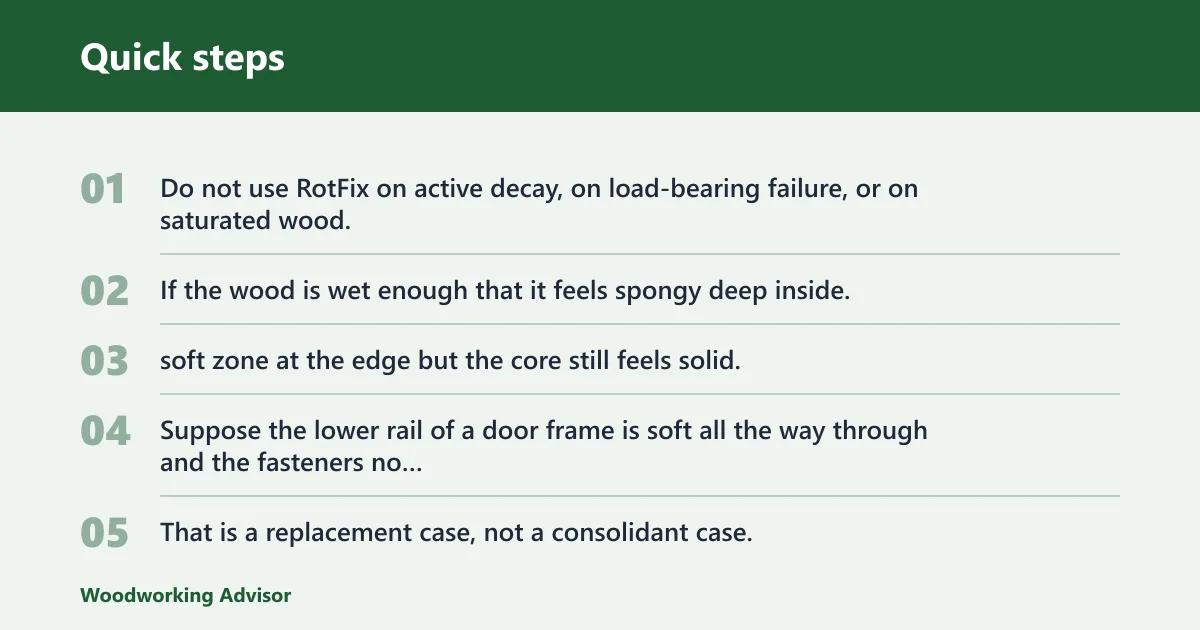
This table helps separate repairs that can be consolidated from repairs that should be replaced. The main questions are how deep the damage goes, how wet the wood is, and whether the part still has enough structure to hold fasteners and finish work.
| Defect depth | Wood moisture | Structural load | Expected filler volume | Recommended next step |
|---|---|---|---|---|
| Surface punkiness, less than 1/4 in. | Dry to slightly damp | Low | Small | RotFix alone |
| 1/4 in. to 1 in. soft area | Dry to slightly damp | Low to moderate | Moderate | RotFix + SculpWood Paste |
| Deep void with intact outer shell | Dry or only mildly damp | Moderate | Large | RotFix + SculpWood Putty |
| Decay through most of the section | Damp but stable | Moderate to high | Very large | Replace the part |
| Localized edge damage | Dry | Low | Small to moderate | RotFix alone or RotFix + SculpWood Paste |
Do not use RotFix on active decay, on load-bearing failure, or on saturated wood. If the wood is wet enough that it feels spongy deep inside, the repair is likely to fail later even if the surface looks hard after cure.
Say your exterior window sill has a 3/8 in. soft zone at the edge but the core still feels solid. That is a good RotFix case. Suppose the lower rail of a door frame is soft all the way through and the fasteners no longer hold. That is a replacement case, not a consolidant case.
How do you use RotFix on punky wood?
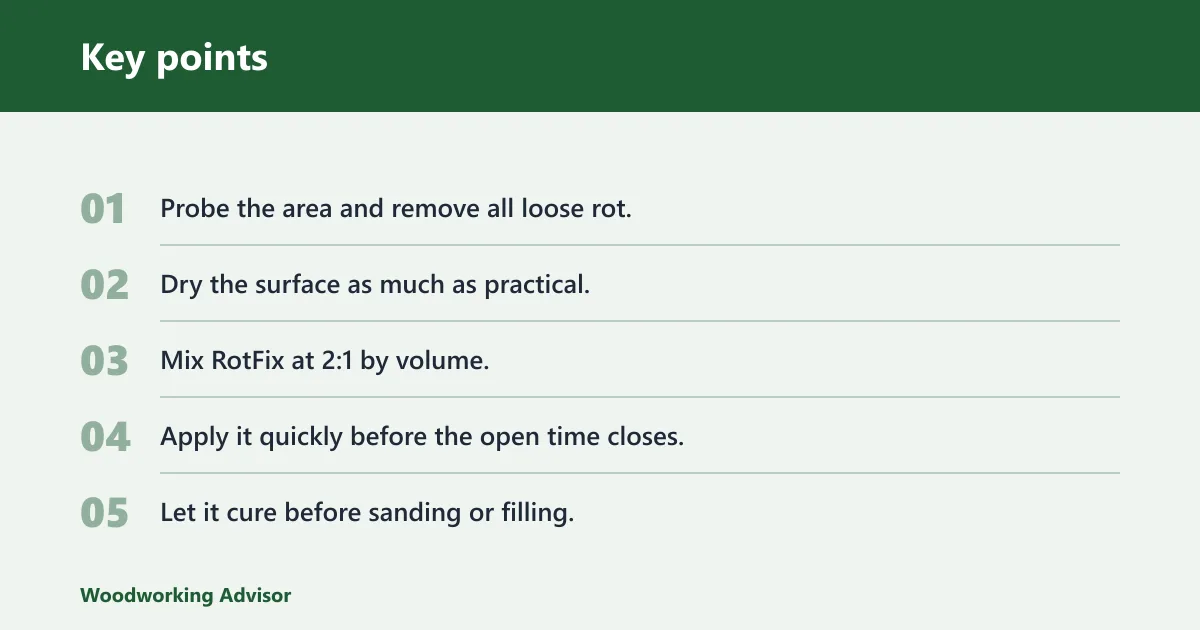
Start by removing loose rotten material and any fibers that no longer support the part. Then dry the area as much as practical, mix RotFix at 2:1 by volume, and apply it promptly within the 5-10 minute working time at 70°F. After cure, add SculpWood if the repair needs shape or volume.
For small repairs, brush or work the epoxy into exposed fibers until the wood stops drinking it in. For larger damage, apply in thin passes rather than trying to flood the entire void at once. If the repair needs a crisp edge or a fair surface, leave room for the filler step instead of trying to build shape with consolidant alone.
- Probe the area and remove all loose rot.
- Dry the surface as much as practical.
- Mix RotFix at 2:1 by volume.
- Apply it quickly before the open time closes.
- Let it cure before sanding or filling.
- Add SculpWood Putty or SculpWood Paste if the repair needs bulk or finish shaping.
A common first-timer mistake is to skip the loose material removal and expect the epoxy to glue rotten fibers back together. It will not restore wood that has already lost its internal strength.
How does RotFix compare with SculpWood?
RotFix and SculpWood solve different parts of the same repair. RotFix consolidates and seals damaged wood. SculpWood fills the missing volume after the substrate is firm enough to hold a patch. If you need strength first, start with RotFix. If you need shape, use SculpWood after consolidation.
RotFix versus SculpWood Putty
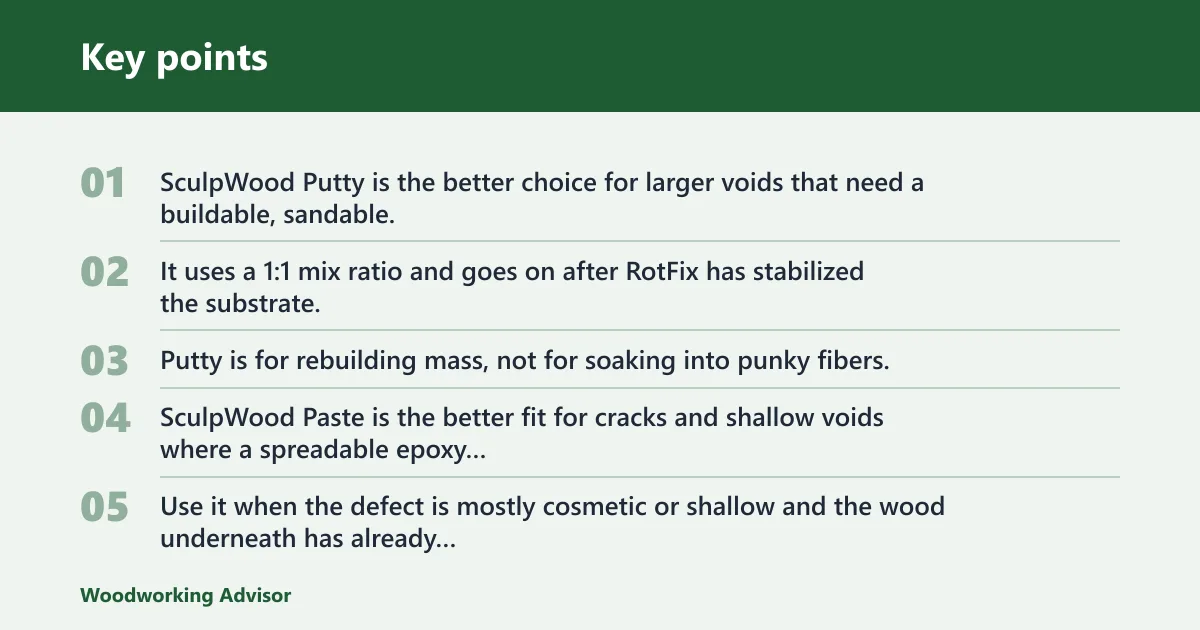
SculpWood Putty is the better choice for larger voids that need a buildable, sandable, paintable fill. It uses a 1:1 mix ratio and goes on after RotFix has stabilized the substrate. Putty is for rebuilding mass, not for soaking into punky fibers.
RotFix versus SculpWood Paste
SculpWood Paste is the better fit for cracks and shallow voids where a spreadable epoxy paste makes more sense than a deeper fill. It also uses about a 1:1 mix ratio. Use it when the defect is mostly cosmetic or shallow and the wood underneath has already been consolidated.
Which one fills, and which one strengthens?
RotFix strengthens the damaged wood itself. SculpWood products fill what is missing. That split matters because a thick filler can bridge a defect, but it cannot reliably restore weak fibers underneath. The strongest repair usually starts with consolidant and ends with the right filler.
Does RotFix work on damp wood?
Yes, System Three says RotFix can cure over damp wood. That is useful when you cannot get the area perfectly dry before repair. But damp is not the same as saturated. Moisture still affects bond quality, penetration, and the odds of long-term success, especially if the defect keeps taking on water.
Use that claim as a practical allowance, not a green light for wet rot. If the wood is still actively wet from a leak, trapped condensation, or repeated rain exposure, fix the moisture source first. Then let the substrate dry as much as the job allows before you decide whether consolidation is worth doing.
Picture a fascia board after a short rain. The surface is damp, but the core is still firm and the damage is shallow. That is within RotFix territory. Now picture the same board after weeks of seepage, with dark, soft wood several inches deep. That is a stop-and-reassess case.
Pros and cons
Pros
- Penetrates soft, punky wood instead of sitting only on the surface.
- Uses a 2:1 mix ratio by volume.
- Has a short 5-10 minute working time at 70°F, so you can move quickly.
- Can cure over damp wood.
- Fits well into a repair sequence with SculpWood filler.
Cons
- Does not kill rot fungus or stop it from coming back by itself.
- Not a solution for saturated wood.
- Too shallow a product for major section loss or load-bearing failure.
- Short working time leaves little room for slow mixing or long setup.
- Needs the right filler afterward if you want a finished profile.
The EndRot system parts
The EndRot System includes Board Defense, RotFix, SculpWood Putty, and SculpWood Paste. That matters because RotFix is only one step in the workflow. The system pairs a borate treatment with a consolidant and then two different fillers for rebuilding the damaged area.
Board Defense borate powder
Board Defense is the first-step treatment in the system and is described as borate powder for killing active rot fungus. It is the part meant to address the biological side of the problem before consolidation and filling.
RotFix consolidant
RotFix is the consolidant in the middle of the process. It firms up punky wood so the repair has a base strong enough for filler and finish work. It is recommended before SculpWood Putty or Paste in the repair process.
SculpWood Putty and paste
SculpWood Putty and SculpWood Paste finish the repair. Putty is for larger voids and is sandable and paintable after cure. Paste is for cracks and shallow voids where a spreadable epoxy paste is easier to tool. Both are 1:1 mix products used after RotFix.
Who it’s for
RotFix is for DIY wood repair shoppers who need to save trim, sill, fascia, or similar exterior parts that are soft but still repairable. It also suits anyone comparing consolidants and wanting a clear cutoff between repair and replacement. If you want a product that can save an edge, then be filled and painted, this is the right category.
It is not for wood that is structurally failed, deeply saturated, or actively breaking apart through its thickness. It is also not the best choice if you are looking for a single-step fix for ongoing moisture problems. In those cases, repair the source of water first or replace the part.
What size kits does RotFix come in?
RotFix is sold in multiple size options, including a measuring bottle option. System Three’s site lists prices from $3.95 to $209.95. Woodessence also lists kit sizes as 0.7 litre, 1.4 litre, and 5.6 litre, with a 1.5 pint kit shown at $69.00.
Frequently asked questions
Is System Three Rot Fix good for rotted wood repair?
Yes, but only for rotted wood that is still salvageable. RotFix is a good choice for dry or lightly damp, lightly decayed, non-structural wood that needs consolidation before filling. It is not the right answer for deep decay, saturated timber, or parts that have already lost structural strength.
How long does RotFix take to cure?
System Three gives RotFix a working time of 5-10 minutes at 70°F. That is the practical number to watch during mixing and application. Cure time depends on conditions and repair thickness, so the main planning point is to get it on quickly and move to filler only after the consolidant has set.
What is the mix ratio for system three rot fix?
The mix ratio is 2:1 by volume. That means you need to measure the two parts carefully before combining them. A measuring bottle helps reduce error, which matters because the product has a short working time and little margin for a redo once mixed.
Does RotFix kill rot fungus or stop rot from coming back?
No. System Three says RotFix does not kill rot fungus or keep it from returning. That is why the EndRot System includes Board Defense as a separate borate treatment. RotFix consolidates wood; it does not replace the biological control step or the need to fix the moisture source.
Can you paint over System Three Rot Fix?
Yes, after cure and proper surface prep. The final paint result depends on how well you remove loose fibers, fill the defect, and sand the repair smooth. RotFix is the base layer, not the final surface, so paintability depends on the whole repair sequence.
What is the difference between RotFix and SculpWood?
RotFix soaks into punky wood and hardens it. SculpWood Putty and SculpWood Paste fill missing material after the substrate is stable. In short, RotFix is for strength and SculpWood is for shape. Use both when the repair needs consolidation plus rebuild.
Sponsored / affiliate links. As an Amazon Associate I earn from qualifying purchases. I may earn additional commission from eligible campaigns.