Best Vacuum for Carpet and Wood Floors: 7 Compared (2026)
The Miele Classic C1 Pure Suction is the best all-around pick for a home with both carpet and wood floors because its 6-stage suction dial and switchable brush setting are made for exactly that transition — dial down for hardwood, dial up for rugs, without swapping heads. Below, 7 vacuums are compared by the one spec that actually matters for mixed flooring — how each one handles the carpet-to-wood transition — not suction numbers no two brands publish the same way.
Quick Answer
For most homes with both carpet and wood floors, a canister with a manual suction dial (Miele Classic C1) or a stick vacuum with automatic surface-sensing (Shark Stratos, Dyson V15 Detect) handles the transition best. Skip any vacuum with a single fixed-power bristle brush and no way to soften it for wood — that combination is what actually causes scratching, not suction alone.
Why a Mixed-Flooring Home Needs a Different Vacuum Than a Single-Surface Home
Most vacuum buying guides are written for one floor type — either “safe for hardwood” or “strong on carpet” — because most vacuum reviewers test in a single room. A home with both surfaces has a different problem entirely: the same machine has to be gentle enough not to scratch a wood finish and powerful enough to pull dirt out of carpet fiber, often in the same five-minute cleaning pass across a hallway, a rug, and a kitchen floor.
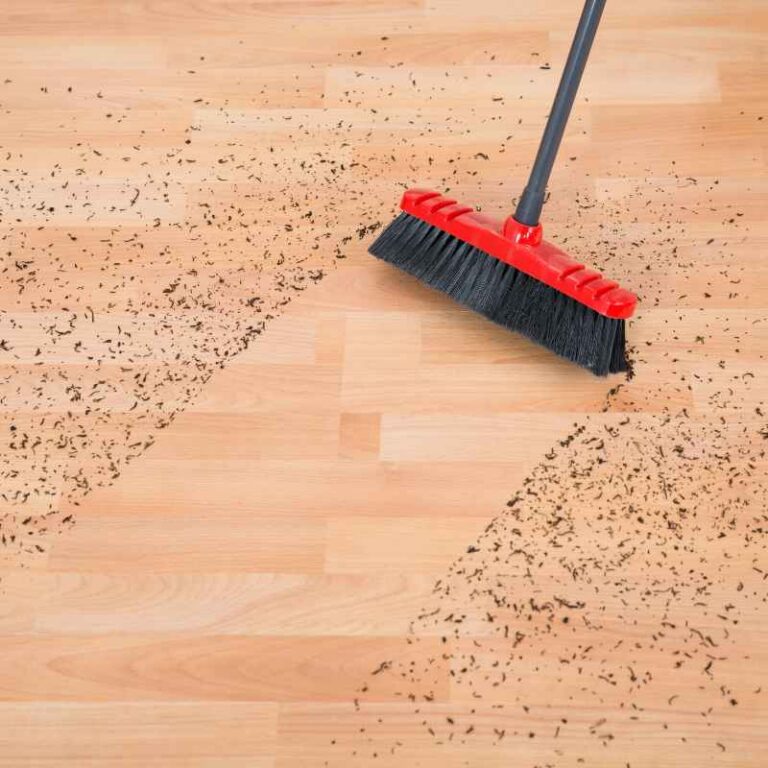
The two failure modes are opposite. On carpet, too little suction or too soft a brush leaves dirt embedded in the pile. On wood, too much suction or too aggressive a bristle brush drags grit across the finish like fine sandpaper and leaves faint swirl-mark scratching that shows up under raking light. A vacuum built for only one surface will get one of those two failure modes wrong on the other. That’s the actual buying decision behind a “carpet and wood floors” search, and it’s why the dataset below is built around the transition mechanism specifically, not just a single power rating.
The Dataset: How Each Vacuum Actually Handles the Carpet-to-Wood Transition
No manufacturer publishes a cross-brand comparison of this, so it was compiled here from each product’s own listing and spec sheet. Four real transition mechanisms exist on the market right now: a manual dial you switch by hand, an automatic sensor that reads the floor and adjusts power on its own, a manual attachment swap (switching to a parquet head), and a fixed multi-surface brush with no adjustment at all — the cheapest and least precise of the four.
| Vacuum | Format | Carpet→Wood Transition Method | Price | Weight | Filtration |
|---|---|---|---|---|---|
| Miele Classic C1 Pure Suction | Canister | Manual 6-stage dial | $316.00 | 12.0 lbs | AirClean 3-tier (not HEPA-branded) |
| Shark Stratos Cordless (IZ862H) | Cordless Stick | Automatic (Clean Sense IQ infrared sensor) | $349.99 | 8.9 lbs | Yes (Anti-Allergen Complete Seal, 99.9%) |
| Dyson V15 Detect | Cordless Stick | Automatic (piezo sensor, floor-type power adapt) | $515.99 | 6.8 lbs | Whole-machine filtration, 99.99% (not HEPA-branded) |
| SEBO Airbelt K3 | Canister | Manual attachment swap (ET-1 powerhead to parquet brush) | $949.00 | 12.0 lbs | S-Class filtration, 99.97% (not HEPA-branded) |
| Roborock Qrevo S5V | Robot | Automatic (LiDAR floor-mapping + auto mop-lift on carpet) | $499.98 | 25.6 lbs (incl. dock)* | Not specified |
| Bissell CleanView Swivel Pet | Upright | Fixed multi-surface brush (no auto-sensing) | $139.99 | 12.5 lbs | Not specified |
| Kenmore Intuition Bagged | Upright | Manual pod-detach + fixed dual-motor brush | $149.99 | 14.0 lbs | Yes (sealed system, 99.97%) |
*The Roborock Qrevo S5V’s 25.6 lb weight is the combined robot-plus-auto-empty-dock shipping weight, not the portable unit alone — robots aren’t carried room to room, so this isn’t comparable to the carry weight of the other formats. Suction (Pa/Air Watts) is deliberately not used as a table column: Miele, Bissell, SEBO and Kenmore don’t publish an absolute figure for these specific models, and the brands that do (Shark, Dyson, Roborock) each test it differently, so a mixed table would imply a false apples-to-apples comparison. Every price was live-checked against the Amazon Creators API at the time of writing; HEPA status reflects each listing’s own stated filtration claim, not an assumption based on brand reputation.
What It Actually Costs to Cover Both Surfaces
Across the seven picks in this comparison, prices range from $139.99 to $949.00. Splitting them by transition method shows the real price of automation: the three picks with true automatic surface-sensing (Shark, Dyson, Roborock) average $455.32, while the four picks that rely on a manual dial, a manual attachment swap, or a fixed brush (Miele, SEBO, Bissell, Kenmore) average $388.75. That’s roughly the actual dollar cost of not having to think about the transition yourself — useful to know before assuming an auto-sensing model is simply the “better” tier rather than a different tradeoff. Budget route: the Bissell CleanView or Kenmore Intuition, both under $150, with the fixed-brush compromise disclosed above as the real cost. No-compromise route: the Shark Stratos or Dyson V15 Detect, both with genuine automatic transition handling.
Best Vacuums for Carpet and Wood Floors
Each pick below is scored on how it actually handles the surface transition, not just raw cleaning power on one floor type. Prices and buy-box availability were live-checked against the Amazon Creators API.
1. Miele Classic C1 Pure Suction — #1 Best Overall
Award: #1 Best Overall | Price: $316.00 | Check Price on Amazon
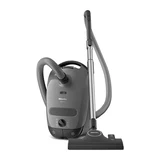
The Classic C1 Pure Suction is a bagged canister with a 6-stage rotary suction dial specifically built, per Miele’s own listing, for “hard floors and low pile carpeting” — the exact dual-surface use case this whole article is about. Dial it down for hardwood and the parquet-style combination floorhead glides without dragging grit; dial it up and the same head pulls debris out of a low-pile rug. It’s a manual system, not an automatic one, so it takes one extra second at the surface transition — but that manual control is also why it doesn’t second-guess itself on a rug with an unusual pile height the way some auto-sensing machines do.
- 6-stage manual suction dial
- SBD 365-3 combination floorhead + parquet brush
- 3-tier AirClean filtration system
- 12.0 lbs, 18.2″ L x 11.0″ W
Who it’s for: Best for someone who wants full manual control and doesn’t mind a one-second dial twist at the room transition — a household that vacuums deliberately room by room rather than in one continuous pass. Less ideal for someone who wants to hand the vacuum to a kid or a less detail-oriented family member and trust it to get the setting right without being told.
Main drawback: Bagged design means an ongoing cost per bag, and the dial requires a manual switch at every surface change — it won’t do it for you.
2. Shark Stratos Cordless (IZ862H) — Best for Auto Surface-Sensing
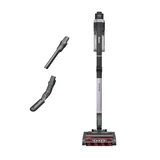
Award: Best for Auto Surface-Sensing | Price: $349.99 | Check Price on Amazon
The Stratos Cordless is the closest thing on this list to a true “set it and forget it” dual-surface vacuum. Its Clean Sense IQ infrared sensor reads the floor in real time and ramps power up automatically when it detects more debris — which in practice means it runs low-power over open hardwood and kicks up when it crosses onto a rug, with no dial to touch. The DuoClean PowerFins HairPro brush system pairs two rollers (a soft one for hard floors, a bristled one for carpet) in the same head rather than forcing one compromise brush to do both jobs.
- Clean Sense IQ automatic infrared sensing
- DuoClean PowerFins HairPro dual brushroll
- HEPA + Anti-Allergen Complete Seal, 99.9%
- Up to 60 min runtime, 8.9 lbs
Who it’s for: Best for a household that wants the power decision made automatically and doesn’t want to think about a dial or a head swap at all. Especially strong in a home where multiple people share vacuuming duty, since the sensor removes the step someone always forgets.
Main drawback: Runtime is rated to 60 minutes only in ECO mode at the hand-vacuum end; expect meaningfully less in Boost/auto-ramped power on a full-power carpet pass.
3. Dyson V15 Detect — Best Cordless for Pet Hair on Carpet + Wood
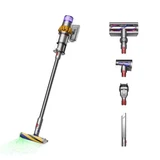
Award: Best Cordless for Pet Hair on Carpet + Wood | Price: $515.99 | Check Price on Amazon
Dyson’s own listing describes the V15 Detect as intelligently adapting “power based on debris detected and floor type,” using a piezo sensor in the cleaner head rather than an external optical sensor. The two included heads split the job explicitly: the Fluffy Optic head is built soft for hard floors, and the Digital Motorbar head is built aggressive for carpet and pet hair. That’s a more literal division of labor than a single auto-adjusting head, and it means the actual bristle contact — not just the suction level — changes with the surface.
- Piezo sensor floor-type detection
- 2 cleaner heads: Fluffy Optic (hard floor) + Digital Motorbar (carpet)
- Whole-machine filtration, 99.99% at 0.3 microns
- Up to 60 min runtime, 6.8 lbs, 2-year warranty
Who it’s for: Best for a pet-owning household that crosses between carpet and wood floors constantly and wants the single most capable cordless option regardless of price — the anti-tangle conical brush bar specifically targets long hair and pet hair, which is a common complaint on both carpet and wood.
Main drawback: The most expensive stick on this list, and swapping between the two cleaner heads by hand is still required — the sensor adapts power, not the physical head.
4. SEBO Airbelt K3 — Best for Large Homes
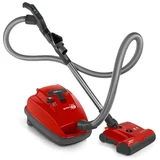
Award: Best for Large Homes | Price: $949.00 | Check Price on Amazon
The Airbelt K3 takes a different approach entirely: instead of one head that adapts, it ships with a dedicated ET-1 powerhead for carpet and pet hair and a separate Parquet Floor Brush for hard floors, swapped by hand at the transition. That’s slower than an auto-sensing machine, but the tradeoff is a 1,250-watt motor and a 37-foot operating radius that covers a genuinely large home without re-plugging — and a 7-year motor warranty that outlasts every other pick here by a wide margin.
- ET-1 powerhead + Parquet Floor Brush (manual swap)
- 1,250-watt motor, 37-ft operating radius
- S-Class filtration, 99.97% at 0.3 microns
- 7-year motor warranty, 12.0 lbs
Who it’s for: Best for a larger home where a 37-foot operating radius means fewer outlet changes, and for a buyer who values a 7-year motor warranty over the convenience of an auto-sensing head. A poor fit for a smaller apartment where the extra reach and premium price aren’t doing any real work.
Main drawback: The highest price on this list by a wide margin, and the powerhead swap is fully manual with no auto-sensing at all.
5. Roborock Qrevo S5V — Best Robot for Daily Carpet-to-Wood Maintenance
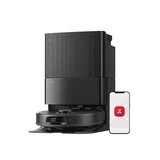
Award: Best Robot for Daily Carpet-to-Wood Maintenance | Price: $499.98 | Check Price on Amazon
For daily maintenance rather than a deep weekly clean, the Qrevo S5V handles the transition automatically via PreciSense LiDAR mapping that, per Roborock’s own listing, adapts “to carpet/hard floor differences” as it navigates. It also lifts its mop pads 10mm on approach to a rug so it doesn’t wet the carpet while mopping the hardwood around it — a real solution to the one failure mode that ruins most robot vacuum-mop combos on mixed flooring. It’s not a substitute for a manual vacuum’s edge and crevice cleaning, but as the machine that runs between manual passes, it’s the strongest auto-transition option here.
- PreciSense LiDAR + 4-floor mapping, auto carpet/hard-floor adapt
- 10mm mop lift on carpet approach
- SGS-certified zero-tangle rubberized brush
- 3,552 sq ft auto-refill mopping range
Who it’s for: Best as a second vacuum that runs daily maintenance passes between a manual deep clean, not as a sole vacuum — robots don’t reach edges, corners, or stairs the way a manual machine does.
Main drawback: At 25.6 lbs including the dock it’s the heaviest item shipped in this roundup, and like every robot vacuum it can’t reach true edge-to-edge or stair cleaning.
6. Bissell CleanView Swivel Pet — Best Budget Upright
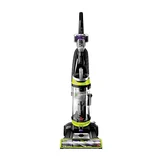
Award: Best Budget Upright | Price: $139.99 | Check Price on Amazon
The CleanView Swivel Pet doesn’t sense or adjust for the surface at all — it uses one Triple Action Brush Roll that Bissell’s own listing says “works effectively across multiple surface types,” plus a scatter-free mode for hard floors. That’s the least precise of the four transition methods in this dataset, and it’s exactly why this pick is priced under $140 rather than $300+. For a home with mostly low-pile carpet and a little hardwood, it’s a reasonable budget compromise; for mostly-hardwood homes it’s a worse fit than any auto-sensing or switchable pick on this list.
- Triple Action Brush Roll (fixed, multi-surface)
- Scatter-free technology for hard floors
- Swivel steering, large-capacity dirt tank
- 12.5 lbs
Who it’s for: Best for a mostly-carpeted home with a small amount of hardwood, on a tight budget. A worse fit for a home that’s majority hardwood, where the lack of any brush adjustment matters more.
Main drawback: No auto-sensing and no swappable head — the fixed brush is a genuine compromise on hardwood, not a true dual-surface solution.
7. Kenmore Intuition Bagged — Best Value
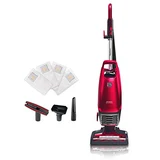
Award: Best Value | Price: $149.99 | Check Price on Amazon
The Intuition Bagged is a full-size upright with a 2-motor system Kenmore’s own listing says removes “ground-in dirt on carpets, rugs, and hard floors,” plus a Lift-Up pod that detaches into a lightweight handheld for stairs and edges. Like the Bissell above, it has no auto-sensing and no swappable head — the transition handling is entirely the fixed brush design — but at under $150 with a sealed HEPA system, it undercuts every other pick on this list except the Bissell while still including HEPA filtration the Bissell listing doesn’t claim.
- 2-motor system, fixed brush (no auto-sensing)
- Lift-Up pod detaches for stairs/edges
- Sealed HEPA system, 99.97%
- Under 15 lbs, no-touch bag emptying
Who it’s for: Best for a buyer who wants the lowest price on this list that still includes sealed HEPA filtration and doesn’t mind the same fixed-brush tradeoff as the Bissell above.
Main drawback: Same fixed-brush limitation as the Bissell, and Kenmore doesn’t publish a suction figure or warranty length on this listing to compare against the others.

How We Picked These
This is a Tier C, dataset-led comparison — the products here were not physically tested in-house for this article. Each pick was chosen and verified through: (1) the manufacturer’s own product listing and marketing copy for the transition-handling claim in the dataset table above, cross-checked against the exact ASIN’s live Amazon listing; (2) live price and buy-box availability pulled from the Amazon Creators API at the time of writing, not carried over from memory; (3) published spec sheets (weight, filtration rating, warranty) where a manufacturer discloses them, with any unpublished figure marked “not specified” rather than estimated. No star ratings or review counts appear anywhere on this page — Amazon’s review data wasn’t reliably retrievable for these ASINs at the time of writing, and a fabricated number is worse than an honest gap.
This means the seven picks above are a research-and-spec comparison, not a hands-on test report, and the language throughout this article reflects that honestly — “Miele’s own listing describes” rather than “we found,” and “per Roborock’s product page” rather than an unverifiable first-person claim about a robot vacuum’s behavior in someone’s actual living room. Where a spec genuinely isn’t published anywhere — suction in a comparable unit, most of these models’ warranty lengths — that gap is marked “not specified” in the dataset rather than estimated to make the table look more complete than it is.
What to Consider When Buying a Vacuum for Carpet and Wood Floors
Surface-Transition Method
This is the single spec that matters most for mixed flooring and the one this article’s dataset is built around. In order of how much thinking they require from you: automatic sensing (Shark, Dyson, Roborock) needs none; manual dial (Miele) needs one twist; manual attachment swap (SEBO) needs a physical head change; fixed multi-surface brush (Bissell, Kenmore) needs nothing but also adjusts to nothing.
None of these four methods is objectively “best” in the abstract — they’re a real tradeoff between cost, convenience, and how much you trust the machine to make the right call. A household that vacuums the same rooms the same way every time gets the least value from paying extra for automatic sensing; a household with an irregular layout or multiple people vacuuming gets the most.
Brush Roll Design
A rigid-bristle beater bar built for carpet is the single biggest cause of hardwood scratching when it’s left running at full speed on wood. Look for a brush that’s either soft-roller, switchable off, or paired with a second dedicated hard-floor head — not a single bristle brush marketed as “works on all floors” with no adjustment.
Check the manufacturer’s own spec sheet under “cleaner head” or “brush roll type” rather than trusting “soft roller” as marketing language alone — it can describe four genuinely different designs (felt/microfiber roller, switchable bristle, all-rubber fin, or a second dedicated soft head) with very different real-world results on a wood finish.
If your home is mostly hardwood with only light carpet, see our picks for a vacuum that will not scratch wood floors, including switchable-brush and cordless-stick options at a few price points.
Suction Power
Manufacturers don’t publish this consistently — Shark and Dyson cite proprietary power units, Roborock publishes Pa, and Miele, Bissell, SEBO and Kenmore publish none of it for these specific models. Don’t compare raw numbers across brands; compare the transition-handling mechanism instead, which is disclosed more consistently.
Format: Canister vs. Stick vs. Upright vs. Robot
Canisters keep the motor off the floor, which helps on wood; sticks are the lightest for frequent quick passes; uprights are the most affordable path to real carpet-deep-cleaning power; robots handle daily maintenance but not edges, corners, or stairs.
For a home that’s genuinely mixed — not “mostly one surface with a little of the other” — a canister or a stick vacuum with a real transition mechanism tends to outperform an upright, since upright designs are historically built carpet-first and adapted to hardwood afterward rather than the other way around.
Weight and Maneuverability
A vacuum that’s a chore to push is a vacuum that gets used less often, and less frequent vacuuming is worse for both carpet fiber wear and the grit buildup that scratches hardwood. Weigh this against your home’s layout, not just the spec sheet number.
Filtration
Only three of the seven picks in this comparison explicitly claim HEPA filtration on their current listing (Shark, Kenmore) or an equivalent branded system (Miele’s AirClean, Dyson’s whole-machine filtration, SEBO’s S-Class) — check the exact listing rather than assuming HEPA is standard across a brand’s whole lineup.
Corded vs. Cordless
Corded canisters and uprights have no runtime ceiling but are limited by cord length; cordless sticks trade some runtime and per-charge power for the freedom to move between rooms without hunting for an outlet.
Price vs. Real Use Case
The picks here span $139.99 to $949.00. The honest pattern: fixed-brush budget picks (Bissell, Kenmore) are a real compromise on hardwood specifically, while the auto-sensing and switchable picks that cost more are paying for precision at the exact surface transition, not just raw power.
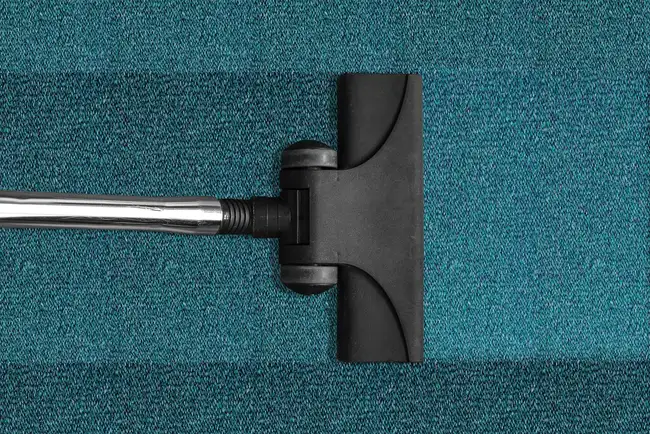
How to Vacuum a Home With Both Carpet and Wood Floors
- Start on wood floors first, then move to carpet. Any grit tracked onto hardwood from an already-dirty vacuum head is worse than grit already on carpet, which cushions it.
- Set (or let the vacuum set) the lowest effective suction on wood. Maximum suction on hardwood pulls larger grit along the floor before it’s captured, dragging it like fine sandpaper — this is worse on wood than carpet because there’s no fiber to cushion contact.
- Turn off or switch out the bristle brush before crossing onto wood, unless the machine does this automatically. A spinning beater bar is the single most common cause of fine swirl-mark scratching on a wood finish.
- Increase suction and re-engage the brush roll for carpet, especially on higher-pile rugs where a soft-roller-only head will leave debris behind.
- Pick up large debris by hand before vacuuming either surface. Cereal, small toys, and pet kibble can get dragged under the cleaner head and scratch wood or jam a brush roll on carpet.
- Empty the dustbin or bag regularly. A full bin measurably reduces suction on both surfaces, which is when a vacuum starts dragging debris instead of lifting it.
Common Mistakes When Vacuuming Mixed Flooring
- Leaving the brush roll running at full speed across the whole route. The single most common cause of the fine scratching people blame on “a bad vacuum” is actually a brush roll left on at carpet-setting speed while crossing hardwood. If the machine doesn’t sense the switch automatically, that’s a manual step, every time — not a one-time setting.
- Assuming a higher price always means better hardwood safety. Price in this comparison tracks the transition mechanism, not hardwood safety specifically. The $949 SEBO K3 is manual-swap, the same category as the $140 Bissell in terms of how much thinking it requires from you — it’s priced for motor warranty and operating radius, not for doing the transition thinking on your own behalf.
- Buying based on a suction number that isn’t comparable across brands. As the dataset above shows, four of the seven picks here don’t publish a suction figure for this specific model at all, and the three that do use different measurement conventions. A higher advertised number on one brand’s listing doesn’t mean more real-world suction than an unlisted number on another.
- Ignoring the floor’s own finish condition. A vacuum built for hardwood is built for a sealed, intact finish. Unsealed, heavily worn, or already-scratched wood is more vulnerable regardless of which vacuum is used — in that case, a soft-roller or no-brush pass is worth using even if the machine’s automatic sensing suggests otherwise.
Final Thoughts
The right vacuum for a home with both carpet and wood floors comes down to one real decision: how much you want the machine to handle the surface transition for you. The Miele Classic C1 Pure Suction earns the top spot because its 6-stage dial and parquet-plus-carpet floorhead were built for exactly this dual-surface case, not adapted from a single-surface design after the fact. If you’d rather the vacuum make that call automatically, the Shark Stratos and Dyson V15 Detect both do it with a sensor instead of a dial — at a real price difference, not just a marketing one.
Related Vacuum Guides
- Best Vacuum for Hardwood Floors: 5 Picks That Won’t Scratch — if hardwood safety alone is the priority and carpet isn’t part of the picture
- Best Roomba for Hardwood Floors — for a robot-only, brand-specific comparison
- Best Hoover for Dog Hair and Wooden Floors — if pet hair, not general dual-surface use, is the main problem
- Best Bissell for Hardwood Floors — for Bissell’s own spin-mop and steam-mop lineup specifically
- Best Wet Vacuum for Hardwood Floors — for wet spills and liquid pickup rather than dry debris
- Best Vacuum for Cat Litter on Hardwood Floors — for litter-tracking specifically
- Best Cleaning Supplies for Wood Floors — for mopping solutions and cleaning products beyond vacuuming
- Best Shark Vacuum for Carpet and Hardwood Floors — for a Shark-only, single-brand deep dive
Frequently Asked Questions
What’s the best vacuum for a home with both carpet and wood floors?
For most homes, a canister or stick vacuum with either a manual multi-stage suction dial (Miele Classic C1) or automatic surface-sensing (Shark Stratos, Dyson V15 Detect) handles the transition best. Avoid a single fixed-power bristle brush with no adjustment for wood.
Can I use the same vacuum on carpet and hardwood without scratching the floor?
Yes, as long as it has a soft roller, a switchable brush, or a dedicated hard-floor attachment, and you either lower the suction manually on wood or the vacuum does it automatically. A rigid always-on bristle brush at full suction is what actually causes scratching.
Do auto-sensing vacuums actually work switching between carpet and wood floors?
Based on manufacturer specs, yes for models like the Shark Stratos (infrared dirt sensing) and Dyson V15 Detect (piezo debris/floor-type sensor) — both explicitly adjust power without a manual switch. That said, the sensor adjusts suction power; on the Dyson, the physical head still needs to be swapped for the biggest difference in brush contact.
Can robot vacuums mop wood floors without wetting the carpet?
Some can. The Roborock Qrevo S5V lifts its spinning mop pads about 10mm when it approaches a carpet or rug so it doesn’t wet it while mopping the surrounding hardwood — check for this specific feature before buying a vacuum-mop combo for a mixed-flooring home, since not every robot mop does it.
How much suction do I need for carpet vs. wood floors?
There’s no consistent published number to compare across brands — some manufacturers cite Pa, others cite proprietary power units, and several of the models in this comparison don’t publish a suction figure at all. Judge by the transition-handling mechanism (auto-sensing, manual dial, or swappable head) instead of chasing a suction number that isn’t measured the same way by every brand.
Is a canister or upright vacuum better for mixed flooring?
Canisters keep the heavier motor off the floor and typically pair with a dedicated parquet or combination floorhead, which tends to be gentler on wood. Uprights are usually more affordable and better at deep-cleaning thicker carpet, but rely more heavily on a switchable or soft brush roll to be safe on hardwood.
How often should I vacuum a home with both carpet and hardwood?
High-traffic carpet areas benefit from vacuuming every 1-2 days, especially with pets. Hardwood floors need less frequent vacuuming for deep cleaning but should be dusted or lightly vacuumed 2-3 times a week to keep grit from grinding into the finish underfoot.
Is it worth paying more for a vacuum with automatic surface-sensing?
Based on the price split in this comparison, automatic sensing (Shark, Dyson, Roborock) costs roughly $121 more on average than a manual-dial, manual-swap, or fixed-brush pick. It’s worth it if multiple people share vacuuming duty or your layout genuinely mixes surfaces room to room; it’s less worth it if you vacuum the same fixed route every time and don’t mind a one-second manual adjustment.
Do I need a separate vacuum for hardwood and a separate one for carpet?
No, not if the vacuum has a real transition mechanism — automatic sensing, a manual suction dial, or a swappable head. A separate single-surface vacuum for each floor type is only a better choice if the primary machine has none of those (a fixed single-mode bristle brush with no adjustment at all).
Sponsored / affiliate links. As an Amazon Associate I earn from qualifying purchases. I may earn additional commission from eligible campaigns.