Western Red Cedar vs Eastern White Cedar
Western Red Cedar is the stronger pick for siding and most outdoor builds. Eastern White Cedar is the lower-cost option for fences, posts, and lighter-duty projects. Choose poorly and you may end up with boards that dent more easily, move more, or cost more to replace. This comparison covers durability, strength, clear-lumber availability, and fastening performance so you can choose the right cedar for your project.
Western Red Cedar vs eastern White Cedar
| Factor | Western Red Cedar | Eastern White Cedar | Winner |
|---|---|---|---|
| Strength | Published strength: 61,000 psi | Published strength: 45,000 psi | Western Red Cedar |
| Density and weight | 24 lbs per cu ft / 385 kg/cu m; specific gravity 0.47 | 21 lbs per cu ft / 335 kg/cu m; specific gravity 0.31 | Eastern White Cedar for lighter handling; Western Red Cedar for a stiffer feel |
| Decay resistance | Heartwood has very high natural decay resistance | Heartwood has very high decay resistance | Tie |
| Clear, knot-free stock | Usually clearer, with very straight grain | Often knotty in common grades | Western Red Cedar |
| Regional supply and price pressure | Often easier in the Pacific Northwest | Often easier in eastern North America and can ship cheaper there | Eastern White Cedar in eastern markets; Western Red Cedar in western markets |
Strength and handling
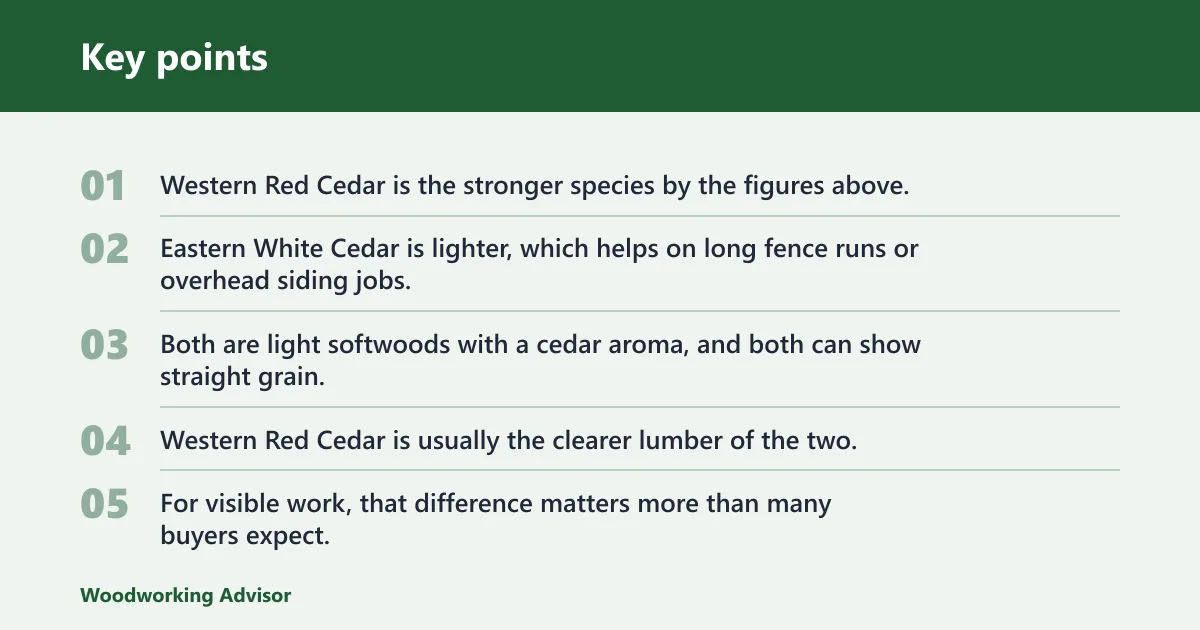
Western Red Cedar is the stronger species by the figures above, so it usually holds up better where boards need to span, stay straight, or take more abuse. Eastern White Cedar is lighter, which helps on long fence runs or overhead siding jobs, but that lower density also means you need to watch fastener pullout more closely.
Weight, grain, and appearance
Both are light softwoods with a cedar aroma, and both can show straight grain. Western Red Cedar is usually the clearer lumber of the two, while Eastern White Cedar is often more knotty in common stock. For visible work, that difference matters more than many buyers expect.
Decay resistance and the heartwood rule
Outdoor durability comes from heartwood, the inner wood that carries the natural oils and most of the decay resistance. Color is not a reliable test by itself; redder boards are not automatically better, and paler boards are not automatically weak. For any exterior cedar, heartwood content matters more than a board’s surface tone.
Fastening behavior
Low-density cedar can let fasteners back out or pull through if the head is too small or the board is too dry and brittle. Large-headed nails or screws are the safer default, and predrilling is wise near ends and on narrow trim. Splitting is a bigger risk on shingles, thin siding, and knotty stock.
What is the difference between western red cedar and eastern white cedar?
Western Red Cedar and Eastern White Cedar are different species with different strength, density, and market patterns. Western Red Cedar is usually stronger and clearer; Eastern White Cedar is lighter and often more knotty, but it can be the smarter buy when local supply is better or shipping costs are lower.
Botanical and naming confusion
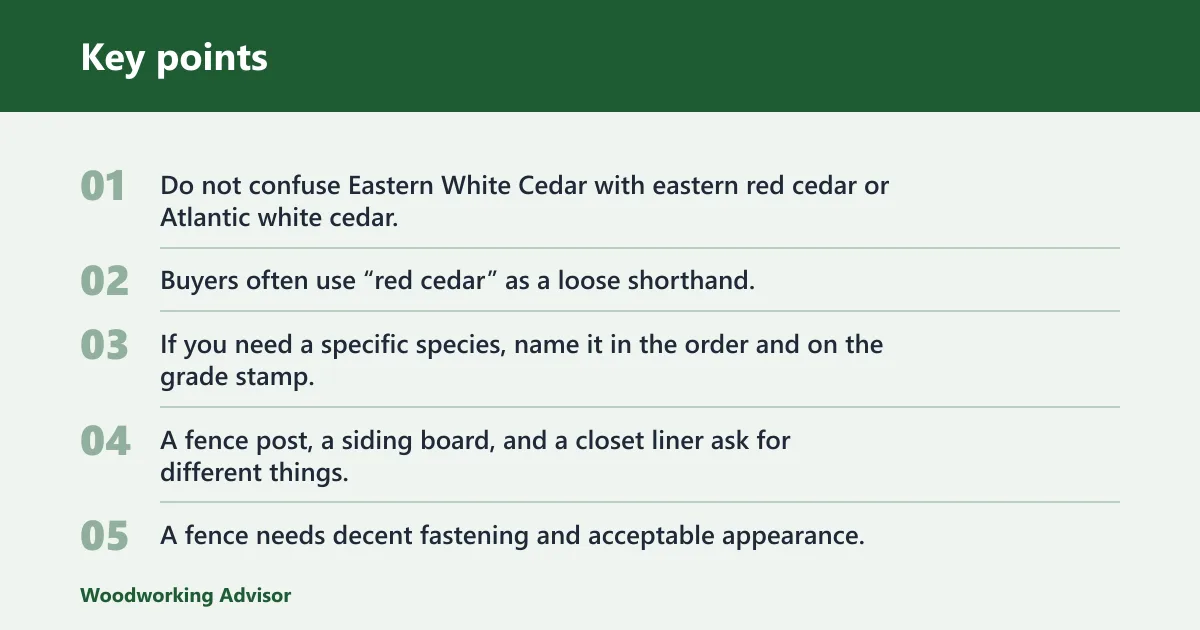
Do not confuse Eastern White Cedar with eastern red cedar or Atlantic white cedar. Buyers often use “red cedar” as a loose shorthand, but that label is not precise enough for lumber selection. If you need a specific species, name it in the order and on the grade stamp.
Why the answer changes by use
A fence post, a siding board, and a closet liner ask for different things. A fence needs decent fastening and acceptable appearance. Siding wants stability and clearer stock. Closet lining wants aroma, light weight, and a clean finish more than raw strength.
How do the species compare at a glance?
At a glance, Western Red Cedar is the stronger, clearer option, while Eastern White Cedar is the lighter and often cheaper local buy. Both are naturally decay resistant in heartwood and both are easy to work, but the project outcome changes once you factor in knots, fastener grip, and how much clear stock you need.
Side-by-side traits
| Trait | Western Red Cedar | Eastern White Cedar |
|---|---|---|
| Grain | Very straight grain | Straight grain |
| Weight | 24 lbs per cu ft / 385 kg/cu m | 21 lbs per cu ft / 335 kg/cu m |
| Specific gravity | 0.47 | 0.31 |
| Strength | 61,000 psi | 45,000 psi |
| Decay resistance | Very high natural decay resistance | Very high decay resistance |
Appearance and knot content
Western Red Cedar usually gives you more usable clear faces, which is why it shows up so often in siding and shingles. Eastern White Cedar commonly has more knots, so you may need to sort harder for appearance-grade boards. That sorting time is part of the real cost.
Moisture behavior and stability
Both species have low shrinkage compared with many softwoods, so neither is a high-movement choice. Western Red Cedar’s straight grain and stronger fiber structure make it the safer bet when you want flatter siding or more forgiving trim. Eastern White Cedar still works well, but the lower density gives you less margin on rough handling.
Which cedar works best outdoors?
Western Red Cedar is the better outdoor choice when the job needs stronger boards, cleaner faces, or tighter appearance standards. Eastern White Cedar can still work outdoors because its heartwood is also very decay resistant, but it fits best where the structure is lighter, the spans are short, or local supply makes it the better buy.
Heartwood and decay resistance
Use heartwood as the basis for any durability claim. Sapwood on either species is not what you want to rely on for long service outdoors. If the board is mostly sapwood, the species label matters less than the exposed wood you are actually buying.
Moisture cycling and shrinkage
Both cedars shrink little, which helps with siding and shingles. That said, a board that is knotty, thin, or cut from lower-density stock is still easier to distort if you fasten it poorly or leave end grain exposed. Finish and detailing still matter.
Fasteners, split risk, and pullout
Use large-headed nails or screws, especially on thin boards and edge fastening. Cedar’s low density means a small head can sink too far, and fasteners can loosen if the board dries and moves around them. Pre-drill near ends, on narrow trim, and around knots where splitting is more likely.
Say your 1×6 fence boards are going up on a windy lot and the fence line is 140 feet long. Western Red Cedar gives you a better mix of strength and cleaner faces, while Eastern White Cedar may save money if the local yard stocks it heavily and the panels are short enough that lighter boards are not a liability.
Where western red cedar usually wins
Western Red Cedar usually wins when the job needs better strength, fewer knots, and a cleaner finished look. It is the safer all-around pick for siding, many fences, and most cedar shingles or shakes because those projects punish weak stock, edge splitting, and poor fastener holding.
Fences
For fence boards and rails, Western Red Cedar gives you better stiffness and typically better appearance grades. That matters on long runs where warped or knot-heavy boards become obvious fast. It also tolerates fastening a bit better when the build uses exposed faces and repeated wind load.
Siding and trim
Siding needs boards that stay flatter and look cleaner after installation. Western Red Cedar is the better fit because its stronger, straighter stock is easier to align and more forgiving where trim meets trim. If you are painting or staining, the better clear stock also reduces patchy grain issues.
Shingles and shakes
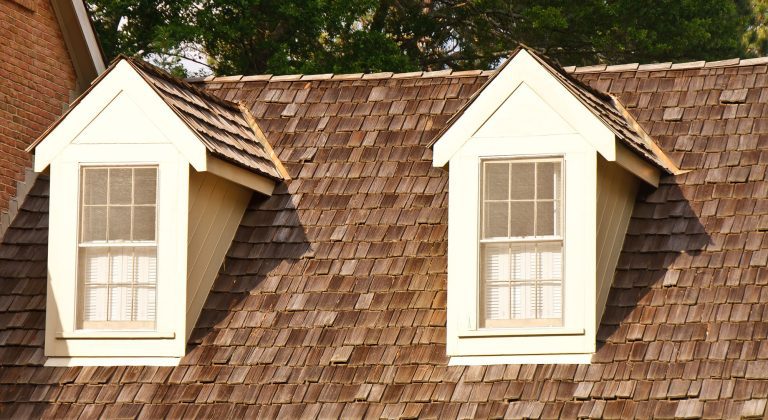
Cedar shingles and shakes are commonly associated with Western Red Cedar. These products can split if handled roughly or fastened badly, so the species with the better clear stock gives you more usable pieces. Proper fastening matters here more than on thicker boards.
Where eastern white cedar can be the better buy
Eastern White Cedar can be the better buy when local supply is close, the build is lighter, or the budget matters more than clear lumber selection. It is still a sound outdoor species in heartwood form, and in some eastern markets it can beat Western Red Cedar on delivered cost even if the wood itself is less strong.
Local availability and shipping cost
Price often tracks freight as much as species. Eastern White Cedar is more available in eastern North America, while Western Red Cedar is generally more available in the Pacific Northwest. If one species has to travel much farther, shipping can erase the raw lumber price advantage quickly.
Lighter-duty outdoor builds
For low-load jobs like short fences, garden edging, and small outbuildings, Eastern White Cedar can be enough. Its lighter weight is easier to handle overhead, and the lower density is not a problem when the structure is not carrying much load. The trade-off is less forgiveness if you use undersized fasteners.
Interior lining and closets
For closet lining, chest interiors, and similar dry-space uses, Eastern White Cedar can be a practical choice. The aroma is noticeable, the wood is light, and the decay resistance is more than enough for indoor service. Clear, knot-free Western Red Cedar can still be preferred for a premium finish.
Suppose you are lining a 6-foot closet and the local yard has Eastern White Cedar in stock but Western Red Cedar would require freight from out of state. For that dry interior use, the lighter species often makes more sense, because the main concerns are clean appearance, scent, and cost rather than maximum strength.
Cedar project decision table
The right cedar depends on the project, not just the species name. Use this table to match the wood to the job you are actually building, then verify grade and heartwood before you buy.
| Project | Better cedar species | Reason | Main installation risk |
|---|---|---|---|
| Fence | Western Red Cedar | Stronger stock and usually clearer boards | Split ends and pullout if fasteners are too small |
| Deck | Western Red Cedar | Better strength for exposed members and better board quality when available | Deflection or loose fasteners if spans are pushed too far |
| Siding | Western Red Cedar | Cleaner grain and better dimensional control for visible work | Edge splitting and uneven fastening on thin boards |
| Shingles | Western Red Cedar | Commonly chosen for shingles and shakes because clear stock matters | Splitting from overdriving nails or using small heads |
| Closet lining | Eastern White Cedar | Light, aromatic, and usually the cheaper acceptable option for a dry interior | Knotty boards and uneven appearance if grade is not checked |
Choose Western Red Cedar if… / Choose Eastern White Cedar if…
Choose Western Red Cedar if the project is visible, you want straighter grain and fewer knots, or you need stronger boards for siding, shingles, or a fence that takes more wind and abuse. It is also the better pick when your local market already carries it without a freight penalty.
Choose Eastern White Cedar if you are building a lighter-duty fence, lining a closet, or buying in an eastern market where it is easier to source and ship. It makes sense when the job needs decay resistance and aroma, but not the higher strength and clearer stock of Western Red Cedar.
Western Red Cedar vs Eastern White Cedar checklist
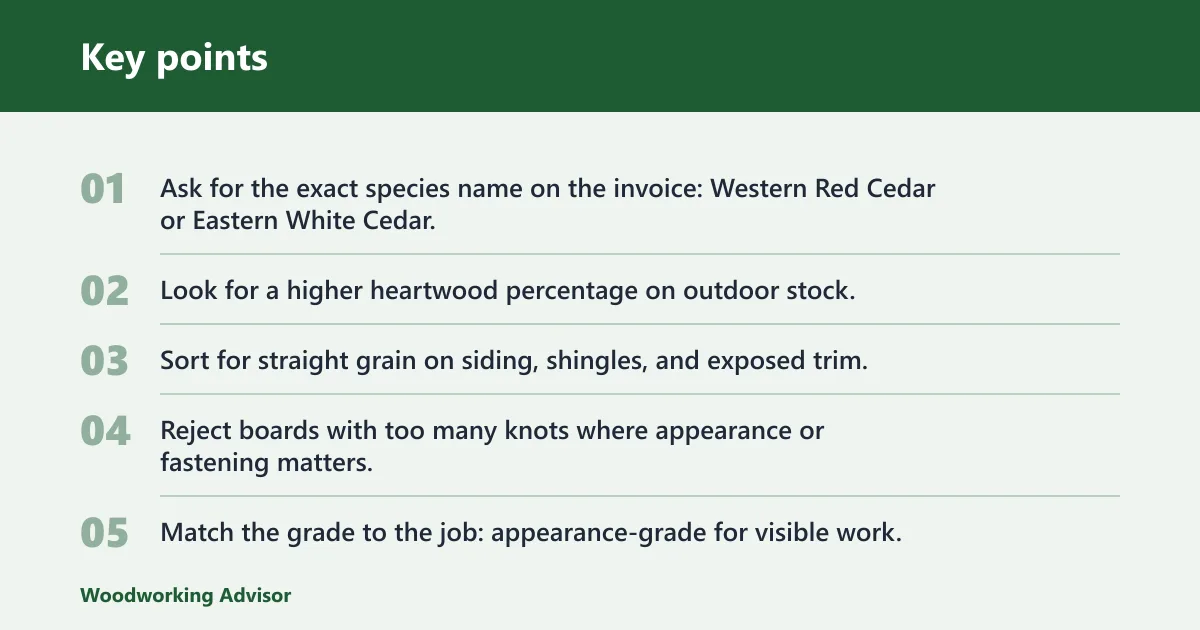
- Ask for the exact species name on the invoice: Western Red Cedar or Eastern White Cedar.
- Look for a higher heartwood percentage on outdoor stock.
- Sort for straight grain on siding, shingles, and exposed trim.
- Reject boards with too many knots where appearance or fastening matters.
- Match the grade to the job: appearance-grade for visible work, lower-grade stock only where knots will not matter.
Fastener and finish
Use large-headed nails or screws so the fastener bears on the soft wood without pulling through. Pre-drill near ends and on narrow strips, especially in knotty stock. If the project is exposed outdoors, finish the cut ends and any fresh end grain so water does not keep soaking in.
Frequently asked questions
Which is better for exterior use, western red cedar or eastern white cedar?
Western Red Cedar is usually the better exterior choice when you care about strength, clean faces, and siding or shingle performance. Eastern White Cedar can still work outdoors, especially in lighter-duty builds or where it is cheaper and easier to buy locally. Heartwood content still matters for both.
Is western red cedar stronger than eastern white cedar?
Yes. That strength gap is one reason Western Red Cedar is the safer pick for siding, exposed trim, and other jobs that benefit from stiffer boards.
Which cedar is more rot resistant: western red cedar or eastern white cedar?
Both are highly rot resistant in heartwood. Western Red Cedar is listed with very high natural decay resistance, and Eastern White Cedar is also listed as having very high decay resistance. For outdoor use, the key is buying heartwood-rich boards, not assuming the species color tells the whole story.
What is the difference between red cedar and white cedar?
“Red cedar” and “white cedar” are common names, not precise buying instructions. Western Red Cedar is the usual meaning of red cedar in lumber buying, while Eastern White Cedar is the usual meaning of white cedar in eastern markets. Always confirm the full species name before ordering.
How do western red cedar and eastern white cedar compare for fences and decks?
Western Red Cedar is usually better for both fences and decks because it is stronger and more likely to come in clearer stock. Eastern White Cedar can still be used for fences, especially lighter builds, but it is less forgiving on fastening and appearance. For decks, stronger stock usually matters more.
Why is eastern white cedar often cheaper than western red cedar?
Eastern White Cedar is often cheaper where it grows and ships easily, especially in eastern North America. Price also reflects knot content and the amount of clear stock available. If Western Red Cedar has to travel farther, freight can push it above the local white cedar price quickly.
How do I specify western red cedar for a project?
Put the exact species name in the order: Western Red Cedar. Then specify grade, thickness, width, and whether you need clear stock or a knotty appearance grade. For outdoor work, ask for heartwood-rich boards and use fasteners sized for softwood pullout resistance.
How do I identify a western red cedar board?
Look for the species label on the bundle or grade stamp first. Western Red Cedar is often very straight-grained and commonly sold in clearer stock than Eastern White Cedar. Color alone is not enough, because tone can vary with cut, exposure, and age.
Can eastern white cedar be used outdoors like western red cedar?
Yes, if the board is heartwood and the project is sized for its lower strength. Eastern White Cedar handles fences, siding, and other outdoor work when the design is sensible and the fasteners are correct. It is just less forgiving than Western Red Cedar in higher-demand uses.
Northern white cedar vs eastern red cedar
Those are different woods, and they are often confused with one another. Northern white cedar is the same general species many buyers mean by Eastern White Cedar, while eastern red cedar is a separate species group. Do not substitute one for the other without checking the full lumber label and intended use.
Sponsored / affiliate links. As an Amazon Associate I earn from qualifying purchases. I may earn additional commission from eligible campaigns.
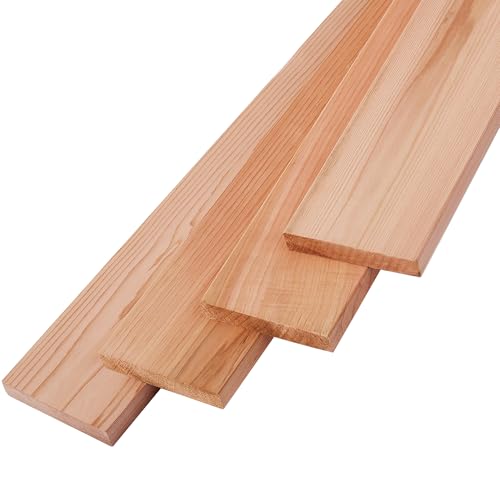
 Rustic Revival | Handmade Reclaimed Barnwood Craft Bundle | Unfinished Authentic Reclaimed Western Red Cedar Wood Planks for DIY, Home and School Projects (24" x 5.5" x .375") 6 Pack
 Rustic Revival | Handmade Reclaimed Barnwood Craft Bundle | Unfinished Authentic Reclaimed Western Red Cedar Wood Planks for DIY, Home and School Projects (24" x 7.25" x .375") 4 Pack