What Does a 45-Degree Angle Look Like? Draw and Check It
A 45-degree angle looks like a diagonal that cuts a square corner exactly in half: it rises one unit for every unit it runs. In woodworking that is a 12/12 roof pitch and the miter on every picture-frame corner. But a 1-degree error per cut opens a gap about 1/8 inch wide on a 3-1/2 inch board. This guide shows how to recognize, draw, and check a true 45.
What Does a 45-Degree Angle Look Like?
A 45-degree angle is exactly half of a square corner. Draw a line from one corner of a square to the opposite corner and that diagonal makes a 45-degree angle with both sides. It looks like a clean diagonal, neither shallow nor steep, halfway between a flat line and an upright one.
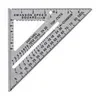 |
Best 45-Degree Layout Pick Swanson Speed Square, 7 in. Aluminum (S0101) – $9.98 The long edge of this triangle is a built-in 45-degree line against its fence, so you can mark the angle this guide describes without a protractor.
|
As an Amazon Associate we earn from qualifying purchases.
The fastest test is rise equals run. If a line climbs 5 inches for every 5 inches it travels sideways, it is at 45°. Any right triangle with two equal short sides is a 45-45-90 triangle. Another way to picture it: 45° is one-eighth of a full turn (360 / 8 = 45), which is the point angle of a slice from an eight-slice pizza.
Rise Equals Run: How Pitch, Slope and Percent Grade Compare
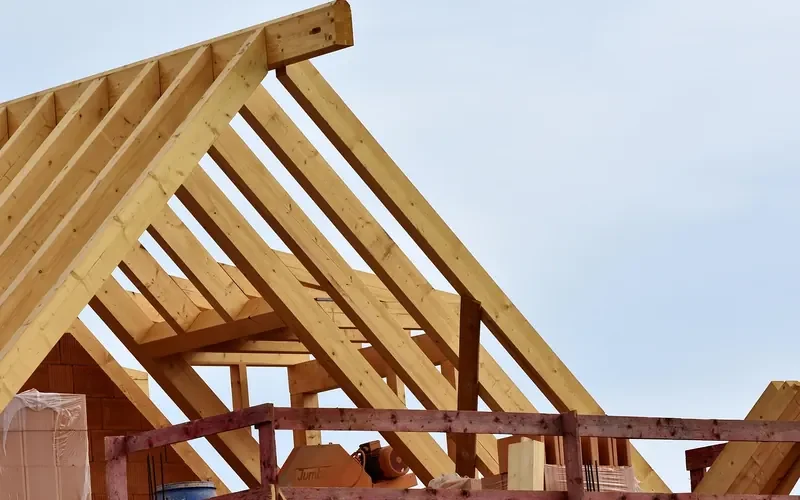
Builders describe the same slope three ways, and mixing them up is the most common 45-degree mistake. A 45-degree angle is a 100 percent grade, not a 45 percent grade. Percent grade is rise divided by run times 100, and a 45 percent grade is only about 24.2°. Roof pitch is written as inches of rise per 12 inches of run, so 12/12 is the 45° roof.
| Rise per 12 in. of run | Angle | Percent grade |
|---|---|---|
| 1 in 12 | 4.76° | 8.3% |
| 3 in 12 | 14.04° | 25% |
| 4 in 12 | 18.43° | 33.3% |
| 6 in 12 | 26.57° | 50% |
| 9 in 12 | 36.87° | 75% |
| 12 in 12 | 45.00° | 100% |
Angle = arctangent of rise divided by run. Stairs are a good reality check: a stair with a 7-3/4 inch rise and a 10 inch run works out to about 37.8°, so even a steep staircase is noticeably shallower than 45°. Most people overestimate how steep 45° really is.
How to Draw a 45-Degree Angle Without a Protractor
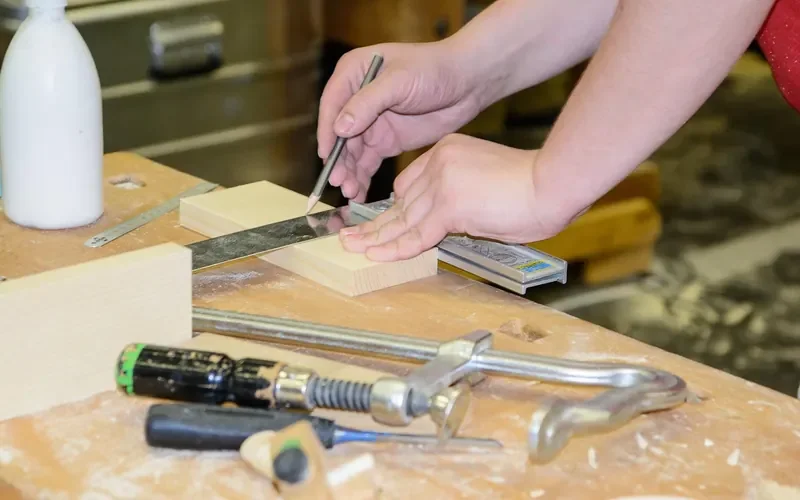
- Speed square: press the fence against a straight board edge, then draw along the long diagonal edge. That line is 45° to the edge and to the other leg. The square also has a degree scale if you need other angles.
- Equal distances: from a corner, measure the same distance along both edges (say 6 inches each) and connect the two marks with a straightedge. Equal legs always give 45°.
- Combination square: the head has a 45° face in addition to the 90° face. Seat it on the board edge and run your pencil along the blade. See how it compares in combo square vs speed square.
- Paper fold: fold one corner of a square sheet onto the adjacent edge. The crease is the 45° line, a handy full-size template.
Which tool you reach for depends on the board. A speed square is the quick choice for 2x lumber and trim, and it is one of the basic layout tools in our guide to woodworking tools and saws. For wide panels, the equal-distance method with a long straightedge is more accurate than a short square.
How Long Is a 45-Degree Diagonal or Brace?
In a 45-45-90 triangle the long side is the short side times 1.414 (the square root of 2). Going the other way, multiply the diagonal by 0.707 to get the legs.
| Leg length (equal run and rise) | Diagonal (leg x 1.414) | To the nearest 1/16 in. |
|---|---|---|
| 6 in. | 8.49 in. | 8-1/2 in. |
| 12 in. | 16.97 in. | 17 in. |
| 24 in. | 33.94 in. | 33-15/16 in. |
| 48 in. | 67.88 in. | 67-7/8 in. |
These are the theoretical distances between the two points. Mark the points first, then lay out the brace board across them. For a framing example, see how to frame a 45 degree corner.
How to Check That a Cut Is Really 45 Degrees
A saw scale or a stamped mark is not proof. Check the cut itself.
- Cut two scraps: use the same saw setting and the same wood for both pieces, one cut left and one cut right.
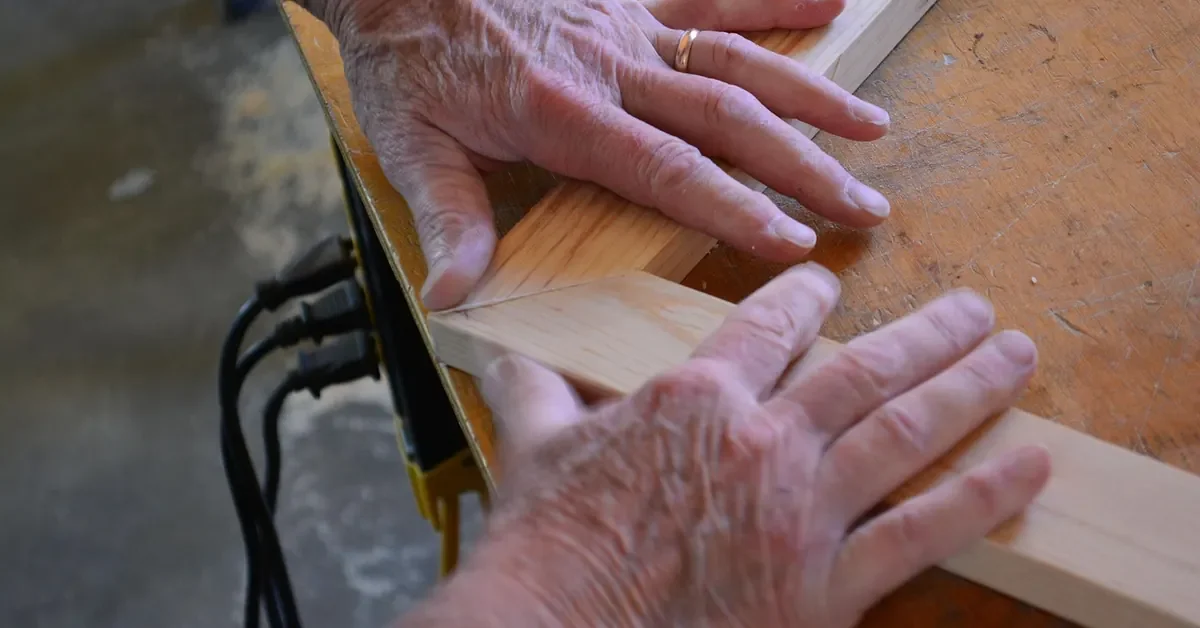
- Join them on a flat surface: press the two cut faces together with the long edges against a fence.
- Test the corner: set a square into the inside corner. It should sit flat with no light showing, and the joint line should close along its full length.
- Read the error: if the corner is wider than 90°, each cut is under 45°. If it is narrower, each cut is over. Adjust and repeat. Our miter saw adjustment guide covers the saw side of this.
Errors double at a joint because both pieces carry the same mistake. The gap below is calculated as board width times the tangent of the total corner error, for a 3-1/2 inch wide board.
| Error on each cut | Total corner error | Gap at the outer edge |
|---|---|---|
| 0.5° | 1° | 0.06 in. (about 1/16 in.) |
| 1° | 2° | 0.12 in. (about 1/8 in.) |
| 2° | 4° | 0.24 in. (about 1/4 in.) |
A gap that size is why a frame that looked fine on the saw scale still opens at the corner. Wider boards show the same error as a bigger gap.
45-Degree Angle vs Miter Cut vs Bevel Cut
A 45-degree angle is a measurement. A miter is an angled cut across the face of a board, made by rotating the saw, and a bevel is an angled cut through the thickness, made by tilting the blade. Either can be set to 45°. Our guides explain how to cut miter joints and how to make a bevel cut in detail.
The saw setting is not always the corner angle. Each of the two pieces is cut at half of what is needed, so the setting is (180 minus the corner angle) divided by 2.
| Corner you are building | Miter saw setting |
|---|---|
| 90° (picture frame, door casing) | 45° |
| 120° (hexagon) | 30° |
| 135° (octagon) | 22.5° |
| 108° (pentagon) | 36° |
This also clears up an octagon trap: the angle at the center of an octagon is 45° (360 / 8), but the joints are cut at 22.5°.
Where You See 45 Degrees in the Shop and Around the House
| Where | Why it is 45° |
|---|---|
| Picture frame corner | Two pieces mitered at 45° each make a 90° corner |
| 12/12 roof pitch | 12 inches of rise over 12 inches of run |
| Corner-to-corner line on a square | The diagonal splits the right angle in half |
| Speed square long edge | The square is a 45-45-90 triangle |
| Slice of an eight-slice pizza | 360 divided by 8 equals 45 |
| Flat trim and baseboard corners | Square 90° wall corners use 45° miters; crown molding sits at an angle and uses compound settings, see cutting crown molding corners |
Frequently Asked Questions
What does a 45-degree angle look like?
A 45-degree angle looks like the diagonal of a square: a line that splits a 90-degree corner into two equal halves. It sits exactly halfway between a flat line and an upright line, and it rises one unit for every unit it runs.
What is a 45-degree angle?
A 45-degree angle is an acute angle that measures one-eighth of a full turn (360 divided by 8) and exactly half of a right angle. In a right triangle with two 45-degree angles, the two short sides are equal and the long side is about 1.414 times as long.
How do you make a 45-degree angle without a protractor?
Fold a square corner of paper onto its adjacent edge, or measure the same distance out from a corner along both edges and connect the marks. On wood, use the long edge of a speed square against the board edge, or the 45-degree face of a combination square.
Is a 45-degree angle the same as a 45 percent slope?
No. Percent grade is rise divided by run times 100, so a 45-degree angle is a 100 percent grade because rise equals run. A 45 percent grade is only about 24.2 degrees. Roof pitch uses a third system, inches of rise per 12 inches of run, where 12 in 12 is 45 degrees.
How do you cut a 45-degree angle on wood?
Set a miter saw to its 45-degree stop and cut with the board held firmly against the fence, or use a hand miter box with a 45-degree slot. Cut two scrap pieces first and hold them together against a square. If the corner is not 90 degrees, adjust the saw before cutting good stock.
The Short Version
A 45-degree angle is a diagonal where rise equals run, half of a right angle, and a 100 percent grade. Mark it with a speed square or equal distances, test every miter on two scraps, and remember that a small saw error doubles at the joint.
Sponsored / affiliate links. As an Amazon Associate I earn from qualifying purchases. I may earn additional commission from eligible campaigns.