Cutting Board Cracking Down the Middle: Causes and Fixes
A cutting board that cracks down the middle usually has a moisture imbalance; shallow edge checks in a solid wood board can often be repaired, but a through-crack, repeated split, or cracked laminated board usually means replacement. If you ignore it, the split can widen, trap food residue, and weaken the board enough to warp or break further. This guide shows how to diagnose the crack, decide repair versus replace, and keep the split from reopening.
Why did the board crack?
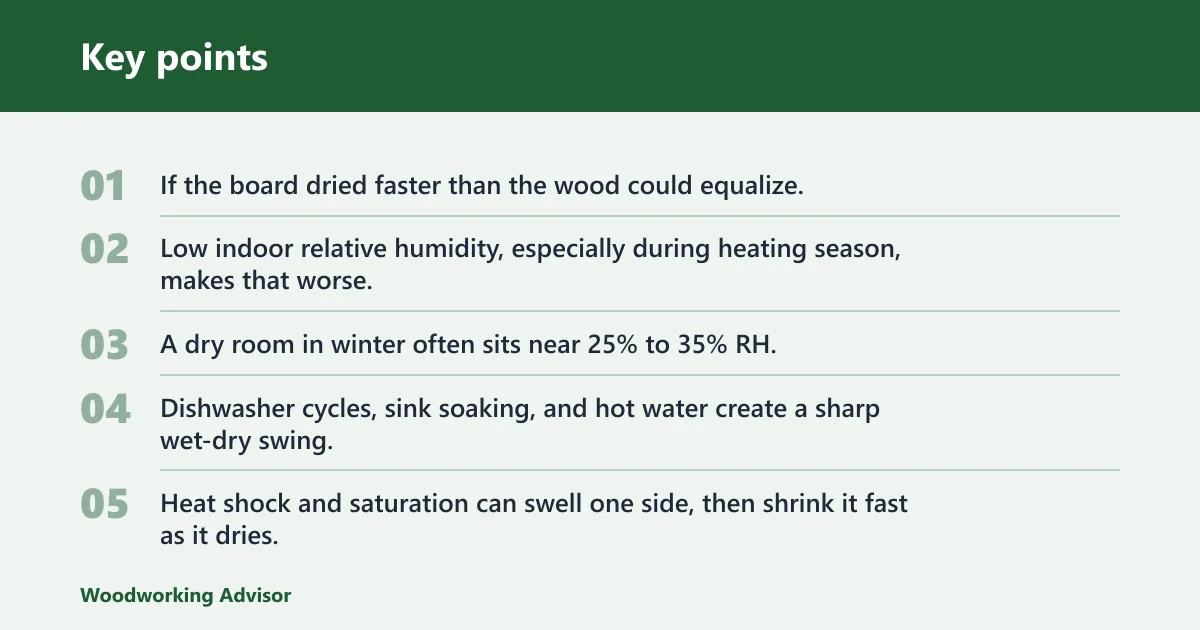


Wood moves as it gains and loses moisture. If the board dried faster than the wood could equalize, tension builds across the grain and the center can split first. Low indoor relative humidity, especially during heating season, makes that worse. A dry room in winter often sits near 25% to 35% RH, while many woodworkers aim for roughly 40% to 60% RH for stable interior conditions.
Dishwasher cycles, sink soaking, and hot water create a sharp wet-dry swing. Heat shock and saturation can swell one side, then shrink it fast as it dries, which raises checking and warp risk. If the board came from a damp kitchen, then got left on a counter near a vent or radiator, the movement can be even more uneven.
What you’ll need
- Moisture meter for wood moisture content
- Food-safe wood glue rated for water resistance
- Bar clamps or pipe clamps
- Cauls or scrap wood to spread clamp pressure
- Damp cloths and a dry towel for cleanup
- Mineral oil
- Beeswax or board cream
- Clean applicator cloths
- Sandpaper if resurfacing is part of the fix
How bad is the split?
A crack is not the same as a glue-line failure. Solid end grain, edge grain, and face grain boards move differently, and a laminated butcher block can split at the joints instead of through the wood itself. End grain boards resist movement better and often show surface checks first; face grain boards are more prone to splitting across the width, especially after seasonal drying.
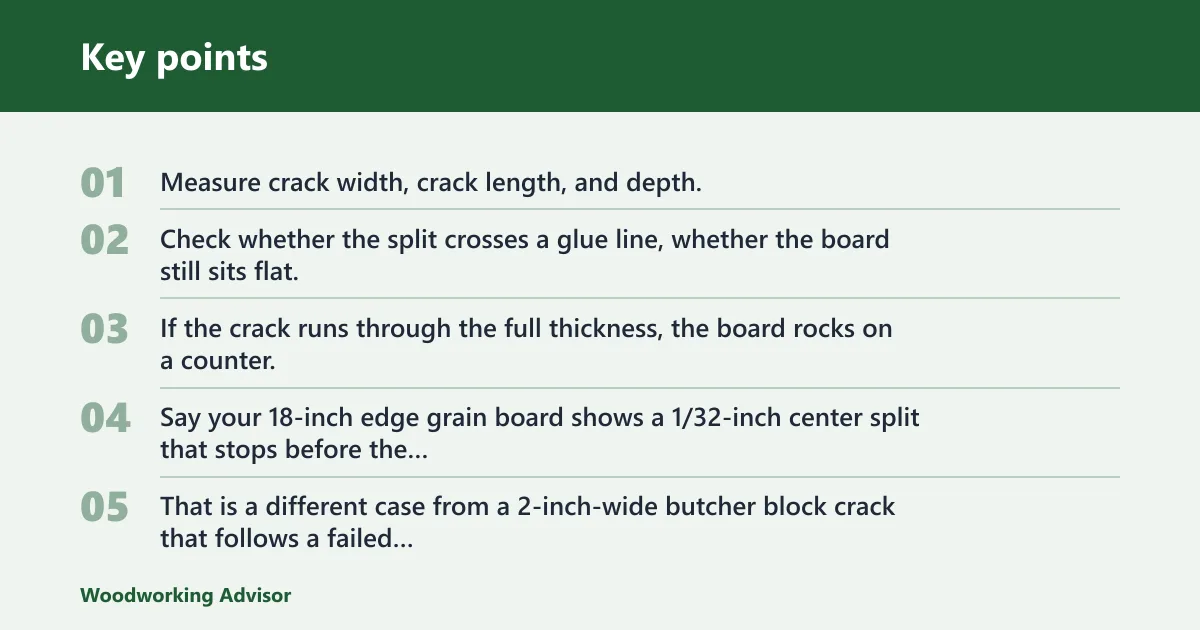
Measure crack width, crack length, and depth. Check whether the split crosses a glue line, whether the board still sits flat, and whether the gap opens when you flex it gently. If the crack runs through the full thickness, the board rocks on a counter, or the joint has let go in several places, repair odds drop fast.
Say your 18-inch edge grain board shows a 1/32-inch center split that stops before the bottom face and does not cross a glue line. That is a different case from a 2-inch-wide butcher block crack that follows a failed seam for half the board’s length. The first may be repairable; the second usually is not.
Cutting board repair matrix
| Board type | Crack width | Crack length | Crosses glue line? | Recommended action | Post-repair maintenance |
|---|---|---|---|---|---|
| End grain wood | Hairline to 1/32 in. | Under 6 in. | No | Monitor | Oil weekly for 3 weeks, then monthly; store at 40% to 60% RH |
| End grain wood | Up to 1/16 in. | 6 to 12 in. | No | Glue and clamp | Oil after cure, then every 2 to 4 weeks for 2 months |
| Edge grain wood | Hairline to 1/32 in. | Under 8 in. | No | Glue and clamp | Recheck moisture, then oil every 2 weeks for a month |
| Face grain wood | Over 1/32 in. | Any centerline split | No | Resurface only if shallow and flat; otherwise replace | Oil monthly only if the board remains structurally sound |
| Butcher block | Any visible opening | Through a lamination joint | Yes | Replace if the seam will not close square | Do not return to food use unless the repair is fully stable |
| Bamboo board | Any split at a strip joint | Long or recurring | Usually yes | Replace | Keep in a dry room and avoid soak exposure |
Can you glue and clamp it?
A stable crack that closes cleanly can often be glued with food-safe wood glue. The glue needs clean wood, a dry bond line, and enough clamp pressure to bring the faces together without squeezing out every bit of adhesive. Most water-resistant wood glues list a clamp time of about 30 minutes to 1 hour and a full cure near 24 hours, but follow the label on the bottle.
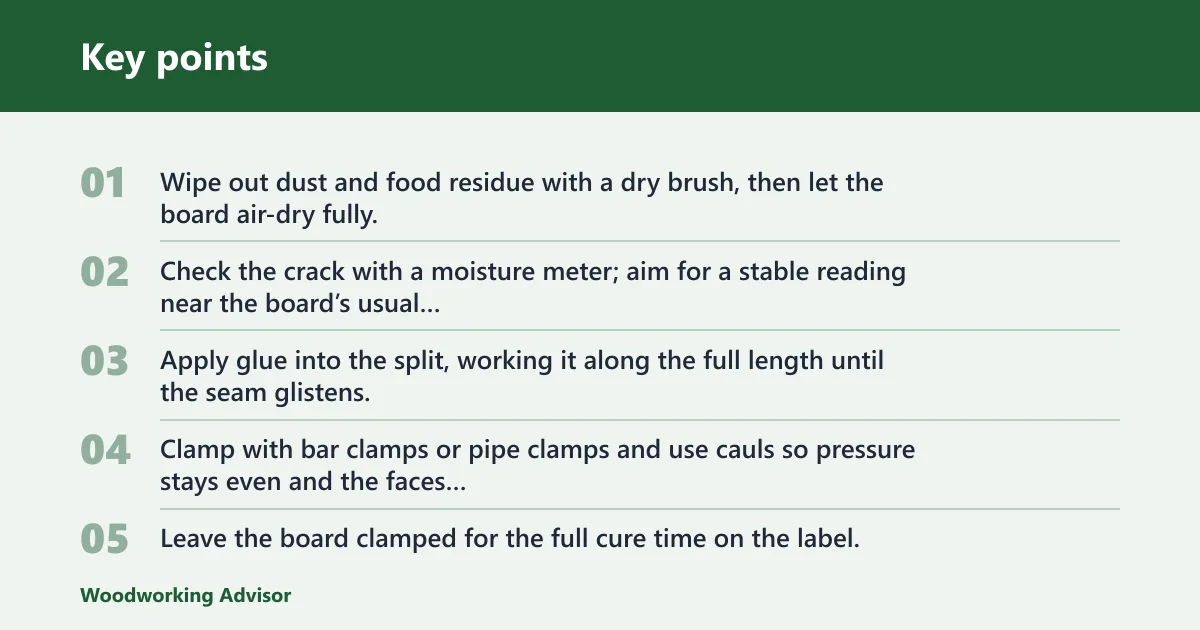
- Wipe out dust and food residue with a dry brush, then let the board air-dry fully.
- Check the crack with a moisture meter; aim for a stable reading near the board’s usual indoor level before glue goes in.
- Apply glue into the split, working it along the full length until the seam glistens.
- Clamp with bar clamps or pipe clamps and use cauls so pressure stays even and the faces stay aligned.
- Leave the board clamped for the full cure time on the label, then scrape off squeeze-out after it hardens.
Suppose a 16-inch edge grain board has a 10-inch crack that closes under hand pressure and does not cross a joint. That is a good glue-and-clamp candidate. If the same board springs open after clamping or the seam stays offset, move to the replacement path.
When should you replace it?
Replace the board if the crack is deep enough to threaten strength, if the split will not close without force, or if the damage reaches a surface that must stay sanitary. A gap that repeatedly opens after oiling, a centerline split in a butcher block, or a crack through a glue line that will not hold alignment is a replacement call.
Any board with a through-crack that traps debris along the full depth is hard to keep food safe. The same is true when warping leaves the board rocking, because movement keeps stressing the repair. If sanding would remove too much material to leave a flat, usable surface, do not chase the crack farther.
How do you stop it cracking again?
After repair, apply mineral oil in a thin coat to dry wood so it replaces moisture lost from the surface and slows further drying. Use it after the glue has cured, on a fully dry board. Reapply after the first wash, then every 2 to 4 weeks for the first two months, and about monthly after that if the board gets regular use.
Finish with beeswax or board cream as a topcoat. That layer slows moisture exchange, but it does not replace oiling. Keep the board out of the dishwasher, off long sink soaks, and away from constant heat or steam. Store it upright or flat in a stable room, not beside a range, radiator, or bright window.
A moisture meter helps here too. If one side reads noticeably drier than the other after sanding or repair, keep conditioning instead of putting the board straight back into heavy use. Sanding alone removes the surface split; it does not fix the drying pattern that caused it.
Common mistakes
Over-sanding a dry board and then leaving it unconditioned can reopen the same crack. The exposed wood takes on and loses moisture faster than the finished surface did, so the split comes back. If sanding is needed, follow it with oil and a topcoat after the dust is gone.
Another error is clamping without alignment control. Uneven pressure can leave one face proud of the other, which creates a weak ridge and a poor food-contact surface. Use cauls or scrap blocks so the board stays flat under the clamp bars.
Do not treat a glue-line failure the same as a moisture split. A board that split on a lamination seam has a different failure path, and the repair may not last through another seasonal swing.
Frequently asked questions
Why is my cutting board cracking down the middle?
Most center cracks come from moisture movement, not sudden damage. Dry indoor air, repeated washing, and heat exposure pull moisture out unevenly, then the board splits where the tension is highest. A crack that follows the grain in a solid board is often a drying problem; a split on a joint suggests a lamination failure.
Can a cracked wooden cutting board be repaired?
Yes, if the crack is shallow, stable, and still closes cleanly. Use food-safe wood glue for a split that does not run through the full thickness or across a critical glue line. If the board rocks, the seam stays open, or the damage is deep, replacement is the safer choice.
When should I replace a cracked cutting board instead of fixing it?
Replace it when the split is through-crack, the board warps, or the crack crosses a glue line that no longer holds. Bamboo boards and laminated butcher blocks often fall into this group faster than solid wood boards. If the gap will collect debris after clamping, do not keep repairing it.
How do I stop a wood cutting board from splitting again?
Keep the board in a room with stable humidity, away from dishwasher heat, sink soaking, and direct radiator airflow. Oil it with mineral oil on a regular schedule, then add beeswax or board cream as a topcoat. After repair, check the moisture content before putting the board back into heavy service.
Is a crack in the middle of a cutting board caused by drying too fast?
Often, yes. Fast drying can create enough internal stress to split the center, especially in face grain and wide edge grain boards. If the board was washed, left to dry near heat, or stored in very dry air, that pattern fits a moisture-loss crack better than a damage from impact.
Can I use wood glue on a food cutting board crack?
Use only a food-safe, water-resistant wood glue and only on a crack that can close fully. The joint should be clean, dry, and held with even clamp pressure until the full cure time has passed. Do not use glue to bridge a gap that will stay open or flex under use.
Sponsored / affiliate links. As an Amazon Associate I earn from qualifying purchases. I may earn additional commission from eligible campaigns.