1/8 Plywood Sheets: Thickness, Weight, Types & Bending
A sheet labeled 1/8 plywood can be 0.118, 0.125 or something thinner, and it can be door-skin lauan, void-free Baltic birch or soft basswood. That is why the same “1/8 plywood” search sends people to very different products. This guide covers what you are really buying: thickness in inches and millimeters, what a 4×8 sheet weighs by material, how tightly it bends, and when to step up to 1/4 inch plywood. Full-sheet dimensions and grade stamps are covered separately in our guides to actual 4×8 sheet size and reading a plywood grade stamp.
1/8 Plywood vs 3mm: What Thickness Are You Really Getting?
 |
Best 1/8″ Baltic Birch Pick Woodpeckers 3mm Baltic Birch Plywood, 12 x 20 In, Box of 20 (B/BB Grade)
|
As an Amazon Associate we earn from qualifying purchases.
Nominal “1/8 inch” and “3mm” are not the same number. An exact eighth of an inch is 0.125 inch, or 3.18 mm. A 3mm sheet is 0.118 inch. The 0.007 inch gap is small, but it is enough to make a snug slot loose or a press-fit tab too tight, which is why laser users who switch between metric and imperial stock often have to retune their kerf offsets.
| Label | Inches | Millimeters | Typical use |
|---|---|---|---|
| 1/8 inch (exact) | 0.125 | 3.18 | Lauan and door skin, hardwood veneer-core sheets |
| 3mm (metric) | 0.118 | 3.00 | Baltic birch and most laser plywood |
| 1/4 inch (exact) | 0.250 | 6.35 | Cabinet backs, light panels, underlayment |
| 6mm (metric) | 0.236 | 6.00 | Sturdier laser and CNC parts |
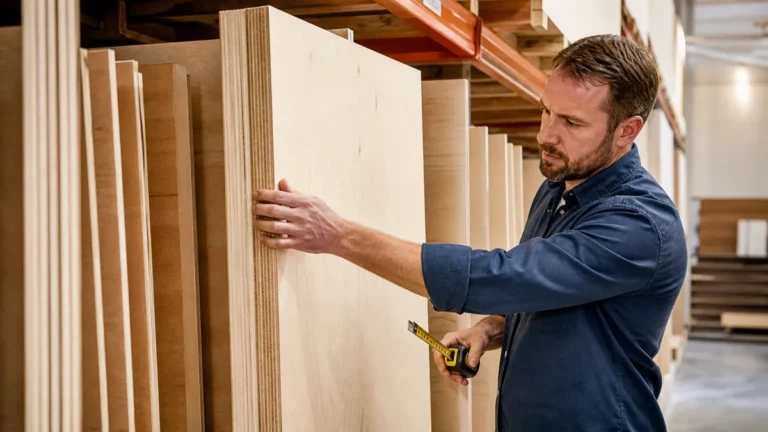
The conversions above are plain arithmetic. Actual sheets vary by maker, and thin plywood is often sanded a little under its label, so measure three sheets from the same pack with calipers and design around the thinnest one. If you are fitting a panel into a groove, cut the groove from a test piece, not from the nominal number.
Types of 1/8 Inch Plywood and Look-Alikes
At this thickness the type of wood matters more than the grade stamp, because there are only a few thin layers to work with. These are the sheets you will actually find:
| Type | What it is | Best for | Watch out for |
|---|---|---|---|
| Baltic birch (3mm) | Birch plies, void-free core, sold in small precut sheets | Laser, CNC, small boxes, joinery | Costs more per square foot |
| Lauan / luan door skin | Soft tropical hardwood face with a soft core, sold in full 4×8 sheets | Drawer bottoms, cabinet backs, templates, door skins | Splinters easily; weak edges and screws |
| Basswood craft ply | Very light, soft layers | Scroll saw, low-power laser, models | Fragile; dents and cracks |
| Hardwood veneer ply | Maple, oak or birch face over a thin core | Visible panels and furniture backs; see our 1/8 maple plywood guide | Face veneer can sand through |
| Hardboard (not plywood) | Pressed wood fiber, often called Masonite | Jigs, templates, drawer bottoms | Heavier, no grain, swells if it gets wet |
Lauan is the sheet most people mean when they say “1/8 plywood” at a home center, and it is a very different material from Baltic birch. Our plywood vs luan comparison covers the full differences, and Baltic birch vs maple plywood explains why birch plies behave so differently from a face-veneer-only hardwood sheet.
How Much Does a 4×8 Sheet of 1/8 Plywood Weigh?
Sheet weight is volume times density. A 4×8 sheet is 32 square feet, and at 1/8 inch (0.125 inch) thick it holds 0.333 cubic feet of wood. Multiply that by the density of the wood and you get the sheet weight. Here are estimates using typical dry densities, not weights from a scale:
| Material | Typical density (lb per cu ft) | Estimated 4×8 sheet at 1/8 inch |
|---|---|---|
| Basswood-type light ply | About 26 | About 9 lb |
| Lauan / meranti door skin | About 34 | About 11 lb |
| Baltic birch | About 40 | About 13 lb |
| Hardboard | About 55 | About 18 lb |
The commonly quoted “9 pounds per sheet” is the light end of that range. Real sheets shift by roughly 10 percent with glue content and moisture, so treat these as planning numbers. For stacking and hauling, a 10-sheet bundle of lauan is closer to 110 pounds than 90. If you want to run the numbers for other thicknesses, use our woodworking calculators guide.
1/8 vs 1/4 Plywood: How Much Difference Does Thickness Make?
Doubling thickness does far more than double the performance. For a panel loaded across its face, bending strength rises with the square of thickness and stiffness rises with the cube. Switching from 1/8 inch to 1/4 inch of the same plywood gives you about 4 times the strength and 8 times the stiffness for only twice the weight.
| Property | 1/8 inch | 1/4 inch |
|---|---|---|
| Relative bending strength | 1x | About 4x |
| Relative stiffness | 1x | About 8x |
| Relative weight | 1x | 2x |
| Good for | Drawer bottoms, backs, crafts, templates | Larger backs, light panels, shelf liners |
That is why 1/8 inch sheets sag across a wide span with any load, and why a drawer bottom wider than about a foot needs support. Our 1/4 inch 4×8 plywood guide and the Menards 1/4 plywood guide cover the next step up in more detail.
What Is 1/8 Plywood Actually Used For?
At this thickness, plywood is a thin skin or a backing, never a structural member. Common jobs where it works well:
- Drawer bottoms and cabinet backs: thin enough to slide into a groove without adding bulk.
- Door skins: the lauan face on hollow-core interior doors.
- Templates and jigs: cheap, easy to cut, and easy to replace.
- Laser, CNC and scroll saw crafts: Baltic birch and basswood are the usual choices.
- Models and RV or camper paneling: light and easy to shape.
One thing it is not good for is sheathing or subflooring. Structural wall and roof sheathing panels are built from much thicker plywood or OSB, and a 1/8 inch sheet has nowhere near the stiffness for those jobs, as the strength math above shows.
Can You Bend 1/8 Plywood? Minimum Bend Radius
Yes, within limits. Thin plywood bends because each ply is thin, but the outer plies stretch and compress, and the outside face is what cracks first. Woodworkers often start testing at roughly a 6 inch radius for dry 1/8 inch plywood and tighten from there if the scrap survives. There is no single guaranteed number, since it depends on species, glue and ply count.
- Bend along the face grain. Curve the sheet like a ruler flexed lengthwise, so the bend line runs across the grain. Bending the other way splits the surface far sooner.
- Use a form. Clamp or strap the sheet to the curve and leave it overnight so it takes the shape.
- Go tighter with kerfs. Shallow cuts on the inside face relieve the stress, but they show, so they suit hidden surfaces.
- Laminate for strength. Glue two or three 1/8 inch layers around a form and clamp. The result is a rigid curved panel that holds its shape, which a single bent sheet will not.
Wetting or steaming helps on tight curves, but thin plywood has glue lines that can swell and warp, so test before you commit a project to it.
Cutting and Finishing 1/8 Plywood
Thin plywood tears its face veneer easily. A fine-tooth blade, a zero-clearance insert and a piece of tape over the cut line all reduce tearout. Support the sheet fully while you cut, because an unsupported 1/8 inch sheet flexes and chatters. A fresh blade in a utility knife will score and snap a straight line in thin lauan, and a scroll saw handles curves.
For finishing, sand lightly (120 to 150 grit), because the face veneer is thin enough to sand through. Seal both faces equally, since a heavy coat on one side only can cup the sheet.
1/8 Plywood Cost: How to Compare Prices Fairly
Full 4×8 sheets are priced per sheet, and hobby packs are priced per pack, so price per square foot is the fair comparison. A 4×8 sheet is 32 square feet, so divide the sheet price by 32. For packs, multiply sheet area by sheet count. Prices change, so these examples are as listed on Amazon on 2026-10-07 and may be different when you read this:
| Pack | Listed price | Area | Cost per sq ft |
|---|---|---|---|
| Woodpeckers 3mm Baltic birch, 12×20 in, 20 sheets | $67.31 | 33.3 sq ft | About $2.02 |
| Baltic birch 1/8 in, 11.8×11.8 in, 20 sheets | $33.99 | 19.3 sq ft | About $1.76 |
Smaller sheets cost more per square foot than full sheets, and you pay for precision cutting and the void-free birch core. If you only need panels bigger than 12 inches, a full sheet of lauan or birch is usually the cheaper route, and a lumber yard can cut it down to fit your car.
Frequently Asked Questions
How thick is 1/8 plywood really?
It depends on the product. A sheet sold as 3mm (common for Baltic birch) is about 0.118 inch, while a true 1/8 inch is 0.125 inch. Lauan and door-skin sheets are often a little thinner than either. Measure with calipers before you cut a slot or dado for it.
How much does a 4×8 sheet of 1/8 plywood weigh?
Roughly 9 to 14 pounds for most plywood, depending on the wood. A light basswood-type sheet lands near the bottom, lauan in the middle and Baltic birch near the top. Hardboard of the same thickness is heavier, around 18 pounds. These are calculated estimates, so weigh a sheet if the number matters.
Can you bend 1/8 plywood without steaming?
Yes, gently. Curve it along the face grain, support it on a form, and test a scrap first. If it cracks on the outside face, use a wider radius, cut kerfs on the inside of the bend, or glue two or three thin layers around a form.
Is 1/8 plywood the same as luan or lauan?
No. 1/8 inch describes a thickness. Lauan (luan) door skin is one 1/8 inch product, with a soft core and a thin face veneer. Baltic birch and basswood craft ply also come in 1/8 inch and behave differently when cut, glued and screwed.
Is 1/8 plywood strong enough for shelves or sheathing?
No. Bending strength rises with the square of thickness and stiffness with the cube, so a 1/4 inch sheet is about 4 times as strong and 8 times as stiff as 1/8 inch of the same material. Use 1/8 inch for drawer bottoms, backs and crafts, not for load-bearing shelves, floors or wall sheathing.
Conclusion
Treat “1/8 plywood” as a thickness, not a material. Check whether the sheet is 3mm or a full 0.125 inch, pick the type for the job (lauan for backs and templates, Baltic birch for laser and joinery), and expect a 4×8 sheet to weigh roughly 9 to 14 pounds. When you need real stiffness, step up to 1/4 inch plywood.
Sponsored / affiliate links. As an Amazon Associate I earn from qualifying purchases. I may earn additional commission from eligible campaigns.
 Baltic Birch Plywood Sheets Box of 45 - Laser Engraving Cutting, Scroll Saw Nature Veneer Color, Stronger Than Basswood, A/A Grade,12 x 12 x 1/8”, 3mm Thickness Perfect for Wood Burning
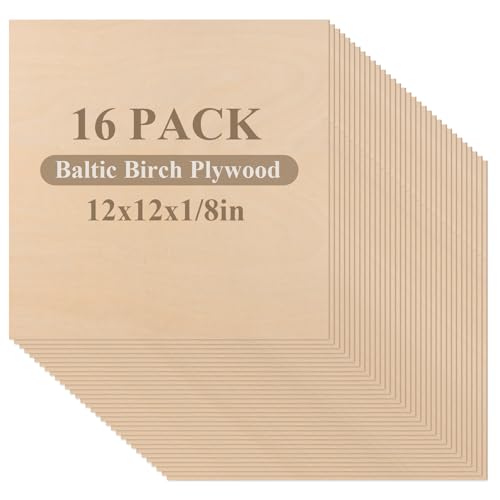 16 Pcs Baltic Birch Plywood 1/8" Plywood Sheets 12" x 12" Inch Thick Birch Unfinished Wood for Arts and Crafts, DIY Projects, Drawing, Painting, Laser, Wood Engraving