2 Minute Remover Advanced Review: Does It Work?
2 Minute Remover Advanced can strip many furniture finishes in one pass, but thick varnish, oil-based polyurethane, or layered finishes often need a second application; the gel is the better buy for vertical surfaces. Choose the wrong version or rush the dwell time, and you waste product, risk veneer damage, and leave softened finish that gums up scraping. This review explains how 2 Minute Remover Advanced works on common wood finishes, when liquid or gel makes sense, and when a different stripper is the better choice.
Verdict
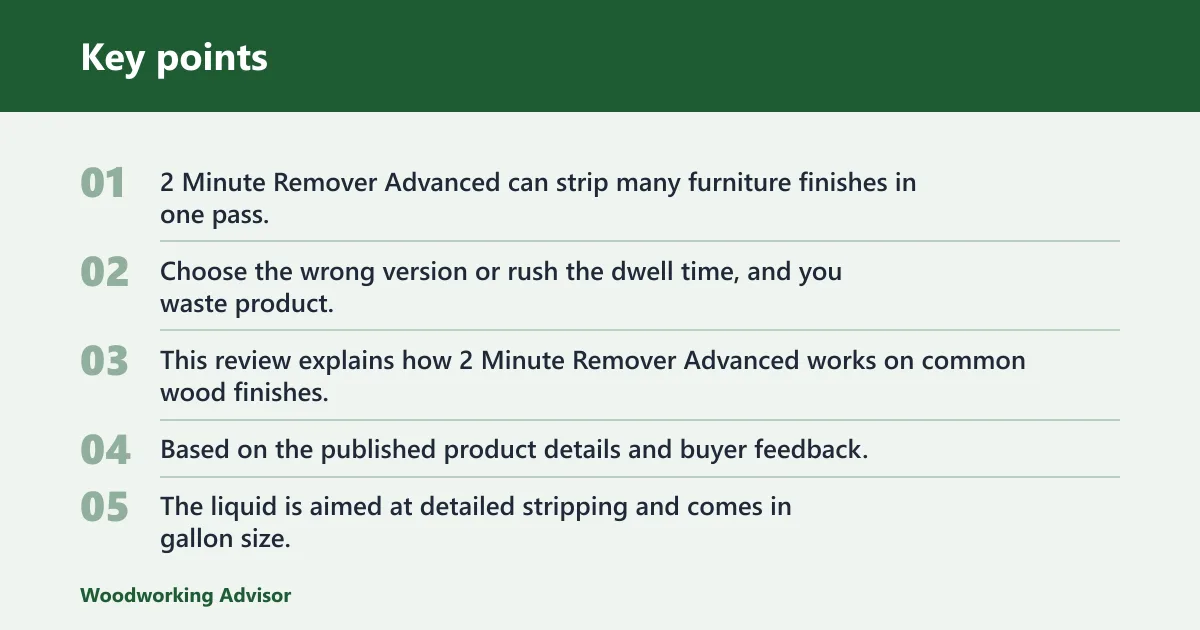

Based on the published product details and buyer feedback, this is a solid furniture stripper when you match the format to the job. The liquid is aimed at detailed stripping and comes in gallon size. The gel gives better control on vertical or detailed surfaces and comes in quart and gallon sizes. Neither format is a one-coat fix for old, heavy coatings.
Specs at a glance
| Item | 2-Minute Remover Advanced Liquid | 2-Minute Remover Advanced Gel |
|---|---|---|
| Format | Liquid | Gel |
| Size | Gallon | Quart and gallon |
| Solvent profile | Methylene chloride free; less than 50% VOC; medium evaporation rate; medium odor | Methylene chloride free |
| Best use | Detailed stripping, flat surfaces, tight features where flow helps | Vertical surfaces, edges, moldings, carvings, and controlled application |
| Targets | Latex paint, oil-based paint, lacquer, shellac, varnish, epoxy, polyurethane | Same product family and finish targets |
| Wood compatibility | Will not harm wood or corrode metal | Will not harm wood or corrode metal |
| Stain effect | Quickly attacks finish and lightens wood stain | Same family behavior on stain lightening |
Pros and cons
What it does well
- Removes multiple layers of finish in one application on many furniture jobs.
- Works on latex paint and oil-based paint, plus lacquer, shellac, varnish, epoxy, and polyurethane.
- Liquid is useful for detailed stripping where flow into profiles helps.
- Gel gives better control on vertical or detailed surfaces.
- It is methylene chloride free.
Where it falls short
- Thick polyurethane buildup often needs a second pass.
- Carved corners and recesses can hold softened residue that scraping misses.
- Cleanup can be more work than the label promise suggests, especially around hardware and joints.
- Wood stain may lighten, but that is not the same as full stain removal from the wood fibers.
Who it
This is for DIYers stripping furniture, cabinets, trim, or mixed-finish woodwork who want a product that can handle paint and traditional clear coats. It is a better fit if you need control on edges, moldings, or vertical panels. It is not the best choice if you want a one-and-done answer on thick, aged polyurethane or layered refinishing jobs.
A common first-timer mistake is choosing the liquid for a carved chair back because it sounds faster. On a vertical spindle or recessed panel, the liquid can run away from the finish film, leaving high spots soft and low spots untouched. The gel is usually the cleaner choice there.
Best projects for the liquid
Pick 2-Minute Remover Advanced Liquid when the piece has detailed profiles, but the surface still lies mostly flat. The liquid can move into grooves and raised grain more easily, which helps on ornate trim, drawer fronts, and furniture parts with consistent horizontal exposure. The gallon size also fits larger stripping jobs.
Best projects for the gel
Pick 2-Minute Remover Advanced Gel for vertical panels, cabinet doors, chair backs, carved aprons, and any surface where run-off is a problem. The gel format holds position better, so you waste less product on gravity-driven drips and get more even contact on edges and corners. Its quart and gallon sizes help match project scale.
What works
2 Minute Remover Advanced is aimed at the finish stack most furniture owners actually face: latex paint, oil-based paint, lacquer, shellac, varnish, epoxy, and polyurethane. That range matters because old furniture is often not wearing a single clear coat. It may have stain, sealer, topcoat, and touch-up layers all in one piece.
Finish types it can remove
Latex paint and oil-based paint are both within the product’s stated target list. That makes it more versatile than a mild cleaner or paint wash, which only removes surface grime. It also targets lacquer, shellac, varnish, epoxy, and polyurethane finishes, so it covers common furniture coatings and some tougher repair coatings.
For stain, the claim is narrower. The product quickly attacks the finish and lightens wood stain, but that does not mean every pigment line disappears completely. On a stained table or cabinet, you may see lighter color in the wood surface after the topcoat is gone, yet darker dye in the fibers can remain.
One-pass expectations
Yes, it can strip many furniture finishes in one application, especially thinner lacquer, shellac, or a light topcoat over stain. Thick varnish and oil-based polyurethane are different. If a piece has heavy buildup, old repairs, or multiple refinished layers, a second pass is common and should be planned for rather than treated as a failure.
Suppose a dresser top has two visible finish eras: a later amber polyurethane over an older coat. A single pass may soften the upper layer enough to scrape, but the lower film can stay bonded in pores and corners. A second application usually matters more there than on a lightly coated side panel.
What does not?
The weak spots are predictable. Thick polyurethane buildup resists a quick single pass. Corner recesses and carvings trap softened finish, so wipe-off alone leaves residue behind. Mixed-finish furniture can also create patchy results because one area may strip clean while another still holds hardened sealer or touch-up film.
Another limitation is cleanup burden. After stripping, you still need to remove residue before sanding or refinishing. If softened finish stays in pores, it can clog sandpaper and interfere with adhesion. That is especially true around inlay lines, hinge mortises, pulls, and edge profiles where residue gathers.
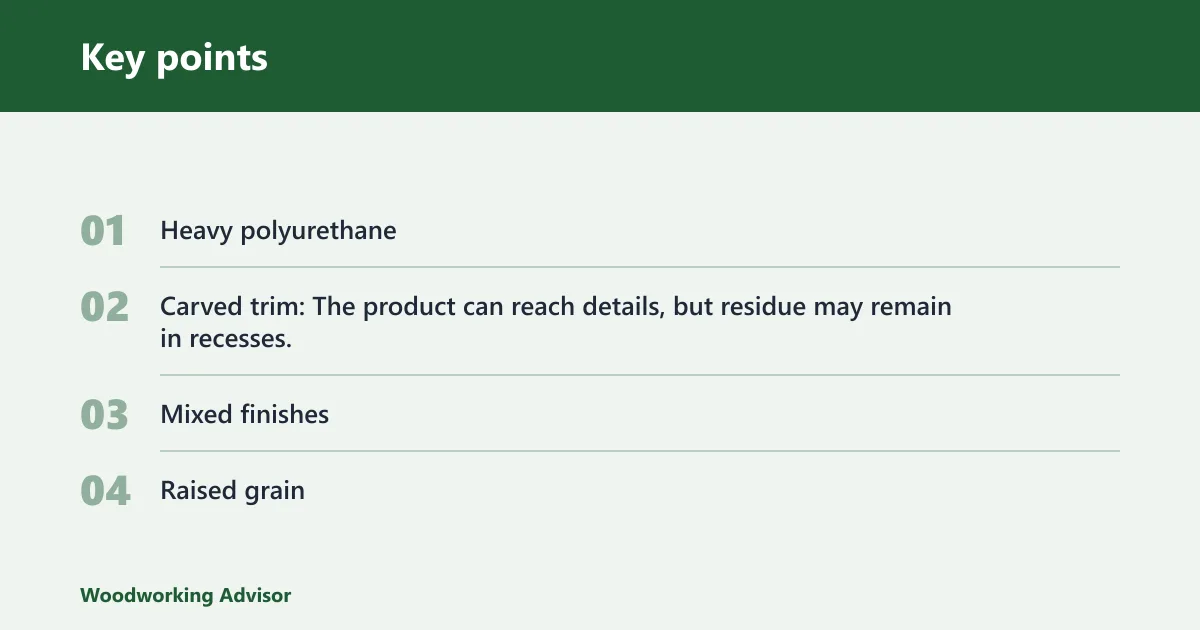
Typical failure cases
- Heavy polyurethane: Often needs more dwell time and a second application.
- Carved trim: The product can reach details, but residue may remain in recesses.
- Mixed finishes: One section may clear faster than another, which makes the surface uneven.
- Raised grain: After stripping, the wood can feel rough and need sanding before refinishing.
2-Minute Remover Advanced specs
The liquid and gel are close relatives, but they are not interchangeable on furniture. The liquid is the detailed-stripping version in gallon size, with less than 50% VOC, medium evaporation, and medium odor. The gel comes in quart and gallon sizes and is the better choice when control matters more than flow.
Liquid version
2-Minute Remover Advanced Liquid is methylene chloride free and designed to remove multiple layers of finish in one application. It is the version to consider when you want detailed stripping and need a liquid that can move into texture. The downside is that liquid can also move off the target area if the surface is vertical or highly shaped.
Gel version
2-Minute Remover Advanced Gel is the steadier option for furniture edges, moldings, and vertical panels. It stays where you place it longer, which helps with dwell consistency on chairs, cabinets, and carved trim. The tradeoff is that gel may need more careful spreading to cover broad flat surfaces evenly.
What works on wood furniture?
On wood furniture, this stripper is meant for the coatings on top of the wood, not a miracle cure for every color change inside the grain. It removes latex paint, oil-based paint, lacquer, shellac, varnish, epoxy, and polyurethane finishes. It can also lighten wood stain, which may help before refinishing, but stain removal is not the same as resetting the wood color completely.
Latex paint and oil-based paint
Latex paint usually softens quickly, though heavy buildup in corners can still need a second pass. Oil-based paint is tougher and often needs a stronger stripper than simple cleaners. On furniture, both coatings can hide details, so the real test is how evenly the old film breaks loose from profiles and edges.
Lacquer, shellac, varnish, epoxy, and polyurethane
Lacquer and shellac are often easier than old polyurethane, but age and layer thickness matter more than the label name alone. Varnish and polyurethane are common furniture topcoats and often build up in film thickness over time. Epoxy is harder to strip than simpler coatings, so expect more scraping, more residue removal, and possibly a second application.
Wood stain lightening
The product can lighten wood stain, which is useful when a dark topcoat has locked color into the finish stack. Still, lighter stain after stripping is not the same as clean bare wood. If the stain has penetrated deeply, you may need sanding, oxalic acid treatment in specific cases, or a different refinishing plan after the stripper is removed.
When does it need a second pass?
A second pass is most likely on thick polyurethane buildup, old varnish that has hardened in layers, and mixed-finish pieces where one coating sits on another. Carvings, corners, and recesses also create false confidence because the flat faces may look stripped while the details still hold softened film.
Where one coat is usually not enough
Thick polyurethane, especially on tabletops and dresser tops, can resist one application because the coating film is dense and often aged unevenly. On those surfaces, plan for scraping after the first dwell, then a second application where the residue stays bonded. That is normal furniture work, not a product defect.
Temperature and dwell behavior
Research and label guidance from related strippers commonly point to 60-80 F as a practical working range. Cool conditions usually slow stripping, while heat can change evaporation and shorten working time. That means the same product may look fast in a warm room and slow on a cold porch or unheated shop.
How long should it sit before wiping off? Use the point where the finish looks softened, wrinkled, or liftable, not a fixed clock alone. A thin lacquer layer may be ready sooner than a thick varnish stack. If the surface starts to dry before scraping, you have waited too long for that temperature and coating combination.
2 minute remover advanced decision table
| Scenario | Expected dwell behavior | Likely number of applications | Cleanup risk | Better fit |
|---|---|---|---|---|
| Flat tabletop | Even contact; finish softens across a broad area | 1, sometimes 2 on heavy polyurethane | Moderate, because residue can pool near edges | Liquid if the surface is flat and detailed; gel if edges drip |
| Carved trim | Uneven dwell in recesses and profile cuts | 2 is common for full cleanup | High, because softened finish hides in grooves | Gel for control on contours |
| Vertical panel | Runs and sags can shorten effective contact | 1 on light coats; 2 on old build-up | High if product drips onto adjacent parts | Gel |
| Heavy polyurethane | Slow softening; film may wrinkle before it releases | 2 or more | Moderate to high, with scraping residue in pores | Gel for control; liquid only if the part is broad and detailed |
| Lacquer | Usually faster release than heavy varnish | 1, sometimes a touch-up pass | Moderate, depending on how much finish was sprayed on | Liquid for detailed stripping; gel for vertical parts |
| Shellac | Softens readily, but old contamination can slow cleanup | 1 | Low to moderate | Either; gel for edges, liquid for detailed flats |
| Mixed-finish furniture | Patchy dwell because different coatings react differently | 2 is common | High, because one area clears before another | Gel for controlled spot work |
How should you use it on furniture?
Use it on furniture with more care than a basic paint job. Mask adjacent parts, protect hardware, and plan for residue removal after the finish lifts. The product will not harm wood or corrode metal, but hinges, pulls, inlay edges, and adjacent veneer still need protection so the softened stripper does not creep where it should not.
Prep and masking
Remove loose dust and identify the finish before coating the entire piece. Mask or remove metal hardware when possible. On a cabinet or dresser, pay attention to hinge barrels, pulls, escutcheons, and inlay because stripped residue can collect around those edges and make cleanup harder later.
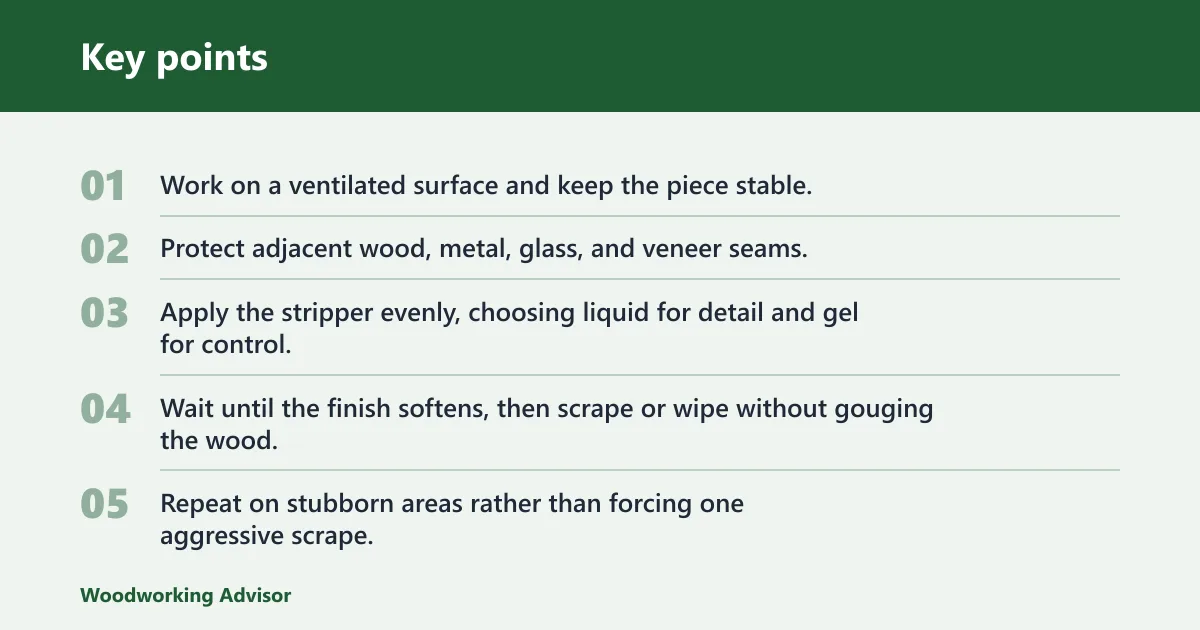
- Work on a ventilated surface and keep the piece stable.
- Protect adjacent wood, metal, glass, and veneer seams.
- Apply the stripper evenly, choosing liquid for detail and gel for control.
- Wait until the finish softens, then scrape or wipe without gouging the wood.
- Repeat on stubborn areas rather than forcing one aggressive scrape.
- Remove residue before sanding or refinishing.
Wipe-off and cleanup
Cleanup is not just a final wipe. Residue may remain tacky in corners, pores, and carvings after the top film comes off. Use the least aggressive scraping that clears the finish, then clean the surface until it is ready for sanding. If a piece still feels slick or gummy, stop and remove more residue before you move on.
After stripping, expect raised grain on many wood surfaces. That is normal once the finish film is gone and the wood has been wetted by stripper. Let the surface dry fully before sanding. If stain has lightened unevenly, decide whether you want to even the tone before applying a new finish, because new clear coats will not hide poor prep.
Before sanding or refinishing
Do not rush into new finish coats over residue. A stripped surface that still holds softened film, dust, or waxy remover traces can cause adhesion problems. If the project calls for a new stain, check whether the stripped wood is evenly colored enough to accept it. If not, plan for additional prep rather than hoping the topcoat will disguise the variation.
Alternatives

Citristrip QCG73801T Paint and Varnish Stripping Gel, 1-Quart is the better comparison if your main problem is vertical control. Based on the product details, it clings well to vertical surfaces and stays active up to 24 hours, which helps on doors, moldings, and detailed furniture parts. The drawback is slower workflow, and the quart size may be limiting for larger projects.
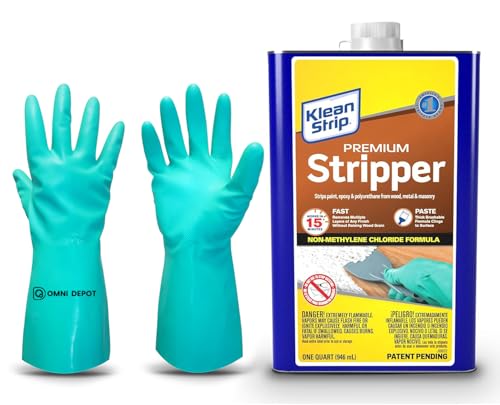
Paint & Varnish Remover Klean Strip Premium Stripper– Fast-Acting Stripper for Epoxy, Polyurethane, Wood, Metal & Masonry – Includes Protective Omni Depot Gloves – 1 QT is the tougher alternative for epoxy and polyurethane. Its listed strengths make sense if you are dealing with especially stubborn coatings. The tradeoff is that it is less furniture-specific in feel, and the included gloves do not solve the bigger issue of messy cleanup on detailed woodwork.
Should you buy it?
Buy 2 Minute Remover Advanced if your project is a real furniture stripping job and not just a light paint touch-up. It is a practical fit when you need one product that can handle multiple finish types, including lacquer, shellac, varnish, epoxy, and polyurethane, and when you can choose gel for vertical control or liquid for detail work.
Skip it if you want the easiest possible removal on thick, layered polyurethane without a second pass, or if the piece has so many carvings and mixed finishes that controlled spot work will take longer than the strip itself. For most DIY furniture owners, the value is in matching format to surface shape, not in expecting a single universal dwell time.
Frequently asked questions
Does 2 Minute Remover Advanced actually strip wood finish in one application?
Often, yes, but not always. It can remove many furniture finishes in one pass, especially lighter coatings and single-layer films. Thick varnish, oil-based polyurethane, and layered refinishes often need a second application, especially where the finish has built up in corners or around hardware.
Is 2 Minute Remover Advanced safe for wood furniture and metal hardware?
The product details say it will not harm wood or corrode metal, which is helpful for furniture stripping. Even so, you should protect adjacent parts because residue can collect around hinges, pulls, and inlay. Safe use here means control, masking, and cleanup, not careless flooding of the piece.
How long should 2 Minute Remover Advanced sit before wiping off?
There is no single furniture-safe clock that fits every finish. Wipe or scrape when the coating softens, wrinkles, or lifts cleanly. Cool conditions usually slow the process, while heat can shorten working time, so a lacquered drawer front and a polyurethane tabletop may not behave the same way.
What finishes can 2 Minute Remover Advanced remove?
It is aimed at latex paint, oil-based paint, lacquer, shellac, varnish, epoxy, and polyurethane. That is a broad range for furniture use. The important distinction is that some finishes release quickly while others, especially thick polyurethane or epoxy, often need more than one application.
Does 2 Minute Remover Advanced lighten wood stain too?
Yes, the product details say it quickly attacks the finish and lightens wood stain. That does not guarantee full stain removal, though. If pigment has penetrated deeply into the wood fibers, the stain may remain uneven after stripping, and sanding or a different refinishing plan may still be needed.
Is 2 Minute Remover Advanced methylene chloride free?
Yes. The liquid version is methylene chloride free, and that is one of its main selling points. The gel is in the same product family and is also positioned as a no-methylene-chloride option. That matters for users who are comparing stripping chemistry before buying.
What is the difference between the liquid and gel versions?
The liquid is designed for detailed stripping and comes in gallon size. The gel is available in quart and gallon sizes and gives better control on vertical or detailed surfaces. In practice, the choice comes down to flow versus hold: liquid moves into detail, while gel stays put better on edges and panels.
What temperature range works best for 2 Minute Remover Advanced?
A related FAQ for strippers says some products work best at 60-80 F. That is a useful working window for many furniture jobs, though the exact performance depends on the finish and the room. Cold slows stripping. Excess heat can speed evaporation and reduce working time.
Sponsored / affiliate links. As an Amazon Associate I earn from qualifying purchases. I may earn additional commission from eligible campaigns.