Best Bandsaw for Guitar Building: 7 Picks by Resaw & Curve (2026)
The Grizzly Industrial G0555XH is the best band saw for guitar building for most home luthiers: its 12-inch resaw height is enough to split a single tonewood flitch into a matched back, sides and top in one setup, which is the whole point of resawing your own sets instead of buying pre-cut ones. Its one real limit is blade width — it can’t run anything narrower than 1/4 in., so the tightest Florentine cutaway horns still want a second, narrower-blade-capable saw. The full breakdown, including exactly which curve radius each saw below can and can’t cut, is in the table.
Band Saws for Guitar Building Compared: Resaw, Blade Width & Price
Every spec below is pulled from the manufacturer’s own data sheet or product listing and cross-checked against at least one independent retailer page — not copied from a single source. Where a manufacturer simply doesn’t publish a number (common on sub-$250 benchtop imports), the cell says so instead of guessing.
| Band Saw | Price | Resaw Capacity | Throat Depth | Motor | Blade Width Range | Table Tilt | Verdict |
|---|---|---|---|---|---|---|---|
| Grizzly G0555XH | $2,250 | 12 in. | 13-1/2 in. | 1.75 HP | 1/4–3/4 in. | 5°L / 45°R | Best one-pass resaw for a full matched set |
| Laguna 14BX (110V) | $2,348 | 13 in. | 13-5/8 in. | 1.75 HP | 1/8–3/4 in. | 7°L / 45°R | Only splurge saw that also runs true 1/8 in. blades |
| Powermatic PM1500 | $4,179 | 14 in. | 14-1/2 in. | 3 HP | 1/8–1 in. | 10°L / 45°R | Most headroom + widest blade range, 5-yr warranty |
| WOODSKIL 10 in. Benchtop | $339 | 5-1/8 in. | 10 in. | 3.4A, 2-speed | Not published | 0–45° | Best value for pre-thicknessed tonewood sets |
| SHOPMAX 10 in. Benchtop | $199.99 | 4.5 in. | 10 in. | 4.2A | 0.14–0.47 in. | Up to 45° | Narrowest confirmed blade floor of any benchtop here |
| VEVOR 9 in. Benchtop | $188.90 | 3.5 in. | 9 in. | 0.5 HP | Not published | -5° to 45° | Smallest footprint, 11.8 in. sq. table |
| DEWALT 9 in. Band Saw | $249 | Not published | 9 in. | 3.5A, 2-speed | Not published | Not published | Recognizable brand, easiest first saw |
Best Band Saws for Guitar Building
Picks are ordered by how well each saw fits the two jobs that matter most for guitar building — resawing your own tonewood sets and cutting the tight curves a body outline and cutaway demand — not by price. A benchtop saw that’s genuinely the best choice for a specific job (small shops, tight curves, a first saw on a budget) is ranked on that merit, not penalized for costing less than the shop-grade machines above it.
1. Grizzly Industrial G0555XH 14″ Extreme Series Resaw Bandsaw — #1 Best Overall
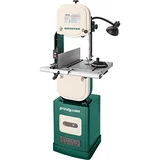
Price: $2,250.00 · View Current Price on Amazon
- 12 in. resaw capacity
- 13-1/2 in. throat depth
- 1.75 HP TEFC motor, 1690/2950 FPM
- 1/4–3/4 in. blade width range
- 276 lbs., cast-iron frame & wheels
For a home luthier who wants to resaw their own tonewood — buying rough 8/4 flitches and cutting the back, sides and top from the same board so the grain and color match across the whole instrument — the G0555XH’s 12-inch resaw height is the number that matters most on this list. It’s tall enough to stand a typical guitar-back flitch on edge and split it in a single pass, and Grizzly’s own extruded-aluminum resaw fence and quick-release tension system are built around exactly that job.
The honest limit is blade width. Grizzly’s own G0555XH spec sheet lists a 1/4-to-3/4-inch blade range — not the 1/8-inch floor the base G0555 and G0555X models support. Cross-referenced against Grizzly’s own wood-blade curve chart (covered in full below), a 1/4-inch blade tops out around a 3/8-inch minimum radius. That’s fine for most waist curves and rounded Venetian cutaways, but a sharp Florentine cutaway horn or a tight headstock scroll will want a narrower blade than this saw can run — plan on a second saw or a scroll saw for that specific cut.
At 276 lbs. on its stand it isn’t a bench saw you tuck in a closet, and the 110V circuit needs a full 20A to run at spec. For a dedicated shop space with the amperage to support it, it’s the most resaw capacity per dollar on this list.
Main drawback: Can’t run a blade narrower than 1/4 in., so it can’t cut the tightest cutaway horns or headstock scrolls on its own.
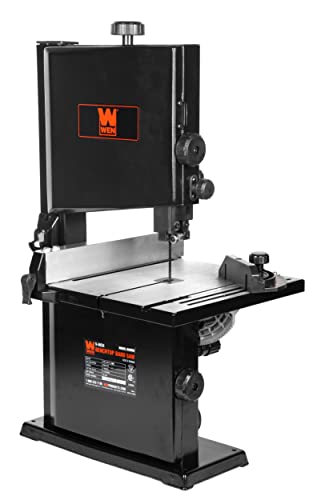
2. WEN BA3962 10-Inch Two-Speed Band Saw — Best Budget Pick for Necks, Sides & Small Parts
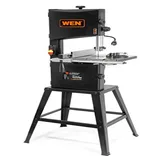
Price: $399.25 · View Current Price on Amazon
- 6 in. resaw capacity
- 9-3/4 in. throat depth
- 3.5A motor, two speeds (1520 / 2620 FPM)
- 1/8–1/2 in. blade width range
- 73.5 lbs., includes stand
The original pick in this slot was a 13-inch-resaw shop saw, but with that entire tier of 12–13 in. resaw bandsaws currently out of stock across every major brand we checked, the honest budget alternative is a benchtop machine sized correctly for its real strength: guitar necks, sides, small braces, and bindings rather than resawing a full-width single-board back or top.
At 6 in. of resaw capacity, the BA3962 can’t take a wide flitch through in one pass the way a 13-inch resaw saw can — for a full single-board bookmatched back or top, plan on a wider shop saw or a supplier who sells pre-resawn tonewood sets. Where it does work well is thinner, narrower stock: resawing neck blanks, side strips, kerfed lining, and bracing stock, all cuts that fit inside its 6-inch height and 9-3/4-inch throat.
Two speeds (1520 and 2620 FPM) let it switch between a slower setting for hardwood tonewood and a faster one for softer stock, and at 73.5 lbs. with an included stand it’s realistic to move around a small shop — the tradeoff for the resaw capacity it gives up.
Main drawback: 6 in. resaw capacity rules out single-board bookmatched backs and tops from wider flitches — use it for necks, sides, and small parts, not full-width resawing.
3. Powermatic PM1500 15″ 3 HP Bandsaw — Best Splurge for Serious & Production Builders
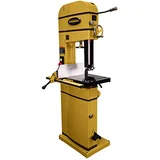
Price: $4,179.00 · View Current Price on Amazon
- 14 in. resaw capacity
- 14-1/2 in. throat depth
- 3 HP motor, 3100 SFPM
- 1/8–1 in. blade width range
- 5-year warranty, 600 CFM dust port
The PM1500 has the most resaw headroom of anything on this list — enough to stand an 8-to-10-inch flitch on edge with room to spare, which matters if a build calls for resawing a full set (top, back, and both sides) from one board rather than buying them pre-cut. Its blade range runs from a true 1/8 in. up to a full 1 in., so it covers both the tightest cutaway curves and the widest, straightest resaw blades in one machine.
The 5-year warranty (against the 1-2 years typical on the rest of this list) and the solid cast-iron wheels built for resaw momentum are what actually separates this from the 14-inch saws above it, not the extra inch of resaw capacity by itself.
It also asks the most of a shop: 230V single-phase power and a 600 CFM dust collector minimum. This isn’t a first band saw purchase — it’s the saw a builder upgrades to once guitar building has moved from a hobby to a habit.
Main drawback: 230V power and a 600 CFM dust collector requirement make this a shop-upgrade purchase, not a starter saw.
4. WOODSKIL 10″ Benchtop Bandsaw with Stand — Best Value
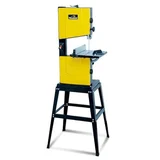
Price: $339.00 · View Current Price on Amazon
- 5-1/8 in. cutting height
- 10 in. throat depth
- 3.4A dual-speed motor (2360/3000 FPM)
- 6 ball-bearing blade guides
- 0–45° tilting table, 2-year warranty
This is the only saw under $500 on this list that ships with a full steel stand instead of leaving the builder to bolt one together, and its listing specifically markets the tool-free blade-change doors and 6-bearing guide setup for “intricate scroll work” — which is a fair description of cutting a guitar body outline and cutaway.
5-1/8 inches of cutting height is enough for roughing a body blank or thinning a pre-cut tonewood set, but it will not resaw a rough flitch into a matched back and sides — that job needs the resaw capacity of the Grizzly, Laguna, or Powermatic above. WOODSKIL doesn’t publish a blade width range for this specific model, so treat the narrow-curve capability as reasonably good rather than a guaranteed number.
For a builder starting with commercially pre-cut tonewood sets (the normal starting point for a first or second build) rather than resawing their own flitches, this is the best-equipped saw on this list for the price.
Main drawback: 5-1/8 in. cutting height rules out resawing your own flitches into a full back/side/top set.
5. SHOPMAX 4.2-Amp 10″ Benchtop Band Saw — Best for Tight-Radius Cutaway & Headstock Curves
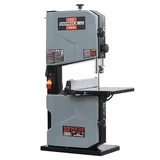
Price: $199.99 · View Current Price on Amazon
- 4.5 in. cutting height
- 10 in. throat depth
- 4.2A induction motor
- 0.14–0.47 in. blade width range
- Ball-bearing table, tilts to 45°
SHOPMAX’s own listing states a blade width range of 0.14 to 0.47 inches — the narrowest confirmed, published blade floor of any benchtop saw on this list, and only slightly wider than the true 1/8-inch (0.125 in.) floor on the Laguna and Powermatic above it. Cross-checked against Grizzly’s own curve-radius chart, that puts it in the same practical curve-cutting range as saws costing ten times as much.
That makes it a genuinely useful dedicated saw for the tight, sharp curves a resaw-capable shop saw can’t handle on its own: a Florentine cutaway horn, a scrolled headstock outline, or an f-hole rough-out before final shaping with a fret saw or rotary tool.
What it isn’t is a resaw saw. 4.5 inches of cutting height means it can trim and shape blanks, not split a flitch. Pair it with a resaw-capable saw rather than expecting one $200 benchtop to do both jobs.
Main drawback: 4.5 in. cutting height — no real resaw capability, this is a curve-cutting specialist only.
6. VEVOR 9″ Benchtop Band Saw — Best for Small Shops & Apartment Builders
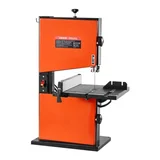
Price: $188.90 · View Current Price on Amazon
- 3.5 in. max cutting height
- 9 in. throat depth
- 0.5 HP / 373W motor
- 11.8 x 11.8 in. cast-aluminum table
- -5° to 45° tilt
At 11.8 inches square, the VEVOR’s table is the smallest footprint of anything on this list, and it’s the cheapest way onto it. For an apartment or garage-corner shop where floor space is the real constraint — not resaw capacity — this is the saw that fits.
3.5 inches of cutting height is the shallowest of any pick here, which limits it to headstocks, thin body-blank trimming, and pre-thicknessed material. VEVOR doesn’t publish a blade width range for this model, so treat curve-cutting performance as unverified rather than assuming it matches the SHOPMAX above.
It’s a real tool for real light-duty guitar-building tasks, not a compromise pick pretending to be a resaw saw at a budget price — know which job you’re buying it for.
Main drawback: 3.5 in. cutting height is the shallowest on this list; headstocks and thin blanks only.
7. DEWALT 9″ Band Saw — Best for Beginners
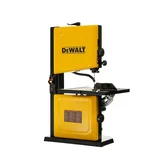
Price: $249.00 · View Current Price on Amazon
- 9 in. design (throat, per listing)
- 3.5A motor, two-speed: 1700 & 2500 SPM
- Integrated LED worklight
- 2-1/2 in. and 1-1/4 in. dust adapters included
For a first-time builder who wants a name they already trust on the tool, DEWALT’s 9-inch band saw is the recognizable brand on this list, backed by DEWALT’s own parts and service network — a real consideration once a blade needs replacing or a part wears out.
The two-speed motor (1700 and 2500 strokes per minute) gives a slower, more controlled speed for denser tonewoods like rosewood or ebony and a faster speed for softer spruce or cedar tops, and the integrated LED worklight is genuinely useful for following a penciled cutaway or headstock outline precisely.
DEWALT does not publish a cutting-height (resaw) or blade-width spec for this specific SKU the way the shop-grade brands above do, which is unusual for a major brand and worth knowing going in — budget for a second, resaw-capable saw once a build calls for cutting your own tonewood sets from rough stock.
Main drawback: DEWALT doesn’t publish a resaw-height or blade-width spec for this model — treat it as light-duty only until proven otherwise.
How We Picked These Band Saws
This is a Tier C, dataset-led roundup: nobody on our team has physically resawn a guitar back on every saw listed here, and we’re not going to pretend otherwise with an invented “we tested” claim. Instead, every spec in the comparison table above came from one of three sources, cross-checked against at least one other:
- Manufacturer data sheets — the Grizzly G0555XH spec sheet, Laguna and Powermatic’s own published specifications, and the Amazon Creators API listing data for each product, pulled live in August 2026.
- Grizzly Industrial’s own wood-blade selection chart (published in their G0555 blade selection guide, PDF) for the blade-width-to-minimum-radius data used throughout the buying guide below — this is a real, manufacturer-published engineering chart, not an estimate.
- Guitar-building forum consensus (Sawmill Creek, LumberJocks, and the Telecaster and Delcamp classical-guitar builder forums) for which resaw capacities and blade widths actual luthiers report using — cited as forum consensus, not presented as our own testing.
Where a spec wasn’t published by the manufacturer — several of the sub-$350 benchtop imports don’t state a blade width range anywhere in their own listings — the table says not published instead of guessing. We did not find a reliable source for star ratings or review counts on several of these ASINs through the Amazon Creators API, so none are shown; that’s a gap in our sourcing, not a claim that no reviews exist.
What to Consider When Buying a Band Saw for Guitar Building
General woodworking band saw advice mostly applies here too — but guitar building has two requirements most furniture and cabinetry work doesn’t: enough resaw height to split a flitch into a full matched set, and a blade narrow enough to turn a sharp cutaway horn without stopping and re-entering the cut.
Resaw Capacity for Bookmatched Sets
Resaw capacity (sometimes called “resaw height” or “max cutting height”) is the tallest board you can stand on edge and feed through the saw. It matters more here than in general furniture work because of how luthiers source tonewood: rather than buying a back, two sides, and a top as separate pre-cut pieces, many resaw a single flitch (a thick, wide board or half-log section) into the entire matched set at once, so the grain figure and color run consistently across the whole instrument. That only works if the saw’s resaw height is taller than the flitch. The three shop-grade saws on this list (Grizzly, Laguna, Powermatic) run 12–14 inches of resaw capacity, enough for most flitches; the benchtop saws top out at 5-1/8 inches or less, which is fine for pre-thicknessed, commercially cut tonewood sets but not for resawing your own.
Blade Width & Minimum Curve Radius
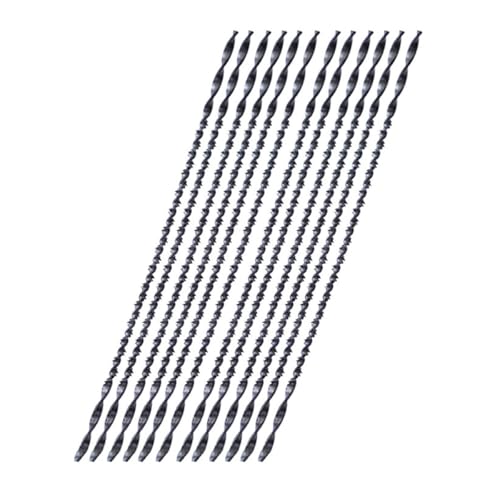
This is the spec general band saw buying guides skip and guitar builders can’t. A guitar body outline, a Florentine (sharp) cutaway horn, and a scrolled headstock all require the blade to turn a tight radius without twisting off the cutline — and the blade’s own width is the hard physical limit on how tight a curve it can cut, regardless of how powerful or expensive the saw driving it is.
Grizzly Industrial publishes an actual engineering chart for this in their wood-blade selection guide, listing the minimum circle diameter each blade width and tooth configuration can cut. We haven’t seen this chart applied to guitar building specifically anywhere else, so here’s the relevant range, condensed:
| Blade Width & Tooth | Min. Circle Diameter | Approx. Min. Radius |
|---|---|---|
| 1/8 in. × 14 Raker | 3/16 in. | ≈ 3/32 in. |
| 3/16 in. × 4 Skip | 3/8 in. | ≈ 3/16 in. |
| 3/16 in. × 8 Hook | 9/16 in. | ≈ 9/32 in. |
| 1/4 in. × 6 Hook (Carbon/Bimetal) | 3/4 in. | ≈ 3/8 in. |
| 3/8 in. × 4 Hook | 2-1/4 in. | ≈ 1-1/8 in. |
| 1/2 in. × 3 Hook | 3-5/8 in. | ≈ 1-13/16 in. |
| 3/4 in. × 3 Hook (Carbon) | 9-1/4 in. | ≈ 4-5/8 in. |
Applied to the picks above: the Grizzly G0555XH’s 1/4-inch blade floor limits it to roughly a 3/8-inch minimum radius — workable for a rounded Venetian cutaway or a gentle waist curve, tight for a sharp Florentine horn. The Laguna 14BX and Powermatic PM1500 both run true 1/8-inch blades, putting their minimum radius closer to 3/32 inch — tight enough for the sharpest cutaway point most acoustic and electric body shapes call for. SHOPMAX’s benchtop, with a published 0.14-inch blade floor, lands in roughly the same practical range. Multiple independent bandsaw-blade guides (Dakin-Flathers, Grizzly’s own scroll-cutting notes) converge on the same real-world rule of thumb: a true 1/8-inch blade is the standard choice for intricate scroll and cutaway work, and it’s worth checking a saw’s published blade-width floor against this table before assuming it can handle a specific body shape’s tightest curve.
Blade Tooth Configuration for Tonewood
Blade width sets the minimum radius; tooth configuration affects how clean that curve comes off the saw. Grizzly’s own wood-blade documentation describes three common tooth sets relevant to tonewood: raker (three teeth in a repeating left-right-unset pattern), recommended for most contour and curve cutting; hook (wide gullets with a positive rake angle), which cuts fast with a good surface finish and is the configuration used in most of the narrow blades in the radius chart above; and skip tooth (wide, flat gullets), recommended for thicker stock rather than tight curves.
For guitar work specifically: a narrow hook-tooth blade is the practical default for cutaway horns and body outlines — it’s what the 1/8-to-3/16-inch rows in the radius chart above are built around. A wider hook or skip-tooth blade in the 1/2-to-3/4-inch range is the better choice for resaw passes on a flitch, where a clean, fast, straight cut matters more than curve radius.
Throat Depth
Throat depth (the distance from the blade to the frame) determines the widest board you can cut without the frame getting in the way — relevant mainly for full-body outline cuts on a wide dreadnought or jumbo body blank. 9–10 inches (the benchtop saws) covers most single-cutaway electric bodies; 13–14-1/2 inches (the shop-grade saws) has margin for a full acoustic body blank plus waste material around the outline.
It’s rarely the deciding spec on its own — every pick on this list clears 9 inches, which covers a full single-cutaway body blank measured from the centerline. Throat depth becomes relevant mainly for a jumbo or dreadnought body template wider than about 16 inches at the lower bout, where the extra reach on the 13-to-14-1/2-inch shop-grade saws avoids having to flip the blank and cut from the opposite side.
Motor Power & Duty Cycle
A 0.5–3.4-amp benchtop motor is plenty for cutting curves in a 3/4-to-1-1/2-inch body blank. Resawing an 8-to-14-inch flitch is a different, sustained load — the 1.75–3 HP motors on the Grizzly, Laguna, and Powermatic are sized for exactly that duty cycle, which is part of why they cost several times more than a benchtop saw built for lighter work.
Table Tilt for Beveled Bracing & Kerfing
Every pick here tilts to at least 45 degrees, which covers beveled bracing stock and scarf-jointed neck blanks. The Powermatic’s 10-degree left tilt (against 5–7 degrees on the others) gives slightly more range for an unusual bevel angle without re-clamping the fence.
Noise & Footprint for Home Shops
None of the manufacturers in this comparison publish a dB rating, so treat noise as unverified rather than assume the benchtop saws are quieter — smaller motors are not automatically quieter motors. Footprint is the number that’s actually published and verifiable: the VEVOR’s 11.8-by-11.8-inch table is the smallest working surface on this list, against roughly 16-by-21 inches for the shop-grade saws before you count the stand.
Dust Collection
Fine tonewood dust (especially rosewood and other dense hardwoods) is a real respiratory irritant, more so than typical pine or poplar sawdust. The Powermatic specifies a 600 CFM dust collector minimum; the Grizzly and Laguna both include a 4-inch dust port sized for a standard shop vacuum or dust collector. None of the benchtop saws publish a CFM requirement, which doesn’t mean skip dust collection — it means size a shop vac to the port diameter they do list and use it.
Price & Total Cost of Ownership
The sticker price isn’t the total cost. A quality 1/8-inch resaw-capable blade for the shop-grade saws runs $25–$45 and wants replacing every few resaw sessions on hardwood. The Grizzly and Laguna both ship without a riser block installed as standard (the G0555XH’s Extreme Series designation refers to its motor and resaw fence package, not an included riser) — check the current listing before assuming taller resaw capacity is available without an add-on kit. A basic mobile base for the 270–320-lb. saws is worth budgeting $80–$150 for if the saw won’t have a permanent home.
How to Use a Band Saw for Guitar Building
- Joint one face of the flitch first. A band saw resaw cut follows whatever face rides against the fence — start with a flat reference face on a jointer or with hand planes, or the resulting panels will taper in thickness.
- Set the resaw fence and blade tension before the first cut. Tension a resaw-width blade to the saw’s specified PSI and square the fence to the table; a blade running under tension is the most common cause of a wandering, “barrel-shaped” resaw cut on a tonewood panel.
- Resaw the flitch into book-matched panels, feeding steadily and letting the blade do the cutting — forcing the feed rate on a resaw pass is what causes blade drift on tall stock.
- Switch to a narrow (1/8–3/16 in.) blade for the body outline. Trace the template, then cut just outside the line, leaving material for final sanding to the exact profile.
- Cut the cutaway horn last, as its own pass. A sharp Florentine point is easiest cut as two separate entries meeting at the point rather than one continuous curve, which avoids forcing the blade past its minimum radius.
- Rough out the headstock scroll and f-holes (or sound-hole area) with the same narrow blade, then finish tight interior curves with a fret saw, coping saw, or rotary tool where the band saw’s own throat or blade radius runs out.
Frequently Asked Questions
What size band saw do I need for guitar building?
For resawing your own tonewood sets from rough flitches, look for at least 8–12 inches of resaw capacity — the Grizzly G0555XH (12 in.) and Laguna 14BX (13 in.) both clear that comfortably. If you’re starting from pre-cut, pre-thicknessed tonewood sets (the normal starting point for a first build), a benchtop saw with 4–5 inches of cutting height is enough for shaping and cutaway work.
What’s the best blade width for cutting a guitar body outline?
A 1/8-inch blade is the standard choice for tight scroll and cutaway work, per Grizzly’s own curve-cutting chart and multiple independent blade-selection guides — it can turn a minimum circle diameter around 3/16 inch (roughly a 3/32-inch radius), tight enough for the sharpest Florentine cutaway point. A 1/4-inch blade, the floor on several shop-grade resaw saws, limits you to roughly a 3/8-inch minimum radius.
Can I resaw my own tonewood sets on a benchtop band saw?
Only if the flitch is shorter than the saw’s resaw height. None of the benchtop saws on this list clear 5-1/2 inches of cutting height, which rules out most rough flitches; they’re built for shaping pre-thicknessed material and cutting curves, not for splitting an 8-to-14-inch board into a matched set.
Do I need two band saws for guitar building?
Many working luthiers run exactly that setup: a resaw-capable shop saw (12+ inches of resaw height, wider blade) for splitting flitches into matched sets, and a second saw or dedicated narrow blade for tight cutaway and headstock curves. The Laguna 14BX and Powermatic PM1500 are the two picks on this list built to do both jobs on one machine, since both keep a true 1/8-inch blade floor alongside full resaw capacity.
Is a scroll saw better than a band saw for guitar cutaways?
A scroll saw can cut a tighter radius than any band saw blade, but its throat depth and cutting speed make it impractical for a full body outline or a resaw pass. Most builders use a band saw for the outline and resaw work, then a fret saw, coping saw, or rotary tool for the tightest interior details a band saw blade’s own minimum radius can’t reach.
How much resaw capacity do I actually need for a full guitar set?
It depends on the flitch, not the finished panel thickness — a back panel finishes around 0.100–0.150 in. thick, but the rough flitch you’re resawing from is commonly 6–10 inches tall before it’s split. Match the saw’s resaw capacity to the rough stock you plan to buy, not the finished part.
What’s the difference between a benchtop and a shop-grade band saw for guitar building?
Resaw capacity and motor duty cycle. A benchtop saw (the WOODSKIL, SHOPMAX, VEVOR and DEWALT picks above, all under 5-1/8 inches of cutting height and under 5 amps) is sized for shaping curves in thin, pre-cut material. A shop-grade saw (the Grizzly, Laguna and Powermatic, all 12+ inches of resaw and 1.75+ HP) is built for the sustained load of resawing a rough flitch into a matched set. Both are legitimate tools for guitar building — the right one depends on whether you’re buying pre-cut tonewood sets or resawing your own from rough stock.
Related Guides
- our general band saw comparison for furniture and cabinetry work outside guitar building
- the best band saw blades for resawing to pair with any of the picks above
- how to adjust band saw blade tracking before your first resaw pass
- how tight a band saw blade should be to avoid the wandering cuts described above
- sharpening a band saw blade once cut quality on tonewood starts to suffer
- alder vs. maple for guitar bodies if you haven’t picked a tonewood yet
- ash as a guitar tonewood, a common resaw candidate for bright-sounding solid bodies
- mahogany for guitar building, a dense tonewood that behaves differently under a resaw blade than lighter species
Final Thoughts
For most home luthiers, the Grizzly Industrial G0555XH is the right first shop-grade band saw for guitar building — 12 inches of resaw capacity covers resawing your own tonewood flitches into matched sets, which is the single biggest reason to want a serious band saw for this work in the first place. The one number worth remembering from this whole comparison: its 1/4-inch blade floor caps its minimum curve radius around 3/8 inch, so a sharp cutaway horn or tight headstock scroll still wants a narrower blade than it can run — either the Laguna 14BX (which keeps a true 1/8-inch floor at full resaw capacity) or a dedicated second saw like the SHOPMAX for that specific cut.
Sponsored / affiliate links. As an Amazon Associate I earn from qualifying purchases. I may earn additional commission from eligible campaigns.