Best Epoxy for Wood Rot Repair (2026): We Compared
For deep rot and restoration work, Abatron WoodEpox is the strongest overall fit because it is meant for structural rebuilding, can be painted or stained, and pairs well with consolidant-first repairs where wood has lost body but is not fully gone.
Quick comparison
| Product | Badge | Best for | Price | ||
|---|---|---|---|---|---|
 |
Abatron WoodEpox Kit – 2 Pint – 2-Part Structural EpoxyAbatron | Our pick | 2 Pint · Two-part · Structural epoxy filler | $49.75
Price as of 30 Oct 2026
|
View |
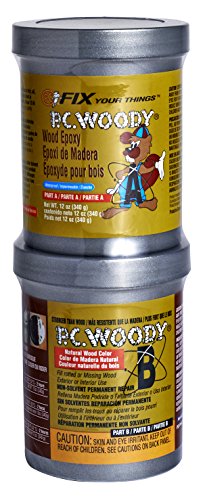 |
PC Products PC-Woody Wood Repair Epoxy Paste, Two-Part 12PC Products | Also great | 12 oz · Two-part · Tan paste | $18.89
Price as of 30 Oct 2026
|
View |
 |
J-B Weld Tan KwikWood Wood Repair Epoxy Putty, 1 oz. StickJ-B Weld | Budget pick | 1 oz · Hand-mixable · Tan stick | $6.19
Price as of 30 Oct 2026
|
View |
 |
System Three SculpWood Putty Epoxy Wood Filler, 8 oz, BrownSYSTEMTHREE | Upgrade pick | 8 oz · Two-part · Brown putty | $19.95
Price as of 30 Oct 2026
|
View |
The right epoxy depends on rot depth, moisture, and whether the part carries load. A shallow trim repair needs a different product than a soft sill edge or a damaged frame member.
If the wood is still damp or the damage is structural, do not treat every epoxy the same way. A thin consolidant, a paste filler, and a toughened adhesive solve different failure modes.
How we chose
We compared each option against five decision points: rot depth, moisture tolerance, cure behavior, finish compatibility, and repair role.
We also looked at whether the product fits small trim work, larger voids, exterior exposure, or structural consolidation. Cost per repair matters too, especially when a kit needs to cover a long sill or a single post corner.
The goal here is not to pick the “strongest” epoxy in a vacuum. The goal is to match the product to dry or damp wood, to cosmetic or load-bearing damage, and to the amount of material you need to rebuild.
| Repair need | Best product type | Why it fits | Watch out for |
|---|---|---|---|
| Deep rot with remaining sound wood | Consolidant plus filler system | Penetrates weak fibers, then rebuilds shape | Do not trap moisture in the core |
| Shallow surface loss on trim | Paste filler | Easier shaping, less material waste | Not enough for hollowed-out sections |
| Exterior voids and exposed edges | Waterproof exterior epoxy | Better weather resistance after cure | Still needs clean, dry prep |
| Small cosmetic repairs | Fast-curing putty | Quick to sand and finish | Too small for major structural loss |
| Bonding mixed materials | Toughened adhesive | Good for dissimilar substrates | Not a general wood filler |
PC Products PC-Woody: best for structural rot
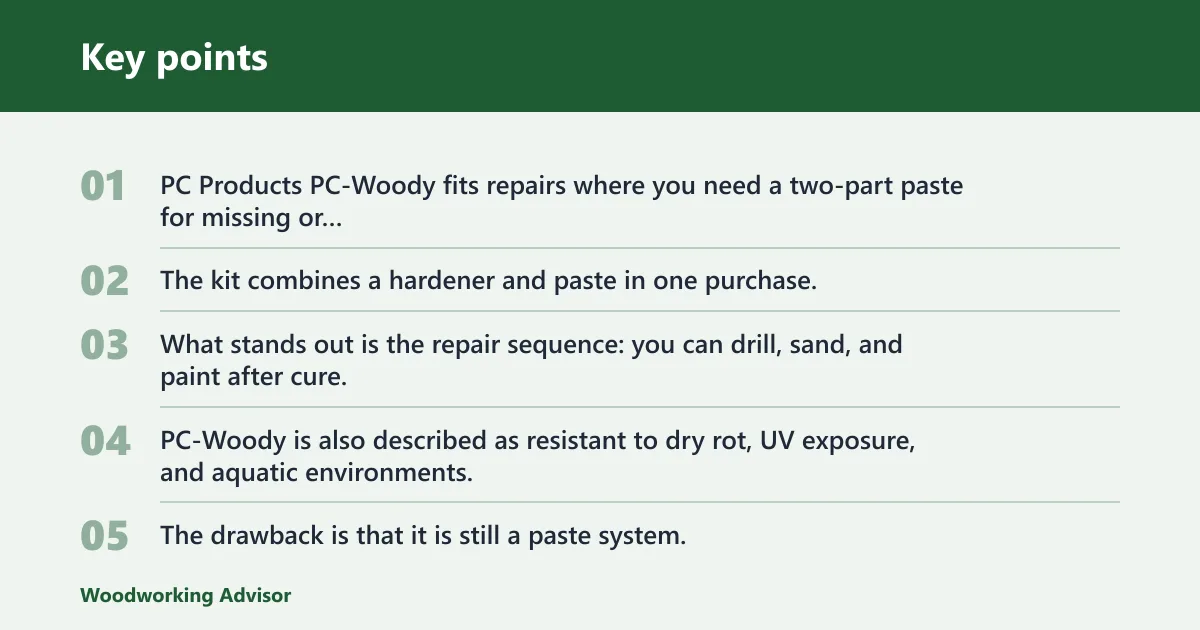
PC Products PC-Woody fits repairs where you need a two-part paste for missing or weakened wood, especially on trim, frames, and other sections that still need a solid rebuild. The kit combines a hardener and paste in one purchase, and the listed full cure time is 25 hours.
What stands out is the repair sequence: you can drill, sand, and paint after cure, which makes it useful when the damaged area needs shaping before finish work. PC-Woody is also described as resistant to dry rot, UV exposure, and aquatic environments.
The drawback is that it is still a paste system, so it is not the first choice when the wood is punky all the way through or when a large void needs a thin penetrant first. For deep decay, a consolidant ahead of the paste is often the safer route.
Abatron WoodEpox: best for restoration work
Abatron WoodEpox is the best fit when the repair has to look and behave like a restoration job rather than a simple patch. Abatron’s LiquidWood and WoodEpox system is known for low VOC, minimal odor, and use on historical restoration work, including windowsills, frames, trim, clapboards, and structural members.
This kind of system makes sense when you need a consolidant plus filler approach. LiquidWood helps stabilize weak fibers, then WoodEpox rebuilds the shape. That two-stage method matters when the wood is soft but still present, because filler alone cannot lock down crumbly core fibers.
The downside is that this category often asks for more prep and more patience than a quick putty repair. It is a better match for careful, paintable restoration than for a fast, tiny cosmetic fix.
System Three SculpWood: best for large voids
System Three SculpWood is the best fit when the job involves large or sculptural void fills, not just a narrow edge chip. It is a non-shrinking epoxy putty, sold here in an 8 oz size, and it sands and machines easily once cured.
That combination makes it useful when the repair needs shaping after the epoxy sets. It is a better match for built-up profiles, carved details, or broader missing sections than a thin repair paste that sags or pulls back as it cures.
The drawback is straightforward: 8 oz is not much material for a long sill or a major trim rebuild, so cost per repair rises fast on bigger jobs. For larger coverage, the 0.5-gallon pail version is the quantity class that matters, not the small pack.
J-B Weld Tan KwikWood: best for small repairs
J-B Weld Tan KwikWood is the fastest small-repair option in this group. It is a hand-mixable 1 oz putty stick that sets and cures quickly, and it can be stained or painted after cure, which makes it practical for minor chips, nail holes, and edge touchups.
The strength here is convenience. Small repairs often fail because people mix too much product or use a system meant for larger voids, and a putty stick helps avoid that waste. It is also a sensible choice when the damaged area needs shaping by hand rather than a broad trowel application.
The drawback is capacity. A 1 oz stick is not a serious answer for deep rot, and it is not the right tool when you need a full consolidant-and-filler sequence. It is a finishing repair, not a rebuild kit.
Rot repair decision matrix
Use this matrix to match the repair to the failure mode before you buy anything. The wrong choice is usually obvious later: a patch cracks, a face stays soft, or a hidden damp pocket keeps feeding rot behind the finish.
| Rot depth | Moisture condition | Repair location | Best product type | Decision rule |
|---|---|---|---|---|
| Surface rot only | Dry wood | Trim, casing, small edge | Paste filler or fast putty | Remove all soft fibers first, then rebuild the missing surface |
| Deep rot with firm outer shell | Dry wood | Window sill, frame, clapboard | Penetrating consolidant plus filler | Use a thin hardener before any paste so weak fibers do not collapse |
| Deep rot with hidden softness | Damp wood | Exterior trim, sill, porch detail | Dry further or replace section | Do not epoxy active moisture or an ongoing leak |
| Structural loss | Dry wood | Load-bearing member | Structural repair kit or replacement | If the part carries load and has major loss, replacement may be safer than filler |
| Large void or sculptural shape | Dry wood | Decorative profile, carved detail | Non-shrinking sculptable putty | Choose a product that stays put and machines cleanly after cure |
Surface rot versus deep rot
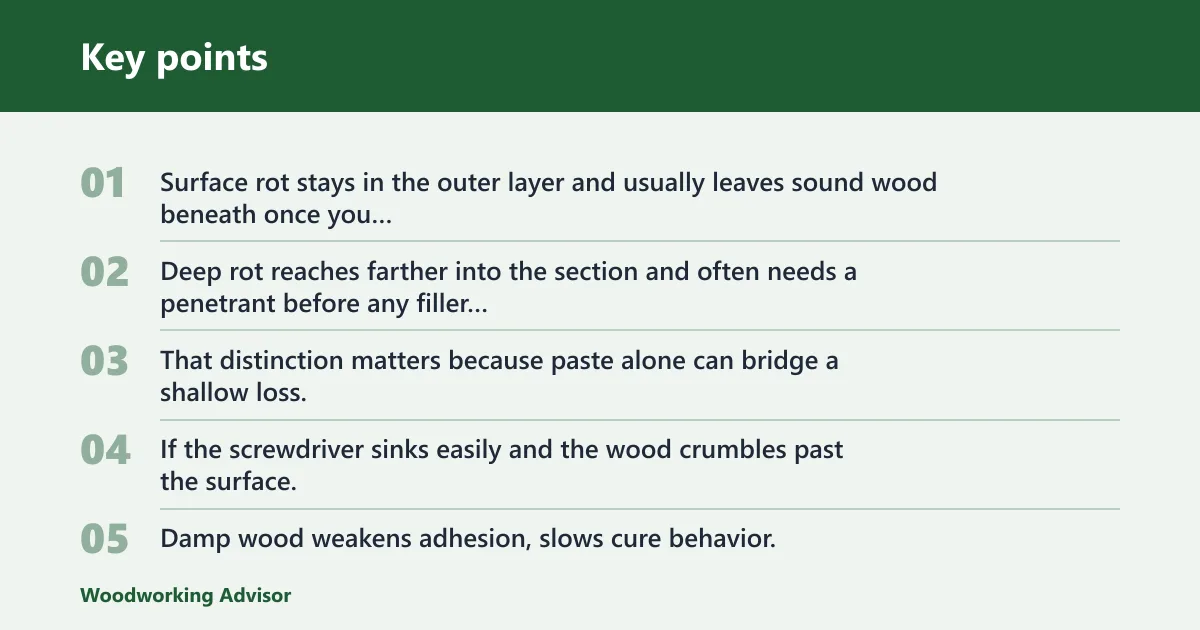
Surface rot stays in the outer layer and usually leaves sound wood beneath once you scrape out the failed fibers. Deep rot reaches farther into the section and often needs a penetrant before any filler goes on.
That distinction matters because paste alone can bridge a shallow loss, but it cannot restore wood that is soft through the core. If the screwdriver sinks easily and the wood crumbles past the surface, think consolidant first.
Dry wood versus damp wood
Dry wood bonds best. Damp wood weakens adhesion, slows cure behavior, and can trap moisture under the repair where rot keeps moving.
A practical rule: if the wood still feels cool and damp to the touch, or if the source of moisture has not been fixed, stop and dry the area more or change the repair plan. Epoxy is not a cure for an active leak.
Cosmetic trim versus load-bearing parts
Cosmetic repairs can tolerate a paste-only approach when the wood underneath is sound. Load-bearing parts demand a more conservative call, because a pretty surface patch does not restore lost strength.
If a porch post, sill end, or structural member has major decay, replacement is often the better choice. Epoxy can stabilize and rebuild limited loss, but it should not be asked to rescue unsafe wood.
Small patch, large void, or structural consolidation
Small patches want a putty that sands fast and does not waste material. Large voids need more body and less shrink risk. Structural consolidation needs a thin, penetrating product before the fill stage.
That is why consolidant-only, filler-only, and full system kits are not interchangeable. Each one fills a different role in the repair sequence.
Start with what the wood is doing, not with the brand name. If the fibers are punky but still present, a consolidant helps harden them before you shape the area back out with filler. If the repair is mostly missing material, go straight to a paste or putty made for that depth.
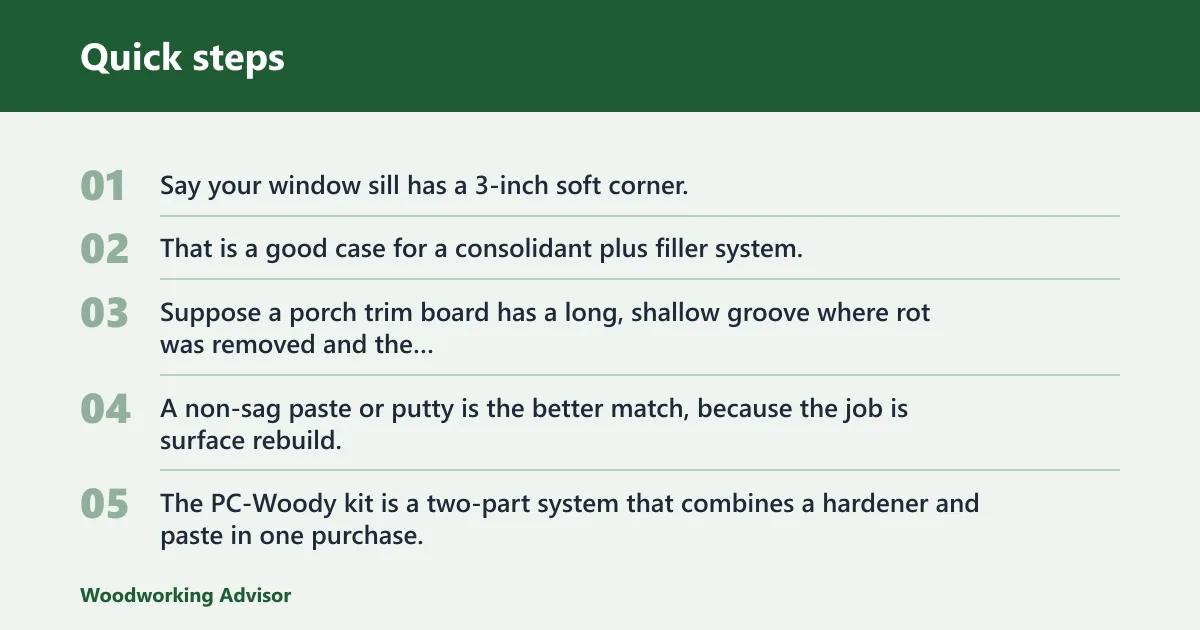
Say your window sill has a 3-inch soft corner, but the inner sill is still firm after scraping out the decay. That is a good case for a consolidant plus filler system, because you need both stabilization and a rebuild at the edge.
Suppose a porch trim board has a long, shallow groove where rot was removed and the substrate is dry. A non-sag paste or putty is the better match, because the job is surface rebuild, not deep stabilization.
PC products PC-Woody + PC-Petrifier kit
The PC-Woody kit is a two-part system that combines a hardener and paste in one purchase, and the kit lists a 25-hour full cure time. It fits general structural rot repair where you need a more complete rebuild after prep, drilling, and decay removal.
This is a sensible choice when the repair has to be drilled, sanded, and painted after cure. The long cure time is not a flaw by itself, but it does mean you need to plan the job around a full day before finishing work begins.
The drawback is work speed. If you need a fast cosmetic repair or a tiny fill, this is more system than you need.
RTG Supply Co wood rot repair epoxy
RTG Supply Co’s wood rot repair epoxy is a clear two-part liquid system that is meant to stabilize, harden, and seal damaged wood. The stated waterproof claim makes it attractive for exterior work where you need a liquid consolidant rather than a heavy paste.
That type of system is useful when the damage is in weak fibers and you want the epoxy to soak in before a filler stage. It is especially relevant on exposed edges, but only after the wood is dry and the rotten material has been removed.
TotalBoat Fixwood
TotalBoat Fixwood is a marine putty, and that matters outdoors. Once cured, it is 100% waterproof, and it is positioned for stainable exterior repairs and wood void filling where weather exposure is part of the job.
That makes it a good option for visible exterior details where paint is not the only finish choice. If stain matching matters, a stainable putty gives you more flexibility than a product intended only for paint.
The drawback is that stainable does not mean invisible. On many species, epoxy still takes stain differently from surrounding wood, so exact match is never guaranteed.
West System G/flex epoxy
West System G/flex is a toughened adhesive, not a general rot filler. Its listed modulus of elasticity is 150,000 PSI, which points to a more flexible bond line than a brittle glue joint.
That makes it useful when you need to bond dissimilar materials or handle movement between substrates. It is not the first pick for filling rotten voids in trim, but it can matter in mixed-material repairs where wood meets another substrate.
The drawback is scope. This is an adhesive choice, so it should not replace a dedicated consolidant or putty for rot repair.
System Three SculpWood putty
The larger System Three SculpWood format is the one to think about for broad sculptural work. It is a non-shrinking epoxy sold in a 0.5-gallon pail, which gives it coverage advantages for larger rebuilds.
That size makes it more practical for longer runs of trim or wider voids where smaller packs run out too fast. It also suits shaped repairs where you need time to form the profile before cure.
The drawback is overbuying. A 0.5-gallon pail is too much product for many homeowners fixing one sill corner or a few small chips.
PC Products 84113 rotted wood repair kit
The PC Products 84113 kit is aimed at novice-friendly small repairs because it includes application tools. That detail matters when you want a bundled kit that reduces setup friction.
It is a reasonable choice for a beginner repairing a small amount of rotten trim, especially when the job is mostly about learning proper prep, fill, and finish steps without buying separate tools.
The drawback is scale. A tool-inclusive kit is convenient, but it is still a small-repair option, not a replacement for structural reconstruction on deep damage.
Which one should you buy?
For deep rot with sound wood still present, choose Abatron WoodEpox if you are doing restoration-grade rebuilding, or PC Products PC-Woody if you want a structural paste kit with a long, predictable cure. For damp wood, the better answer is usually not a different epoxy but more drying, leak repair, or replacement.
For small, paint-ready fixes, J-B Weld Tan KwikWood is the easiest quick patch. For bigger exterior voids where waterproofing matters, TotalBoat Fixwood is the better fit. For restoration work on sills, frames, trim, clapboards, or structural members, Abatron’s LiquidWood plus WoodEpox approach is the most complete system on this page.
If the part carries load and the wood loss is major, replacement is the safer answer. Epoxy can repair limited loss. It should not be asked to rescue unsafe structure.
Frequently asked questions
Can you repair wood rot?
Yes, but only when the remaining wood is sound enough to hold a repair. Remove all loose rot first, dry the area, and choose a consolidant or filler based on depth. If the damage is structural or the wood stays damp, replacement is often the safer call.
What is the best epoxy for wood rot repair?
The best epoxy depends on the damage, not the brand alone. For deep rot, a consolidant plus filler system is usually the right match. For shallow loss, a paste works better. For structural rebuilding, Abatron WoodEpox and PC-Woody are strong candidates based on published specs.
Do I need a wood hardener before epoxy filler?
If the wood is punky but still present, yes, a hardener or consolidant usually comes first. It stabilizes weak fibers so the filler has something firm to bond to. If the wood is already solid after scraping, a filler alone may be enough for the repair.
How do you fix wood rot on a window sill?
Cut out every soft section, dry the sill fully, and fix the source of moisture before any epoxy work. For shallow loss, use a filler. For deeper rot, use a consolidant first, then rebuild with putty. If the sill has major structural loss, replacement may be better.
What epoxy works for vertical wood rot repairs?
Use a non-sag paste or thick putty for vertical repairs. Thin liquids can run off before they cure, leaving weak coverage. Products like PC-Woody, WoodEpox, and SculpWood are better fits than a runny filler when the repair has to stay in place on a face.
What is the difference between penetrating hardener and epoxy paste?
A penetrating hardener soaks into weak fibers and stiffens them. An epoxy paste fills missing material and reshapes the surface. They are not interchangeable. If the wood is soft inside, start with the hardener. If the cavity is already clean and firm, paste can do the rebuilding.
Sponsored / affiliate links. As an Amazon Associate I earn from qualifying purchases. I may earn additional commission from eligible campaigns.