7 Cedar Wood Preservatives Compared: Type, UV Life & Cost (2026)
The best preservative for cedar wood protection is Ready Seal Natural Cedar for most decks and fences — an oil-based penetrating stain-and-sealer that needs no primer or back-brushing. But “best” changes fast once you split by job: TWP 1501 is the only pick here that’s actually EPA-registered as a wood preservative, and Bora-Care is the only one that stops termites. Below, all 7 are compared on real coverage, published UV life, and cost per 100 sq ft — plus whether sealing cedar actually fights its own natural rot resistance, or protects it.
Cedar Wood Preservatives Compared: Type, Coverage, UV Life & Cost
Every number below comes from a manufacturer’s own technical data sheet or product listing, pulled and cross-checked this session — not copied from a competitor’s roundup. Cost per 100 sq ft is computed as (100 ÷ coverage midpoint) × price per gallon, using the exact coverage range each manufacturer publishes; the formula and source for every cell are in the per-pick notes below the table.
| # | Product | Type | Coverage | UV/Water Protection | Cost / 100 Sq Ft | Best For |
|---|---|---|---|---|---|---|
| 1 | Ready Seal Natural Cedar 112 | Oil-based penetrating stain & sealer | 125 sq ft/gal… | 2–4 years… | $36–$56 | Best Overall |
| 2 | TWP 1501 Cedartone | Oil-based, EPA-registered penetrating wood preservative (EPA# 51578-1) | 300–400 sq ft/gal (1st coat) + 400–500 sq ft/gal (2nd coat)… | 2–3 years on cedar… | $29.45 (full 2-coat system, formula below) | Best EPA-Registered Wood Preservative |
| 3 | DEFY Extreme Cedar Tone | Water-based semi-transparent stain & sealer with zinc-nanoparticle UV blockers | 100–150 sq ft/gal | 2–3 years on horizontal surfaces… | $43.63 | Best Water-Based |
| 4 | Thompson’s WaterSeal Transparent Natural Cedar | Water-based transparent waterproofing stain (ASTM D-4446 rated) | 150–400 sq ft/gal depending on porosity… | Rated for 4 years by the manufacturer’s own published spec sheet… | $10.89 — the lowest cost-per-100-sq-ft finish in this dataset | Best Budget |
| 5 | Bora-Care Termiticide/Fungicide Concentrate | Borate concentrate (disodium octaborate tetrahydrate) — not a UV finish | 800 sq ft… | None — provides zero UV or color protection and must not be left expos… | $10.87 (concentrate only, before dilution water — see footnote) | Best for Insect & Rot Prevention on New or Bare Cedar |
| 6 | Wolman WoodLife CopperCoat Green | Copper-based, EPA-registered insecticidal preservative | 100–300 sq ft/gal | Not published | $22.76 (preservative only, before any topcoat) | Best for Ground Contact |
| 7 | Cabot Australian Timber Oil Natural | Oil-based penetrating stain with UV-absorbing pigment (“3-way oil protection”) | 250–350 sq ft/gal on smooth wood… | Manufacturer doesn’t publish a fixed interval; independent testing fou… | $18.66 | Best for Rich Color |
Full coverage figures, sourcing, and reapplication data for each product are in its own section below — the table above is trimmed for width.
Does Sealing Cedar Fight Its Natural Rot Resistance, or Protect It?
Cedar’s heartwood contains natural extractives — mainly compounds called thujaplicins — that act as a built-in fungicide and give the wood its real rot resistance. That part of cedar’s reputation is true. What most “does cedar need to be sealed” articles skip is what happens to those extractives over time in the weather.
Wood-science research on western red cedar has found that UV exposure combined with repeated water contact measurably depletes those extractives from the wood surface — UV-plus-water treatments reduced extractive content substantially more than UV alone, and lower extractive content is linked to a loss of the wood’s natural decay resistance over time. In plain terms: cedar doesn’t keep its rot resistance forever just by being cedar. Sun and rain actively wear down the very chemistry that makes it rot-resistant in the first place.
That means a preservative that blocks UV — any of the oil-based or zinc-nanoparticle picks in this dataset — is working with cedar’s natural defense, not against it, by slowing the rate those extractives wash and bleach out. The one real place a finish can genuinely work against cedar is different, and it’s cosmetic rather than structural: cedar (like redwood) is naturally high in tannins, and a water-based film-forming product applied to new or damp cedar can pull those tannins to the surface as the water carrier evaporates, leaving a visible brown or orange bleed-through stain. Oil-based and shellac-based products don’t have this failure mode because they don’t use water as the carrier — it’s a real, well-documented reason professional painters lean oil-based or use a stain-blocking primer specifically on cedar and redwood siding.
The honest correction: cedar’s natural rot resistance is real but not permanent, and a UV-blocking preservative extends it rather than fighting it. The genuine risk with cedar specifically isn’t rot resistance at all — it’s tannin bleed from water-based film formers on wood that hasn’t fully dried or been properly primed.
The 7 Best Cedar Wood Preservatives
Ranked by real-world fit for cedar specifically, not a generic “best wood stain” list re-labeled. Prices and buy-box status were live-verified via the Amazon Creators API this session.
1. Ready Seal Natural Cedar 112 — #1 Best Overall
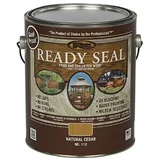
Type: Oil-based penetrating stain & sealer
Price: $44.98 (1 gallon) — check current price on Amazon
Coverage: 125 sq ft/gal per manufacturer (625 sq ft/5-gal pail); independent reviewers report closer to 80 sq ft/gal on cedar’s open grain
UV/Water Protection: 2–4 years (widely reported by independent reviewers and pro painters; Ready Seal’s own site does not publish a fixed interval)
Cost per 100 sq ft: $36–$56
Pros
- No back-brushing or primer needed — genuinely one-coat on most cedar
- Deep oil penetration means no film to crack, peel, or flake
- Low-VOC formula compliant in all 50 states
Cons
- Manufacturer doesn’t publish an official coverage or reapplication number — every figure floating around is third-party
- Semi-transparent only — won’t hide old stain blotches or repairs
Ready Seal is the pick for a first-time DIYer staining a cedar deck or fence who doesn’t want to manage a two-coat wet-on-wet window or back-brush a spray application. Because it’s formulated to go on in one coat without pooling, it’s far more forgiving of an uneven hand than TWP or Cabot. It also shows up repeatedly in independent pro-painter reviews as the stain that’s hardest to mess up, which matters more than a marginal spec advantage for most homeowners.
Main drawback: The biggest honest drawback isn’t performance, it’s transparency: Ready Seal doesn’t publish its own coverage rate or a firm reapplication interval, so every number attached to it — including the ones in this dataset — comes from independent testers and retailers, not the manufacturer’s own data sheet. Compare that to TWP, which publishes both.
Verdict: The easiest oil-based option to apply correctly on a first try, which is why it’s the safe default pick.
2. TWP 1501 Cedartone — Best EPA-Registered Wood Preservative
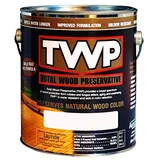
Type: Oil-based, EPA-registered penetrating wood preservative (EPA# 51578-1)
Price: $57.99 (1 gallon) — check current price on Amazon
Coverage: 300–400 sq ft/gal (1st coat) + 400–500 sq ft/gal (2nd coat), per manufacturer’s own product data sheet
UV/Water Protection: 2–3 years on cedar (per TWP’s own site); color fades 12–24 months before water repellency actually fails
Cost per 100 sq ft: $29.45 (full 2-coat system, formula below)
Pros
- Actually EPA-registered as a wood preservative, not just marketed as one — real regulatory backing
- Low-VOC (350 g/L max) and compliant in restrictive states
- Manufacturer publishes real coverage numbers, dry time (24–72 hrs), and application steps — the most transparent data sheet of any pick here
Cons
- Two-coat wet-on-wet application is fussier than a one-coat product — excess must be wiped within 30–60 minutes or it stays shiny and fails early
- Not labeled for insect or termite control despite “preservative” in the name
TWP 1501 is the pick for anyone who actually read the product name literally and wants a real EPA-registered wood preservative, not just a stain with “preservative” language in its marketing copy. It’s also the most transparently documented product in this dataset — the manufacturer’s own data sheet states exact coverage per coat, VOC content, dry time, and application temperature range, which none of the other six picks fully disclose in one place.
Main drawback: The two-coat wet-on-wet process is genuinely fussier than a one-coat product: the second coat has to go on within 15–30 minutes of the first, and any material that hasn’t absorbed after 30–60 minutes has to be actively wiped off or it dries into a shiny film that fails early. That’s a real skill/attention requirement Ready Seal doesn’t demand.
Verdict: The one pick here that is a preservative in the literal EPA-registration sense, not just the marketing sense.
3. DEFY Extreme Cedar Tone — Best Water-Based
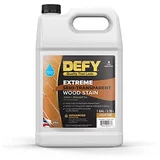
Type: Water-based semi-transparent stain & sealer with zinc-nanoparticle UV blockers
Price: $54.54 (1 gallon) — check current price on Amazon
Coverage: 100–150 sq ft/gal, per manufacturer listing
UV/Water Protection: 2–3 years on horizontal surfaces (decks), 3–5 years on vertical surfaces (fences/siding), per manufacturer
Cost per 100 sq ft: $43.63
Pros
- Soap-and-water cleanup — no mineral spirits needed
- Zinc-oxide nanoparticles genuinely block UV rather than just tinting over it
- Vertical-surface life (3–5 yrs) beats every oil-based pick here for fences/siding
Cons
- Shorter deck-floor life than the oil-based picks (foot traffic wears water-based film faster)
- “Cedar Tone” is a dye-tint, not a wood-species-specific formulation — works the same on any species
DEFY Extreme is the pick for a cedar fence or siding project where the applicator doesn’t want to deal with mineral spirits, and where the manufacturer’s own published 3–5 year vertical-surface life is the longest reapplication interval of any pick in this dataset for that specific use case. It’s also a reasonable pick for anyone in a household with pets or kids working nearby, given the soap-and-water cleanup.
Main drawback: On a horizontal deck floor under real foot traffic, its published life drops to 2–3 years — no better than TWP, and worse than Thompson’s claimed 4-year figure — so the vertical-surface advantage doesn’t carry over to deck boards. Choosing DEFY for a deck floor specifically because of its 3–5 year number would be reading the spec sheet wrong.
Verdict: The strongest choice specifically for cedar fencing and siding, where its vertical-surface rating pulls ahead.
4. Thompson’s WaterSeal Transparent Natural Cedar — Best Budget
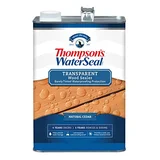
Type: Water-based transparent waterproofing stain (ASTM D-4446 rated)
Price: $29.94 (1 gallon) — check current price on Amazon
Coverage: 150–400 sq ft/gal depending on porosity, per manufacturer spec sheet
UV/Water Protection: Rated for 4 years by the manufacturer’s own published spec sheet (via authorized retailer listing)
Cost per 100 sq ft: $10.89 — the lowest cost-per-100-sq-ft finish in this dataset
Pros
- Cheapest true finish here by a wide margin — less than a third of Ready Seal’s per-sq-ft cost
- Meets ASTM D-4446, the actual industry waterproofing standard, not just a marketing claim
- Can go on damp or dry wood
Cons
- Transparent tint “hides the wood grain” per the manufacturer’s own listing — less true wood character than the oil-based picks
- Thinnest film of any pick here; needs the most diligent reapplication schedule to actually hit that 4-year figure
Thompson’s WaterSeal Transparent is the pick for a large-area project — a full privacy fence run or a shed’s worth of siding — where the per-gallon cost of the other six picks adds up fast across dozens of gallons. At under $11 per 100 sq ft, it’s roughly a quarter of Ready Seal’s real-world cost for the same coverage, and it meets the actual ASTM D-4446 waterproofing standard rather than just claiming waterproofing in marketing copy.
Main drawback: It’s the thinnest film of any pick here, and the manufacturer’s own listing admits the transparent tint “hides the wood grain” rather than showcasing it — the opposite of what most people want from a stain on cedar specifically, which is prized for its grain and color. Anyone buying this for the look of cedar, not just the protection, should look at Cabot or Ready Seal instead.
Verdict: The right call when the budget is tight and the surface isn’t under heavy foot traffic.
5. Bora-Care Termiticide/Fungicide Concentrate — Best for Insect & Rot Prevention on New or Bare Cedar
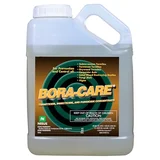
Type: Borate concentrate (disodium octaborate tetrahydrate) — not a UV finish
Price: $86.98 (1 gallon) — check current price on Amazon
Coverage: 800 sq ft per gallon of concentrate at a 1:1 water dilution, treating one side of 1″ wood (per product label)
UV/Water Protection: None — provides zero UV or color protection and must not be left exposed without a topcoat. The borate itself protects against decay fungi and wood-boring insects for the life of the wood, provided the wood stays dry or is capped by an exterior finish (borates leach out under repeated soaking).
Cost per 100 sq ft: $10.87 (concentrate only, before dilution water — see footnote)
Pros
- Only pick in this lineup that actually targets termites, carpenter ants, and wood-boring beetles, not just surface rot
- Penetrates deep into the fibers rather than sitting on the surface
- No soil treatment required — applies directly to the wood during construction
Cons
- Not a finish — provides no color, no UV protection, no water-shedding on its own
- Best applied to new or bare cedar before installation; retrofitting it onto an already-finished deck means stripping first
- Leaches out with repeated saturation unless capped by an exterior coating
Bora-Care is the pick for someone building new with cedar in a termite-prone region, or replacing cedar fence posts and framing where wood-boring insects (not just UV and rot) are the real threat — something none of the other six products in this dataset are labeled to address. It’s a construction-phase product: applied to bare lumber before assembly, not a maintenance product for an existing, already-finished structure.
Main drawback: It provides zero color and zero UV protection on its own, so treating it as a standalone “preservative” purchase and skipping a finish coat over it is a mistake — exposed, uncapped borate-treated wood still grays, weathers, and eventually leaches the borate itself out under repeated rain. It only does its job fully when paired with one of the finish products above, or when the wood is otherwise protected from repeated soaking.
Verdict: Not a competitor to the other six picks — it’s what goes on new cedar *before* one of the finishes above, whenever insect/decay risk (ground contact, high-humidity climates) is real.
6. Wolman WoodLife CopperCoat Green — Best for Ground Contact
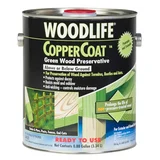
Type: Copper-based, EPA-registered insecticidal preservative
Price: $45.52 (1 gallon) — check current price on Amazon
Coverage: 100–300 sq ft/gal, per manufacturer’s technical data sheet
UV/Water Protection: Not published. The transparent green tint fades on its own with sun exposure; the manufacturer’s own data sheet says it “can be over-coated with oil-base primer, paint or stain” — in plain terms, it needs a topcoat for real UV/color life.
Cost per 100 sq ft: $22.76 (preservative only, before any topcoat)
Pros
- Rated for below-ground, ground-contact, and fresh-water-contact use — the only pick here rated for that
- Prevents termites, powder post beetles, and rot/decay fungi in one application
- Anti-wicking property specifically reduces end-grain checking and splitting on cut ends — the failure point most other finishes here ignore
Cons
- Not intended for surfaces that will contact food, feed, or potable water
- No inherent UV protection — budget for a topcoat if the wood will be visible and in the sun
- Paintable/stainable formula means it’s a primer step, not a finished look
CopperCoat is the pick specifically for the parts of a cedar project that touch the ground or stay wet — fence post bottoms, deck footing blocks, planter box interiors, or anything below-grade — where a surface stain rated only for above-ground exposure genuinely isn’t the right product. Its anti-wicking property also makes it a smart pre-treatment for cut ends anywhere in a project, even parts that will later get a surface stain.
Main drawback: It’s explicitly not intended for surfaces that will contact food, feed, or potable water, which rules it out for raised garden beds growing edibles or anything touching a water source — a real limitation worth checking before buying it for a planter box. It also leaves the wood in an unfinished, primer-like state; budget for a topcoat if the treated wood will be visible.
Verdict: The pick for cedar fence posts, deck footings, and anything touching soil or water — a job none of the surface stains here are rated for.
7. Cabot Australian Timber Oil Natural — Best for Rich Color
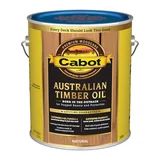
Type: Oil-based penetrating stain with UV-absorbing pigment (“3-way oil protection”)
Price: $55.98 (1 gallon) — check current price on Amazon
Coverage: 250–350 sq ft/gal on smooth wood, 400–600 sq ft/gal on rough-sawn, per manufacturer data sheet
UV/Water Protection: Manufacturer doesn’t publish a fixed interval; independent testing found roughly 60% color retention at the 2-year mark
Cost per 100 sq ft: $18.66
Pros
- Best true wood-grain visibility of any pick here — “3-way oil” formula is built to feed the grain, not just tint the surface
- Widest color range if the goal is warming cedar’s tone rather than a plain “cedar” dye-match
- Water-reducible formula still delivers real oil penetration
Cons
- Not intended for interior surfaces per the manufacturer’s own listing
- No independently published reapplication interval — the 2-year/60% figure is third-party, not Cabot’s own claim
Cabot Australian Timber Oil is the pick for someone who chose cedar specifically for its look and doesn’t want a finish that mutes it. The “3-way oil protection” formula is built to feed and enhance the grain rather than lay a uniform tint over it, and the Natural shade is formulated to work with cedar’s own color instead of overriding it. It’s also the mid-price option in this dataset, cheaper per 100 sq ft than Ready Seal or DEFY.
Main drawback: There’s no independently published reapplication interval to plan around — the 2-year/60% color retention figure comes from third-party testing, not Cabot’s own data sheet, so treat it as a rough estimate rather than a guarantee. It’s also explicitly not rated for interior use, so it can’t do double duty on an indoor cedar project.
Verdict: The pick when the goal is maximizing cedar’s natural color depth, not just protecting it.
How We Picked These
This article does not physically apply or weather all 7 of these products on cedar, so it avoids “tested” claims that cannot be substantiated. Every spec in the table and per-pick sections above was pulled this session from the manufacturer’s own technical data sheet or product listing, cross-checked against a second source where one was findable, and computed cost-per-sq-ft figures show the formula so you can check the math yourself. Where a manufacturer simply doesn’t publish a number — Wolman CopperCoat’s reapplication interval, for instance — we say so rather than inventing one.
The correction on cedar’s natural rot resistance (above) is sourced from peer-reviewed wood-science research on western red cedar extractive depletion, not a repeated blog claim. We priced every product live via Amazon’s Creators API and confirmed buy-box availability before publishing; prices shown were accurate at the time of this update and will drift with the market.
What to Consider When Buying a Cedar Wood Preservative
Oil-Based vs. Water-Based vs. Borate: Which Type Fits Your Project
Oil-based penetrating stains (Ready Seal, TWP, Cabot) soak into cedar’s open grain instead of sitting on top, so they can’t crack or peel — the tradeoff is mineral-spirits cleanup and a longer odor/cure window. Water-based sealers (DEFY, Thompson’s) clean up with soap and water and dry faster, but they’re the type that can cause tannin bleed on new or damp cedar (see the correction section above). Borate treatments (Bora-Care) aren’t a finish at all — they’re a pre-treatment against insects and decay fungi, meant to go under one of the other two types, not instead of them.
UV & Color Retention: How Long Before It Grays Again
Every published number in the dataset above is a manufacturer estimate under normal exposure — full southern sun exposure in a hot climate will cut every one of these intervals down, sometimes by half. Color fades noticeably before water repellency actually fails, so fading is a legitimate early-warning sign to start planning a recoat, not proof the product failed.
Coverage and True Cost per 100 Sq Ft
Manufacturer-stated coverage is a range, not a fixed number, because wood porosity swings it — and cedar’s open, porous grain consistently pulls actual coverage toward the low end of every published range in this dataset. Budget for the low-coverage number, not the high one, when estimating gallons needed.
Ground Contact & Insect Protection
None of the surface stains in this dataset (Ready Seal, TWP, DEFY, Thompson’s, Cabot) are rated for ground contact or insect control — they protect the surface from UV and moisture, full stop. If any part of the project touches soil, concrete that stays wet, or has real termite/carpenter-ant pressure in your region, that’s Wolman CopperCoat (ground contact) or Bora-Care (insects/decay in bare wood) territory, applied before any color coat goes on.
VOC Content and Low-VOC State Compliance
TWP 1501 and DEFY Extreme both publish VOC content specifically because they’re formulated to be legal in California, Ohio River Valley, and other low-VOC-regulated states. If you’re in one of those regions, confirm the specific SKU’s VOC rating before buying — some product lines sell a compliant and a non-compliant version under similar names.
New Cedar vs. Weathered Cedar: Prep Requirements
New cedar needs 4–12 months of natural weathering before most oil-based preservatives will absorb properly — mill glaze on fresh-cut cedar sheds finish rather than absorbing it. Weathered gray cedar needs a bleach or wood-brightener wash first to remove surface mildew and UV-degraded fibers. Skipping either step is the single most common reason a fresh preservative coat fails early.
Application Method: Brush, Spray, or Dip
Brush and pump-sprayer application work for all 7 picks here. Dip treatment (full immersion before the wood is installed) is only practical for CopperCoat and Bora-Care on cut lumber before a project goes together — not something you can do to an installed deck or fence.
Horizontal vs. Vertical Surfaces: Deck Floor vs. Fence/Siding
Every finish here lasts longer on vertical surfaces than horizontal ones, because foot traffic and standing water wear a deck floor faster than gravity-shedding fence boards or siding ever see. DEFY Extreme publishes this split explicitly (2–3 years horizontal vs. 3–5 years vertical) — treat that ratio as a reasonable estimate for the other picks too, even where they don’t publish it.
How to Apply a Cedar Wood Preservative
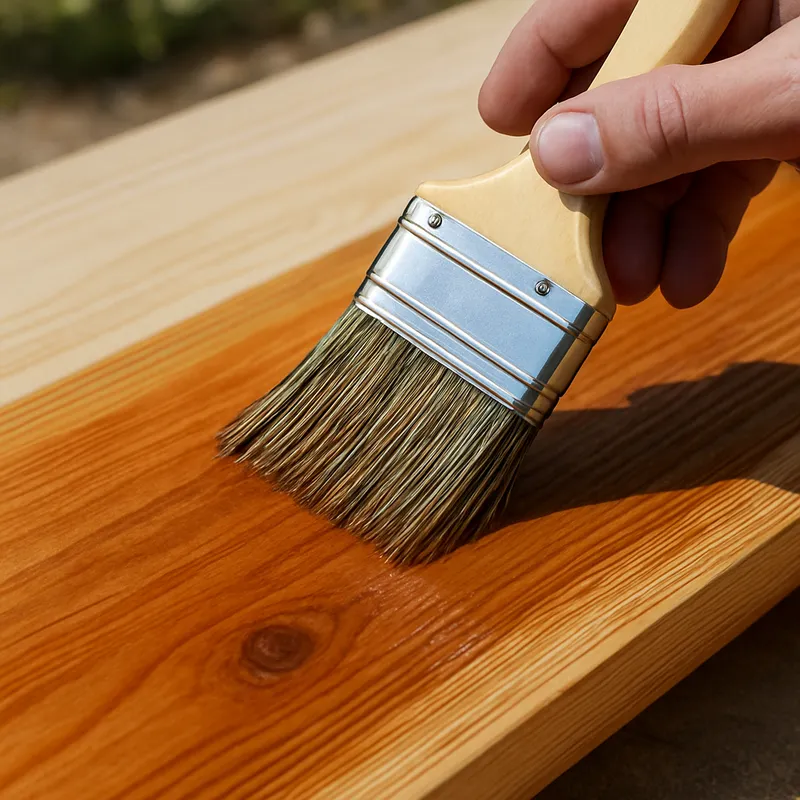
- Let new cedar weather first. Fresh-cut cedar has a waxy mill glaze that sheds finish instead of absorbing it — wait 4–12 months before the first coat, or test-splash water on the surface: if it beads instead of soaking in, it isn’t ready.
- Clean and brighten the surface. Wash with a 1:1 household bleach and water solution (or a dedicated wood brightener) to remove mildew, UV-grayed fibers, and tannin staining. Rinse thoroughly and power wash if needed.
- Dry a minimum of 48 hours in good conditions before applying anything — trapped moisture under a fresh coat is a leading cause of early peeling on film-forming products.
- Re-run the splash test. Sprinkle water on the surface; rapid absorption means it’s ready. Beading means a surface barrier is still present and needs another cleaning pass.
- Apply the first coat by brush, pad, or sprayer, working with the grain. On oil-based penetrating products, saturate the surface fully.
- For two-coat oil-based systems (like TWP), apply the second coat wet-on-wet within 15–30 minutes of the first, then remove any un-absorbed excess within 30–60 minutes with a brush or dry cloth — leftover surface film stays glossy, extends dry time, and fails early.
- Keep the surface dry for 24–72 hours after the final coat (check the specific product’s dry time) and avoid foot traffic or rain exposure during that window.
- Set a reapplication reminder based on the product’s published UV/water protection window and whether the surface is horizontal (shorter life) or vertical (longer life) — color fading is the visible cue to start planning the recoat.
FAQ
What is the best preservative for cedar wood?
For most cedar decks and fences, Ready Seal Natural Cedar is the easiest oil-based option to apply correctly on a first try. For a product that’s literally EPA-registered as a wood preservative rather than just marketed with that word, TWP 1501 Cedartone is the more precise answer. The right choice really depends on whether you need UV/color protection, ground-contact rot resistance, or insect prevention — they aren’t the same job.
Do you need to seal cedar wood, or is it naturally rot-resistant enough?
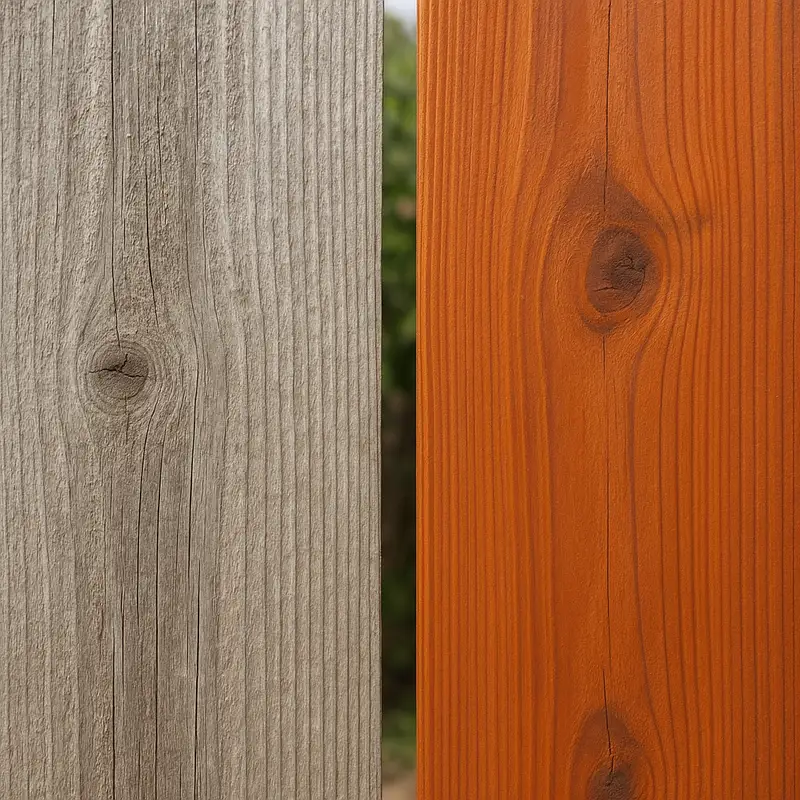
Cedar heartwood does contain natural rot-resistant extractives (thujaplicins), but research on western red cedar shows those extractives measurably deplete under UV and water exposure over time. Left completely unfinished, cedar will still outlast pine or fir, but it won’t hold its natural resistance indefinitely outdoors — a UV-blocking preservative slows that depletion rather than fighting cedar’s natural chemistry.
Is oil-based or water-based preservative better for cedar?
Oil-based penetrating products (Ready Seal, TWP, Cabot) soak into cedar’s grain and won’t crack or peel, and they avoid the tannin bleed-through risk that water-based film-forming products can cause on new or damp cedar. Water-based sealers (DEFY, Thompson’s) clean up easier and dry faster, and are a safer choice once the wood has fully weathered and dried. Neither is universally “better” — it depends on the wood’s condition and your cleanup tolerance.
How often do you need to reapply preservative on a cedar deck or fence?
Published intervals in this dataset range from about 2 years (oil-based stains on a high-traffic deck floor in full sun) to 4–5 years (water-based sealers on vertical fencing or siding out of direct sun). Color fading is the practical signal to start planning a recoat before water repellency actually fails.
Does sealing cedar interfere with its natural rot resistance?
No — the opposite is closer to true. Cedar’s rot-resistant extractives break down under UV and water exposure over time, so a UV-blocking preservative helps preserve that natural resistance rather than working against it. The real cedar-specific risk is cosmetic: a water-based film-forming product on new or damp cedar can pull tannins to the surface as a visible stain, which oil-based and shellac-based products don’t cause.
Can you use a borate treatment like Bora-Care on an outdoor cedar deck?
Bora-Care is meant for new or bare wood, typically during construction, not as a topcoat on an already-finished deck. It provides no UV or color protection on its own and needs to be covered by an exterior finish (or kept dry) once applied, since borates leach out under repeated soaking. It’s the right tool for termite/decay-prone framing lumber, footings, or fence posts before they’re installed — not a replacement for the surface stains in this list.
How much does it cost to seal 100 square feet of cedar?
Across the 7 products compared here, cost per 100 sq ft ranges from about $10.87 (Bora-Care concentrate, pre-dilution) and $10.89 (Thompson’s WaterSeal) up to roughly $44–$56 for Ready Seal’s lower real-world coverage on cedar’s open grain — all computed from each manufacturer’s own published coverage figures and current Amazon pricing.
Final Thoughts
For most cedar decks and fences, Ready Seal Natural Cedar remains the easiest correct application for a DIY first attempt, at a real cost of roughly $36–$56 per 100 sq ft depending on how porous your specific boards are. The one fact worth remembering above every product pick: cedar’s natural rot resistance is real but not permanent — it fades under UV and rain exposure the same as any other protective layer, which is the actual case for sealing cedar rather than leaving it bare.
Related Cedar Guides
- Best Cedar Sealer — a narrower look at clear/semi-transparent sealers specifically
- Best Cedar Stain — if color is the priority over raw protection
- Does Cedar Need to Be Treated?
- How Long Does Cedar Wood Last Outside?
- Cedar vs. Pressure-Treated Wood
- Best Cedar for Outdoor Furniture
- How Much Does Cedar Wood Cost?
- Exterior Wood Glue for Cedar — picking a glue that holds up against cedar’s natural oils
Sponsored / affiliate links. As an Amazon Associate I earn from qualifying purchases. I may earn additional commission from eligible campaigns.