Best Exterior Cedar Wood Stain: 7 Options Compared (2026)
The best exterior cedar wood stain for most projects is Ready Seal in Natural Cedar, an oil-based semi-transparent stain that Amazon’s listing says needs no priming, thinning or back-brushing. But coverage, not price per gallon, decides what a job costs. We compared 7 cedar stains using each maker’s published coverage, VOC and coat count, plus Amazon prices checked on 2026-10-05.
Already decided on a penetrating oil-based stain and just need the application steps? See our guide on how to apply stain to cedar without blotching or yellowing for the full prep-to-cure process.
Exterior Cedar Wood Stain Comparison: Coverage, VOC & True Cost
Best Cedar Stain Pick | |
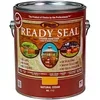 |
Ready Seal Exterior Wood Stain & Sealer, Natural Cedar (1 gal), $49.21 Ready Seal’s own guide lists 125 sq ft per gallon on rough cedar fences and siding, so plan on 3 gallons for 300 sq ft, as the table below shows.
|
As an Amazon Associate we earn from qualifying purchases.
Coverage, coat count and VOC below come from each maker’s own data sheet or guide where we could read one, and are marked where they come from a retailer listing instead. Where a maker does not publish a figure, the cell says so rather than guessing. Prices are Amazon buy-box prices for a 1-gallon can on 2026-10-05.
| Stain | Base and opacity | Coverage per gallon | Coats | VOC | Cost to cover 300 sq ft** |
|---|---|---|---|---|---|
| Ready Seal Natural Cedar | Oil-based, semi-transparent | 125-150 (cedar, maker chart) | Maker intends 2; dense or smooth-milled wood may take only 1 | Not stated in maker guide | $147.63 (3 gal) |
| Armstrong-Clark Mountain Cedar | Oil-based (linseed), semi-solid | 175-200 horizontal; 300 vertical | 1 (one coat only on decks) | Under 50 g/L | $189.90 (2 gal) |
| DEFY Extreme Cedar Tone | Water-based, semi-transparent | 100-150 at two coats | 1 on horizontal cedar; 2 on porous wood | Under 250 g/L | $163.62 (3 gal)* |
| Thompson’s WaterSeal Natural Cedar | Water-based, semi-transparent | 150-400 (retailer listing) | Not confirmed | 22.51 g/L (retailer listing) | $57.96 (2 gal) |
| Cabot Semi-Transparent, Cedar | Oil-based, semi-transparent | 100-350 (maker site) | 1 | Low VOC, g/L not stated | $170.31 (3 gal) |
| Olympic Maximum Cedar Naturaltone | Semi-transparent, base not confirmed for this listing | 250-350 (retailer listing, not confirmed for this ASIN) | Not confirmed | Not confirmed | $82.96 (2 gal) |
| Flood Cedar Solid Pro | Water-based acrylic, solid color | 350-500 (maker data sheet) | 1 to 2 (2nd coat evens out cedar tannin) | Under 100 g/L | $68.66 (1 gal) |
**Computed from the low end of each published coverage range, rounded up to whole 1-gallon cans at the Amazon price shown: gallons = 300 divided by low-end sq ft per gallon, rounded up. Larger cans are often cheaper per gallon, so treat these as a like-for-like comparison, not a quote. *DEFY’s range assumes two coats, but its data sheet says to apply only one coat on horizontal cedar, so a cedar deck should cost less than shown. Olympic and Thompson’s rows use retailer-listing figures, not a data sheet we could read.
Raw sq-ft-per-gallon numbers are not comparable across brands. DEFY’s 100-150 figure already includes a second coat that its own sheet says not to apply on horizontal cedar. Ready Seal’s guide says the product is meant to be a two-coat job but that dense wood may take only one. Armstrong-Clark and Cabot are one-coat products. Check the coat count behind any coverage number before you do the math.
Maker sheets also disagree on conditions: Ready Seal says it can go on in any temperature and in direct sun, Armstrong-Clark wants 50 F or warmer but also tolerates hot sun, and DEFY wants 45 to 95 F and says to avoid direct sunlight. Armstrong-Clark’s sheet adds a hard limit worth knowing: its semi-solid stains are not for new wood less than 1 year old and not for sitting surfaces or furniture.
Best Exterior Cedar Wood Stains
1. Ready Seal Exterior Wood Stain & Sealer (Natural Cedar): #1 Best Overall
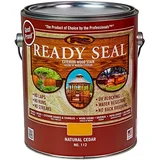
Amazon price checked 2026-10-05: $49.21 for 1 gallon, in stock.
- Base: oil-based, semi-transparent
- Coverage (maker chart): 125 sq ft/gal rough cedar fence or siding, 150 smooth cedar deck
- Dry: dries within hours when wood is dry; up to 14 days to fully cure and reach final tone
- VOC: not stated in the maker guide
Ready Seal’s own guide describes it as a penetrating stain that soaks into the wood instead of forming a film, with trans-oxide pigments for UV protection and no linseed oil. The guide says there are no temperature restrictions and you can apply it in direct sunlight, as long as the can is well stirred.
The guide’s biggest condition is moisture: the wood must dry down to 12% or less before staining, and over-applying is the main way to get a stain that stays wet or flakes later. It also advises against sanding before application, because sanding closes the pores the stain needs to enter.
- Best for: A cedar fence, siding or deck where you want the least fussy oil stain
- Why we picked it: No primer, no thinning and no back-brushing per the Amazon listing, and no temperature or sun restriction per the maker guide
- Main drawback: The lowest cedar coverage of the semi-transparent picks, so it costs more per project than its can price suggests
2. Armstrong-Clark Oil-Based Wood Stain (Mountain Cedar Semi-Solid): Best for Weathered or Older Cedar Decks
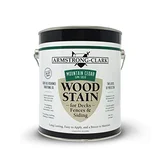
Amazon price checked 2026-10-05: $94.95 for 1 gallon, in stock.
- Base: linseed oil-based, semi-solid
- Coverage: 175-200 sq ft/gal horizontal, 300 vertical
- VOC: does not exceed 50 g/L
- Reapply: 1 to 3 years horizontal, 2 to 4 years vertical (maker)
Semi-solid sits between semi-transparent and solid: more pigment to even out a grayed or patchy surface, while the light oil still soaks in. Armstrong-Clark’s data sheet says one coat only on decks and that it can be applied in direct sun above 50 F.
The sheet is just as clear about where not to use it: not on wood under 1 year old, not on seating or furniture, and not on hardwoods. It also publishes a reapply interval, which most makers do not: 1 to 3 years on horizontal surfaces and 2 to 4 years on vertical ones, depending on exposure.
- Best for: An older cedar deck, fence or siding that has grayed or been stripped and needs more pigment
- Why we picked it: Semi-solid hides more discoloration than semi-transparent, and the maker publishes both coverage and a reapply schedule
- Main drawback: The priciest can here at $94.95, it is wrong for new cedar, and over-application can rub off
3. DEFY Extreme Wood Stain and Sealer (Cedar Tone): Best Water-Based Formula
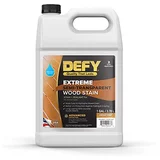
Amazon price checked 2026-10-05: $54.54 for 1 gallon, in stock.
- Base: water-based, semi-transparent, zinc nanoparticle UV blockers
- Coverage: 100-150 sq ft/gal at two coats
- VOC: under 250 g/L
- Dry: touch in 2 to 6 hours; 24 hours before using a deck
DEFY’s data sheet contains the most useful correction on this page: its 100-150 sq ft figure is for two coats, yet the same sheet says to apply only one coat on horizontal cedar, mahogany and other dense woods, and two coats on pressure-treated lumber and other porous woods. Reading the coverage number without that line makes DEFY look weaker on a cedar deck than it is.
Conditions differ from the oil stains: 45 to 95 F surface and air temperature, avoid direct sunlight, and no rain expected within 12 hours. The sheet says new wood should weather 3 to 6 months first, though kiln-dried lumber can be stained right away. A shiny surface, it says, signals over-application.
- Best for: Anyone who prefers soap-and-water cleanup and a matte, grain-showing finish
- Why we picked it: Water-based with a published sheet that spells out coats by wood type, drying, and temperature limits
- Main drawback: Not for direct sun or hot, windy days, and its coverage figure needs the coat-count footnote to be read correctly
4. Thompson’s WaterSeal Semi-Transparent Waterproofing Stain (Natural Cedar): Best Value
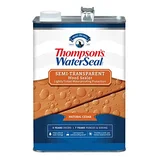
Amazon price checked 2026-10-05: $28.98 for 1 gallon, in stock.
- Base: water-based, semi-transparent
- Coverage (retailer listing): 150-400 sq ft/gal
- VOC (retailer listing): 22.51 g/L
- Amazon listing: exceeds ASTM D-4446 for waterproofing
At $28.98 a gallon this is the cheapest can here, and its wide coverage range keeps the 300 sq ft cost under $60 even at the low end. The Amazon listing describes it as a lightly tinted stain that hides the grain color but still lets the wood texture show, and says it can go on damp or dry wood.
We could not read a Thompson’s data sheet, so the coverage and VOC figures come from retailer listings and the durability years printed on the can are not quoted here. Check the can before relying on them.
- Best for: Large fence or siding jobs on a tight budget
- Why we picked it: Lowest can price and lowest published VOC in the table, with an ASTM D-4446 waterproofing claim on the listing
- Main drawback: Light tint hides less discoloration than a semi-solid, and its figures are not from a maker sheet we could read
5. Cabot Semi-Transparent Wood Stain + Sealer, Low VOC (Cedar): Best for Showing Off Cedar Grain
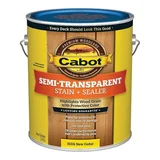
Amazon price checked 2026-10-05: $56.77 for 1 gallon, in stock.
- Base: oil-based, semi-transparent
- Coverage (Cabot site): 100-350 sq ft/gal
- Coats: 1 only
- Dry: 24 to 48 hours; apply at 50 to 90 F
Cabot’s product page says to apply one coat only and lists a 100-350 sq ft per gallon range. The spread between 100 and 350 is the real story: rough, thirsty cedar sits near the bottom, smooth wood near the top, which is why we price it at the low end in the table.
Cabot’s page does not give an exact VOC figure beyond the Low VOC name, so we do not list one.
- Best for: Cedar you want to still look like cedar, with grain and color showing through
- Why we picked it: One coat, 50 to 90 F window, and a wide published coverage range
- Main drawback: The coverage range is so wide that budgeting is guesswork on rough boards, and no exact VOC or reapply interval is published on the page
6. Olympic Maximum Cedar Naturaltone Wood Stain & Sealer: Budget Cedar Naturaltone Option
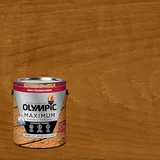
Amazon price checked 2026-10-05: $41.48 for 1 gallon, in stock.
- Base: not confirmed for this listing (Olympic sells Maximum in more than one formulation)
- Coverage (retailer listing for a Cedar Naturaltone SKU): 250-350 sq ft/gal
- Amazon stock: low, only 1 can left when checked
Olympic Maximum is a mid-priced semi-transparent line at $41.48 for this gallon. We could not confirm from a data sheet whether this exact Amazon listing is the oil or the water formulation, so we show no VOC, coat count or durability years for it.
Because Olympic sells Maximum in more than one formulation, read the can for base, VOC and coat count before you buy, and expect stock to be thin: Amazon showed a single can available when we checked.
- Best for: Shoppers who want a big-box-brand cedar tone and will check the label
- Why we picked it: Priced between Thompson’s and Cabot, with a cedar tone built for natural-looking fences
- Main drawback: Formulation and VOC not confirmed for this listing, and stock was down to one can
7. Flood Cedar Solid Pro Exterior Wood Stain: Best Solid-Color Stain for Cedar
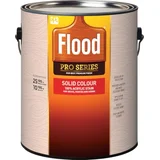
Amazon price checked 2026-10-05: $68.66 for 1 gallon, in stock.
- Base: 100% acrylic, water-based, solid color
- Coverage (maker data sheet): 350-500 sq ft/gal
- VOC: under 100 g/L
- Recoat in 2 to 4 hours; dries to touch in about 30 minutes at 50 to 85 F
A solid-color stain is closer to an exterior acrylic coating than a penetrating stain. Flood’s data sheet for the Pro Series line (the family that includes the Cedar color) lists 350-500 sq ft per gallon, application down to 35 F ambient, and a 30-day cure before washing.
The sheet also addresses cedar directly: cedar and redwood contain tannin, the first coat may show some discoloration, and a second coat evens it out. If you go this route, our guide to Flood solid stain on cedar covers priming and coat timing, and the maker data sheet is available from Flood’s parent company.
- Best for: Cedar too weathered or mismatched for semi-transparent or semi-solid stains to even out
- Why we picked it: Best published coverage in the table and a very low VOC for a coating
- Main drawback: Solid color hides the grain, which defeats the point if you chose cedar for its look
How We Picked These
We did not physically test these 7 stains on cedar, and nothing here is a testing claim. What we did: checked live Amazon price and buy-box stock for every pick on 2026-10-05, read the maker documents we could get (Ready Seal’s application guide, Armstrong-Clark’s and DEFY’s product data sheets, Flood’s Pro Series data sheet, Cabot’s product page), and built the cost table from those numbers with the formula shown.
Where a number came from a retailer listing instead of a maker document (Thompson’s, Olympic), we say so. If your experience on real cedar differs from what a maker publishes, that is worth knowing: published coverage is a range for typical wood, not a promise for yours.
Why Cedar Specifically Changes This Comparison
None of these stains is made only for cedar; each also works on other softwoods. What changes on cedar is how the wood takes stain. Flood’s data sheet notes that cedar and redwood contain tannin that can discolor a first coat. Ready Seal’s coverage chart gives cedar its own figures (125 to 150 sq ft per gallon). DEFY’s sheet singles out horizontal cedar as a wood that takes only one coat. In other words, the same can behaves differently on cedar than on pressure-treated pine, which is why the coat counts in the table differ so much.

What to Consider When Buying Exterior Cedar Wood Stain
Oil-Based vs. Water-Based
Oil-based stains (Ready Seal, Armstrong-Clark, Cabot here) penetrate the wood and clean up with mineral spirits or paint thinner. Water-based stains (DEFY, Thompson’s, Flood) clean up with soap and water and tend to publish lower VOC numbers, but their sheets are stricter about weather, as DEFY’s sun and temperature limits show. For a broader walkthrough of sealer, oil and stain options, see how to treat cedar wood properly.
Opacity: Transparent, Semi-Transparent, Semi-Solid, or Solid
Semi-transparent stains show the most grain and hide the least discoloration. Semi-solid, like Armstrong-Clark’s Mountain Cedar, carries more pigment to even out aged wood. Solid color, like Flood Cedar Solid Pro, hides the grain entirely. If you want a paint-store alternative to this lineup, see our Sherwin-Williams exterior wood stain comparison.
Coverage Rate – and Whether It Already Includes a Second Coat
Published coverage in this comparison runs from 100 sq ft per gallon (DEFY and Cabot at the low end) up to 500 (Flood, best case). Before comparing two cans by that number, check how many coats it assumes: DEFY’s figure is for two coats while its own sheet tells you to apply one on horizontal cedar.
VOC Content
Among the picks with a figure we could find, VOC runs from 22.51 g/L (Thompson’s, retailer listing) through under 50 g/L (Armstrong-Clark) and under 100 g/L (Flood) to under 250 g/L (DEFY). Ready Seal’s guide and Cabot’s page do not state a number, so we do not list one. If your area limits VOC, check the can for your exact color.
Application Temperature and Weather Window
The maker sheets give different windows: Ready Seal says any temperature and direct sun are fine; Armstrong-Clark says 50 F and up and can be exposed to light to normal rain 60 minutes after the stain absorbs; DEFY says 45 to 95 F, no direct sun and no rain within 12 hours; Cabot says 50 to 90 F; Flood allows 35 to 90 F ambient. Check the forecast against your stain’s own window, not a general rule.
New vs. Weathered Cedar
Makers disagree on new wood. DEFY says to let new wood weather 3 to 6 months (kiln-dried lumber can be stained immediately), and Armstrong-Clark says its semi-solid colors need wood at least 1 year old, while Ready Seal says brand-new rough-cut lumber needs no special prep as long as it is dry. For prep and protection ideas before you choose, see how to protect cedar wood outdoors.
Decks vs. Fences vs. Siding
Horizontal surfaces take more wear and absorb more stain per square foot. Armstrong-Clark publishes this directly: 175-200 sq ft per gallon on horizontal wood versus 300 on vertical, and a 1 to 3 year reapply on decks versus 2 to 4 on vertical surfaces. For fence-specific advice, see our guide to the best way to stain a cedar fence.
Real Cost, Not Just Sticker Price
The cheapest can is not always the cheapest project. At the low-end coverage, Thompson’s costs about $57.96 to cover 300 sq ft, Flood about $68.66, and Ready Seal about $147.63 because it covers less per gallon. Armstrong-Clark’s $189.90 is the highest, but it is a semi-solid with a published reapply schedule. Do the coverage math before assuming the lower shelf price wins.
Warranty and Guarantee Language
Makers rarely publish a durability number you can compare. Armstrong-Clark gives reapply intervals (1 to 3 years horizontal, 2 to 4 vertical). DEFY says to recoat when graying starts and offers a satisfaction guarantee that returns or replaces the unused product, not labor. We did not find comparable published figures for the others, so we do not quote any years of protection. Read what a guarantee actually covers before treating it as a durability promise.
Color Matching to Existing Cedar
Natural Cedar, Cedar Tone and Mountain Cedar are each brand’s own tint and are not guaranteed to match each other or your wood. Armstrong-Clark’s sheet recommends testing color in an inconspicuous spot and waiting 48 to 72 hours for the true color, and DEFY and Ready Seal also advise a test area first. Test before you commit the whole surface.
How to Apply Exterior Cedar Wood Stain
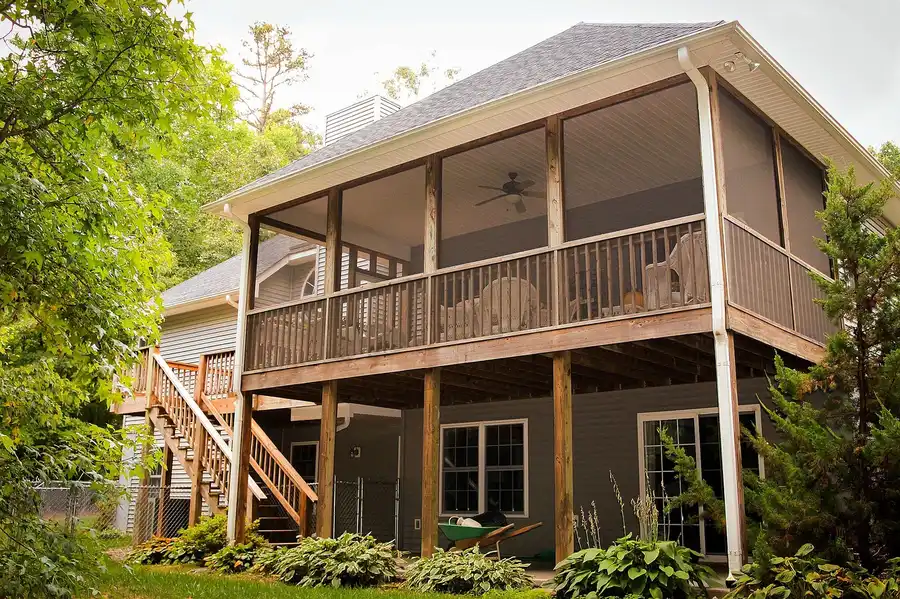
- Clean the surface and let it dry. Remove dirt, mildew and old failing finish. Ready Seal says wood must be at 12% moisture or less, Armstrong-Clark says 20% or less (15% for cedar shingles) and to wait 48 hours after cleaning.
- Test absorption. DEFY’s sheet says sprinkle a few drops of water on the wood; it should soak in within a few seconds, and if it does not, the wood is too wet or not porous enough.
- Sand only if needed. Ready Seal advises against sanding because it closes pores. If you must sand off an old finish, DEFY says to use coarse grit and Armstrong-Clark says not finer than 80 grit.
- Check the sun and temperature rules on your can. Ready Seal allows direct sun; DEFY says avoid it; Armstrong-Clark says 50 F and up; Flood allows 35 to 90 F ambient.
- Apply the number of coats your maker specifies. One coat only for Armstrong-Clark on decks and for Cabot, one coat on horizontal cedar for DEFY, two for Ready Seal if the wood will take it, and a second coat on Flood if cedar tannin shows through.
- Do not over-apply. Ready Seal, Armstrong-Clark and DEFY all warn about it; DEFY says a shiny surface signals too much stain.
- Respect the rain window. Armstrong-Clark: light to normal rain is fine 60 minutes after the stain absorbs; DEFY: no rain expected within 12 hours.
Frequently Asked Questions
What is the best stain for exterior cedar wood?
Ready Seal Natural Cedar is our pick for most exterior cedar projects because the maker says it needs no priming, thinning or back-brushing and can go on in any temperature. For an older, weathered deck, Armstrong-Clark’s semi-solid Mountain Cedar hides more discoloration. Check each maker’s coat count before comparing prices.
Should I use oil-based or water-based stain on cedar?
Oil-based stains like Ready Seal and Armstrong-Clark soak into the wood and clean up with mineral spirits. Water-based stains like DEFY and Flood clean up with soap and water and tend to publish lower VOC, but have stricter weather limits. Neither is better for every cedar project.
How many coats of stain does cedar need?
It depends on the product. Armstrong-Clark and Cabot are one-coat products. DEFY says apply one coat on horizontal cedar and two on porous wood. Ready Seal is meant as two coats but dense wood may take only one. Flood’s sheet notes a second coat evens out cedar tannin. Follow your can.
Does cedar wood need to be sealed if it’s stained?
Not with the stain-and-sealer products in this comparison. Ready Seal, DEFY, Cabot and Thompson’s are sold as stain and sealer combinations per their listings, so a separate sealer step is not needed. A pure pigment stain with no sealing agents would need a compatible topcoat.
Can you stain cedar wood right away, or does it need to weather first?
It depends on the stain and the lumber. DEFY says new wood should weather 3 to 6 months, though kiln-dried lumber can be stained right away. Armstrong-Clark says its semi-solid colors need wood at least 1 year old. Ready Seal says new rough-cut lumber just needs to be dry.
Why is my cedar siding turning gray even though it’s stained?
Graying usually means the stain has worn past its useful life. Armstrong-Clark suggests reapplying every 2 to 4 years on vertical surfaces and 1 to 3 years on horizontal ones, and DEFY says to recoat when graying starts. A coat applied too thin or onto wet wood can also fade early.
How often should you restain a cedar deck vs. a cedar fence?
Horizontal decks wear faster than vertical fences and siding. Armstrong-Clark’s data sheet gives 1 to 3 years on horizontal surfaces and 2 to 4 years on vertical ones, depending on exposure. Other makers in this comparison do not publish comparable intervals, so inspect the finish each year.
Is a semi-transparent or solid stain better for cedar?
Semi-transparent stains like Ready Seal, Cabot and DEFY show the grain but hide little discoloration. Solid color like Flood Cedar Solid Pro hides the grain completely and evens out weathered or mismatched wood. Choose by whether seeing the cedar grain matters more than hiding its flaws.
Final Thoughts
Ready Seal in Natural Cedar is our #1 overall pick for most exterior cedar projects, with Armstrong-Clark as the choice for older, weathered wood. The number worth remembering is that coverage and coat count, not shelf price, decide your real cost, and that a coverage figure can mislead if you do not check how many coats stand behind it, as with DEFY.
If you are staining a vertical surface, remember that makers that publish both figures show better coverage and longer reapply intervals on fences and siding than on deck floors. Whichever stain you pick, the can’s own sheet is the final word on moisture, temperature and coats.
Related Cedar Care Guides
- Cedar wood stains: types, prep, and color selection
- Oil vs. stain vs. sealer: what is the best finish for cedar wood?
- Best cedar sealer, if you want waterproofing without color
- How to seal a cedar deck step by step
- Best preservative for cedar wood protection
- Staining cedar: a complete process guide
Sponsored / affiliate links. As an Amazon Associate I earn from qualifying purchases. I may earn additional commission from eligible campaigns.