5 Best Wood Stains for Cedar (2026): Based on Specs and Reviews
For cedar in full sun or weather, choose a penetrating oil stain with pigment; for newer cedar or furniture, use a clear or lightly tinted penetrating finish; for maximum color control on siding, a semi-transparent stain is the safer default. The wrong stain can lead to fast graying, peeling film, or cedar that turns darker than expected. Ready Seal Natural Cedar is the best all-around starting point for new or lightly weathered cedar because it stays in the penetrating-stain lane and is easy to apply.
Quick comparison
| Product | Badge | Best for | Price | ||
|---|---|---|---|---|---|
 |
Cabot Australian Timber Oil Wood Stain and Protector,Cabot | Our pick | 1 gallon · oil-based · Jarrah Brown | $50.38
Price as of 30 Oct 2026
|
View |
 |
Ready Seal Exterior Wood Stain & Sealer, Natural Cedar, 5Ready Seal | Pair with it | 5 gallon · semi-transparent · Natural Cedar | $189.94
Price as of 30 Oct 2026
|
View |
 |
TWP 101 Pro-Series Cedartone Exterior Wood Stain &TWP | Also great | 1 gallon · oil-based · Cedartone | $54.66
Price as of 30 Oct 2026
|
View |
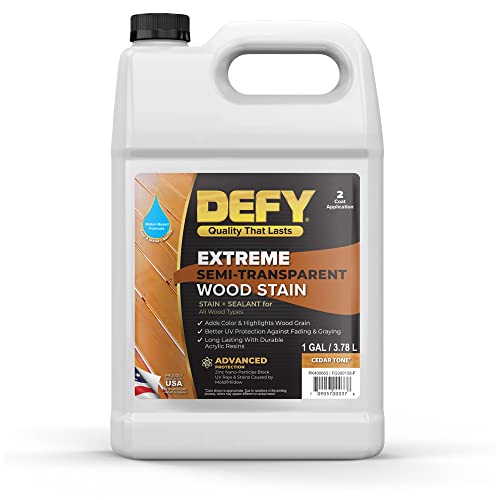 |
DEFY Extreme Wood Stain and Sealer in One – 1 GallonDEFY | Also great | 1 gallon · semi-transparent · Cedar Tone | $54.54
Price as of 30 Oct 2026
|
View |
 |
Olympic Maximum 1 gal. SC-1014 Cedar Solid Color ExteriorOLYMPIC | Budget pick | 1 gallon · solid color · SC-1014 Cedar | $41.86
Price as of 30 Oct 2026
|
View |
The main trade-off is simple: the more a product builds film, the more color it can control, but the greater the peel risk if the cedar moves or was not prepped well. The more a product penetrates, the safer it is for cedar grain and texture, but the less it can hide weathering or uneven color.
How we chose
Three things matter most on cedar. First is penetration, because cedar’s natural oils and grain need a finish that soaks in rather than sits on top.
Second is UV and water protection, since untreated cedar can turn silver-gray in 6–12 months and clear sealers with zero pigment do not stop that. Third is fit: smooth boards, rough-sawn siding, weathered decks, and previously sealed surfaces do not all need the same finish.
Application method also matters. Sprayer-friendly formulas help on fences and siding. Brush and roller compatibility matters more on furniture and railings.
Cedar stain decision matrix
Use this matrix to match cedar condition to the finish type that makes the most sense. It also separates a true stain-sealer from a clear water repellent, which is where many buying mistakes start.
| Cedar condition | Finish type | Expected look | UV protection level | Recoat window | Application cautions |
|---|---|---|---|---|---|
| New smooth cedar | Penetrating oil stain with light pigment | Near-natural, with visible grain | Moderate to good if tinted | Varies by product; follow label after cure | Clean first; a sodium percarbonate cleaner and oxalic acid brightener help remove mill glaze and improve porosity |
| Weathered cedar | Semi-transparent or solid stain | More color correction; grain still visible with semi-transparent | Good with semi-transparent, highest with solid | Varies by product and exposure | Remove loose gray fibers and check for uneven absorption before coating |
| Rough-sawn cedar | Deep-penetrating oil stain | Natural texture stays visible | Moderate to good if pigmented | Varies by product | Texture can drink in more stain; wipe or back-brush to avoid dark blotches |
| Previously sealed cedar | Compatibility depends on existing coating; stripping or thorough cleaning may be needed | Depends on the old finish and prep | Depends on the replacement finish | Do not recoat until the surface is properly opened up | Clear sealers, film-forming coatings, and older stains can interfere with penetration; adhesion failure is common if you skip prep |
Penetration versus film build
Cedar usually performs best with a finish that soaks in. Penetrating oil-based stain lowers peel risk because it avoids the thick surface film that can crack as cedar expands and contracts. That matters on decks and railings, where water and sun hit the surface hard.
Solid stain gives the most coverage and the best color correction, but it also hides grain. Semi-transparent stain keeps more cedar character visible. Transparent and clear-tinted products keep the look closest to raw cedar, but they need pigment if you want meaningful UV protection.
UV and water protection for cedar
Cedar resists decay better than many softwoods, but it still fades. Clear sealers with zero pigment do not prevent graying. A true cedar sealer needs to repel water, block UV, and penetrate without filming.
That is why a “clear” water repellent is not the same as a stain-sealer. If you want the cedar color to stay close to fresh lumber, choose at least a lightly tinted product.
Recoat window and application method
Application method should match the project size. Sprayer-friendly products help on fences and siding. Brush and roller work better where you need control on furniture, trim, or railings.
Weather also changes the job. Olympic WaterGuard Woodland Cedar is described as drying in 24 hours, while Ready Seal Natural Cedar darkens at first and reaches its true tone after about two weeks. Behr Naturaltone Penetrating Wood Stain is described as able to withstand rain in 4 hours. Those timing differences matter when you need the surface back in service quickly.
Fit for decks, fences, siding, and furniture
Decks usually need a finish that penetrates and resists wear. Fences need easy application over large areas. Siding needs even color and reliable UV control. Furniture often benefits from a lighter, more controlled look so the cedar grain stays visible without over-darkening.
Say your cedar fence was cleaned but still shows pale and dark patches from uneven weathering. A semi-transparent or penetrating oil stain is usually safer than a heavy solid film if you still want the grain to read through the color.
Ready Seal Natural Cedar: best for new cedar
Ready Seal Natural Cedar is the best fit for new or lightly weathered cedar when you want an easy, penetrating lane rather than a heavy film. It is semi-transparent, needs no primer, and can be applied by sprayer, roller, or brush.
Its biggest strength is application forgiveness. The product is described as “goof proof,” with no laps, runs, or streaks, and it can be applied in direct sunlight. That makes it a strong choice for fences, siding, and other long exterior runs where uniform application matters.
The trade-off is color development. It darkens initially, then reaches its true tone after about two weeks, so it is not the best pick if you need the final color to read instantly.
Cabot Australian Timber Oil: best for exposed cedar
Cabot Australian Timber Oil is the strongest match when cedar sees hard sun and weather exposure. It is oil-based, transparent, and built around deep penetration, which helps protect cedar while keeping the grain and patina visible.
That makes it a good fit for decks, railings, siding, and furniture where you want a natural cedar look with water and UV protection. The three-way oil blend is the main reason it belongs in the “exposed cedar” slot rather than the “maximum coverage” slot.
The drawback is the same thing that makes it look good: transparency. If your cedar already has blotchy aging or wants more color correction, this finish will not hide much.
Behr Naturaltone Penetrating Wood Stain: best for weathered cedar
Behr Naturaltone Penetrating Wood Stain is the best match here for older cedar that needs more color control while still staying in the penetrating category. It is oil-based, and published product details say it covers up to 400 sq. ft. per gallon and can withstand rain in 4 hours.
That makes it practical for weathered decks, fences, and siding where the color has gone uneven but the owner still wants cedar grain to show. Published product details also describe mildew and dirt resistance, which helps on exterior cedar surfaces that collect residue.
The drawback is that a penetrating stain still cannot fix every surface issue. Severely gray, uneven, or previously sealed cedar may still need cleaning, brightening, or stripping before this product can look right.
Olympic WaterGuard Woodland Cedar: best for quick sealing
Olympic WaterGuard Woodland Cedar is the quick-sealing choice when basic exterior protection matters more than deeper color change. It is described as a semi-transparent waterproofing sealant with 24-hour drying, which makes planning easier for smaller cedar jobs.
This type fits light-duty exterior wood use where you want some color and water repellency without a heavy finish. It can work on cedar that does not need major color correction or long-term visual preservation.
The drawback is protection depth. If the cedar needs stronger UV control, or if you want to slow graying as much as possible, a lightly pigmented penetrating stain is usually the safer route.
Thompson’s WaterSeal Solid Color: best for heavily weathered cedar
Thompson’s WaterSeal Solid Color is the pick for heavily weathered cedar when maximum coverage matters more than showing grain. As a solid color stain and sealer, it gives the most hiding power and the most color correction of the group.
That is useful on old fences, sun-battered siding, or cedar that has faded too unevenly for a transparent or semi-transparent finish to look consistent. The finish is also presented as fade resistant with full coverage.
The drawback is that solid color obscures cedar grain. It is also the least forgiving choice if you want a natural wood look, so it should be used when coverage is the main goal, not wood character.
Which one should you buy?
Choose Ready Seal Natural Cedar if you want the easiest all-around option for new or lightly weathered cedar. It keeps a natural look, applies easily, and stays in the penetrating-stain lane.
Choose Cabot Australian Timber Oil if the cedar gets strong sun, weather, or heavy exposure and you want a transparent finish with deeper penetration.
Choose Behr Naturaltone Penetrating Wood Stain if the cedar is older, uneven in color, and needs more correction without moving to a solid finish.
Choose Olympic WaterGuard Woodland Cedar if speed and basic sealing matter more than deeper color or stronger UV control.
Choose Thompson’s WaterSeal Solid Color if the cedar is heavily weathered and you want the highest coverage and the most uniform appearance.
A common first-timer mistake is treating a clear water repellent like a UV-blocking stain-sealer. On a cedar gate with fresh lumber on one side and lightly grayed lumber on the other, that mistake can leave both sides looking different within a season.
Picture a 12-foot cedar fence in full afternoon sun. If it is new and smooth, a deep-penetrating, lightly tinted product is usually the safer choice; if it is already gray and patchy, a solid color stain may give a more even result.
Frequently asked questions
What is the best wood stain for cedar?
For most cedar, the best wood stain is a penetrating oil stain with some pigment, because it lowers peel risk while giving better UV protection than a clear sealer. Ready Seal Natural Cedar is the best all-around starting point for new or lightly weathered cedar. Heavily weathered cedar may need more coverage.
What is the best finish for cedar wood?
The best finish for cedar wood depends on the condition of the board. Fresh cedar usually does well with a penetrating oil finish, while weathered cedar may need a semi-transparent or solid stain for more color correction. If you want to keep the grain visible, avoid thick film-forming coatings.
What is the best finish for cedar furniture?
For cedar furniture, a transparent or lightly tinted penetrating finish is often the safest choice because it preserves grain and reduces the chance of a heavy surface film. Cabot Australian Timber Oil fits that role well. If the furniture sits outdoors, choose a product with stated UV and water protection.
What stain works best on cedar
The stain that works best on cedar is usually one that penetrates rather than films over the top. That is especially true on smooth or rough-sawn boards, where cedar’s texture can trap a surface coating and lead to peeling. For older cedar, a semi-transparent or solid option may be more practical.
What stain to use for cedar
Use a penetrating oil stain for new or lightly weathered cedar, a semi-transparent stain when you want more color depth without hiding grain, and a solid stain for badly weathered boards that need the most coverage. If the cedar was already sealed, check compatibility before recoating.
What color stain is best for cedar
The best color for cedar is usually a cedar-tone, natural cedar, or lightly tinted brown that stays close to the wood’s own color. Too much tint can hide the grain, while no pigment at all can still allow graying. On exterior cedar, a slight tint is often the safer balance.
What is the best stain and sealer for cedar?
The best stain and sealer for cedar is usually a penetrating stain-sealer with pigment, not a clear water repellent. Ready Seal Natural Cedar and Olympic WaterGuard Woodland Cedar both fit the stain-sealer category, but they serve different needs. Ready Seal is the stronger all-around cedar option.
What is the best wood stain for cedar fence?
For a cedar fence, the best choice is usually a penetrating or semi-transparent stain that is easy to apply over large areas. Ready Seal Natural Cedar is a strong pick for new or lightly weathered fence boards. For badly faded fences, a solid color stain gives more even coverage.
What is the best wood stain for cedar siding?
For cedar siding, choose a finish that spreads evenly and controls UV fading without building a thick film. Ready Seal Natural Cedar works well for fresh siding, while Behr Naturaltone Penetrating Wood Stain is better when the siding needs more color correction. Solid stain is the fallback for uneven weathering.
What is the best wood stain for cedar deck?
For a cedar deck, use a penetrating oil stain that handles sun and foot traffic without forming a fragile surface layer. Cabot Australian Timber Oil is the best fit for exposed decks, while Behr Naturaltone is a strong choice when the deck is older and needs more color control.
Sponsored / affiliate links. As an Amazon Associate I earn from qualifying purchases. I may earn additional commission from eligible campaigns.