Cabot Deck Stain Temperature Chart
Cabot deck stain is often considered a go/no-go around 50°F to 90°F; if the overnight low is expected to drop below 50°F within 24 hours, wait, especially with water-based products. Bad timing can slow curing, leave lap marks, and shorten the finish. This guide gives a Cabot temperature chart by stain type, overnight low, and forecast window so you can decide whether to stain now or wait.
This guide is part of our Cold Weather Wood Finishing: What Works Below 50°F series.
Match deck temperature bands to Cabot product drying times
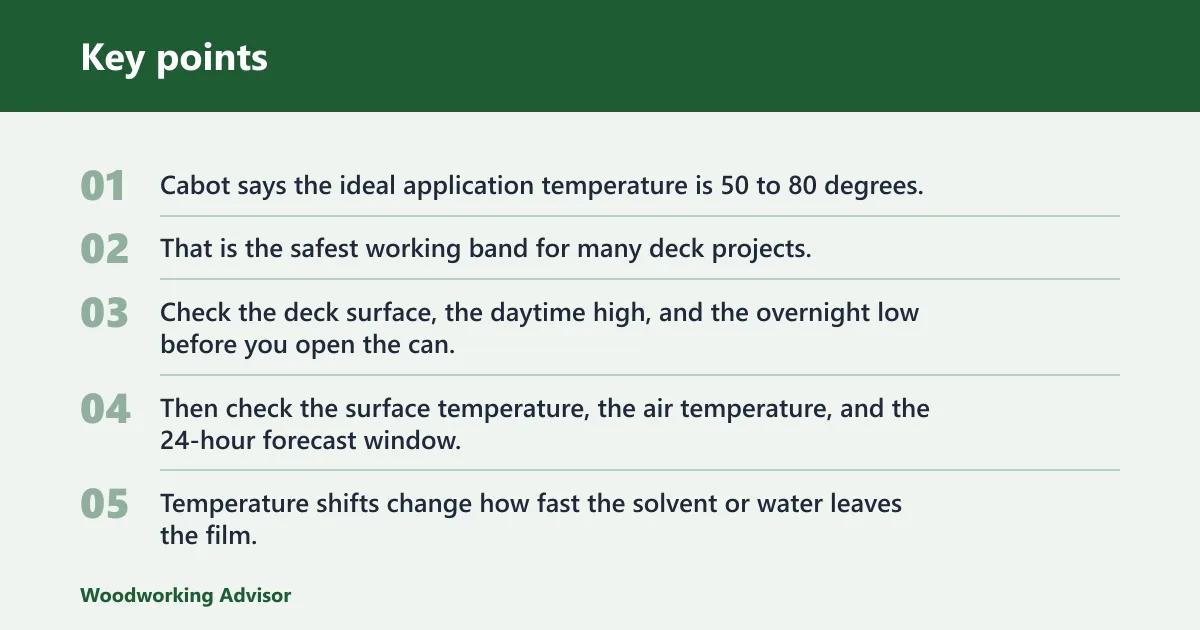

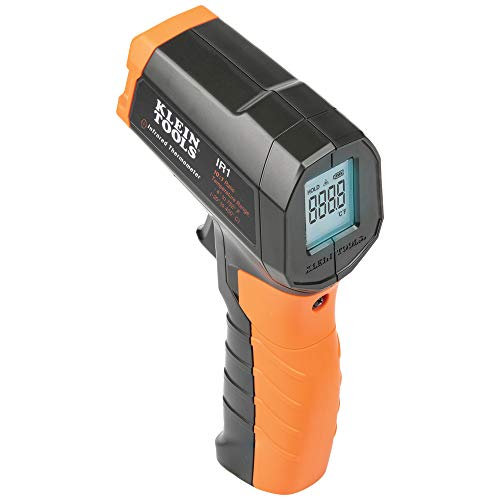
That is the safest working band for many deck projects, but weather control matters just as much as the number on the thermometer. Check the deck surface, the daytime high, and the overnight low before you open the can.
Use the product label first. Then check the surface temperature, the air temperature, and the 24-hour forecast window. Temperature shifts change how fast the solvent or water leaves the film, and they can make stain lay down unevenly if the day heats up, then cools off fast.
| Forecast temperature band | Likely risk | Recommended Cabot product family and timing |
|---|---|---|
| 45-49°F | Cold conditions can slow drying and increase the chance of a soft finish. | Wait if you can. If a label allows cooler weather, choose only a short, dry window and verify the overnight low will rise, not fall. Be extra cautious with oil-based products. |
| 50-59°F | Workable, but drying may still be slow if shade, humidity, or a cool night are involved. | Proceed only if the deck is dry and rain is out of the forecast. Good candidates for this band are products that tolerate slower dry times, including Australian Timber Oil, Semi-Transparent Stain + Sealer, and Transparent Wood Toned Stain + Sealer, if the label conditions are met. |
| 60-80°F | Best-fit band for many Cabot products. Drying is more predictable if humidity is moderate. | Good weather window for Cabot Gold, Transparent Wood Toned Stain + Sealer, Semi-Transparent Stain + Sealer, and many water-based options. Schedule early morning or late afternoon if the deck surface is warming quickly. |
| 80°F+ | Hot-surface risk rises. Stain can flash too fast, making lap marks and uneven penetration more likely. | Stain only if the deck stays cool enough under shade and the surface never gets hot. Start early or move to a shaded side first. DeckCorrect and other thicker products need extra care because heavy application can extend dry time. |
What temperature should you use?
Use the product label first, then treat 50 to 80 degrees as the practical target for many Cabot deck stains. The safest call depends on both the daytime high and the overnight low. A warm afternoon can still fail if the temperature drops too far after application.
Daytime high versus overnight low
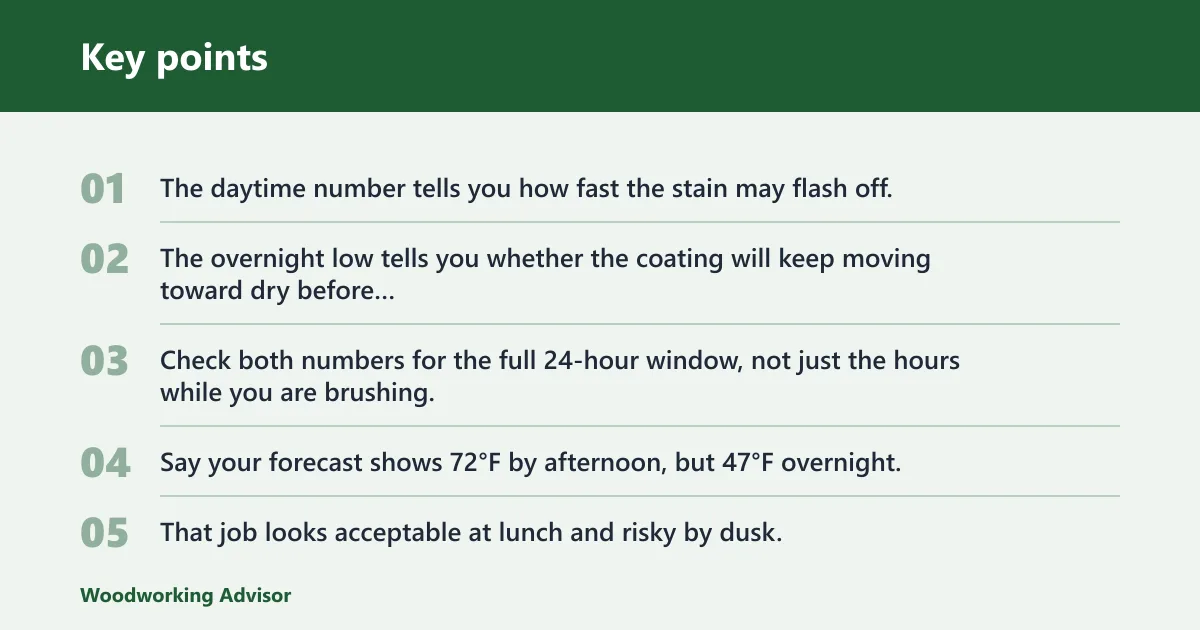
The daytime number tells you how fast the stain may flash off. The overnight low tells you whether the coating will keep moving toward dry before morning dew or chill slows it down. Check both numbers for the full 24-hour window, not just the hours while you are brushing.
Say your forecast shows 72°F by afternoon, but 47°F overnight. That job looks acceptable at lunch and risky by dusk. The better choice is to wait for a window where the overnight low stays in the workable band too.
When forecast swings should stop the job
Stop and reschedule if the day looks warm but the evening drops sharply, or if a cold front is moving in behind a sunny start. Cold or wet conditions can double drying time, which turns a simple deck into a sticky surface that stays vulnerable longer.
How to read the label before you start
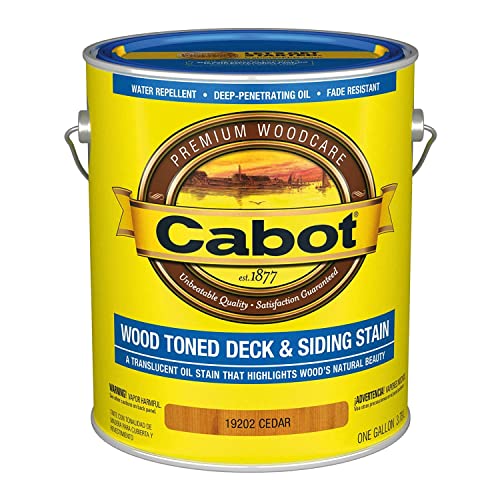
Cabot product families do not all behave the same way. Australian Timber Oil, Cabot Gold, Transparent Wood Toned Stain + Sealer, Semi-Transparent Stain + Sealer, and DeckCorrect can all have different application notes. Follow the can and the technical data sheet for the exact temperature and recoat guidance.
Humidity and rain window
Humidity matters because the air has to take in moisture while the stain dries. A moderate band around 40 to 60% is generally easier to manage. High humidity slows drying, and extreme humidity can keep product wet for much longer, especially on shaded decks or on days with little air movement.
Why 40-60% humidity is easier to manage
That range gives stain a better chance to dry at the rate the label expects. It also lowers the chance that a dry-looking surface is still soft underneath. Shade, local weather, and poor airflow can push a deck out of that comfortable zone even when the weather app looks fine.
How much rain-free time to verify before application
Cabot advises choosing a day with no rain expected for 24 hours. Wet weather can double dry time, so a forecast that looks merely “a little wet” can still turn into a problem. Check for morning drizzle, evening showers, and dew-heavy nights before you start.
Picture a south-facing deck that looks dry at 2 p.m. but gets a humid evening and a chance of showers after midnight. That is not a reliable staining day, even if the afternoon sun feels perfect. The rain risk arrives after the brushwork, not during it.
Which Cabot stain type dries faster?
Water-based Cabot formulations dry faster than oil-based products. That difference matters when your weather window is short. A faster-drying stain can be a better choice for a narrow forecast, while oil-based products usually need a longer stretch of dry, stable weather.
Water-based versus oil-based drying speed
One competitor summary puts water-based Cabot formulations at 1 to 6 hours and oil-based variants at 6 to 24 hours. That is not a replacement for the label, but it shows the practical gap between the two families. Thick application will extend both numbers.
How Australian Timber Oil differs from Cabot Gold
Australian Timber Oil is an oil-based exterior stain family, so it generally needs more patience than faster water-based options. Cabot Gold is commonly used where homeowners want easier application and a faster path to foot traffic. If your forecast is tight, that difference can decide the project date.
Where transparent, Semi-Transparent, and DeckCorrect fit
Transparent Wood Toned Stain + Sealer and Semi-Transparent Stain + Sealer are often chosen when you want classic deck color with protection. DeckCorrect is a thicker resurfacing product, so dry time can stretch if the coat is heavy or the weather turns damp. Choose it only when the forecast gives you room.
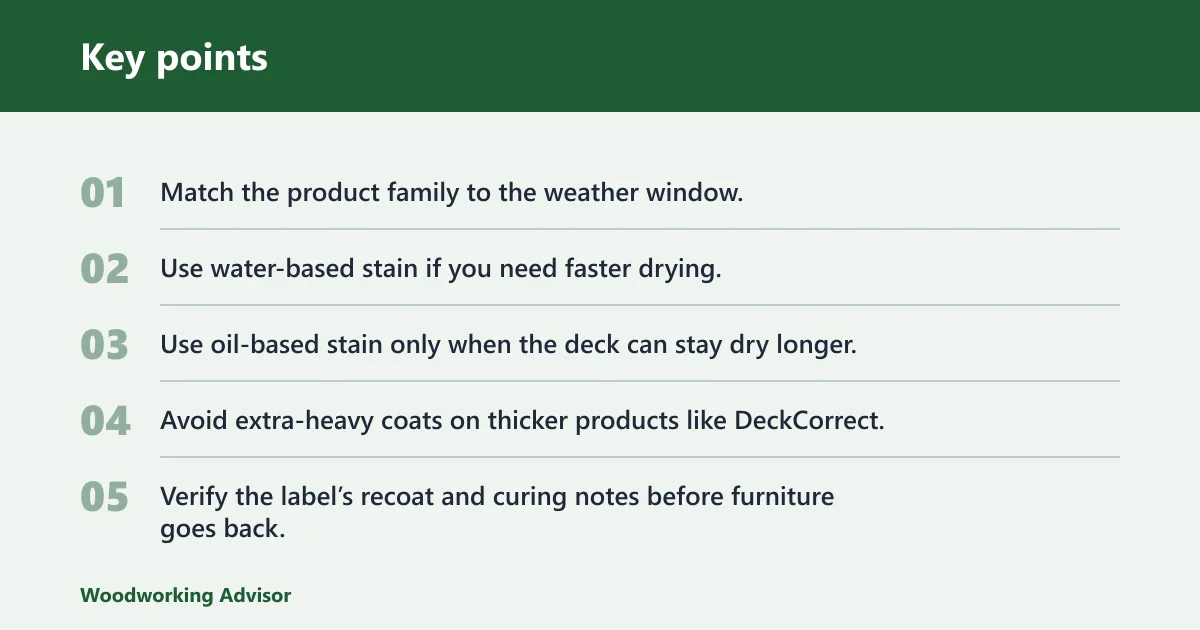
- Match the product family to the weather window.
- Use water-based stain if you need faster drying.
- Use oil-based stain only when the deck can stay dry longer.
- Avoid extra-heavy coats on thicker products like DeckCorrect.
- Verify the label’s recoat and curing notes before furniture goes back.
Overnight lows and deck moisture
A warm afternoon can still fail overnight. If the temperature drops below target after application, drying slows and the finish may stay soft into the next day. Deck moisture matters too; wood that is too damp will delay adhesion and make penetration less even.
Surface moisture limits before staining
Competitor guidance commonly recommends a moisture content below 15% before staining. That is a practical benchmark for a dry substrate. Wet wood can trap stain near the surface, which slows the dry path and can leave blotchy color or weak adhesion.
How wet wood changes penetration and dry time
When wood is damp, stain cannot soak in at a normal rate. That affects both appearance and performance. Even if the air temperature is acceptable, wet boards can make the coating behave like it is still too cold.
A common first-timer mistake is to stain a deck that feels dry to the hand after a short sunny spell. The top looks ready, but the boards still hold moisture from overnight dew. The finish then dries unevenly and stays tacky longer than expected.
What time of day is best to stain?
Early morning or late afternoon is usually easier than noon because the deck surface is cooler and the stain has less chance to flash too fast. The goal is not just air temperature. You also need a surface that stays workable long enough to spread and back-brush without visible lap marks.
Early morning versus late afternoon
Early morning works if the deck has dried after dew and the surface is not still cool and wet. Late afternoon works if there is enough daylight left to finish the board sections before temperatures fall. Either slot can work if the forecast is stable.
Shade, direct sun, and hot surface control
Apply in shade when possible and avoid hot surfaces. Cabot warns that too much warmth can cause lap marks or uneven penetration. Follow the shade across the deck during the day so the surface stays manageable instead of chasing the sun after it has already heated the boards.
Following shade through the deck
Start with the area that stays shaded the longest. Then move with the shadow line as it shifts. That keeps the wet edge more open and reduces the chance that one section dries faster than the next.
Cabot deck stain decision chart
Use this chart when you need a fast call. It combines temperature, likely risk, and the product family most likely to fit the weather window. It does not replace the label. It helps you decide whether the day is worth using.
| Forecast band | Likely risk | Recommended timing |
|---|---|---|
| 45-49°F | Cold drying, longer open time, higher chance of a soft finish. | Wait unless the label allows cooler conditions and the deck stays dry. A short, calm, rain-free window is still not ideal here. |
| 50-59°F | Usable, but only if the overnight low stays steady and humidity stays moderate. | Proceed with caution. Best for a stable forecast and products with slower label-approved dry times. |
| 60-80°F | Most manageable range for application and dry time. | Stain now if the deck is dry, the next day is rain-free, and shade or cooler timing keeps the surface from overheating. |
| 80°F+ | Hot-surface lap marks and uneven penetration become more likely. | Only stain if you can work in shade, keep the deck cool, and start early or finish late. Otherwise wait. |
| Overnight low, rain window, humidity | Threshold to check | Action |
|---|---|---|
| Overnight low | Stay above 50°F when possible within the 24-hour window. | Delay if the forecast drops below that level after application. |
| Rain window | No rain expected for 24 hours. | Do not stain if showers, drizzle, or heavy dew are likely. |
| Humidity | 40-60% is easier to manage. | Expect slower dry time above that range, especially in shade. |
Frequently asked questions
What is the best Cabot deck stain?
The best Cabot deck stain depends on weather window and product goal. For a short, stable forecast, water-based options usually dry faster. For a slower, more forgiving schedule, oil-based products may fit better. Match the family to the forecast first, then follow the can for exact directions.
What temperature should I use Cabot deck stain?
That range works best when the overnight low also stays steady and the deck surface is not hot. If the forecast swings hard after sunset, wait for a better window.
How long does Cabot deck stain take to dry?
A competitor says Cabot deck stain can reach light foot traffic readiness in 4 to 6 hours, with full curing taking 24 to 72 hours. Water-based products are usually faster than oil-based products. Thick coats, humidity, and cool nights can extend both stages.
How long before rain can I apply Cabot deck stain?
Cabot advises choosing a day with no rain expected for 24 hours. That buffer matters because wet weather can double dry time and leave the finish vulnerable. If the forecast includes drizzle, showers, or heavy dew, reschedule.
Can I stain a deck if the temperature drops at night?
Only if the overnight low stays within the product’s usable range and the label allows it. A warm daytime high does not cancel a cold night. If the deck will cool quickly after application, drying slows and the finish may stay soft longer.
Which Cabot stain types dry faster?
Water-based Cabot formulations dry faster than oil-based versions. That makes them the better pick for short weather windows. Australian Timber Oil generally needs more drying room, while Cabot Gold and other faster-drying options can fit tighter schedules when the forecast is stable.
Sponsored / affiliate links. As an Amazon Associate I earn from qualifying purchases. I may earn additional commission from eligible campaigns.