Can You Spray Paint Inside Safely? Respirator & Ventilation Rules
You can spray paint a small wood project indoors, but only with cross-ventilation, no ignition sources, and a respirator rated for organic vapors, not a dust mask. Aerosol paint releases solvent vapor that is flammable, and the EPA notes indoor VOC levels can run up to 1,000 times outdoor background during some paint activities. This guide covers the right mask, ventilation math, fire rules, and when to move outside.
Can You Spray Paint Inside Safely? Start With the Respirator
|
Best Respirator Pick For Indoor Spray Painting 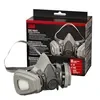 |
3M OV/P95 Paint Project Respirator 6211 (Medium) A reusable half-mask kit with organic vapor cartridges and P95 particulate prefilters, the combination this guide says aerosol paint actually requires.
|
As an Amazon Associate we earn from qualifying purchases.
The honest answer is yes for a drawer front, a picture frame, or a set of cabinet knobs, and no for a bookcase or a chair. The deciding factor is how much solvent you release into air you also have to breathe, which is why the respirator comes before any tip about drop cloths or fans.
Which mask actually stops spray paint fumes?
Most people grab whatever is in the garage. The table below shows why that fails. Paint mist is a particle problem, but the solvent that carries it is a vapor problem, and they need different filters.
| Mask type | Stops paint mist? | Stops solvent vapor? | Verdict for aerosol paint |
|---|---|---|---|
| Cloth or surgical mask | Poor | No | Not protection |
| N95 or P95 alone | Yes | No | Half protected: mist only |
| Half-mask with organic vapor (OV) cartridges only | No | Yes | Half protected: vapor only |
| Half-mask with OV cartridges plus P95 or P100 prefilter | Yes | Yes | The correct setup for solvent-based aerosol |
| Supplied-air respirator | Yes | Yes | Overkill for a small piece, used for large spray jobs |
Organic vapor cartridges use activated carbon to adsorb solvent vapor, and NIOSH color-codes them black. They do not filter particles, so the pleated prefilter in front is what catches the mist. Cartridges are not permanent: once you can smell paint through the mask, the carbon is saturated, so leave the area and replace them, and store used cartridges in a sealed bag between jobs so they do not keep adsorbing room air.
Fit matters as much as the rating. OSHA’s respiratory protection rule (29 CFR 1910.134) requires employers to fit test workers, and the same logic applies at home: do a positive and negative pressure seal check every time you put the mask on, and know that stubble or a beard under the sealing edge breaks the seal. A mask that leaks around the nose protects far less than its label suggests.
What Is in the Can, and What Does It Do Indoors?
Aerosol paint is pigment and resin dissolved in solvents, plus a propellant that pushes it out. Solvent blends vary by product, which is why section 3 of the safety data sheet (SDS) for your specific can is the place to look, not a general list. What the mix has in common is that it evaporates quickly into the room air as volatile organic compounds, or VOCs.
According to the EPA, indoor concentrations of several organic compounds average 2 to 5 times higher than outdoors, and during and for several hours after activities such as paint stripping they may reach 1,000 times background outdoor levels. The EPA lists eye, nose, and throat irritation, headaches, loss of coordination, and nausea among the short-term effects, and liver, kidney, and central nervous system damage among the risks of heavy exposure. Its advice for products with a ventilation warning is to use them outdoors or in an area with an exhaust fan, otherwise to open windows for the maximum outside air possible.
Why your nose is a bad safety gauge
A common belief is that if you cannot smell it anymore, the air is clear. Smell adapts quickly to solvent vapor, so your nose can stop reporting a concentration that is still there. Judge safety by time, airflow, and your respirator, not by odor. The same applies to a room that smells fine the next morning: vapor from a freshly painted piece can keep leaving the coating for hours.
The Fire Risk Most Guides Skip
Most spray paint cans carry an extremely flammable aerosol warning, and the reason is the propellant plus the solvent. The vapor does not stay near the can. Propane and butane propellants are heavier than air, so they settle and travel along the floor, which is how vapor from a workbench can reach a water heater pilot light across the garage.
- Keep the work area clear of pilot lights, furnaces, gas dryers, space heaters, and anything that cycles on with a spark, such as a refrigerator compressor.
- Do not flip light switches or plug in tools in the vapor cloud while spraying, and let the air clear before you resume sanding.
- Never heat a can to speed the spray. Many cans carry a warning against storage above 120 degrees F (49 degrees C).
- Keep an ABC-rated fire extinguisher within reach for any indoor finishing session.
OSHA takes the same view in commercial shops. Its spray finishing standard (29 CFR 1910.107) requires mechanical ventilation adequate to remove flammable vapors and mists, requires that ventilation to run during spraying, and to keep running afterward long enough to exhaust vapors from the drying coated articles. It also calls for special electrical equipment in spraying areas, which is why a standard household box fan is not a rated solution: its motor and switch are exactly the type of ignition source a spray booth is designed to exclude. If you use one anyway for a light coat on a small piece, treat it as dilution only, start it before you spray, keep the can away from it, and keep the amount you spray small.
One more myth: water-based or low-odor aerosol does not remove the fire risk. Most aerosol paints, including latex versions, are pressurized with flammable hydrocarbon or dimethyl ether propellants, so read the flammability warning on the actual can before you decide what precautions to skip.
Where to Spray: Ranked Options
| Location | Verdict | Why |
|---|---|---|
| Outdoors, sheltered from wind and direct sun | Best | Vapor disperses, no ignition sources, no residue in living space |
| Open garage, main door up plus a second opening | Acceptable | Cross-flow works if pilot lights and appliances are clear |
| Basement or spare room with window exhaust | Small pieces only | Dilution only; watch furnaces and water heaters |
| Closed room, bedroom, or apartment with HVAC running | Do not | Vapor recirculates through ducts and lingers where you sleep |
How to Ventilate a Room for Spray Painting
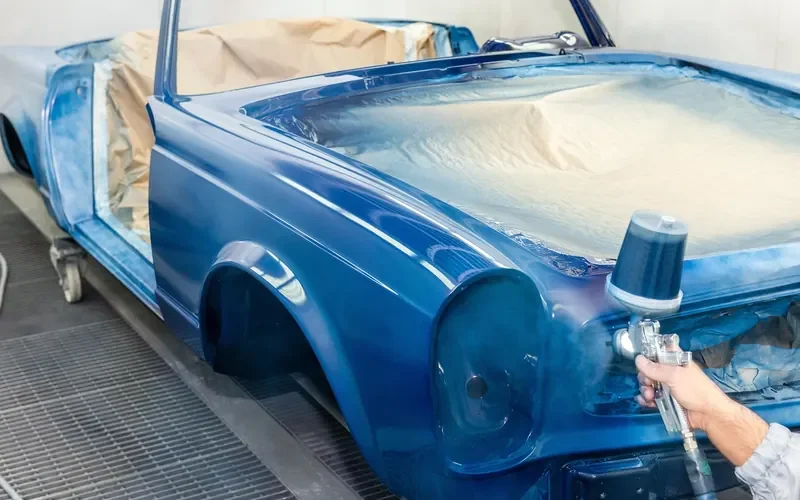
Ventilation lowers vapor concentration; it does not make the air safe to breathe without a respirator. Use it as a second layer, in this order:
- Shut down the HVAC: turn off the furnace or air handler and cover the vents in the room so vapor does not travel through the ducts into other rooms.
- Open two paths: open a window or door on one side for incoming air and another on the opposite side so air crosses the room instead of circling in place.
- Move the air out: point a fan out of the window so it pushes air outward, and keep the can away from the fan (see the fire notes above).
- Spray downwind of your body: the fresh air should reach you before it reaches the work.
- Keep ventilating afterward: leave the fan running until the piece is dry to handle, then move it to a garage or shed to cure.
A quick air-change calculation
Air changes per hour (ACH) is airflow times 60, divided by room volume. Take a 12 by 10 foot room with 8 foot ceilings: 960 cubic feet. If a window fan delivers an effective 300 cubic feet per minute after the window opening and screen restrict it (an assumed figure for illustration, not a rating), that is 300 x 60 / 960 = about 19 air changes per hour. Halve the airflow and you halve that number, which is why one small window with no inlet does far less than it seems to.

Spraying Wood Projects Indoors: Prep and Technique
This is where woodworkers can cut their exposure most. Every extra coat adds solvent to the air, so good prep means fewer passes. Sand and prime outdoors or in a dust-controlled space, not in the finishing room. Raw wood and especially MDF edges drink up the first coat, so a sealing primer keeps you from spraying three heavy coats where two light ones would do. See our guides on the best wood primer and sanding between primer coats for the prep, or spray painting wood furniture without sanding if you are weighing skipping it.
- Hold the can about 10 to 16 inches from the surface, or whatever distance your label specifies, and use sweeping passes that start off the piece and end off the piece.
- Apply thin coats. A thick coat traps solvent, runs, and takes longer to release its vapor.
- Spray small, movable pieces standing on a cardboard sheet so you can carry them out to cure without touching them.
- Check the can before you start. Many enamel labels call for 50 to 90 degrees F and humidity below 70 percent, per Rust-Oleum’s technical data sheets.
For flat panels and plywood, our plywood spray painting guide covers the grain and edge details, and using spray paint on wood compares product types. If you have an old can, read how to tell whether spray paint has expired first, because a clogged old nozzle spits and wastes coats.
Dry time is not the same as safe time
| Stage | Example from a Rust-Oleum enamel data sheet | What it means for you |
|---|---|---|
| Dry to touch | About 15 minutes (Professional Enamel) | Surface is tack-free, solvent is still leaving |
| Handle | 1 to 2 hours | You can move it out of the room |
| Fully dry | 24 hours | Cure in a garage or shed, not a bedroom |
| Recoat window | Within 1 hour or after 48 hours (Stops Rust line) | Miss it and the second coat can wrinkle: check your own label |
These numbers are examples from two Rust-Oleum lines; other brands and finishes differ, so treat your own can’s label as the rule. For the wood-finishing side, a sprayed topcoat you might add later has its own precautions, covered in spraying Minwax polyurethane.
Cleanup and Disposal
- Turn a used can upside down and spray onto scrap cardboard until only propellant hisses so the nozzle clears, and never puncture or burn a can.
- Cans that still contain paint are household hazardous waste in many areas: check your local program before tossing them.
- Let paint-wet rags and cardboard dry flat outdoors before they go in the trash.
- Wipe drips with a rag rather than a solvent spray, which adds more vapor.
Exterior-grade products are a different problem indoors: see why outdoor paint is a poor choice inside before reaching for a leftover can.
Frequently Asked Questions
Can you spray paint in a room with the window open?
Only for a small wood project, and only if air can also enter somewhere else so the room has a real flow-through path. One open window mostly lets vapor drift back into the room. Wear a half-mask respirator with organic vapor cartridges, keep pilot lights and sparks out of the area, and move anything larger than a picture frame outside.
Is an N95 mask enough for spray paint?
No. An N95 filters particles, including paint mist, but it does not adsorb solvent vapor. Solvent-based aerosol paint needs a NIOSH-approved half-mask with organic vapor cartridges, ideally with a P95 or P100 particulate prefilter. If you smell paint through any respirator, leave the area and replace the cartridges.
How long do spray paint fumes last indoors?
Paint dries to the touch far faster than the solvents finish leaving. One Rust-Oleum enamel line lists 15 minutes to dry to the touch, 1 to 2 hours to handle, and 24 hours to fully dry. Keep ventilating until the piece is dry to handle, then cure it in a garage or shed rather than a living space.
Can you spray paint in a garage?
A garage is better than a bedroom, but not automatically safe. Open the main door and a second opening for cross-flow, and keep vapor away from water heaters, furnaces, gas dryers, and freezers that cycle on. Also check the temperature: many enamel labels call for 50 to 90 degrees F.
Is water-based spray paint safe to use indoors without ventilation?
No. Water-based aerosol paints usually have less solvent odor, but the can is still pressurized with a flammable propellant and the mist still needs to be kept out of your lungs. Read the flammability warning on the can, ventilate, and wear a particulate respirator at minimum.
Bottom Line
A small wood piece can be sprayed indoors with cross-ventilation, no flames or sparks, and a half-mask with organic vapor cartridges and a particulate prefilter. Anything larger, or any space that shares air with where people sleep, belongs outdoors. When in doubt, read the can’s warning and the SDS for that exact product.
Sponsored / affiliate links. As an Amazon Associate I earn from qualifying purchases. I may earn additional commission from eligible campaigns.