Best Wood Primer and Undercoat: 8 Compared by Real Cost (2026)
Zinsser Cover-Stain is the best all-round wood primer and undercoat here, at $18.48 per 100 sq ft of manufacturer-published coverage. But if your wood has knots, only 2 of these 8 primers claim to block them, and a primer is not the same thing as an undercoat. This guide ranks all eight by real cost, stain blocking and what each is approved for.
Many roundups rank primers by shelf price. That is the wrong axis. Coverage across these eight products varies by more than 60%, and container sizes vary more than that, so the price on the can tells you very little about what the job will actually cost. This guide compares all eight on cost per 100 square feet of manufacturer-published coverage, and the ranking that produces is not the one the shelf suggests.
Primer and Undercoat Are Not the Same Product
Most American buying guides treat “primer” and “undercoat” as synonyms. In the trade they are two different coatings with two different jobs, and the distinction decides which product you actually need.
- Primer goes on a bare substrate. Its job is adhesion and sealing — gripping raw wood, sealing porous grain, and blocking whatever wants to bleed upward.
- Undercoat goes on a surface that is already primed or painted. It is always pigmented, and its job is to build an even, opaque colour base so the topcoat reaches full colour in fewer coats.
- Primer-undercoat combination products do both, and almost everything in this roundup is one of these — which is why the terms collapsed together in the first place.
This matters practically. If you are painting bare pine, you need the sealing and stain-blocking half of the job and a true primer is essential. If you are repainting trim that is already coated and sound, you mostly need opacity, and a cheaper pigmented undercoat will do. Buying a $46 bonding primer to repaint sound, painted trim is money spent on a property you do not need. Turned trim like stair spindles is the one place where a bonding primer earns its cost even on sound paint; see our guide to painting stair spindles for why the round shape changes the prep and application steps. If that bare wood is a floor rather than trim, our best paint for wood floors comparison covers which topcoats are self-priming on wood and which explicitly aren’t. For a plywood-specific walkthrough — filling seams, priming, and painting — see our guide on how to paint plywood floors.
The Numbers: 8 Wood Primers Compared by Real Cost
Every figure below is transcribed from the manufacturer’s technical data sheet and every price is the live Amazon buy-box price on 2 August 2026. The final column is calculated, not quoted — the formula is directly underneath so you can check it.
| Primer | Chemistry (TDS) | Coverage sq ft/gal | Recoat | Full cure | VOC | Price | Cost / 100 sq ft |
|---|---|---|---|---|---|---|---|
| Zinsser Bulls Eye 1-2-3 Water-Base Primer & Sealer | Styrenated acrylic (water-based) | 350 porous / 450 non-porous | 1 hour | 7 days | <100 g/L | $9.55 (1 quart) |
$10.91 |
| Zinsser B-I-N Shellac-Base Primer-Sealer | Shellac in denatured alcohol | 500 | 45 min | 1-3 days | 550 g/L | $167.63 (2 x 1 gallon) |
$16.76 |
| Zinsser Cover-Stain Oil-Base Primer-Sealer | Styrenated modified alkyd (oil) | 400-450 | 1 hour | 7 days | 450 g/L | $18.48 (1 quart) |
$18.48 |
| INSL-X Aqua Lock Plus Water-Based Primer-Sealer | 100% acrylic (water-based) | 300-400 | 1 hour | 3-4 days | <50 g/L | $20.99 (1 quart) |
$27.99 |
| Zinsser B-I-N Advanced Synthetic Shellac Primer | Acrylic, waterborne | 300-400 | 45 min (2 hr over knots) | 7 days | <100 g/L | $24.39 (1 quart) |
$32.52 |
| INSL-X Stix Acrylic Waterborne Bonding Primer | Urethane-modified acrylic | 300-400 | 3-4 hours | 3-4 days | <100 g/L | $26.99 (1 quart) |
$35.99 |
| KILZ Original Low Odor Interior Primer | Solution acrylic (sold as oil-based) | 300-400 | 1 hour | not published | <350 g/L | $27.56 (1 quart) |
$36.75 |
| KILZ Adhesion High-Bonding Primer | Styrenated acrylic (water-based) | 300-400 | 1 hour | not published | <100 g/L | $45.88 (1 quart) |
$61.17 |
How the last column is calculated
cost per 100 sq ft = (price ÷ gallons in the container) ÷ coverage per gallon × 100
Worked example, Zinsser B-I-N: $167.63 ÷ 2 gal = $83.82 per gallon. $83.82 ÷ 500 sq ft × 100 = $16.76 per 100 sq ft. Where a data sheet gives a coverage range, the low figure is used, because bare wood is the porous case and porous surfaces consume more. Derived values, not measured ones — the inputs are all in the table above.
What the Cost Column Actually Shows
The order changes almost completely. On shelf price these eight span 17.6x, from $9.55 to $167.63. On cost per 100 sq ft they span 5.6x — and the most expensive can on the page becomes the second cheapest primer to use.
- Zinsser B-I-N looks 17x more expensive than Bulls Eye 1-2-3 and is actually 1.5x — $16.76 versus $10.91 per 100 sq ft. It covers 500 sq ft per gallon because Zinsser specifies it at a 0.75–0.9 mil dry film, roughly half the thickness of everything else here. Thin film, more area.
- KILZ Adhesion is the most expensive primer in this comparison at $61.17 per 100 sq ft — 5.6x the cost of Bulls Eye 1-2-3, from a shelf price only 4.8x higher.
- B-I-N Advanced costs nearly double original B-I-N in use ($32.52 vs $16.76) despite a shelf price seven times lower. You are buying low odour, not value.
- Buying quarts carries a 56% penalty. Identical Bulls Eye 1-2-3 is $38.20 per gallon bought as quarts and $24.56 per gallon bought as a 5-gallon pail.
The 8 Best Wood Primers and Undercoats
Ordered by role rather than by price, because the right primer depends almost entirely on what you are priming. Prices are live Amazon buy-box figures from 2 August 2026 and will move.
1. Zinsser Cover-Stain Oil-Base Primer-Sealer — #1 Best Overall
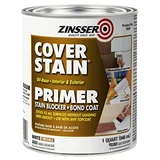 |
#1 Best Overall Zinsser Cover-Stain Oil-Base Primer-Sealer — $18.48 (1 quart)
|
Cover-Stain is the most broadly useful primer in this comparison, and that is why it takes the top spot rather than the strongest stain blocker. Its TDS rates it for whole-surface interior and exterior use, which only one other product here can claim, and it is a genuine oil-based alkyd that penetrates bare wood instead of sitting on top of it. Zinsser explicitly calls it an “excellent tannin blocker” and directs it at bare cedar and redwood.
At $18.48 a quart it works out to $18.48 per 100 sq ft of published coverage — mid-pack, and notably cheaper in use than several water-based primers that look far cheaper on the shelf. The 1-hour recoat means a prime-and-paint day is realistic. Once fully cured it also accepts a latex topcoat: see our guide on using latex paint over oil-based primer for cure times and prep steps.
What it is not is a knot sealer. Zinsser’s own data sheet tells you to spot-prime knots and sap streaks with B-I-N before priming the whole surface with Cover-Stain. Treat that as a two-product job on knotty pine rather than a failure of this one. At 450 g/L VOC it also needs real ventilation and mineral spirits for cleanup.
Pros
- Rated for whole-surface interior and exterior use, unlike most of this list
- True oil-based alkyd that penetrates bare wood rather than sitting on it
- Named by the manufacturer as an excellent tannin blocker for cedar and redwood
- 1-hour recoat allows priming and topcoating the same day
- Blocks nicotine, fire, smoke and water damage stains per the TDS
Cons
- 450 g/L VOC — strong solvent odour, needs cross-ventilation
- Mineral spirits cleanup, not soap and water
- Does not claim knots or sap streaks; needs B-I-N spot-priming first
- 7-day full cure before hard service
Main drawback: It does not block knots. On knotty pine you will need a shellac primer for the knots first, which makes it a two-can job.
2. Zinsser B-I-N Shellac-Base Primer-Sealer — Best for Knots and Tannin Bleed-Through
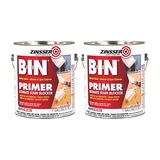 |
Best for Knots and Tannin Bleed-Through Zinsser B-I-N Shellac-Base Primer-Sealer — $167.63 (2 x 1 gallon)
|
If something is bleeding through your paint, this is the answer. B-I-N is shellac dissolved in denatured alcohol, and its TDS claim list is longer than anything else here: water, nicotine, ink, crayon, marker, rust, smoke, grease, creosote, asphalt, lipstick, graffiti, knots, sap streaks and tannin bleed. It also seals odours, including fire damage and animal urine. Every other Zinsser sheet in this comparison defers to it for knots.
The counterintuitive part is the cost. At $167.63 for two gallons it is by far the most expensive item on this page — and at 500 sq ft per gallon of published coverage it works out to $16.76 per 100 sq ft, the second cheapest primer here to actually use. The reason is that B-I-N is specified at a very thin 0.75–0.9 mil dry film, roughly half the thickness of everything else, so a gallon goes much further.
The trade-offs are real. At 550 g/L it has the highest VOC content in this comparison and an alcohol reek that will clear a room. The dried film is brittle, which is part of why Zinsser limits exterior use to spot priming only — seal the knots outdoors, then prime the whole surface with something rated for it. It does dry fast, though: 45-minute recoat and a full cure in 1–3 days rather than the 7 days everything else wants.
Pros
- The most comprehensive stain-block claim list of any primer here, including knots and sap
- Only chemistry in this roundup that reliably seals knot and resin bleed
- Seals odours as well as stains, including smoke and animal urine
- $16.76 per 100 sq ft — second cheapest in real use despite the highest shelf price
- Fastest cure in the group at 1–3 days; 45-minute recoat
- Sticks to glossy surfaces without scuff sanding
Cons
- 550 g/L VOC, the highest here — severe odour, respirator territory
- Brittle film; exterior use limited to spot priming only
- Denatured alcohol cleanup
- Sold on Amazon as a two-gallon pack, so the entry price is high
Main drawback: The odour and the exterior restriction. This is an interior product with a spot-priming exemption outdoors, not a general exterior primer.
3. Zinsser Bulls Eye 1-2-3 Water-Base Primer & Sealer — Best Value
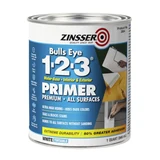 |
Best Value Zinsser Bulls Eye 1-2-3 Water-Base Primer & Sealer — $9.55 (1 quart)
|
Bulls Eye 1-2-3 is the default water-based primer for good reason, and the cost maths confirms it: $10.91 per 100 sq ft, the cheapest in this comparison, at $9.55 for a quart. It is a styrenated acrylic with under 100 g/L VOC, cleans up with water, and is one of only two products here rated for whole-surface exterior use.
It is also the most honestly-scoped product on this page, because Zinsser tells you where it stops. The TDS claims grease, handprints, asphalt, crayon, graffiti, rust and “light water stains and cedar or redwood bleed” — and then instructs you to use B-I-N for severe water and smoke stains and to spot-prime knots and sap streaks with B-I-N first. It does not claim nicotine, smoke, or odour sealing at all.
One wrinkle worth knowing: the current data sheet contradicts itself on coverage, giving 400–450 sq ft/gal in the narrative and 450 non-porous / 350 porous in the properties table on the following page. The 350 figure is used throughout this article because bare wood is the porous case. Note also the 24-hour stain-sealing wait over cedar — far longer than its usual 1-hour recoat.
Pros
- Cheapest real cost in this comparison at $10.91 per 100 sq ft
- Under 100 g/L VOC, low odour, soap-and-water cleanup
- Rated for whole-surface interior and exterior use
- Bonds to glossy surfaces without sanding
- Widely stocked and available in every container size from quart to 5 gallon
Cons
- Weakest stain blocking of the Zinsser products here — light stains only
- Does not claim knots, sap, nicotine, smoke or odour sealing
- Requires a 24-hour wait when sealing stains on cedar
- Water carrier can raise grain on bare wood and swell MDF edges
Main drawback: It is a light-duty stain blocker. Zinsser’s own sheet routes anything serious to B-I-N, so on problem wood this is the second product you buy, not the first.
4. Zinsser B-I-N Advanced Synthetic Shellac Primer — Best Low-Odor Stain Blocker
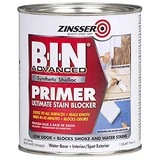 |
Best Low-Odor Stain Blocker Zinsser B-I-N Advanced Synthetic Shellac Primer — $24.39 (1 quart)
|
B-I-N Advanced is the compromise product: most of the stain-blocking reputation of B-I-N with under 100 g/L VOC instead of 550, and soap-and-water cleanup. It claims tannin, knots and sap streaks — one of only two products here that claim knots at all — plus water, nicotine, grease, oil, soot, rust, mildew, crayon and lipstick, and it blocks odours including pet urine. It is also the primer to reach for when sealing raw MDF edges before painting, which absorb paint unevenly without a shellac-based sealer first.
It is worth being precise about what this product is, because the name misleads. Despite “Synthetic Shellac” on the label, the resin line on Zinsser’s own technical data sheet reads “Acrylic”, with water and glycol ethers as the solvents. Chemically this is a waterborne acrylic, not a shellac. That explains both the low odour and the reports that it needs two coats where original B-I-N needs one over difficult knots.
The cost is where it struggles. At $24.39 a quart against 300–400 sq ft/gal coverage it lands at $32.52 per 100 sq ft — nearly double original B-I-N bought by the gallon. You are paying a substantial premium for low odour. If ventilation is your binding constraint, that is a fair trade; if it is not, the original is both stronger and cheaper in use.
Pros
- Claims knots, sap and tannin — rare outside true shellac
- Under 100 g/L VOC with soap-and-water cleanup
- Blocks odours including pet urine, smoke and fire damage
- Excellent adhesion to glossy surfaces with no sanding or de-glossing
- 45-minute recoat
Cons
- $32.52 per 100 sq ft — nearly double original B-I-N in real use
- Marketed as shellac; the TDS resin type is acrylic
- Needs 2 hours over knots rather than the standard 45 minutes
- Exterior use limited to spot priming only
- Reported to need two coats where original B-I-N needs one on hard knots
Main drawback: You pay roughly double per square foot versus original B-I-N for a product that is chemically an acrylic, not a shellac, and is a step weaker over hard knots.
5. KILZ Original Low Odor Interior Primer — Best for Interior Smoke and Water Stains
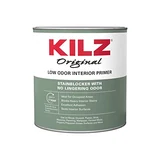 |
Best for Interior Smoke and Water Stains KILZ Original Low Odor Interior Primer — $27.56 (1 quart)
|
KILZ Original Low Odor is the interior remediation primer — the one for a room with smoke damage, water staining or a history you would rather not see through the new paint. Its TDS claims water, tannin, and smoke from tobacco and fire, and it lays down a high-solids film at 53.3% solids by volume.
Two things about it are commonly misreported and worth correcting. First, it is interior only — the data sheet is explicit, and it is not recommended for floors either. KILZ does make an interior/exterior oil primer, but it is a different SKU. Second, although it is sold and described as oil-based, the resin type on the data sheet is “Solution Acrylic”, not alkyd. At under 350 g/L it still has meaningful solvent odour despite the “low odor” name.
The claim list is also narrower than KILZ Original No. 1000, which adds ink, pencil, felt marker, grease and odour sealing. And like every KILZ product reviewed here, it makes no knot-blocking claim whatsoever. At $27.56 a quart it costs $36.75 per 100 sq ft, which is expensive for what it does unless you specifically need its smoke and water stain performance.
Pros
- Strong on interior water stains and smoke and tobacco damage
- High solids at 53.3% by volume for a well-filled film
- Claims tannin blocking
- Lower odour than a conventional oil primer
- 1-hour recoat
Cons
- Interior only — no exterior use at all, and not for floors
- $36.75 per 100 sq ft, one of the more expensive options in real use
- No knot or sap claim on the data sheet
- Narrower stain list than standard KILZ Original
- Requires thorough scuff-sanding of glossy surfaces first
- No published full cure time
Main drawback: It is interior-only and does not claim knots, so on bare knotty pine or anything outdoors it is the wrong tool regardless of price.
6. INSL-X Stix Acrylic Waterborne Bonding Primer — Best for MDF and Glossy Surfaces
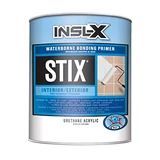 |
Best for MDF and Glossy Surfaces INSL-X Stix Acrylic Waterborne Bonding Primer — $26.99 (1 quart)
|
Stix is the primer professional cabinet painters reach for when the surface is slick. Its vehicle is a urethane-modified acrylic and its TDS lists PVC, vinyl, plastic, glass, tile, glazed block, glossy paints, pre-coated siding, fibreglass and galvanized metal alongside plaster, drywall and wood. Benjamin Moore states it can be used over most glossy surfaces without sanding, and that it cures to an extremely hard film that will accept alkyd, acrylic latex, urethane, epoxy or lacquer topcoats.
For MDF and melamine work it is a sensible choice because it grips without needing the surface abraded, and it will cure at temperatures as low as 35°F — useful in an unheated shop in winter, where most water-based primers simply will not coalesce.
Two limitations matter and neither is well publicised. First, the recoat time is 3–4 hours — by far the longest in this comparison, where everything else sits between 45 minutes and 2 hours. Stix will cost you a day that Bulls Eye 1-2-3 would not. Second, although it is rated interior and exterior, the data sheet explicitly says it is “not recommended as a whole house exterior primer over wood or for wood decking”. It is a bonding primer for difficult surfaces, not an exterior wood primer. It also makes no stain-blocking claims at all.
Pros
- Outstanding adhesion to glossy, slick and non-porous surfaces without sanding
- Urethane-modified acrylic cures to a very hard film
- Cures at temperatures as low as 35°F
- Accepts almost any topcoat — alkyd, latex, urethane, epoxy or lacquer
- Under 100 g/L VOC, soap-and-water cleanup
Cons
- 3–4 hour recoat, the longest here by a wide margin
- Explicitly not recommended as a whole-house exterior primer over wood
- No stain-blocking claims — no tannin, no knots, nothing
- $35.99 per 100 sq ft
- Formica, ceramic tile and glossy paint still want deglossing despite the no-sand claim
Main drawback: The 3–4 hour recoat. It is an adhesion specialist that costs you most of a working day between coats, and it will not block a single stain.
7. KILZ Adhesion High-Bonding Primer — Best for Previously Painted and Laminate Surfaces
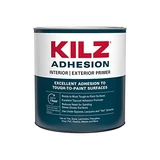 |
Best for Previously Painted and Laminate Surfaces KILZ Adhesion High-Bonding Primer — $45.88 (1 quart)
|
KILZ Adhesion exists to solve one problem: getting paint to stick to surfaces that reject it. Its approved substrate list is the longest here — laminates, glazed tile, glass, Kynar, PVC, vinyl, anodized aluminium, factory finishes, architectural plastics, plus wood, plywood and wood composites. Adhesion is tested to ASTM D3359 above 4B on cured enamels.
It is also the only product in this comparison that claims to remove the sanding step rather than merely tolerate glossy surfaces. Five of the six KILZ sheets reviewed instruct you to scuff-sand gloss thoroughly; Adhesion is formulated to bond without it. On previously painted trim, cabinet doors, or melamine shelving, that is the whole value proposition. See our guide to painting flat over semi-gloss for the full prep sequence this primer fits into.
Be clear about what you are buying, though. Its data sheet makes no stain-blocking claim at all — no tannin, no knots, no water stains, nothing. It is a bonding primer, not a stain blocker. And at $45.88 a quart against 300–400 sq ft/gal it works out to $61.17 per 100 sq ft, the most expensive primer in this comparison by a wide margin — nearly six times the cost of Bulls Eye 1-2-3. Use it where adhesion is genuinely the problem, and not as a general-purpose wood primer.
Pros
- Bonds to laminate, glass, tile, PVC, vinyl and factory finishes
- The only primer here formulated to eliminate scuff-sanding of glossy surfaces
- ASTM D3359 adhesion above 4B on cured enamels
- Rated interior and exterior
- Under 100 g/L VOC, water cleanup
Cons
- $61.17 per 100 sq ft — by far the most expensive here in real use
- No stain-blocking claims of any kind on the data sheet
- Not a sealer for bare porous wood
- 24-hour wait before topcoating with epoxies, lacquers or hot solvents
- No published full cure time
Main drawback: It blocks no stains at all. This is purely an adhesion product, and at $61.17 per 100 sq ft it is an expensive mistake if adhesion was not your actual problem.
8. INSL-X Aqua Lock Plus Water-Based Primer-Sealer — Best Water-Based Undercoat for Bare Wood
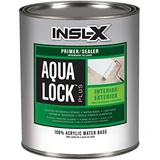 |
Best Water-Based Undercoat for Bare Wood INSL-X Aqua Lock Plus Water-Based Primer-Sealer — $20.99 (1 quart)
|
Aqua Lock Plus is the quiet all-rounder of this group and the one that best fits the “undercoat” half of the search. It is a 100% acrylic primer-sealer rated for interior and exterior plaster, drywall, wood, concrete, aluminium, galvanized metal, PVC and tile, and unlike the two bonding primers here it genuinely claims stain blocking: water stains, tannin, smoke, graffiti, crayon, lipstick and fingerprints.
It also has the lowest VOC content in this entire comparison at under 50 g/L — roughly a tenth of B-I-N. If you are priming inside an occupied home, that number is worth more than a marginal gain in stain-blocking strength. It carries a mildew inhibitor for the paint film, recoats in an hour, and can go under wallcoverings and certain floor coatings.
At $20.99 a quart it works out to $27.99 per 100 sq ft, which puts it mid-pack — more than Bulls Eye 1-2-3, less than every oil, shellac or bonding option here. The compromises are the usual water-based ones: it will not touch knots or sap, and its data sheet asks you to lightly sand glossy surfaces to dull the sheen, which Stix does not.
Pros
- Lowest VOC in this comparison at under 50 g/L
- Genuinely claims tannin, water, smoke, crayon and graffiti blocking
- Rated interior and exterior on wood
- 1-hour recoat and a mildew-inhibiting film
- Suitable under wallcoverings and certain floor coatings
Cons
- No knot or sap streak claim
- Glossy surfaces need light sanding first, unlike Stix
- $27.99 per 100 sq ft — more than twice Bulls Eye 1-2-3
- 3–4 day cure for maximum scrape resistance
Main drawback: Like every water-based primer here, it will not seal knots. On knotty pine you still need a shellac spot coat first.
Which Primer Blocks Which Stain: The Chemistry Matrix
This is the table that decides most purchases, and it is built only from what each manufacturer actually claims on its data sheet — not from what a brand is popularly assumed to do. A blank cell means the manufacturer does not publish that claim, which is not the same as the product failing, but it is the only honest thing to report.
| Primer | Knots / sap | Tannin bleed | Water stains | Smoke / nicotine | Crayon / ink | Odour sealing |
|---|---|---|---|---|---|---|
| Zinsser B-I-N (shellac) | Yes | Yes | Yes | Yes | Yes | Yes |
| Zinsser B-I-N Advanced (acrylic) | Yes | Yes | Yes | Yes | Yes | Yes |
| Zinsser Cover-Stain (alkyd) | — | Yes | Yes | Yes | — | — |
| Zinsser Bulls Eye 1-2-3 (acrylic) | — | Yes (light) | Yes (light) | — | Yes | — |
| KILZ Original Low Odor | — | Yes | Yes | Yes | — | — |
| KILZ Adhesion | — | — | — | — | — | — |
| INSL-X Stix | — | — | — | — | — | — |
| INSL-X Aqua Lock Plus | — | Yes | Yes | Yes | Yes | — |
The Single Most Useful Row Is the First One
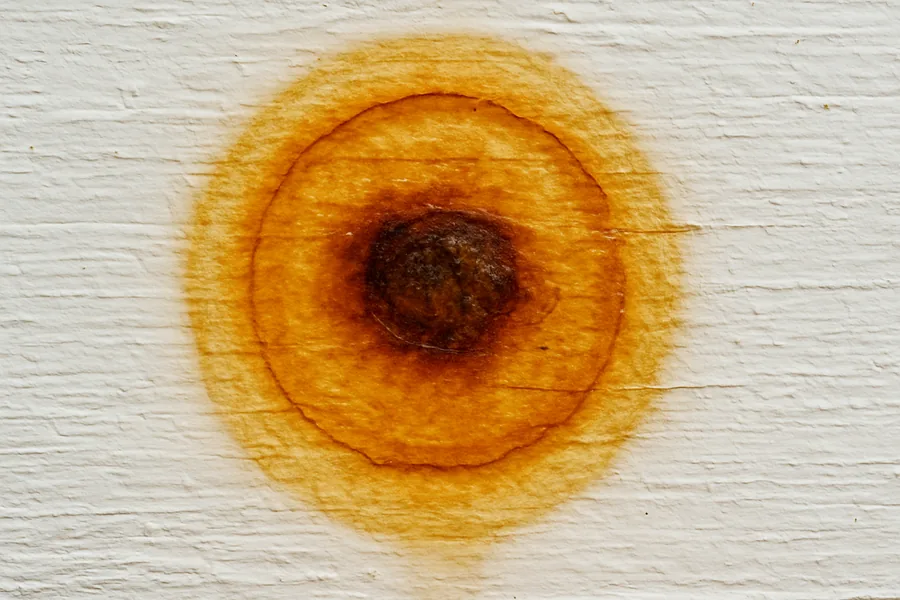
Only 2 of these 8 primers claim to block knots and sap streaks, and both are B-I-N. No KILZ data sheet reviewed for this article claims knot blocking. Neither INSL-X product does. Zinsser is unusually direct about this — the data sheets for Cover-Stain, Bulls Eye 1-2-3 and Zinsser Odorless all instruct the user to spot-prime knots and sap streaks with B-I-N first, then prime the whole surface with the product you actually bought.
Why Knots Defeat Both Oil and Water Primers
The usual explanation — “tannins are water-soluble, so use oil” — is only half right, and the half it gets wrong is the half about knots. The USDA Forest Products Laboratory’s Wood Handbook is direct about it: the oils and resins concentrated in knots are organic and chemically similar to oil-based and alkyd paints, so they dissolve straight into an oil primer and diffuse through it. The same chapter adds that latex formulations are also ineffective on knots.
So knots defeat the two common chemistries for opposite reasons. Water-soluble extractives — the tannins in cedar, redwood and oak — dissolve into a water-based primer. Solvent-soluble extractives — the resins in knots — dissolve into an oil-based primer. Each carrier re-dissolves the stain class that matches it. A joint American Coatings Association and Forest Products Laboratory paper states the resolution in one sentence: knots require an alcohol-borne coating such as shellac because both classes of extractive have low solubility in alcohol. Alcohol dissolves neither, so it sidesteps the choice entirely.
There is a second distinction hiding in the manufacturers’ own wording, and it explains why water-based stain primers so often need a second coat. Zinsser says Bulls Eye 1-2-3 “traps most stains in the primer film”; it says B-I-N stops stains so they “will not bleed into the topcoat.” Trapping is a finite-capacity mechanism — the stain enters the primer and the film has to hold it. Blocking is a barrier that keeps the stain in the wood. That is the difference between a primer you may need to apply twice and one you will not, and it is why Bulls Eye 1-2-3 asks for 24 hours over cedar against its usual 2-hour stain-sealing wait — a twelvefold penalty.
Two honest caveats about shellac, since this article has just spent several paragraphs recommending it. It does not stop pitch bleed — pitch is a kiln-drying problem, not a coating problem, and the ACA and Forest Products Laboratory specifically say to spot-prime cleaned pitch with an exterior-grade primer that is not shellac. And the reason B-I-N is restricted to exterior spot priming is that shellac is moisture-sensitive and prone to cracking in exterior exposure — not, as is often repeated, because of UV.
The practical consequence for a knotty pine door: this is a two-product job. Spot the knots with B-I-N, then prime the whole door with Cover-Stain or Bulls Eye 1-2-3. Buying one $46 bonding primer instead will not help, because as our Zinsser vs KILZ comparison covers in more depth, bonding and stain blocking are different properties entirely.
Substrate Matrix: What Each Primer Is Actually Approved For
| Substrate | Manufacturer-approved options |
|---|---|
| Bare softwood (pine, fir) | All 8, but only B-I-N and B-I-N Advanced claim the knots |
| Tannin-rich wood (cedar, redwood, oak) | Cover-Stain, both B-I-N, KILZ Original Low Odor, Aqua Lock Plus |
| MDF and its cut edges | Not named on a single one of the 8 data sheets. Stix names wood composites in its broader substrate list |
| Plywood | B-I-N and Cover-Stain name plywood explicitly; KILZ Adhesion names wood/plywood |
| Glossy or previously painted | Stix and KILZ Adhesion without sanding; most others with a scuff sand |
| Laminate, melamine, PVC, tile | KILZ Adhesion and Stix only |
| Whole-surface exterior wood | Cover-Stain, Bulls Eye 1-2-3, Aqua Lock Plus, KILZ Adhesion. Not either B-I-N (spot only), not Stix, not KILZ Original Low Odor |
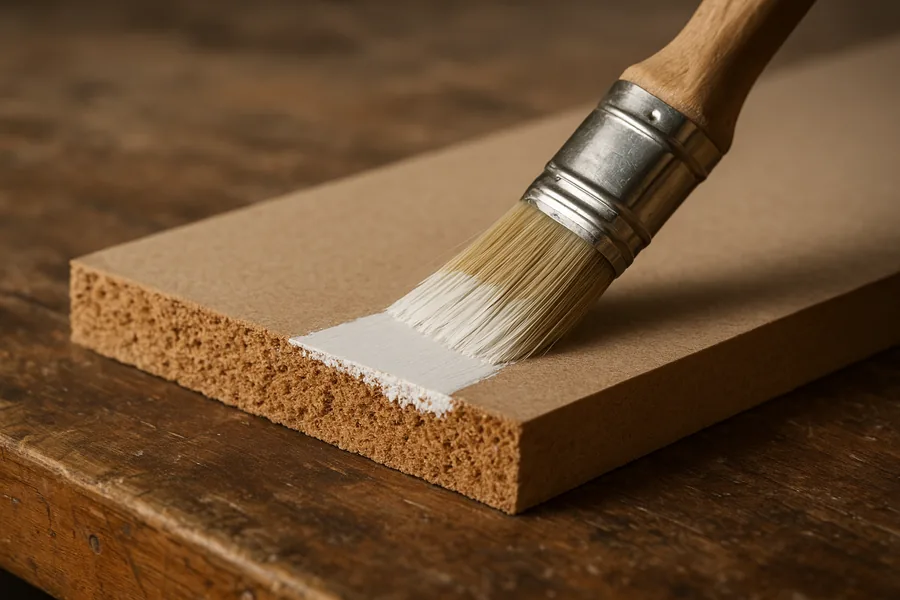
The MDF row deserves a flag. MDF is not named as an approved substrate on any of the eight technical data sheets reviewed for this article — not Zinsser’s, not KILZ’s, not Benjamin Moore’s. Plenty of these primers are used on MDF successfully every day, and the closest manufacturer language is Stix’s “wood composites” and KILZ Adhesion’s “wood composites.” But if you were expecting a manufacturer guarantee for MDF, none of them give you one. Our guide on whether MDF needs undercoating covers the edge-sealing problem in detail.
How We Picked These
Nobody at Woodworking Advisor applied these eight primers to test boards for this article. There is no lab here, and inventing one would not help you. What this guide does instead is something none of the roundups currently ranking for this term have done: it puts every product on a single, comparable cost axis using the manufacturers’ own published numbers.
Here is exactly what was done, so you can check any of it:
- Coverage, dry times, VOC content and resin chemistry were read off the manufacturer technical data sheets — the Rust-Oleum/Zinsser TDS documents (BIN-03, BIN-01, BEY123-01, CVS-03) and the KILZ/Behr data sheets (1004, 2111). Not retailer listings, which are frequently wrong or paraphrased.
- Prices and availability came from the Amazon Creators API on 2 August 2026, using the live buy-box price. A product with no buy box was treated as not genuinely purchasable and left out.
- Cost per 100 sq ft was calculated, not quoted — the formula is in the next section and every input is in the table so you can redo the arithmetic.
- Stain-blocking claims were taken only from what each TDS actually claims, not from what the brand is popularly assumed to do. Where a manufacturer does not claim a stain type, this guide says so rather than filling the gap.
- Container sizes were verified individually. Three products that looked like quart cans in search results turned out to be aerosols and were removed before any cost was calculated.
The limits, stated plainly: published coverage is a manufacturer figure measured under favourable conditions, and real bare softwood will drink more than the sheet suggests. These numbers are excellent for comparing products against each other — that is what they are used for here — and merely indicative for estimating how much to buy. Buy a little more than the maths says.
What to Consider When Buying Wood Primer and Undercoat
Chemistry: Shellac, Oil or Water-Based?
This is the decision that drives everything else. Shellac dissolved in denatured alcohol is the strongest stain and odour blocker available, dries fastest, and is the only chemistry that reliably stops knot and sap bleed. Its film is brittle, its odour is severe, and it is not rated for whole-surface exterior use. Oil and alkyd primers penetrate bare wood deeply and block tannin well, with a slower dry and high VOC content. Water-based acrylics are low-odour, flexible, quick to clean up and the weakest stain blockers of the three. There is no chemistry that wins on every axis, which is why this list has eight products on it and not one.
If shellac chemistry specifically is what you need, see our full shellac-based primer comparison, which also flags which nationally sold “shellac” primers are actually acrylic under their own manufacturer spec sheets.
Coverage, and What a Can Actually Costs
Shelf price is close to meaningless here because coverage varies by more than 60% across these products and container sizes differ. The comparison that matters is cost per 100 square feet, and it reorders the list dramatically — the most expensive can in this roundup is the second cheapest primer to actually use. The full arithmetic is in the table above.
Stain Blocking: Match the Primer to the Stain
Manufacturers are specific about which stains they will and will not block, and those claims differ far more than the marketing suggests. Tannin, knots, smoke, nicotine, water damage, ink and grease are all separately claimed or separately absent. Buying a primer that does not claim your stain type is the single most common way people end up priming twice.
Dry to Recoat vs Full Cure
These are different numbers and confusing them causes real failures. Dry-to-recoat is when you may apply the next coat — between 45 minutes and 2 hours for everything here. Full cure is when the film reaches final hardness, which is 7 days for most of these products and only 1–3 days for shellac. You can topcoat long before full cure, but do not sand aggressively, scrub, or put the piece into hard service until it has cured. Notably, none of the KILZ sheets publish a full cure figure at all. If your schedule slips before you can topcoat, our guide to leaving primer unpainted shows how long each primer type can safely wait.
Interior, Exterior, or Spot Priming Only
This is where buyers get caught out most often. Several well-known primers are interior-only, and both B-I-N products are approved for exterior use as spot priming only — you seal the knots outdoors, then prime the whole surface with something rated for it. Using a spot-prime-only product across an entire exterior door is a warranty-void application, not a shortcut.
Substrate: Bare Wood, MDF, Plywood or Previously Painted
Bare softwood needs sealing and stain blocking. MDF needs its porous cut edges sealed without introducing water that swells the fibres. Glossy, laminated or previously painted surfaces need adhesion above all else, which is what a dedicated bonding primer provides. One caution worth stating plainly: MDF is not named as an approved substrate on a single one of the manufacturer data sheets reviewed for this article. Plenty of these primers work on MDF in practice, but no manufacturer here puts it in writing.
VOC Content, Odour and Ventilation
The spread across these eight products runs from under 100 g/L to 550 g/L — a greater than fivefold difference. High-VOC shellac and oil primers need genuine cross-ventilation and a respirator, not an open window. If you are priming indoors in an occupied home, in winter, or anywhere with poor airflow, the low-VOC water-based options are worth real consideration even at some cost in stain-blocking power.
Sanding and Surface Prep Requirements
Most primers here claim adhesion to glossy surfaces without sanding, but the KILZ sheets are stricter: five of the six KILZ products reviewed instruct you to scuff-sand glossy surfaces thoroughly first. KILZ Adhesion is the single exception, and eliminating that sanding step is essentially the entire reason the product exists.
Container Size and the Quart Penalty
Buying primer in quarts is expensive per unit of coverage. The identical Zinsser Bulls Eye 1-2-3 costs $38.20 per gallon bought as quarts and $24.56 per gallon bought as a 5-gallon pail — a 56% premium for the smaller container. For a single door or a small cabinet, a quart is right. For a room of trim, the larger container is cheaper before you have opened it.
Tinting the Primer, and Whether Paint-and-Primer-in-One Counts
Two questions come up constantly and neither has a complicated answer. Yes, most of these primers can be tinted, and doing so genuinely cuts topcoat coats when you are going to a dark or poor-hiding colour. There is a published limit worth respecting, though: Benjamin Moore specifies up to 2 fl oz of colorant per gallon for both Stix and Aqua Lock Plus. Past that you are diluting the binder that does the sealing. Tint to a shade slightly lighter than the topcoat rather than matching it exactly, and see our guide on whether you can tint primer with paint before improvising with leftover tin.
Paint-and-primer-in-one is not a substitute here. Self-priming paints work on a sound, previously painted surface in a similar colour — that is the case they are formulated for. On bare wood they fail at exactly the job this article is about: they do not seal porous grain, and none of them block tannin or knots. If you are priming raw timber, buy a dedicated primer. The reason is visible in the chemistry matrix above — stain blocking is a specific formulated property, not a side effect of good paint.
How to Apply Wood Primer Properly
The primer you choose matters less than whether you prepare the surface. Nearly every “the primer failed” complaint traces back to one of these steps being skipped.
- Sand the bare wood. Work up to 120–150 grit on interior wood. For exterior wood, Zinsser’s sheets specifically call for 80–100 grit to cut through mill glaze — the polished surface left by the mill that primer cannot grip.
- Remove all dust. Vacuum, then wipe with a tack cloth or a barely damp rag. Dust under primer becomes a permanent bump under the topcoat.
- Spot-prime the knots first. Dab shellac primer directly onto every knot and sap streak and let it dry. Zinsser’s own data sheets for Cover-Stain, Bulls Eye 1-2-3 and Odorless all instruct exactly this before whole-surface priming.
- Prime the whole surface in thin, even coats. Two thin coats beat one thick one every time — a heavy coat skins over and traps solvent underneath.
- Respect the recoat time, not the touch-dry time. Touch-dry means it will not mark your finger. Recoat time means the film has hardened enough to accept the next coat. Over knots, B-I-N Advanced asks for 2 hours rather than its usual 45 minutes.
- Scuff-sand between coats with 180–220 grit, lightly, then dust off. See our guide to sanding between primer coats for how far to take this.
- Topcoat within the window on the can. Some primers, shellac especially, are designed to be painted over promptly rather than left bare for weeks.
Frequently Asked Questions
Do I need to prime bare wood before painting?
Yes. Bare wood is porous and absorbs topcoat unevenly, and softwoods carry tannins and resin that will discolour paint from underneath. Priming seals the grain so the topcoat sits on the surface instead of soaking in, which is why a primed board typically needs one fewer coat of finish paint than an unprimed one.
Is primer the same as undercoat?
No. A primer is designed for bare substrates and does the adhesion and sealing work. An undercoat is a pigmented coat applied over an already primed or painted surface to build an even colour base for the topcoat. Many modern products are combined primer-undercoats, which is why the two words are used interchangeably in the United States, but they describe two different jobs.
What is the best primer to stop knots bleeding through paint?
A shellac-based primer, applied directly to the knots first. Zinsser B-I-N is the standard choice, and Zinsser’s own technical data sheets for Cover-Stain, Bulls Eye 1-2-3 and Odorless all instruct users to spot-prime knots and sap streaks with B-I-N before priming the whole surface. No KILZ data sheet in this comparison claims knot blocking at all.
How many coats of primer does bare wood need?
One coat is usually enough on clean, light, close-grained bare wood. Knotty pine, cedar, redwood, and any wood with existing stains need two — and the knots themselves want a dedicated spot coat of shellac primer before the full coats go on. Skipping that second coat is the most common reason a brown ghost appears through the topcoat weeks later.
Can I use a water-based primer on MDF?
It is the riskiest choice, particularly on cut edges. Water in the primer swells the compressed wood fibres, raising the surface and puffing up the porous edge. A shellac or solvent-based primer, or a dedicated bonding primer, avoids introducing that water. If you do use a water-based product, expect to sand the raised fibres back and apply a second coat.
Do I need to sand between primer coats?
A light scuff with 180–220 grit between coats knocks down raised grain and brush marks and gives the next coat mechanical grip. You are flattening high spots, not removing the primer — if you sand back to bare wood, spot-prime that patch again before continuing.
Can I paint over primer the same day?
Usually yes. Every primer in this comparison publishes a recoat time between 45 minutes and 2 hours, so a same-day topcoat is normal. The figure to follow is the recoat time, not the touch-dry time, and it stretches over problem areas — Bulls Eye 1-2-3 asks for 24 hours when sealing stains on cedar, and B-I-N Advanced wants 2 hours over knots.
How much does wood primer cost?
Across the eight primers compared above, a single quart runs $9.55 to $45.88 (Zinsser B-I-N is sold only as a 2 x 1-gallon set, $167.63). Priced by what the job actually needs — cost per 100 sq ft of manufacturer-published coverage, not shelf price — the range is $10.91 to $61.17. That works out to $4.36-$24.47 in primer for a typical interior door (about 40 sq ft of primed surface, both sides plus edges), or $21.82-$122.34 for a small room of trim and baseboard (about 200 sq ft), using the same cost-per-100-sq-ft figures and formula shown in the table above.
Final Thoughts
Zinsser Cover-Stain remains the best single wood primer for most jobs — it is the only true oil-based primer here approved for whole-surface interior and exterior wood, it blocks tannin by the manufacturer’s own description, and at $18.48 per 100 sq ft it sits in the middle of the cost range rather than the top.
If you take one number away, make it this one: only two of these eight primers claim to block knots, and both are Zinsser B-I-N. Shelf price told you nothing useful here — B-I-N is the most expensive can on the page and the second cheapest primer to actually use, at $16.76 per 100 sq ft against Bulls Eye 1-2-3’s $10.91. Match the chemistry to the stain, buy the largest container the job justifies, and the primer will not be the reason the finish fails.
For the wider finishing picture, see our complete wood finishing guide, our explainer on what white wood primer does and when to use it, or browse everything in the primers category.
As an Amazon Associate we earn from qualifying purchases. Prices and availability were verified on 2 August 2026 and change frequently. Coverage, dry time, VOC and chemistry figures are transcribed from manufacturer technical data sheets; cost per 100 sq ft is calculated from those published figures and the live price.
Sponsored / affiliate links. As an Amazon Associate I earn from qualifying purchases. I may earn additional commission from eligible campaigns.