Danish Oil vs Teak Oil: Which Handles Winter Better?
Neither Danish Oil nor Teak Oil automatically wins in winter; Choose the one whose label allows curing at the lowest temperature, and only apply if it can stay above that minimum for about 24–48 hours. Skip it if the forecast drops lower, because the oil can stay tacky, collect grit, and leave exterior wood less protected. This guide compares cure limits, cold-weather risks, and a simple decision rule for choosing between them.
| Factor | Danish Oil | Teak Oil | Winner |
|---|---|---|---|
| Cold-weather cure risk | Oil-varnish blends usually slow down sharply as temperature and humidity rise; multiple coats can stack up against a cold-night forecast. | Wipe-on exterior formulas also slow in the cold; brand formulas vary a lot, so the label matters more than the name. | tie |
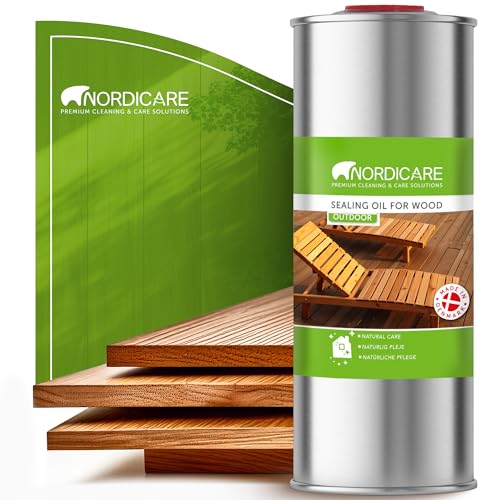
| Outdoor use fit | Most often aimed at furniture and trim, with a matte to low-sheen look rather than outdoor exposure first. | Commonly sold for outdoor wood, especially teak and other dense hardwoods. | Teak Oil |
| Moisture and weather resistance | After cure, protection depends on the blend and coat build; many products are not exterior-rated. | Brand claims for water and UV resistance vary, but outdoor positioning is more common. | Teak Oil |
| Application in a short weather window | Often needs several coats and longer dry windows between them. | Usually wipe-on and wipe-off, which can fit a tighter schedule if the can allows it. | Teak Oil |
| Best winter match by wood type | Better on sheltered pieces if the product label allows the temperature and the wood is dry. | Better on dense outdoor hardwoods when the product is specifically rated for exterior use. | Teak Oil |
The winter trade-off
The real question is not which finish sounds better outdoors in summer. It is which one can dry and cure before the next cold night, using the minimum temperature on the label as the hard limit. That limit varies by product, so the can or data sheet matters more than the marketing name.
Cold extends touch-dry time and full cure time. It also raises the chance of a sticky surface, hazing, uneven absorption, dust pickup, and frost damage before the film has set enough to shed moisture.
Side-by-side winter comparison
Drying and cure speed
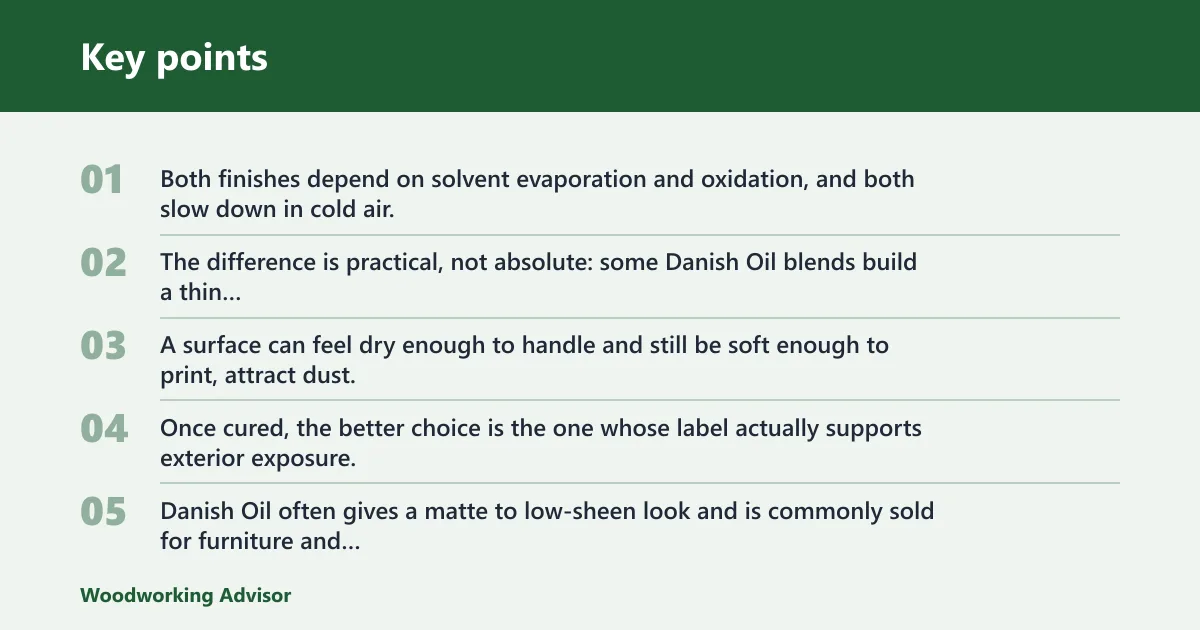
Both finishes depend on solvent evaporation and oxidation, and both slow down in cold air. The difference is practical, not absolute: some Danish Oil blends build a thin oil-varnish film that needs repeated coats, while some Teak Oil products are formulated for wipe-on outdoor work and may fit a short weather window better.
Do not confuse touch-dry with cured. A surface can feel dry enough to handle and still be soft enough to print, attract dust, or trap moisture if the overnight low drops before the film finishes setting.
Moisture resistance after cure
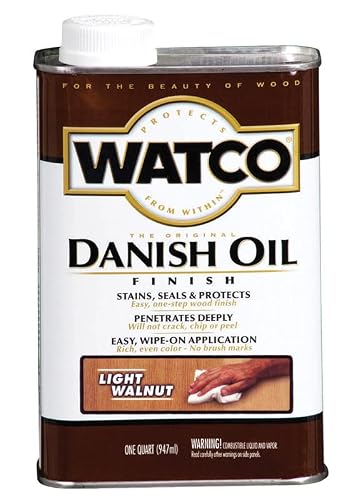
Once cured, the better choice is the one whose label actually supports exterior exposure. Danish Oil often gives a matte to low-sheen look and is commonly sold for furniture and trim, but many versions are not meant as exposed outdoor protection. Teak Oil is commonly marketed for outdoor wood, yet UV and water claims vary by brand.
That means the finish name alone does not settle the issue. Read the label for exterior rating, recoating limits, and any temperature minimum before you count on either product to hold up through frost or wet weather.
Outdoor use fit
For sheltered furniture, trim, and other pieces that will not sit in wind-driven moisture, Danish Oil can make sense if the product supports the job and you have enough warm, dry hours. For exposed teak, cedar, mahogany, or other dense hardwoods, Teak Oil is the more natural starting point when the label is exterior-rated.
Say your cedar bench sits under a covered porch and the overnight low stays above the product minimum for two days. A wipe-on finish with a short recoat window has a better chance than a multi-coat schedule that runs into a cold front.
Winter failure modes
The most common cold-weather failures are easy to miss at first. The surface can stay sticky, blush or haze, absorb unevenly on porous sections, or pick up dust before the solvent has flashed and the oil has oxidized enough to stabilize.
Frost is the bigger risk if the finish is still soft when temperatures drop. Once that happens, the wood can end up with a patchy sheen and weak water shedding, even if the first coat looked acceptable the day before.
Winter decision table
| Forecast low and setup | Wood type | Exposure level | Safer choice |
|---|---|---|---|
| Well above the product minimum for 24–48 hours | Teak, mahogany, or other dense hardwood | Covered patio furniture | Teak Oil |
| Well above the product minimum for 24–48 hours | Trim or furniture-grade wood | Sheltered or indoor-outdoor transition piece | Danish Oil |
| Near the product minimum, or a cold overnight drop is likely | Any species | Exposed deck parts | Neither |
| Mild daytime temperature, but a fast night drop after sunset | Cedar or other softer wood | Fully exposed outdoor piece | Neither |
| Dry spell with stable warmth, no rain, no frost risk | Ipe or other dense hardwood | Outdoor furniture with some shelter | Teak Oil |
Forecast low above the label minimum
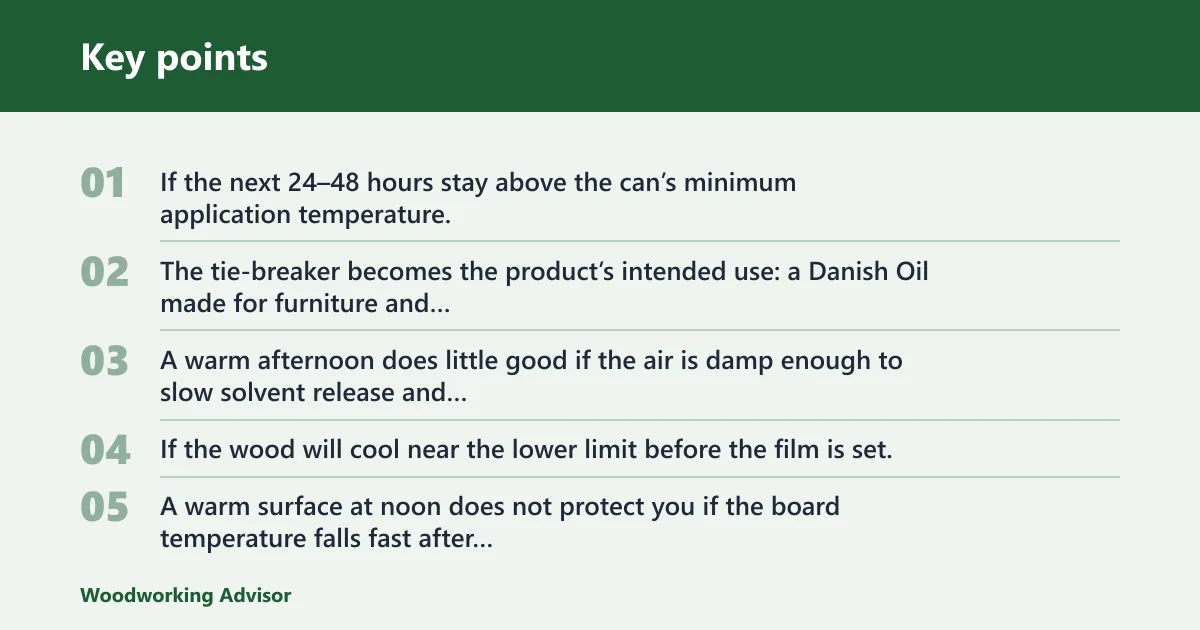
If the next 24–48 hours stay above the can’s minimum application temperature, either finish can be workable. The tie-breaker becomes the product’s intended use: a Danish Oil made for furniture and trim fits sheltered work, while an exterior-rated Teak Oil fits outdoor wood better.
Humidity still matters. A warm afternoon does little good if the air is damp enough to slow solvent release and keep the surface soft into the evening.
Forecast low near the minimum or a cold overnight drop
This is where the winter call changes. If the wood will cool near the lower limit before the film is set, skip the job unless the label gives a lower temperature range and enough cure time. A warm surface at noon does not protect you if the board temperature falls fast after sunset.
Suppose a mahogany side table gets coated at 2 p.m., then the forecast low drops near freezing by midnight. Even a thin wipe-on coat may stay tacky long enough to collect dust or print from a cover, so waiting is the safer move.
Dense hardwood versus softer or resinous wood
Dense hardwoods such as teak, mahogany, and ipe usually absorb more slowly than cedar or other softer woods. That can help you keep the coat thin, but it also means the finish may sit on the surface longer before it sinks in and sets.
Resinous or uneven woods can behave differently from board to board. If the surface has open grain, pitch, or seasonal moisture swings, winter finishing becomes less forgiving and the risk of blotching or uneven absorption rises.
Covered furniture versus fully exposed deck parts
Covered outdoor furniture gets more leeway because it avoids direct rain, frost, and standing moisture. Fully exposed deck parts do not get that cushion, so any finish that has not fully cured faces a harder test.
For deck boards, rails, and other horizontal surfaces, a winter oil job is easiest to regret. Moisture lingers longer there, and a weak cure means the finish can be disturbed by foot traffic or covering.
Can you apply Danish oil when temperatures are near freezing?
Only if the product label allows it and the wood, air, and surface temperatures all stay within that range long enough to dry. Near-freezing weather is risky because a brief warm spell is not enough if the wood cools below the minimum before the oil has flashed and started to cure.
Check the lowest expected overnight temperature, not just the afternoon high. If the surface will hit that low within hours, the safer move is to wait for a warmer stretch.
What the label temperature limit means in practice
The minimum air temperature on the label is a floor, not a target. Surface temperature can run lower than the air in shade or on a cold board, and humidity can slow the process further.
If the can says not to apply below a certain temperature, treat that as the binding number. A board that feels slightly warm in the sun can still cool fast enough to miss the cure window.
Why daytime warmth is not enough
Warm air during the day helps solvent escape, but evening cooling can stop the process before the film is stable. That is when sticky spots, streaks, and dust pickup show up first.
For winter work, think in full days, not hours. If the next cold night arrives before the label’s recoat or cure guidance is satisfied, stop the job.
Does teak oil dry slower in cold weather?
Yes, in most cases it does, because colder temperatures slow both evaporation and oxidation. That said, the exact pace depends on the product formula, solvent load, and how much film it leaves behind, so one Teak Oil can behave very differently from another.
Read the recoat guidance on the can or data sheet. If the product lists a longer interval in cool conditions, that is the schedule you need to respect before adding another coat or exposing the wood to moisture.
How brand formula changes the answer
Some Teak Oil products are heavily wipe-on and leave little residue after the wipe-off step. Others behave more like thin oil finishes with a stronger film component. Those differences change how fast the surface feels dry and how long it stays vulnerable.
The same is true for Danish Oil. The name does not tell you the solvent content, additive package, or exterior rating, which are the details that matter in winter.
How to read recoat guidance
Look for three things: minimum application temperature, recoat interval, and full cure time. If only one of those is listed, assume the others may stretch in cold weather unless the data sheet says otherwise.
Do not stack coats too early. That is one of the easiest ways to trap uncured oil and create a sticky surface that takes days to settle.
Choose Danish Oil if… / Choose Teak Oil if…
Choose Danish Oil if the specific product label supports the temperature range, the piece is sheltered, and you want a matte to low-sheen finish on furniture or trim. It also fits when you can give the wood multiple warm, dry days and do not need a finish that is marketed primarily for outdoor exposure.
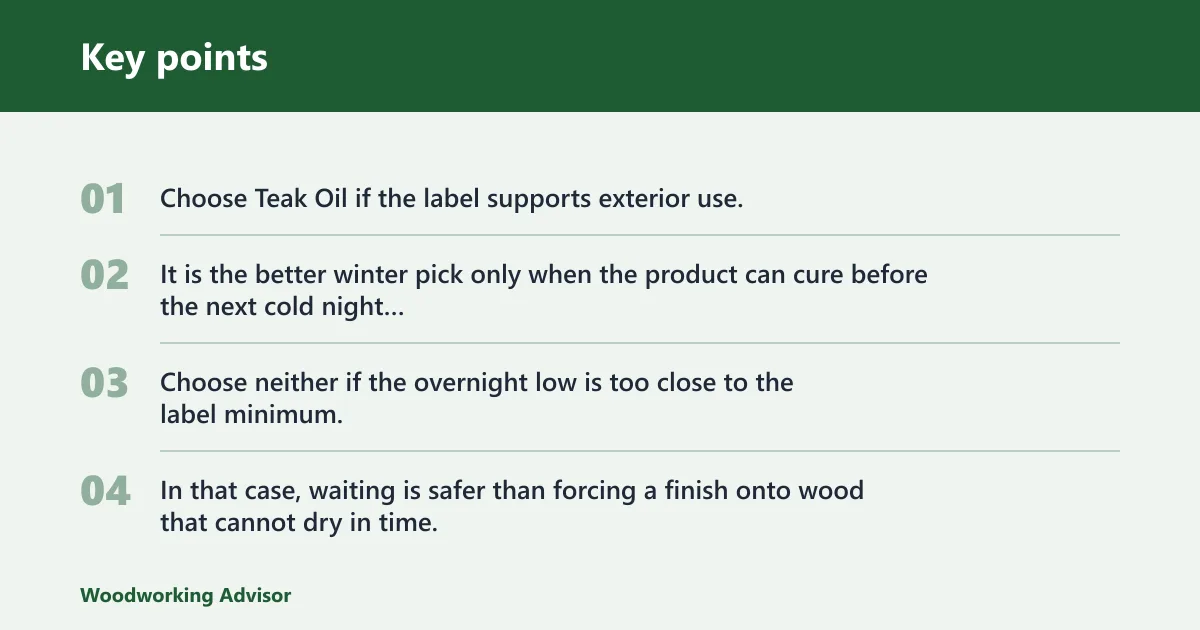
Choose Teak Oil if the label supports exterior use, the wood is teak or another dense hardwood, and you need a wipe-on finish that fits a short weather window. It is the better winter pick only when the product can cure before the next cold night and the piece will face outdoor moisture.
Choose neither if the overnight low is too close to the label minimum, the humidity is high, or frost is likely before cure. In that case, waiting is safer than forcing a finish onto wood that cannot dry in time.

How many coats of teak oil or Danish oil should I use before winter?
Use only as many coats as the label allows within the available warm window, and stop if the surface starts to stay tacky between coats. More coats do not help if the next cold night arrives before the finish has cured enough to handle moisture.
In winter, fewer thin coats are usually safer than a heavy build. Thin coats wipe off more cleanly and reduce the chance of trapping uncured material.
Will winter temperatures ruin an oil finish on a deck or furniture?
They can, if the finish is still soft when the temperature drops or frost lands on it. A cured finish is usually more stable than a fresh one, but the first 24–48 hours matter most because that is when sticky film, dust pickup, and haze can appear.
Deck parts face the highest risk because they cool fast and see more moisture. Furniture with cover and airflow has a better chance, but only if the product can cure before the cold arrives.
Can I use Danish oil on outdoor furniture in cold weather?
Only if the specific Danish Oil product is exterior-rated or otherwise approved by the label, and the forecast gives enough warm, dry time for curing. Many Danish Oil products are aimed at furniture and trim, which means they may fit a sheltered outdoor chair better than a fully exposed bench.
If the piece will sit under cover and the overnight low stays safely above the minimum, the job is more realistic. If not, wait.
Is teak oil actually better for teak, cedar, or hardwoods in winter?
It is often the better starting point for teak and other dense hardwoods, but only when the specific Teak Oil is labeled for exterior use and can cure in the forecast window. Cedar can accept it too, though softer wood may absorb unevenly and need more care with wipe-off timing.
For any species, the winter answer still comes back to temperature, moisture, and exposure. The wood type helps you choose the better fit, but the label and the next 48 hours decide whether either finish should go on at all.
Sponsored / affiliate links. As an Amazon Associate I earn from qualifying purchases. I may earn additional commission from eligible campaigns.