Weather Proof Stain for Fence: Winter-Ready Options
Match fence stain to dry wood, a 24 to 48 hour dry forecast, and the fence’s exposure: penetrating oil stains for damp-prone, weathered boards; film-forming products only if the surface is sound and dry. Use the wrong product or apply it in poor conditions, and winter moisture can get under the coating, leading to peeling, mildew, and wasted labor. This guide shows how to choose the right stain or sealer by wood dryness, forecast window, and exposure level, so you can protect a fence before cold weather hits.
Winter fence stain comparison



Winter changes the job because wood dries more slowly, nighttime lows can stall cure, and rain or freeze-thaw cycles expose weak coatings fast. The main choice is not brand first; it is product class first. For winter use, the question is whether you need a penetrating stain, a clear sealer, or a film-forming coating that depends on a very sound surface.
| Option | Winter strength | Winter limit | Best fit |
|---|---|---|---|
| Oil-based penetrating fence stain | Moisture resistance, UV protection, and flexibility with wood movement | Usually needs application conditions the label allows; Many oil-based stains often need about 24 to 48 hours without rain. | Weathered fences, mixed exposure, and boards that move with seasonal temperature swings |
| Water-based clear fence sealer | Transparent finish with moisture protection and some UV resistance | Less pigment means less UV shielding than a semi-transparent stain | Coastal or high-moisture areas where the goal is clear protection, not color change |
| Film-forming coating | Can look uniform on sound wood | More vulnerable if winter moisture enters through cracks, lap marks, or thin prep | Only on dry, stable, well-prepped fences where the label allows the condition |
What winter changes in a fence finish
Cold weather does not just slow drying. It raises the risk of lap marks, slow cure, wash-off, and freeze-thaw stress if the wood still holds moisture. A finish that seems fine in mild weather can fail faster once water enters seams, checks, or end grain and then expands as temperatures swing.
Side-by-side: oil-based penetrating stain vs water-based clear sealer
Oil-based penetrating stain usually fits winter exposure better when you need more color-driven UV protection and some flexibility as boards expand and contract. Water-based clear sealer makes sense when you want a transparent finish and the fence sees frequent moisture, such as salt air or wet shade, but it does not block UV as strongly as a pigmented stain.
For example, a north-facing privacy fence with gray, dry boards often benefits more from a penetrating stain than from a clear coat, because the stain adds UV defense without leaving a thick film. A newer fence near a coastal lot line may do better with a clear sealer if the owner wants minimal color change and the label supports that use.
Where READY SEAL fits in the comparison
READY SEAL is an oil-based exterior wood stain-and-sealer-in-one. The brand says it has no temperature restrictions if the wood is dry, and it says the finish applies with no laps, runs, or streaks and will not crack, chip, flake, or peel. That positioning makes it a winter-ready option only when the fence itself is dry and the product label still governs use.
Fence stain decision table
This table ties the decision to three things that matter in winter: wood dryness, forecast window, and exposure zone. It is a go/no-go aid, not a substitute for the product label. If any condition falls outside the label, postpone the job.
| Fence condition | Forecast window | Exposure zone | Recommended product class |
|---|---|---|---|
| Wood below 12% moisture, clean, fully dry after washing | 24 to 48 hours dry, no freezing rain or snow in the window | Open, sun-exposed, high-UV | Oil-based penetrating stain |
| Wood below 12% moisture, sound surface, minimal color change wanted | Dry forecast and overnight lows stay within the product label | Coastal, shaded, high-humidity | Water-based clear fence sealer |
| Wood feels damp, meter reading is above target, or boards were washed recently | Rain likely within 24 to 48 hours | Any zone | Postpone |
| Fence is weathered but stable, with no loose coating or active peeling | Dry stretch and temperatures stay inside the label range | Mixed exposure, especially windward sides | Penetrating stain or compatible sealer |
| Fence has freezing conditions overnight or frost risk | Below-freezing period expected | Any zone | Postpone unless the exact product label allows it |
Can you stain a fence in cold weather?
Yes, sometimes, but only if the product label allows the temperature, the wood is dry, and the forecast stays dry long enough for the coating to set. Cold-weather work is workable when the finish can cure before rain, frost, or freezing temperatures interfere. If the label does not permit the conditions, wait.
When cold is workable
Cold is workable when the product is designed for it or the brand specifically allows application outside the common oil-based range. For most oil-based stains, the familiar application range is 50°F to 85°F, with a rain-free window of 24 to 48 hours. READY SEAL is a named exception only to the extent of its brand claim that there are no temperature restrictions if the wood is dry.
When to postpone
Postpone if the fence still holds surface moisture, if rain is likely before the product can set, or if overnight lows will push the surface toward freezing. A coating applied too late in the day can also fail if temperatures drop sharply after sunset and the finish skins over before it bonds properly.
What freezing conditions change
Freezing conditions can trap moisture in the wood or on the surface and interfere with cure. They also raise the odds of uneven penetration and failure at joints, fasteners, and end grain. If the fence is already cold-soaked and damp, the safer choice is to wait for a dry window rather than force a winter application.
How dry should fence wood be?
Wood should be dry enough for the specific product, and a moisture meter is the right tool for checking that. A moisture content below 12% is commonly described as ideal for stain-ready wood, but the product label comes first. After washing, dry time of at least 48 hours is a starting point, not a universal rule.
Using a moisture meter
Read several boards, not just one. Check shaded areas, lower rails, end grain, and the bottoms of posts where moisture lingers longest. A meter reading below 12% is a practical target for many exterior stain jobs, but a higher reading on one hidden board means the fence is not ready yet.
Why below 12% is a common target
Below 12% is a useful benchmark because stain needs open, dry wood to penetrate and bond properly. If the wood is still too wet, the stain can sit on the surface, cure poorly, or discolor unevenly. That problem becomes more likely in winter, when moisture lingers and evaporation slows.
Drying after washing
After pressure washing, READY SEAL advises waiting at least 48 hours. That is a brand-specific minimum, not a universal cure rule for every fence. Species, board thickness, shade, and wind all matter, so confirm dryness with a meter before you start.
Fence prep for winter adhesion

Prep matters more in winter because the margin for error is smaller. Clean the fence before applying stain so dirt and mildew do not block penetration. Mill glaze on new lumber can also interfere with adhesion, so smooth factory faces often need extra attention before stain goes on.
Cleaning and rinse limits
Remove dirt, mildew, and loose fibers without soaking the fence more than needed. If you wash, let the wood dry fully before staining. Low-pressure washing under about 1,000 PSI is a common ceiling for this type of work, since higher pressure can roughen wood, force water deeper, and add drying time.
Mill glaze removal
New fence boards can carry mill glaze, a slick surface left from planing. That layer can block absorption. Light abrasion or the prep method listed by the product can help break that surface so the stain reaches the wood instead of sitting on top of it.
Application methods
Sprayers, rollers, and brushes all work, but each needs control. Apply with the grain, keep a wet edge, and manage overspray carefully near siding, stone, and hardware. A brush is slower but useful for end grain and corners. A sprayer is fast, but it needs back-brushing or rolling where the label recommends it.
Suppose a contractor is handling a 120-foot privacy fence on a calm, cool day with a dry forecast. A penetrating oil stain may be the efficient choice because it can be spread quickly and worked into boards with a brush or roller after spraying, which helps reduce lap marks on long runs.
A common first-timer mistake is staining a newly washed fence after only one warm afternoon. The boards may feel dry on top while the core still holds water. A meter reading and a dry forecast matter more than surface feel, especially when night temperatures drop close to freezing.
Choose oil-based stain or clear sealer
Choose the product class by what the fence needs to survive, not by color chart first. Oil-based penetrating stain is the stronger fit when the fence needs moisture resistance, UV protection, and room to move with the seasons. Water-based clear sealer fits when clear appearance and moisture defense matter more than heavy UV blocking.
Choose oil-based penetrating stain if…
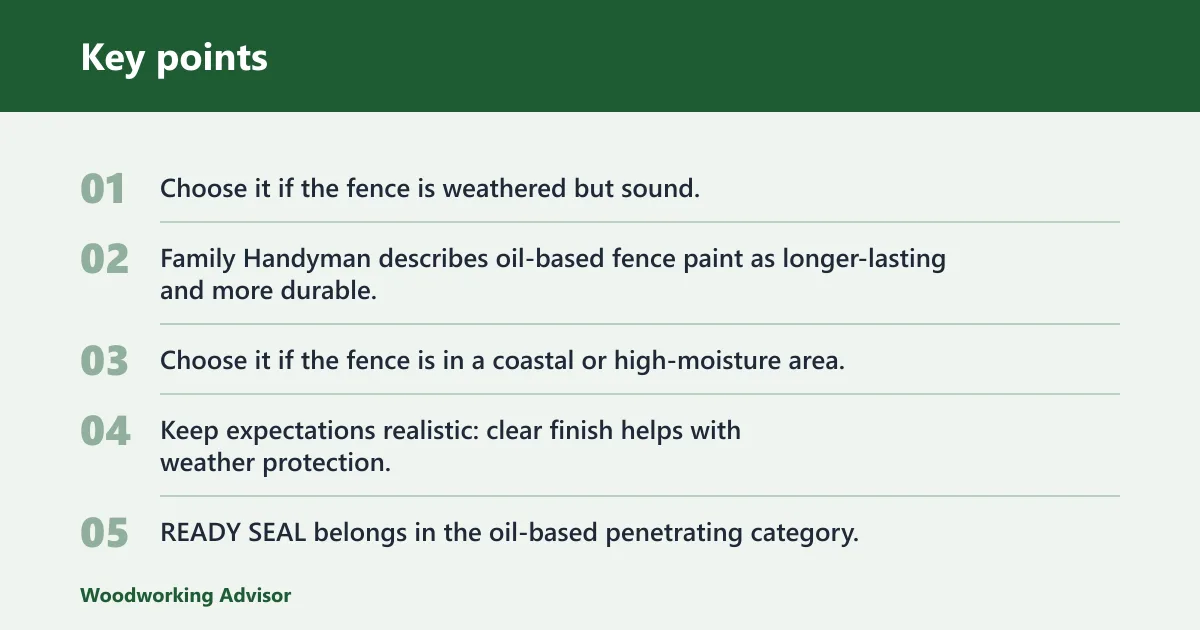
Choose it if the fence is weathered but sound, if you want better UV protection on exposed sections, if the boards will move through winter, or if you need a product class that penetrates rather than forming a thick surface film. Family Handyman describes oil-based fence paint as longer-lasting and more durable, but that does not make every oil product the right choice for every fence.
Choose water-based clear fence sealer if…
Choose it if the fence is in a coastal or high-moisture area, if you want a transparent finish, or if the wood is in good shape and you want moisture protection with some UV resistance. Keep expectations realistic: clear finish helps with weather protection, but it cannot match a pigmented stain for sun blocking.
Where a named product like READY SEAL fits
READY SEAL belongs in the oil-based penetrating category. It is worth considering when you need a stain-and-sealer-in-one and the wood is dry enough for winter application. Its no-temperature-restriction claim may matter in a cold-weather window, but you still need dry wood, a stable forecast, and label-compliant prep.
Choose READY SEAL if… / Choose water-based clear sealer if…
Choose READY SEAL if you need a penetrating oil-based product for dry wood, want a stain-and-sealer-in-one, and have a winter window that is outside the common 50°F to 85°F range but still within the product’s own directions. Choose a water-based clear sealer if the fence sits in a high-moisture zone, you want a transparent finish, and the label supports the exposure and cure conditions.
- Choose READY SEAL if the fence is dry, the forecast is stable, and you want a penetrating finish for weathered boards.
- Choose READY SEAL if you are trying to avoid laps or streaks on long fence runs and the product directions allow your conditions.
- Choose water-based clear sealer if the fence is in coastal air or persistent shade and you want moisture defense without added color.
- Choose water-based clear sealer if appearance matters more than maximum UV shielding and the surface is already in good shape.
- Postpone either option if the wood is wet, rain is due soon, or freezing weather is expected before the coating sets.
Frequently asked questions
What is the best weather proof stain for a fence in winter?
The right choice depends on the fence condition, not a brand name alone. For dry, weathered boards, an oil-based penetrating stain is often the strongest winter fit because it offers moisture resistance, UV protection, and flexibility. For coastal or high-moisture sites, a water-based clear sealer can be the better match.
What temperature should it be to stain a fence?
For many oil-based stains, the common application range is 50°F to 85°F, and Woodcrafters describes 50°F to 80°F as ideal fence-staining weather. That said, the product label wins. If a specific stain allows cooler use, follow that label instead of a general rule.
How long should a fence stay dry before rain after staining?
Most oil-based stains need no rain for 24 to 48 hours. Woodcrafters gives the same 24 to 48 hour rain-free window. If the product label asks for longer, or the forecast turns cold and damp, wait. Shortcuts in winter often lead to streaks, wash-off, or weak cure.
Is an oil-based or water-based fence stain better for winter weather?
Neither is always better. Oil-based penetrating stain is often preferred for weathered, movable boards because it offers flexibility and strong moisture resistance. Water-based clear sealer can be a better fit in coastal or high-moisture areas. The deciding factors are dryness, exposure, and the label’s temperature guidance.
How dry does wood need to be before applying fence stain?
A moisture content below 12% is a common target, and a moisture meter is the right way to confirm it. After pressure washing, READY SEAL advises waiting at least 48 hours, but that is only a starting point. Shade, thickness, and weather can extend the dry time.
Sponsored / affiliate links. As an Amazon Associate I earn from qualifying purchases. I may earn additional commission from eligible campaigns.