DIY Woodworking Plans vs Pre-Cut Kits: Which to Choose?
Choose DIY Woodworking Plans if you want lower material cost, more flexibility, and real skill-building. Choose Pre-Cut Kits if you want faster assembly and fewer cutting mistakes. Pick the wrong option and you can waste money on missing tools, spoil lumber, or end up with a project that takes longer than expected. This guide compares cost, time, tool burden, error risk, and learning value so you can choose the better path.
| Decision factor | DIY Woodworking Plans | Pre-Cut Kits | Winner |
|---|---|---|---|
| Upfront cost | Usually lower if you already own basic tools and can cut accurately from stock lumber. | Usually higher because parts are pre-measured and packaged for you. | DIY Woodworking Plans |
| Tool needs | Needs more layout and cutting tools, plus clamps and often a moisture meter for lumber checks. | Needs fewer cutting tools and usually less setup. | Pre-Cut Kits |
| Time to build | Slower because you must measure, mark, cut, and fit parts. | Faster because the workflow is mostly assembly. | Pre-Cut Kits |
| Waste risk | Higher because mistakes, misreads, and offcuts can force extra lumber purchases. | Lower because the parts arrive pre-measured. | Pre-Cut Kits |
| Skill required | Better if you want to learn straight cuts, joinery, and layout. | Better if you want a beginner-friendly assembly workflow. | Tie |
| Customization | High. You can change size, species, joinery, and hardware if the plan allows it. | Low to moderate. You are limited to the kit’s part sizes and design. | DIY Woodworking Plans |
| Finish quality | Can be high, but only if you cut cleanly and keep parts square. | Can also be high because critical dimensions are already controlled. | Tie |
| Portability | Works with smaller purchases of lumber and can fit on basic saw setups. | Often easier to transport if the kit is boxed in compact parts, but some kits still involve large panels. | Tie |
| Learning value | Higher because you practice reading cut lists, sizing lumber, and making cuts. | Lower because fewer layout decisions reach you. | DIY Woodworking Plans |
| Repairability | Often easier to repair or duplicate parts later because you know the build sequence and dimensions. | Depends on whether the kit supplier still offers replacement parts. | DIY Woodworking Plans |
Plans vs kits: the core trade-off
Woodworking plans give you the full build roadmap: a materials list, a cut list, diagrams, joinery callouts, and step-by-step assembly guidance. Pre-cut kits trade that flexibility for speed, lower setup, and fewer cutting decisions. If you want to practice measuring, cutting, and joining wood, plans fit better. If you want to spend most of your time assembling parts that are already sized, kits fit better.
What you get with woodworking plans
A complete plan should tell you what to buy, how to cut it, and how the parts fit together. A useful plan often includes finished dimensions, part labels such as A, B, and C, nominal versus actual lumber sizes, and a waste allowance so you do not buy too little stock.
For example, a 2×4 is commonly about 1½″ × 3½″ after planing, and a 1×6 is commonly about ¾″ × 5½″. That matters when a cut list names finished dimensions, because the board you buy is not the size you see on the rack.
What you get with a pre-cut kit
A pre-cut kit arrives with pre-measured parts and an assembly-only workflow. That reduces cutting time and lowers the tool burden, but it does not remove all work. You may still need clamps, basic sanding, and a check for fit before final assembly.
Kits fit beginners who want a simpler path, but they can still create problems. Missing hardware, poor instructions, and awkward tolerances can slow the job down more than a clear plan would.
The first decision: build skill or assembly speed
If your goal is to learn layout, cutting, and joinery, plans are the better teacher. If your goal is to finish a shelf, box, or stand with less setup, a kit is usually the faster route. That trade-off matters most for straight-cut beginner projects versus builds with curves or complex joinery.
Plans vs kits comparison matrix
Say your project is a simple shelf for a small apartment, and you only have a circular saw, a few clamps, and one free weekend. The plan route gives more control, but the kit route may save enough setup time to finish in one session.
| Criteria | DIY Woodworking Plans | Pre-Cut Kits | Recommendation |
|---|---|---|---|
| Upfront cost | Lower if you already own tools and can avoid re-buying lumber after mistakes. | Higher for the same finished object because cutting is already done for you. | DIY Woodworking Plans |
| Tool needs | Circular saw or table saw, clamps, measuring tools, and sometimes a moisture meter. | Fewer tools; often mostly assembly tools and clamps. | Pre-Cut Kits |
| Time to build | Longer because you must cut and fit parts. | Shorter because it skips most cutting. | Pre-Cut Kits |
| Waste risk | Higher, especially for first-time builders. | Lower, because the parts are already measured. | Pre-Cut Kits |
| Skill required | More layout and cutting skill, especially for joinery. | Less cutting skill, more assembly skill. | Pre-Cut Kits |
| Customization | High. | Limited by the supplied parts. | DIY Woodworking Plans |
| Finish quality | Depends on your cut accuracy and setup. | Depends on factory or supplier prep. | Tie |
| Portability | Better if you can buy lumber in smaller loads. | Better for some buyers, but large panels still create transport issues. | Tie |
| Learning value | Higher. | Lower. | DIY Woodworking Plans |
| Repairability | Better because you know the part sizes and joinery path. | Depends on spare-part access. | DIY Woodworking Plans |
Upfront cost
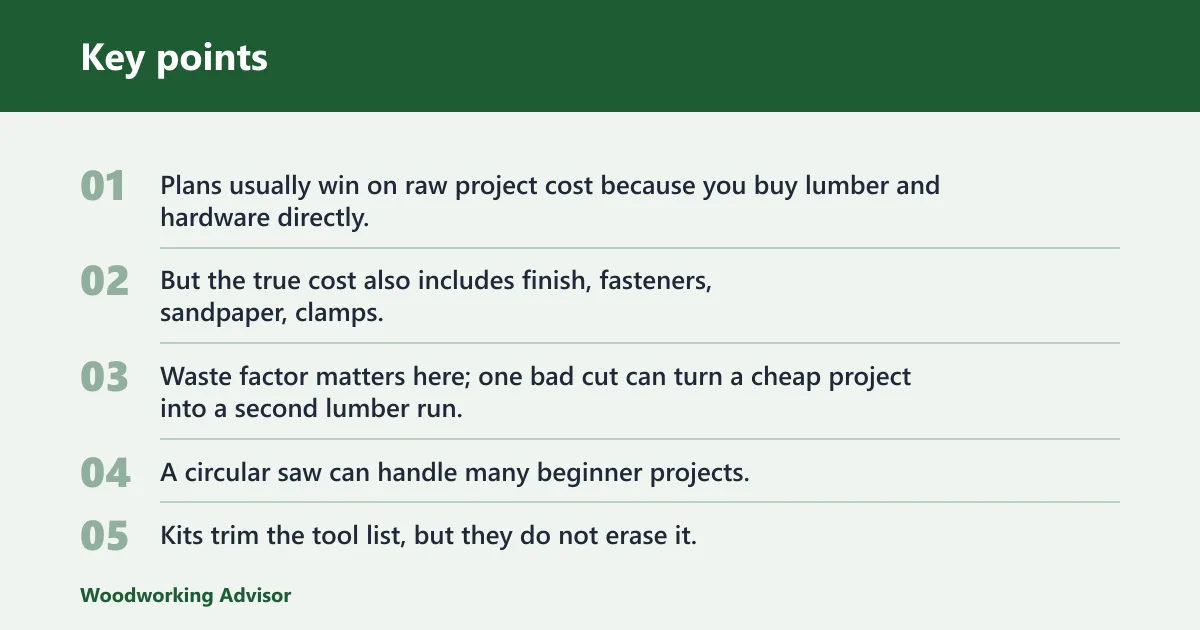
Plans usually win on raw project cost because you buy lumber and hardware directly, not pre-measured parts. But the true cost also includes finish, fasteners, sandpaper, clamps, and any tool you still need to purchase. Waste factor matters here; one bad cut can turn a cheap project into a second lumber run.
Tool needs
Plans ask more of your shop setup. A circular saw can handle many beginner projects, while a table saw helps with repeatable straight cuts, and some kit workflows may use CNC machining upstream before the parts reach you. Kits trim the tool list, but they do not erase it.
Time to build
Kits win when time matters most. The gain comes from skipping layout, cutting, and most error correction. Plans take longer, but they also let you control each step instead of fitting your work to a fixed package.
Waste risk
Plans carry more waste risk because mistakes happen during measuring and cutting. Kits reduce that risk by shipping pre-measured parts, but they can still waste time if the instructions are weak or hardware is missing. An optimizer can even flag awkward or dangerous cuts before you start, and it can account for whether a full 4×8 sheet fits in your SUV.
Skill required
Plans fit beginners best when the project uses straight cuts and simple joinery such as butt joints or pocket screws. More advanced plans may call for dados, rabbets, or mortise-and-tenon joints, which raise the skill bar. Kits lower that bar by shifting the work toward assembly.
Customization
Plans are the better choice when you need a project to fit a narrow wall, a specific storage bin, or a match to existing furniture. Kits usually lock you into the supplied dimensions. That is fine for a small box or shelf, but it narrows your options fast.
Finish quality
Both paths can produce clean results, but they fail in different ways. Plans can drift if cuts are off by even a little. Kits can still leave you sanding gaps or aligning imperfect pre-cut parts, so assembly accuracy still matters.
Portability
Transport limits can decide the project before tool choice does. A kit may arrive in a compact box, while a plan may let you buy lumber in shorter pieces that fit a sedan or small hatchback. The reverse can also happen if the kit includes a large panel or a 4×8 sheet.
Learning value
Plans teach more because you must read dimensions, compare nominal versus actual lumber sizes, and manage cut order. A cut-list optimizer can create a numbered, step-by-step cutting plan, and some tools offer five setup steps before cutting begins. Kits are faster, but they usually teach less layout and cutting skill.
Repairability
With plans, you already know the build logic, so replacing a stretcher, shelf, or side panel is easier. With kits, repair depends on whether the supplier still stocks the exact replacement part. That matters more for long-term furniture than for a one-off project.
Which is cheaper?
DIY Woodworking Plans are usually cheaper when you already own the tools and can avoid waste. Pre-Cut Kits can look cheaper at checkout only when you ignore lumber mistakes, extra clamps, fasteners, finish, and tool purchases. Once those are counted, the price gap often shifts toward plans.
Lumber, hardware, and finish costs
Plans let you buy lumber by the board or sheet and hardware only in the amount the project needs. That keeps material cost closer to the actual design. Kits bundle convenience into the price, and that convenience is often the first added cost you pay for.
Tool purchases and clamp count
If you need to buy a saw, a square, or more clamps just to follow a plan, the budget case changes. Tool cost can outweigh the kit premium on a one-project purchase. For repeat work, though, those tools spread across later projects and plans become cheaper over time.
Waste factor and mistake allowance
Beginners should assume extra lumber is part of the budget. A bad cut on a plan can force a second trip to the store. A kit lowers that risk, but not every kit avoids rework, especially when holes, edges, or hardware do not line up cleanly.
When a kit can cost more than plans
A kit can cost more when the project is simple, the lumber is common, and you already own the needed tools. It can also cost more if you still need clamps, sandpaper, stain, or replacement parts. In those cases, the kit charges you for saved time rather than saved money.
Are kits easier to build?
Pre-cut kits are often easier for many beginners because they remove much of the cutting and layout work. The workflow is mostly assembly, so the project feels less intimidating and usually moves faster. That said, easier does not mean mistake-proof.
Assembly-only workflow
Kits are designed so the hard sizing work is already finished. You usually focus on sorting parts, checking labels, and fastening pieces in the right order. This makes them a good fit for a first project if your main goal is a quick win.
Measuring, fitting, and sanding that still remain
Do not assume a kit removes measuring altogether. You may still need to verify diagonals, check for square, test fit hardware, and sand edges before finishing. Some kits also need minor adjustment if a joint is snug or a panel lands slightly out of line.
Where kits save time
The biggest time savings come from skipping the measurement stage, the cut stage, and some of the trial-and-error that often follows. That is especially useful if you lack a full shop or only have a compact workspace. It is also helpful if you need the project done before a weekend ends.
Where plans are simpler than a kit
Some kits arrive with vague instructions, missing hardware, or odd tolerances that create more friction than a clean plan would. A well-written plan with clear labels and diagrams can be easier to follow than a kit with poor packaging. The package type matters less than the clarity of the instructions.
What a complete plan should include
A complete woodworking plan should include a materials list, a cut list, diagrams, and joinery callouts. It should also show assembly steps in a sequence that matches the parts you will actually build. If any of those pieces are missing, the plan is harder to trust.
Materials list and cut
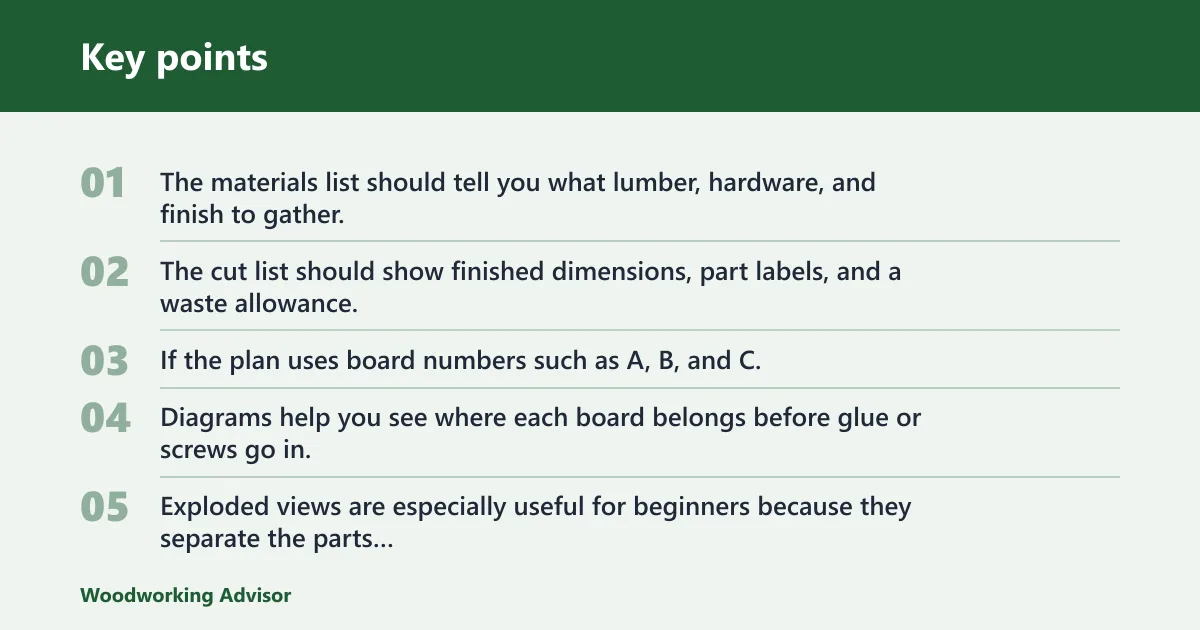
The materials list should tell you what lumber, hardware, and finish to gather. The cut list should show finished dimensions, part labels, and a waste allowance. If the plan uses board numbers such as A, B, and C, those labels should match the diagrams and the assembly order.
Diagrams and exploded views
Diagrams help you see where each board belongs before glue or screws go in. Exploded views are especially useful for beginners because they separate the parts visually and reduce guesswork. A plan without them can still work, but it is harder to read fast.
Joinery callouts
Joinery callouts should tell you whether the build uses butt joints, pocket screws, dados, rabbets, or mortise-and-tenon joints. That matters because your tools and skill level must match the joinery. A beginner should start with straight cuts and simple joints before moving to more demanding methods.
Assembly steps
A common assembly order is cut, dry fit, drill, assemble, sand, finish. The order should prevent trapped parts and reduce the chance of having to undo work. If a plan skips the sequence, it puts more burden on you to solve the build on the fly.
Clear finished dimensions and label references
Finished dimensions should be explicit, not inferred from board sizes. That helps you separate nominal lumber sizes from actual lumber sizes and prevents the classic mistake of building to the wrong number. If the plan says 2×4 stock, remember the actual size is 1½″ × 3½″.
Choose DIY woodworking Plans if…
Choose DIY Woodworking Plans if you want more skill growth, more customization, and lower material cost. Choose them if you already own a circular saw or table saw, have clamps, and have room to cut lumber safely. They are also the better pick when the project is simple enough to use straight cuts and basic joinery, such as a plant stand, simple shelves, or boxes.
Choose Pre-Cut Kits if you want less setup, fewer cut decisions, and a faster path to a finished project. They make more sense when your workspace is tight, your vehicle cannot carry long boards well, or you want a first project with lower tool burden. They are also a strong choice when assembly speed matters more than learning every cutting step.
Four buyer types, one rule
- First-time beginner: choose Pre-Cut Kits if you want the simplest assembly path; choose DIY Woodworking Plans only if the project is a straight-cut beginner build.
- Budget builder: choose DIY Woodworking Plans.
- Time-crunched builder: choose Pre-Cut Kits.
- Repeat hobbyist: choose DIY Woodworking Plans unless you are building the same simple item many times and value speed over layout practice.
How do you judge a plan?
Judge the plan before you buy wood. Look for clear size data, a complete parts list, and joinery that matches the tools you own. If the plan leaves too much to guesswork, it will cost you time and scrap later.
Check for nominal versus actual sizes
Make sure the plan distinguishes between nominal lumber labels and the actual board size you will cut. A 2×4 is not 2 inches by 4 inches. If the plan ignores that difference, the finished project may come out wrong.
Check for waste allowance and hardware counts
A good cut list should include enough lumber for mistakes and enough hardware for assembly. If hardware counts are missing, you may end up short in the middle of the build. If waste allowance is missing, the stock list may be too optimistic for a beginner.
Check whether the joinery matches your tools
If the plan calls for dados, rabbets, or mortise-and-tenon work, confirm that you have the tools and the patience for that joinery. A simpler plan that uses butt joints or pocket screws may be smarter for a first build. Match the design to your saws, clamps, and cutting confidence.
Spot missing dimensions before you buy
Do not start with a vague sketch. Check whether every part has a length, width, thickness, and label reference. Missing dimensions turn a plan into guesswork, which is the opposite of what you need when you are trying to avoid waste.
Frequently asked questions
Should I use woodworking plans or a pre-cut kit for my first project?
For a first project, choose a pre-cut kit if your main goal is a quick, low-stress build. Choose woodworking plans if you want to learn layout, cutting, and basic joinery. If the project is a simple shelf, box, or stand with straight cuts, plans can still be a good first step.
Are pre-cut woodworking kits easier than building from plans?
Yes, usually. Kits remove most measuring and cutting, so the job becomes mostly sorting, fitting, and assembly. That said, a poor kit can still be frustrating if instructions are weak or parts do not fit cleanly. Easier does not always mean better.
Which is cheaper: DIY woodworking plans or pre-cut kits?
DIY woodworking plans are usually cheaper when you already own the needed tools and can cut accurately. Kits often cost more because you are paying for pre-measured parts and convenience. Still, a kit can be cheaper than buying new tools for a one-time project.
Do woodworking kits still require measuring and cutting?
Often, yes, but far less than plans. You may still need to measure for square, check fit, trim small edges, and confirm hardware placement. Many kits are assembly-first, not tool-free, so expect some layout and cleanup work before finishing.
What level of woodworking skill do I need for plans versus kits?
Plans can fit beginner, intermediate, or advanced builders depending on the joinery and cut complexity. Straight cuts and butt joints or pocket screws suit beginners. Kits fit beginners best because they remove much of the cutting and layout skill required for plan-based work.
How do I know if a plan is complete enough to follow?
Look for a materials list, a cut list, diagrams, joinery callouts, and step-by-step assembly instructions. The plan should also show finished dimensions and part labels. If it does not explain lumber sizing or hardware counts, it is probably too thin to trust.
When is it worth buying a paid woodworking plan instead of using a free one?
Buy a paid plan when the free version leaves out dimensions, cut order, or joinery detail. Paid plans are often more complete, but not always. The right test is clarity: if the plan saves you from guesswork, it is worth paying for.
Sponsored / affiliate links. As an Amazon Associate I earn from qualifying purchases. I may earn additional commission from eligible campaigns.