Norway Maple vs Sugar Maple: Which Is Better for Lumber?
For furniture, cabinetry, and painted projects, Norway maple is usually the better buy; choose Sugar Maple only when extra dent resistance matters. Pick the wrong one and you may pay for hardness you do not need, or accept dents and wear sooner than planned. This guide compares grain, machining, finish, stability, and cost so you can match the species to each project.
| Factor | Norway Maple | Sugar Maple | Winner |
|---|---|---|---|
| Hardness and wear | About 1,010 lbf Janka; resists everyday wear better than soft maple, but dents sooner than harder maple | 1,450 Janka; one of the hardest domestic hardwoods, with stronger dent and edge resistance | Sugar Maple |
| Machining and tool behavior | Good for turning and fine machining; can burn if cutters are dull or the feed is too slow | Needs sharp tools and a reduced feed rate; can be slightly brittle and prone to chipping | Norway Maple |
| Finish and stain behavior | Finishes beautifully under clear coats; can blotch with pigmented stain on flat-sawn faces | Closed grain helps the surface look smooth under clear finish; does not stain as easily | Norway Maple for clear finish; Sugar Maple for consistent clarity |
| Availability in common stock | Less common as a lumber species | Common in 4/4, 5/4, and 6/4 lumber | Sugar Maple |
| Best-fit uses | Light-color furniture, cabinet parts, turning stock, and projects where easy machining matters more than dent resistance | Tabletops, shelves, doors, face frames, butcher blocks, cutting boards, and other wear-prone parts | Tie, by project |
Norway maple vs sugar maple at a glance
Both woods are pale hardwoods with fine grain, and both can work well indoors when kiln-dried to furniture moisture levels. The real split is simple: Norway maple is easier to justify for appearance-first work and moderate wear, while Sugar Maple earns its premium where dents, scratches, and edge damage would matter fast.
What the hardness gap means in use
The Janka hardness scale is commonly used to gauge resistance to dents and surface wear, in lbf. Norway maple’s 1,010 lbf rating is solid for furniture, but Sugar Maple’s 1,450 rating gives it a clear edge on tabletops, cabinet edges, and parts that get bumped often.
That difference shows up over time. On a side table, the softer option may pick up chair-leg marks sooner; on a bookcase or face frame, the harder species better resists compressed corners and fastener wear around holes.
Which maple is harder?
Sugar Maple is harder, and the gap is large enough to matter in real use. Norway maple is about 1,010 lbf on the Janka scale, while Sugar Maple is rated 1,450, so Sugar Maple gives better resistance to dents, scratches, and edge wear on exposed parts.
How hardness changes furniture wear
Hardness does not decide everything, but it changes how a project ages. If a table edge gets bumped by a belt buckle, vacuum hose, or chair corner, Sugar Maple is less likely to compress. Norway maple still works, but it reaches visible wear sooner on high-contact parts.
Say your 30-inch entry bench has a front edge that gets hit daily by shoes and bags. Sugar Maple is the safer choice there. For a wall cabinet door panel that sees little impact, Norway maple’s lower hardness is usually acceptable.
Which maple machines and finishes better?
Norway maple is generally easier to machine cleanly, while Sugar Maple often calls for sharper tools and more control. Norway maple turns well and machines fine, but dull cutters or a very slow feed can cause burn marks. Sugar Maple can chip at corners, especially on routed edges or end grain.
Tool sharpness, feed rate, and burn risk
Dense maple rewards sharp tools. Sugar Maple often needs keen cutters and a reduced feed rate to help keep edges from chipping, especially on profiles, raised panels, and cross-grain cuts. Norway maple is a little more forgiving, but it still burns if the tool path lingers too long.
- Use freshly sharpened cutters or knives.
- Keep the feed rate steady; do not crawl through the cut.
- Back up end grain and exit cuts to reduce tear-out.
- Pre-drill for screws near edges in either species.
Diffuse-porous grain, stain, and clear finish
Norway maple is a diffuse-porous hardwood, so its small pores are evenly distributed and the surface reads as fine and fairly uniform. That helps it take clear coats very cleanly. It can still blotch with pigmented stain on flat-sawn faces, which is why many woodworkers prefer a clear or lightly tinted finish on it.
Sugar Maple has a closed, fine grain that also supports a smooth clear finish, but the same closed grain can make pigment stain sit unevenly. If you want a darker color, test a conditioner, dye, or toner on offcuts before committing to the project.
Maple decision table
| Use case | Dent resistance | Machining difficulty | Stain risk | Availability risk | Best finish strategy | Pick |
|---|---|---|---|---|---|---|
| Cabinet face frames | Moderate | Norway Maple is easier | Moderate on both | Higher for Norway Maple | Clear coat or light tone finish | Norway Maple |
| Raised-panel doors | Moderate to high | Sugar Maple needs sharper tooling | Lower with clear finish | Lower for Sugar Maple | Clear finish or toner, with test samples | Sugar Maple |
| Dining tabletop | High | Norway Maple is easier | Moderate | Higher for Norway Maple | Durable clear topcoat | Sugar Maple |
| Bookcase shelves | Low to moderate | Norway Maple is easier | Moderate | Higher for Norway Maple | Clear coat or painted finish | Norway Maple |
| Butcher block or cutting board | Very high | Sugar Maple is the common choice | Low with oil finish | Lower for Sugar Maple | Food-safe oil or board conditioner | Sugar Maple |
Why the table lands that way
Face frames and shelves do not need the same abuse resistance as a kitchen work surface. For those parts, Norway maple gives you easier machining and a pale, clean look without paying for hardness you may never use. Sugar Maple moves ahead when the part gets repeated impact or edge wear.
Availability also matters. Sugar Maple is commonly stocked in 4/4, 5/4, and 6/4 lumber, which makes sourcing easier for thicker parts. Norway maple can be harder to find in regular yard inventory, so it is best treated as a good option when it is available at a sensible price.
Choose Norway Maple if… / Choose Sugar Maple if…
Choose Norway Maple if your project is mostly about clean appearance, easier machining, and a pale clear-finished look. It is a smart buy for cabinet parts, bookcases, dressers, and turned pieces when dents are not the main concern. It also makes sense when Sugar Maple is priced above your budget or unavailable in the thickness you need.
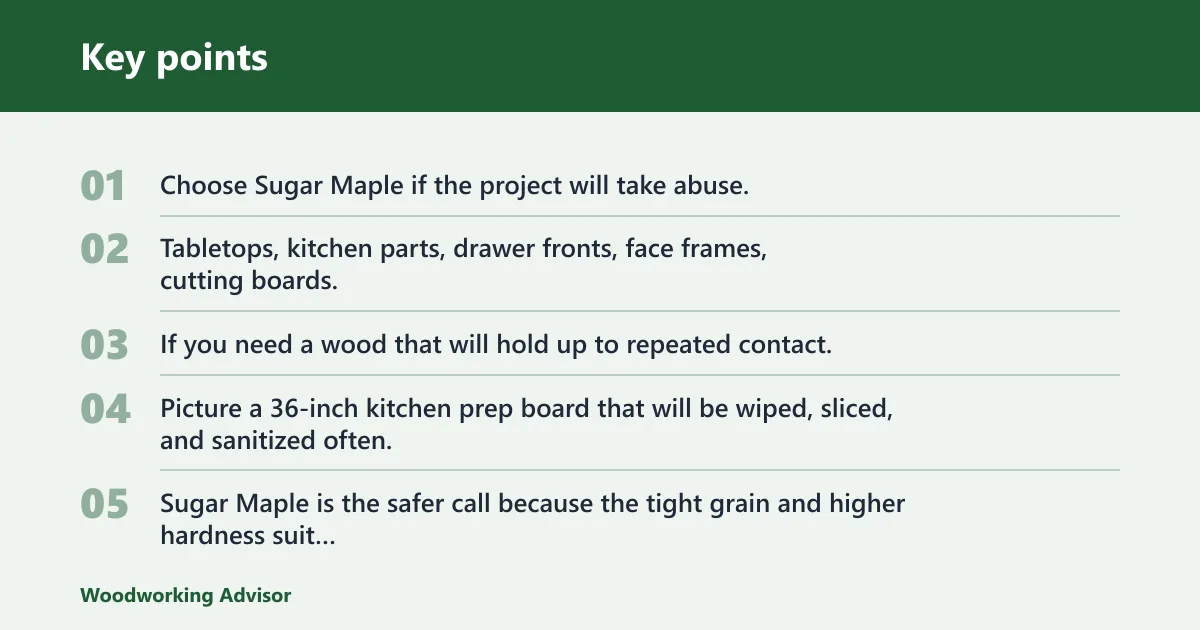
Choose Sugar Maple if the project will take abuse. Tabletops, kitchen parts, drawer fronts, face frames, cutting boards, and butcher blocks benefit from its higher hardness and better edge durability. If you need a wood that will hold up to repeated contact, the premium is easier to justify.
Picture a 36-inch kitchen prep board that will be wiped, sliced, and sanitized often. Sugar Maple is the safer call because the tight grain and higher hardness suit food-contact surfaces. Now picture a pale, painted laundry-room cabinet with inset doors; Norway maple is often the more practical choice there.


Which maple works for cabinets, furniture, and food-contact parts?
For cabinets and furniture, the right answer depends on the part, not just the species. Face frames and shelves can favor Norway maple when machining ease and a clear finish matter more. Tabletops, doors, and exposed edges lean toward Sugar Maple because they benefit from extra dent resistance and longer visual life.
Face frames, doors, tabletops, and shelves
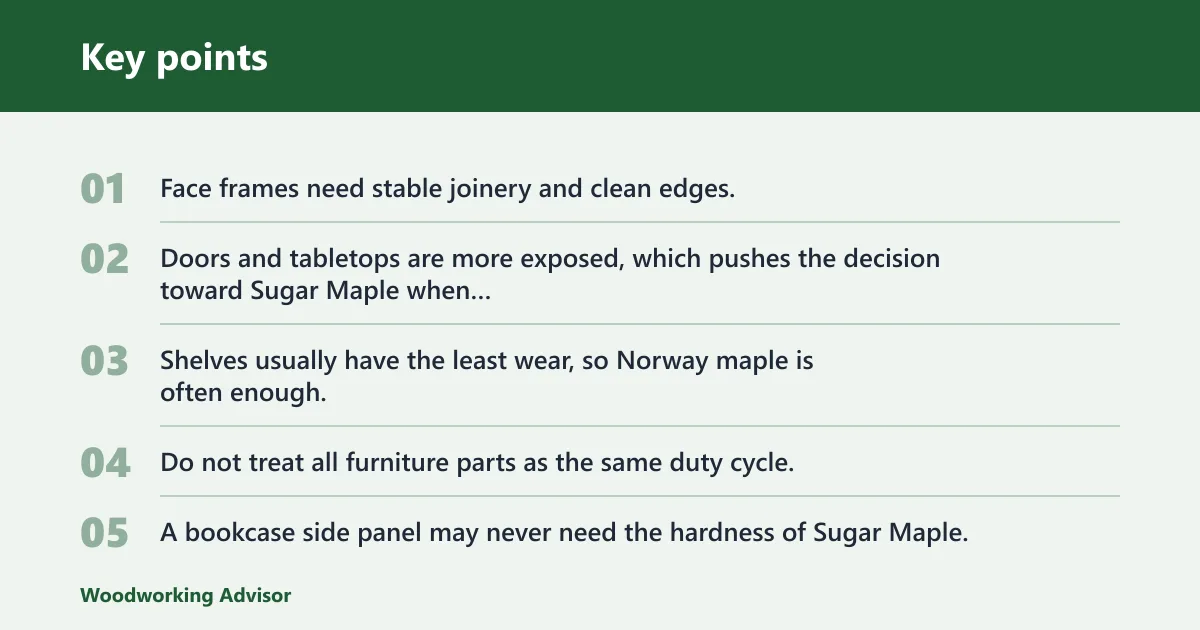
Face frames need stable joinery and clean edges, so either maple can work if you pre-drill screws and keep tools sharp. Doors and tabletops are more exposed, which pushes the decision toward Sugar Maple when the piece is likely to get bumped or slid across. Shelves usually have the least wear, so Norway maple is often enough.
Do not treat all furniture parts as the same duty cycle. A bookcase side panel may never need the hardness of Sugar Maple, while a dining table apron or front edge may benefit from it immediately.
Cutting boards and butcher blocks
For food-contact surfaces, Sugar Maple is a common choice. Its tight grain, hardness, and common use in butcher blocks and cutting boards make it the safer default. Norway maple can be used for some food-contact pieces, but Sugar Maple is the better choice when sanitation, moisture resistance, and long-term wear are priorities.
Both woods should be dried to furniture-grade moisture content before indoor use, then finished with products suited to the application. For cutting boards, use a food-safe oil or conditioner rather than a film finish that can chip under knife use.
Is Norway maple good for lumber?
Yes, Norway maple is good lumber for the right project. Its fine, even grain, light tan to cream color, and good machining behavior make it useful for furniture, cabinets, turning stock, and clear-finished work. It is less suitable where heavy wear, outdoor exposure, or frequent impacts are expected.
Where it fits best
Norway maple works well when you want a pale interior wood with a clean surface and minimal grain distraction. It is a sensible choice for panels, drawer parts, shelves, and decorative components. The main caution is that it can blotch under pigmented stain on flat-sawn faces, so clear finish is often the cleaner route.
Is sugar maple better than Norway maple for furniture?
For furniture that must resist dents and edge wear, yes. Sugar Maple is better when the piece will see more abuse, especially on tops, rails, and exposed corners. Norway maple is still a valid furniture wood, but it is the better bargain when the design prioritizes appearance and easier machining over maximum hardness.
Tabletops, desk edges, chair rails, and child-height cabinet faces are the kinds of parts that benefit most from Sugar Maple. A display cabinet or side table that gets light use may not need that extra hardness, which is why Norway maple can be the better fit for many furniture builds.
What is the Janka hardness of Norway maple vs sugar maple?

Norway maple is about 1,010 lbf on the Janka scale, and Sugar Maple is 1,450. That difference is large enough to matter in dent resistance, scratch resistance, and edge wear, especially on furniture surfaces that are handled often. The harder species is the better choice when durability is part of the job.
Reading the numbers in practice
Janka hardness is useful because it turns a vague feeling into a direct comparison. A 440-lbf gap is not subtle on a tabletop edge or cabinet corner. It does not mean Norway maple is weak; it means Sugar Maple is the stronger wear surface when the project will take repeated contact.
Which maple is easier to machine and finish?
Norway maple is usually easier to machine cleanly, while Sugar Maple is more demanding but still manageable with sharp tooling. Norway maple turns well and takes a clear coat beautifully, though it can burn if the cutter is dull or the feed is too slow. Sugar Maple can chip and needs more careful machining.
Finish behavior to plan
Both woods can look excellent under clear finish, but their grain structure changes how they accept stain. Norway maple’s diffuse-porous structure and Sugar Maple’s closed grain both support smooth surfaces; neither one behaves like an open-pored oak. Pigmented stain is where problems start, especially on broad flat-sawn faces.
Does Norway maple stain or finish like sugar maple?
Not exactly. Norway maple finishes beautifully under clear coats and can blotch with pigmented stains, while Sugar Maple also looks clean under clear finish but does not stain as easily because of its closed grain. If you want a pale, natural look, both work; if you want even color from stain, test first.
What to do before staining
Use scrap offcuts from the same board stack. Try the exact stain, conditioner, and topcoat schedule you plan to use. That matters more with maple than with many other hardwoods because the grain is fine enough to make uneven absorption obvious.
Is Norway maple cheaper than hard maple lumber?
Often, yes, but the bigger issue is supply rather than a fixed price difference. Norway maple is less common in lumber yards, while Sugar Maple is widely stocked in 4/4, 5/4, and 6/4 thicknesses. If Norway maple is hard to source locally, any price advantage can disappear quickly.
How to decide on cost alone
If the project is a painted cabinet interior, utility shelving, or a light-duty furniture piece, Norway maple can be the cheaper way to get a clean hardwood surface. If you need thicker stock, predictable supply, or a hard-wearing surface, Sugar Maple may be the better value even at a higher board-foot price.
Can Norway maple be used for cutting boards or butcher blocks?
It can be used for some food-contact projects, but Sugar Maple is the better choice for cutting boards and butcher blocks. Those surfaces need tight grain, high hardness, and good resistance to repeated knife strikes and moisture cycling. Norway maple is more suitable for non-knife contact or lower-wear kitchen parts.
Food-contact decision rule
If the piece will be cut on, chopped on, or scrubbed hard, choose Sugar Maple. If the piece is a serving board, tray, or light-duty kitchen component where appearance matters more than knife resistance, Norway maple may still be acceptable. For true cutting surfaces, the harder wood is the safer standard.
Frequently asked questions
Which maple is better for cabinets or furniture?
For cabinets and furniture, the answer depends on the part. Norway maple is a smart choice for face frames, shelves, and painted or clear-finished work with moderate wear. Sugar Maple is better for doors, tops, and exposed edges where dent resistance and durability matter more.
Sponsored / affiliate links. As an Amazon Associate I earn from qualifying purchases. I may earn additional commission from eligible campaigns.