How Much Does It Cost to Replace Deck Boards?
Replacing one deck board usually costs about $50 to $150 installed; partial re-decking often runs roughly $300 to $1,200, and full resurfacing can reach about $1,500 to $5,000+. Mismatched boards, hidden rot, or skipped fasteners can turn a small repair into structural damage and a much larger bill. This guide breaks down line-item costs for one-board fixes, partial replacements, and full resurfacing so you can choose the right path.
Deck board cost matrix
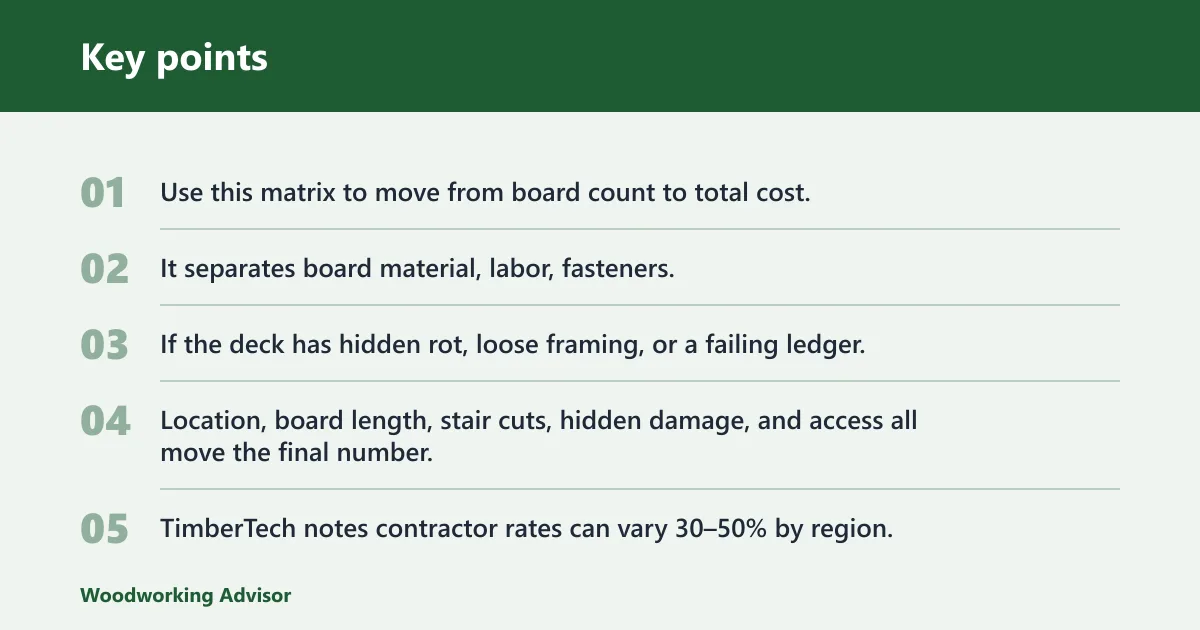

Use this matrix to move from board count to total cost. It separates board material, labor, fasteners, and disposal so you can see where the money goes. If the deck has hidden rot, loose framing, or a failing ledger, stop patching and price resurfacing instead.
| Board count / surface share | Wood boards | Composite boards | Labor | Fasteners | Disposal | Stop patching when… |
|---|---|---|---|---|---|---|
| 1-3 boards | $30 to $180 installed total using pressure-treated pine boards at $30 to $60 each installed | $60 to $300 installed total using composite boards at $60 to $100 each installed | $60 to $180 | $15 to $40 | $0 to $40 | The repair area is localized and the joists, ledger, and fasteners are sound |
| 4-10 boards | $150 to $600 total, which matches the common range for swapping five or six boards | $300 to $1,000 total | $120 to $450 | $25 to $80 | $20 to $75 | You are replacing a noticeable section, not just a few isolated boards |
| 25%+ of deck surface | $600 to $2,500 for a full section of decking | $1,200 to $4,000+ | $300 to $1,000+ | $50 to $150+ | $50 to $200+ | Matching becomes hard, access is broad, or framing work starts to approach resurfacing |
The matrix is a planning tool, not a quote. Location, board length, stair cuts, hidden damage, and access all move the final number. TimberTech notes contractor rates can vary 30–50% by region, and local permits can add $500 to $2,000.
How much does it cost to replace deck boards?
Replacing a few deck boards usually falls in the $150 to $600 range, and five or six boards often land there. A small repair may be closer to the low end if the boards are screwed down and easy to match, while nailed boards, tight access, or disposal push the cost higher.
How much does it cost per square foot?
For partial repairs, the cost per square foot is usually higher than a full deck project because you still pay for setup, removal, and disposal on a small area. A few boards can price out well above a simple material-only estimate, especially if the repair spans stairs, corners, or a short section that forces extra cuts.
Why deck size and access matter
Small jobs do not scale cleanly. A 12-foot board on an open deck is faster to replace than the same board under a railing, beside a hot tub, or over a second-story drop. If access is awkward, labor becomes a bigger share of the bill than the boards themselves.
What drives the price?
The main cost drivers are board material, fastener type, removal difficulty, disposal, and local labor rates. Pressure-treated pine is the common budget option, while composite and Trex replacement boards cost more up front. Hardware matters too, because corrosion-resistant fasteners are required for treated wood and hidden clips can add labor.
Material choice
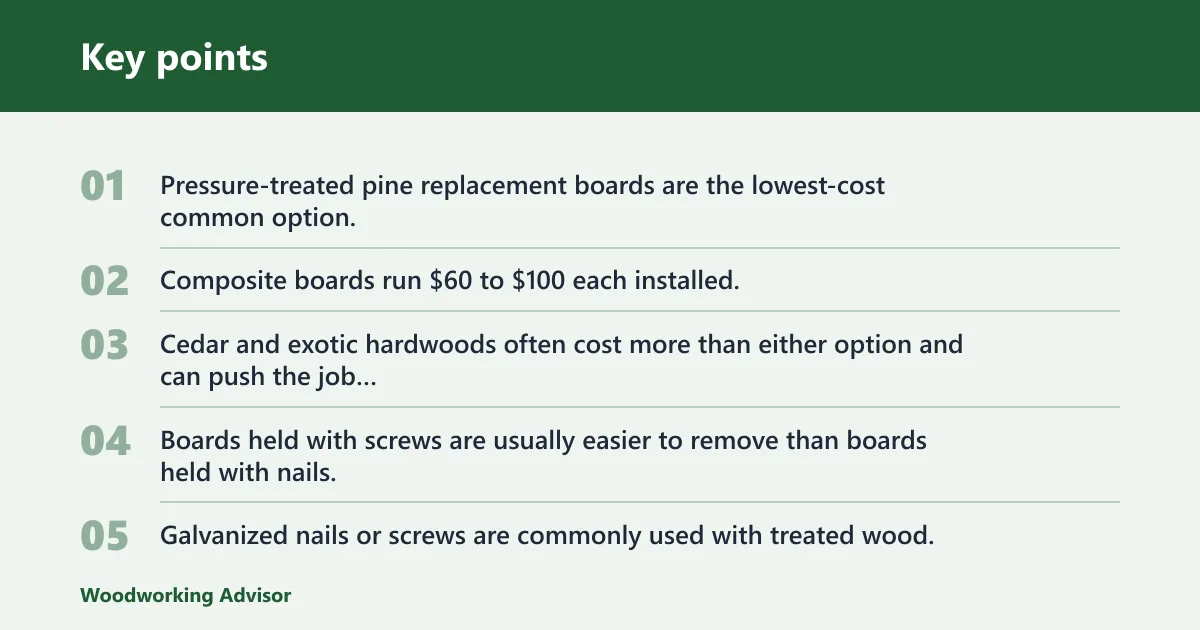
Pressure-treated pine replacement boards are the lowest-cost common option, with installed pricing often at $30 to $60 each. Composite boards run $60 To $100 each installed. Cedar and exotic hardwoods often cost more than either option and can push the job beyond the ranges shown here.
Fasteners and removal difficulty
Boards held with screws are usually easier to remove than boards held with nails. Galvanized nails or screws are commonly used with treated wood, and hidden clip systems on composite decking can make replacement slower. If the fasteners corrode or strip, labor climbs because the old board has to be cut out in sections.
Disposal and labor
Disposal is often a small line item on a one-board job, but it becomes more visible when several boards are removed at once. Labor rises when the deck surface is high, when boards are warped, or when the installer must work around rail posts and stair stringers. That is why a simple parts list rarely matches the final invoice.
Wood boards vs composite boards
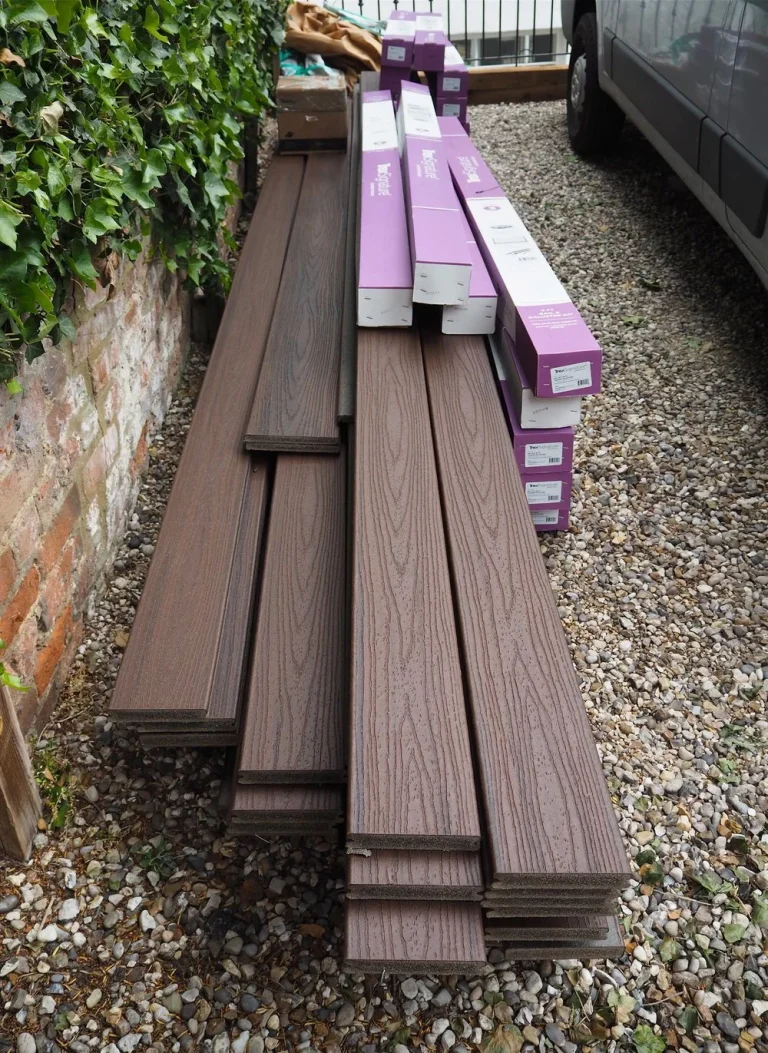
Pressure-treated pine is the simplest replacement path for many older decks. Composite costs more, and it holds up better against rot, which can cut future maintenance. Trex composite decking is one common brand-specific option for wood-to-composite conversions, and it sits in the higher material-cost tier than pressure-treated lumber.
Pressure-treated pine replacement
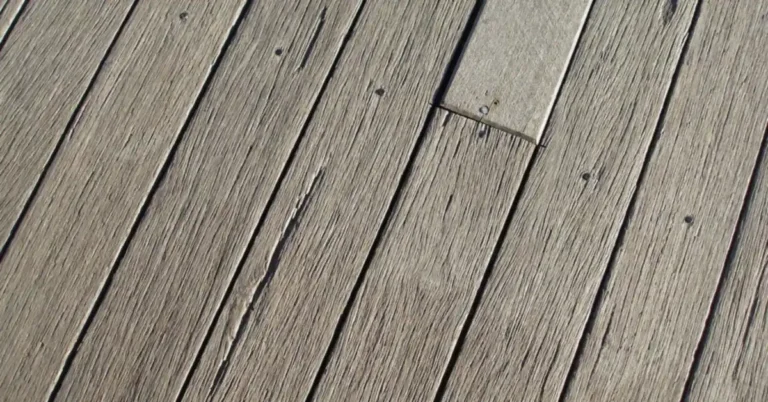
Pressure-treated pine deck boards are common because they are widely available and relatively affordable. They are still subject to rot, cracking, and warping, so matching an older deck can be hard. On a visible deck, a newer board may stand out even if the size matches exactly.
Composite and Trex replacement
Composite boards are heavier and more flexible than wood, so the frame has to be right before you install them. Rock Remodeling notes that standard straight-lay composite framing allows 16-inch joist spacing, while diagonal or herringbone layouts need 12-inch joist spacing. If the joists do not meet span limits, composite is not a simple drop-in swap.
Say your deck has six failed pine boards along one edge, but the joists are level and the ledger is solid. A partial wood repair may be the cheapest answer. If the same deck is being converted to composite, the framing may need tighter spacing or added support before the new boards go down.
Can you replace deck boards without rebuilding?
Yes, one or two boards can often be replaced without rebuilding the whole deck. The repair stops making sense when boards are only the symptom. Soft spots, rot, bounce, sag, or a failing ledger mean the frame may need work first, and deck resurfacing can become the better path.
When a small repair is enough
Choose a small repair when the damage is limited to a few boards, the fasteners can be removed cleanly, and the frame underneath is dry and solid. If the deck has older boards with matching issues, you may still repair it, but do not expect the new lumber to disappear visually into the old surface.
When resurfacing is the better decision
Deck resurfacing replaces the top boards while keeping the frame, so it sits between patching and a full rebuild. It is often cheaper than a new deck, but only if the joists and ledger are structurally sound. The same source says resurfacing with composite can be 30–50% more affordable than other comparable paths.
A common first-timer mistake is replacing three boards on a deck that already feels springy. The new boards look better for a moment, but the movement remains because the joists are the real problem. At that point, more patching is wasteful.
Check the frame before you buy boards
Before you buy replacement material, inspect the joists and ledger board. Deck boards sit on the frame, so rotten framing can make a board-only repair fail early. Composite also depends on correct joist spacing and support, which is why the hidden structure matters as much as the top surface.
Joists: rot, bounce, spacing, and span limits
Joists should be checked for rot, sag, and bounce. If they move underfoot, the deck may need more than new boards. Composite boards are less forgiving of poor framing because they follow span limits more strictly than many wood board repairs.
Ledger board: the house connection
The ledger board ties the deck to the house, and it deserves a careful check before any re-decking. If the ledger is damaged or poorly attached, replacing boards alone will not solve the problem. That is one of the clearest signs that a repair plan is too small.
Why joist tape may appear in resurfacing work
Joist tape is often added during resurfacing to help protect the tops of joists from moisture. It does not fix rotten framing, but it can help a sound frame last longer. It is most useful when the old boards are off and the joists are already exposed.
How much does it cost to remove and replace deck boards?
Removing and replacing deck boards usually costs more than installing new boards on an open, easy-to-access frame because removal adds labor. The total depends on whether the boards are screwed, nailed, or clipped, and whether the old surface can be lifted cleanly without damaging the frame below.
One-board removal versus a larger tear-off
A single board may come out with limited labor if the fasteners are accessible. A larger tear-off can require more cutting, more prying, and more disposal. Once the repair spreads into a section of the deck, the cost can move toward $600 to $2,500 for a full section.
Signs the scope is widening
Warped edges, multiple soft spots, and repeated fastener failure are all signs that the scope is widening. If you replace one board this season and the next row fails next year, you are paying twice for setup and cleanup. That is the point where resurfacing usually makes more sense.
Railings and other add-ons
Railings are often priced separately from deck boards, and they can change the whole job scope. If posts, balusters, or handrails are loose, the project may move from a board replacement to a broader remodel. That is especially common on older decks where the railing and decking are aging together.
How railings affect the budget
The Illinois repair guide gives railing repairs at $25 to $60 per linear foot. That number can be modest on a short run, but long railings add up fast. Once railing work is added, labor and disposal rise because the crew has to work around more posts and more hardware.
Other add-ons that change the scope
Stairs, trim boards, fascia, and hidden structural repairs often appear after the first boards are lifted. Those items are not part of a simple board swap, but they are common on deck remodels. If more than one system needs work, a small repair quote can turn into a partial rebuild quote.
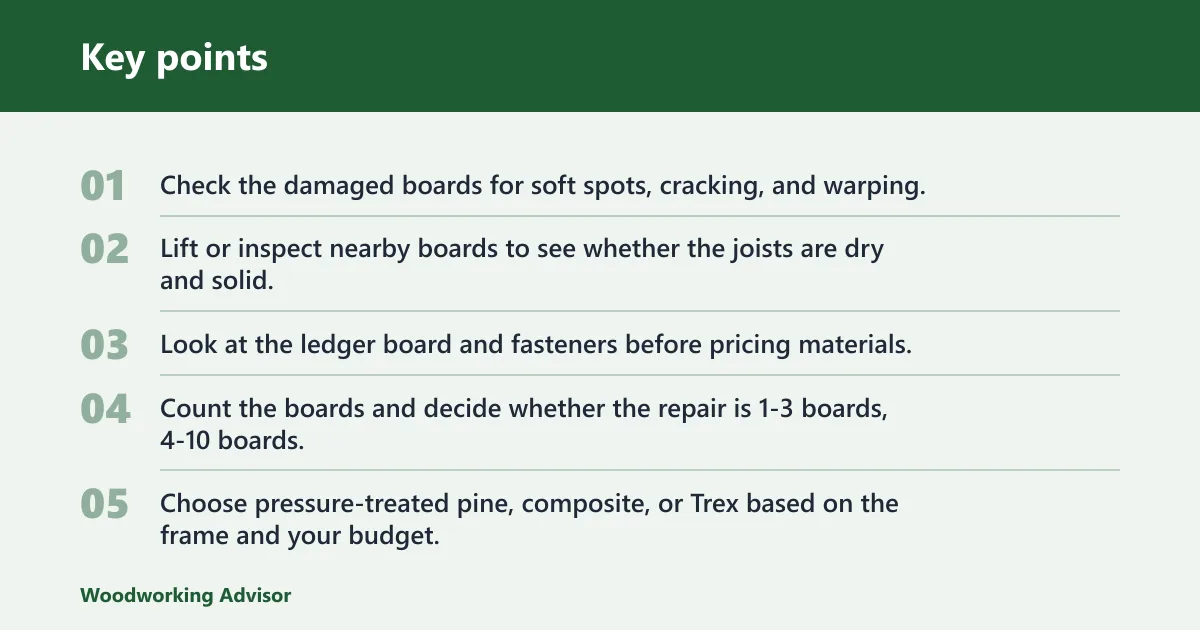
- Check the damaged boards for soft spots, cracking, and warping.
- Lift or inspect nearby boards to see whether the joists are dry and solid.
- Look at the ledger board and fasteners before pricing materials.
- Count the boards and decide whether the repair is 1-3 boards, 4-10 boards, or 25%+ of the surface.
- Choose pressure-treated pine, composite, or Trex based on the frame and your budget.
- Price labor, fasteners, and disposal separately before you decide between patching and resurfacing.
Frequently asked questions
How much does it cost to replace deck boards per square foot?
For partial replacement, the per-square-foot cost is usually a planning number rather than a fixed rate, because setup and removal dominate small jobs.
How much does it cost to replace deck boards with composite?
Composite replacement usually costs more than wood because the boards themselves are pricier and the framing may need to meet tighter spacing rules. Composite boards cost $60 to $100 each installed. If the deck needs added support, the total can move well beyond a simple board swap.
How much is labor to replace deck boards?
Labor varies by access, fastener type, and how many boards are being removed. A small repair often carries a larger labor share than the material share because setup, cutting, and cleanup take time. Screwed boards are usually quicker to remove than nailed boards.
Can I just replace deck boards without rebuilding the deck?
Yes, if the joists and ledger are sound and the damage is limited to a few boards. One or two boards can often be replaced without rebuilding the whole deck. If the frame bounces, sags, or shows rot, board replacement alone is not enough.
How much does it cost to replace wood deck boards with Trex?
Trex replacement usually lands in the composite pricing tier, which is higher than pressure-treated pine. Trex is often chosen during wood-to-composite conversions, but the frame has to support composite span limits first. If the joists are not right, the board choice does not solve the problem.
How much does it cost to replace deck boards and railings?
Adding railings can push the project into a separate scope because railing repairs are often billed by linear foot. The Illinois repair guide lists railing repairs at $25 to $60 per linear foot. Once railings are involved, the job is usually larger than a board-only repair.
Sponsored / affiliate links. As an Amazon Associate I earn from qualifying purchases. I may earn additional commission from eligible campaigns.