How Much Does It Cost to Power Wash and Stain a Deck?
For a full wash-and-stain project, the total usually reaches several hundred to several thousand dollars, with square footage driving most of the bill. Cleaning-only work costs much less than a full refinish, and condition changes the total fast because prep can take as much time as the stain itself.
For power washing alone, a commonly cited average is $150, with a typical range of $90 to $770. Other published per-square-foot figures vary widely, from $0.20 to $1.50 per square foot, while another estimate puts deck washing at $0.44 to $0.54 per square foot. Because these sources use different scopes and assumptions, the spread is why quotes need line items, not just one total.
This guide breaks pricing into light cleanup, standard restain, and heavy-prep restoration so you can judge any bid.
Cleaning-only vs full service and size impact
Cleaning-only versus full project cost
Cleaning-only pricing usually reflects square footage, access, and how dirty the surface is. Full wash-and-stain pricing also includes stain material, drying time, labor for application, and any prep work. If you compare a wash-only bid to a wash-and-stain bid, they are not apples-to-apples unless both include the same prep and finish type.
What size and condition do to the total
Deck size is the strongest price factor because more square footage increases labor and material use. A small 300- to 400-square-foot deck can cost much less than an 800- to 1,000-square-foot deck, but the smaller job may still carry a minimum service call. Heavy prep on a smaller deck can also push the per-square-foot price above a larger, easier deck.
What drives the price most?
Size matters first, but layout and condition can move a bid just as much. A simple rectangular deck with clear access is faster to wash, dry, and stain than a multilevel deck with rails, benches, stairs, and tight corners. Labor often makes up a large share of the bill, so anything that adds hours increases the total.
Deck size and layout
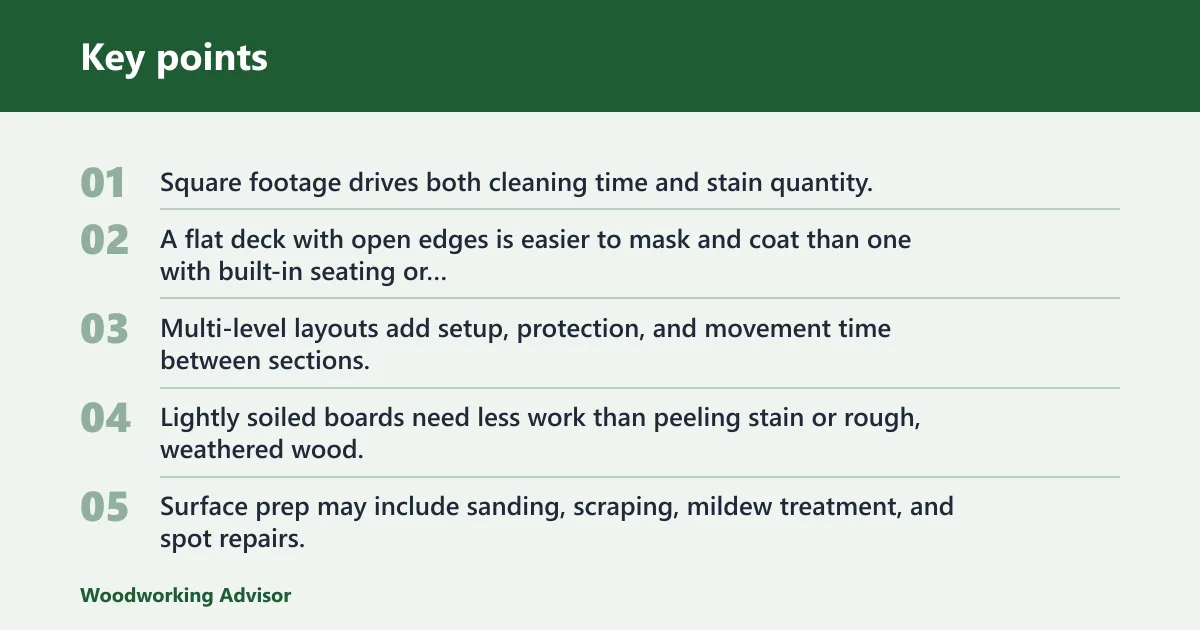
Square footage drives both cleaning time and stain quantity. A flat deck with open edges is easier to mask and coat than one with built-in seating or an attached outdoor kitchen. Multi-level layouts add setup, protection, and movement time between sections, which raises labor even when the footprint is not huge.
Surface condition and prep intensity
Lightly soiled boards need less work than peeling stain or rough, weathered wood. Surface prep may include sanding, scraping, mildew treatment, and spot repairs. Those tasks are not optional on badly worn decks, because new stain applied over loose finish or grime tends to fail early.
Say your 350-square-foot deck has only surface dirt and a sound finish. The contractor may be able to wash, dry, and recoat with limited prep. Now change only one variable: the same deck has peeling stain on the rail caps. The bid rises because scraping and sanding become part of the job.
Wood versus composite
Wood and composite do not get the same treatment. Softwoods need more care because aggressive washing can raise grain and leave splinters. Composite often needs gentler cleaning, and some contractors price that differently because the surface can discolor or mark if the pressure is too high or the chemistry is wrong.
How much does power washing cost by itself?
Cleaning alone is usually the lowest-cost part of the job. Expect a per-square-foot price, but check for a minimum service call because tiny decks can be expensive on a per-foot basis. Washing can also loosen old stain or paint on failing surfaces, but finish removal is a separate task.
Per-square-foot cleaning rates
Published per-square-foot figures vary widely: Current Cost uses $0.25 to $0.75 per square foot, Homewyse estimates $0.44 to $0.54 per square foot, and LatestCost lists $0.20 to $1.50 per square foot. The wide range reflects local labor, deck condition, and whether the crew must work around rails, stairs, or furniture.
Safe pressure settings and damage risk
Decks.com recommends starting around 1800 PSI and avoiding over 2500 PSI on wood. It also advises a 25-degree nozzle. A common safe approach is to begin about 18 inches from the surface and test a hidden spot first. Too much pressure can splinter wood, raise grain, and make sanding more likely.
When cleaning removes old finish
Power washing can loosen loose stain or paint when the surface is already failing, but that is not the same as a full strip-and-restore service. If the finish is intact, washing should remove dirt and mildew without chewing into the wood. On softwood boards, especially, aggressive settings can leave visible damage that must be sanded out later.
How much does staining add to the bill?
Stain adds material cost and application labor, and the finish choice changes both. Oil-based stain usually costs more per square foot than water-based stain, while solid finishes can take more product and may need extra prep to look even. One coat is cheaper than two, but some decks need a second coat for coverage or wear resistance.
Oil-based versus water-based stain
Reported prices for oil-based stain are about $0.70 to $5.50 per square foot, while water-based stain is often about $0.60 to $4.50 per square foot. Current Cost places stain material at $0.75 to $2.00 per square foot. These figures vary by scope, prep, and product choice. Oil-based products often penetrate well and can be easier to maintain later, while water-based products can dry faster and fit tighter schedules. Labor still matters more than the can price on many jobs.
Semi-transparent versus solid finish
Semi-transparent stain usually needs less product than solid stain because it leaves more of the wood visible. Solid finishes can hide color variation and older patches better, but they may require more prep and more careful application to avoid lap marks. That means a solid finish can cost more even if the stain itself does not look dramatically pricier on paper.
Single coat versus two-coat labor
One coat is quicker and uses less material. Two coats add drying time and labor, and a contractor may price the second coat separately if the deck needs it for coverage on worn boards. If a bid does not say whether one or two coats are included, ask before comparing it with another estimate.
What prep work changes the quote?
Prep is where many deck bids change the most. Washing removes dirt and mildew, but sanding, scraping, and repairs are separate work. Heavy prep can cost more than the stain itself on a damaged deck, and that is especially true when boards are rough, peeling, or starting to rot.
Sanding and scraping
Sanding smooths raised grain and evens out old finish edges. Scraping removes loose stain faster than sanding alone, but it leaves an uneven surface that still needs follow-up work. On a deck with peeling finish, these steps can add significant labor because each board edge and rail detail needs attention.
Mildew treatment and washing steps
Mildew treatment is not just cosmetic. If dark streaks or green growth remain, fresh stain may not bond well and can fail sooner. A thorough cleaning sequence often includes treatment, rinse, dry time, then stain. Skipping any of those steps can make a low bid look cheaper than it really is.
Board repair and replacement
Minor repairs can include tightening fasteners, replacing cracked boards, and fixing damaged railing sections. Those items may be priced separately because they depend on what the crew finds after washing. A quote that mentions “miscellaneous repair” without numbers is worth questioning, especially on older decks.
Deck cost by size and condition
Size alone does not tell the whole story. The same 350-square-foot deck can be a light cleanup or a heavy restoration, and the quote difference can be large. Current Cost says a standard two-person crew often completes a 350 square foot deck in 1 to 2 days, which lines up with the idea that prep and finish time are the real cost drivers.
300 to 400 square foot examples
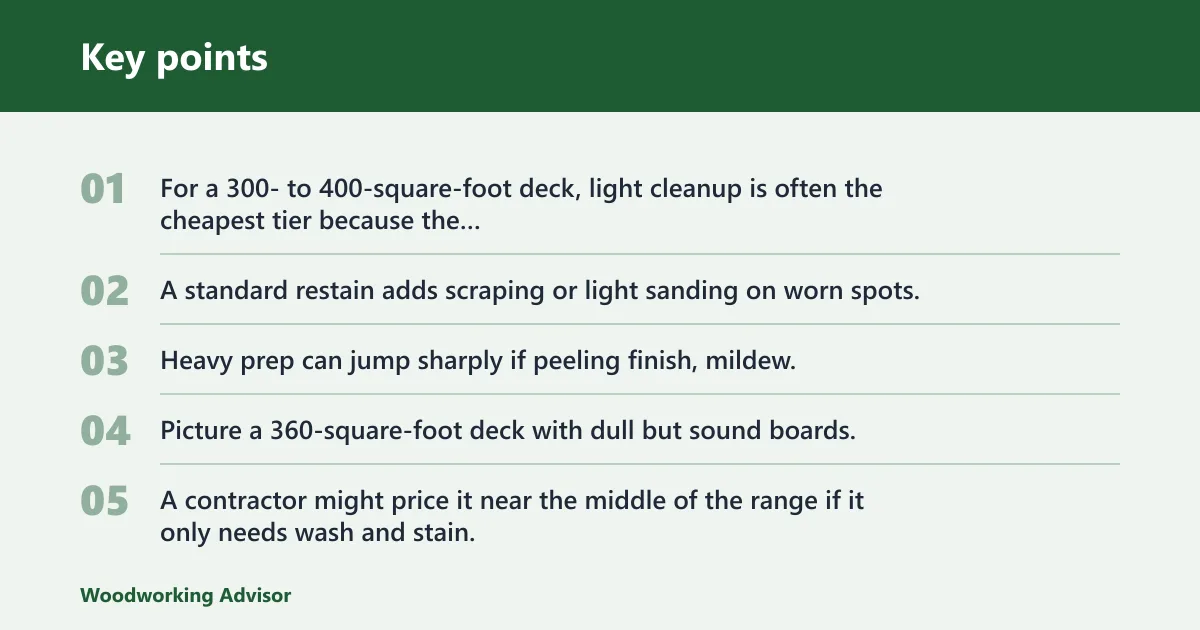
For a 300- to 400-square-foot deck, light cleanup is often the cheapest tier because the crew mainly washes, lets the wood dry, and applies stain. A standard restain adds scraping or light sanding on worn spots. Heavy prep can jump sharply if peeling finish, mildew, or board damage turns the job into repair plus refinishing.
Picture a 360-square-foot deck with dull but sound boards. A contractor might price it near the middle of the range if it only needs wash and stain. Change only one variable: the finish is peeling at the rail caps and stairs. Now the same deck needs more labor and can move into the heavy-prep tier.
800 to 1,000 square foot examples
Larger decks tend to land in the upper part of the range because labor, materials, and setup all rise. A simple 900-square-foot deck may still price well if access is easy and the surface is in good shape, but multilevel layouts, built-ins, or extensive masking can push it toward premium pricing. Minimum service calls matter less here, while labor hours matter more.
Light cleanup, standard restain, and heavy prep tiers
Light cleanup means the deck is mostly sound, with routine washing and a fresh coat or two. Standard restain assumes some prep, such as spot sanding or minor scraping. Heavy prep means peeling finish, mildew treatment, repairs, or other work that consumes much of the crew’s time before stain goes on.
How much cost power table
Use this table to compare contractor estimates against the deck you actually have. The line items matter more than the headline number. A low quote can be fair on a simple deck, but it can also mean missing prep, no dry time, or no repair allowance.
| Deck condition tier | Expected total cost | Likely included line items | Red-flag omissions |
|---|---|---|---|
| Light cleanup | $450 to $850 | Basic wash, dry time, one coat of stain, minor masking | No mention of detergent, dry time, stain type, or cleanup |
| Standard prep | $850 to $1,600 | Wash, spot sanding, scraping of loose finish, stain, minor touch-ups | No prep line, no coat count, no note on rails, stairs, or access |
| Heavy prep | $1,600 to $3,500+ | Wash, mildew treatment, sanding, scraping, board repair, stain, extra protection | No repair allowance, no mildew treatment, no dry-time allowance, no travel or disposal fee |
A reported minimum service-call charge may be about $150 to $800, which can make small decks look expensive per square foot. A tiny 120-square-foot platform deck may still cost a few hundred dollars because the crew must mobilize, set up, and return with materials. That minimum can matter more than stain price on very small jobs.
Why do some quotes cost more in your area?
Regional labor and material markets create real price swings. Urban coastal jobs often cost more because labor rates, travel time, parking, and permit-like access issues can be higher. Rural Southeast pricing can run lower, especially when crews have shorter drive times and lower wage pressure. Some markets move 10% to 25% either way.
City jobs can carry extra cost for parking, tighter access, and slower setup. Multi-story homes with decks above grade may also require more protection and staging, which adds labor. If a contractor has to carry equipment through limited access points, that time shows up in the bid.
Rural Southeast price drops
Lower labor rates and shorter travel distances can reduce the total in many rural markets. That does not mean the work is cheaper in every case, but it can pull the same scope down noticeably compared with a coastal metro. The biggest difference usually shows up in labor, not stain material.
Labor, travel, and access effects
Labor is often the largest share of the bill, and crew size changes the total. A two-person crew may work efficiently on a modest deck, while a larger crew can shorten the schedule on a big, complex layout. Built-in seating, outdoor kitchens, and tight access points all increase setup time and protection needs.
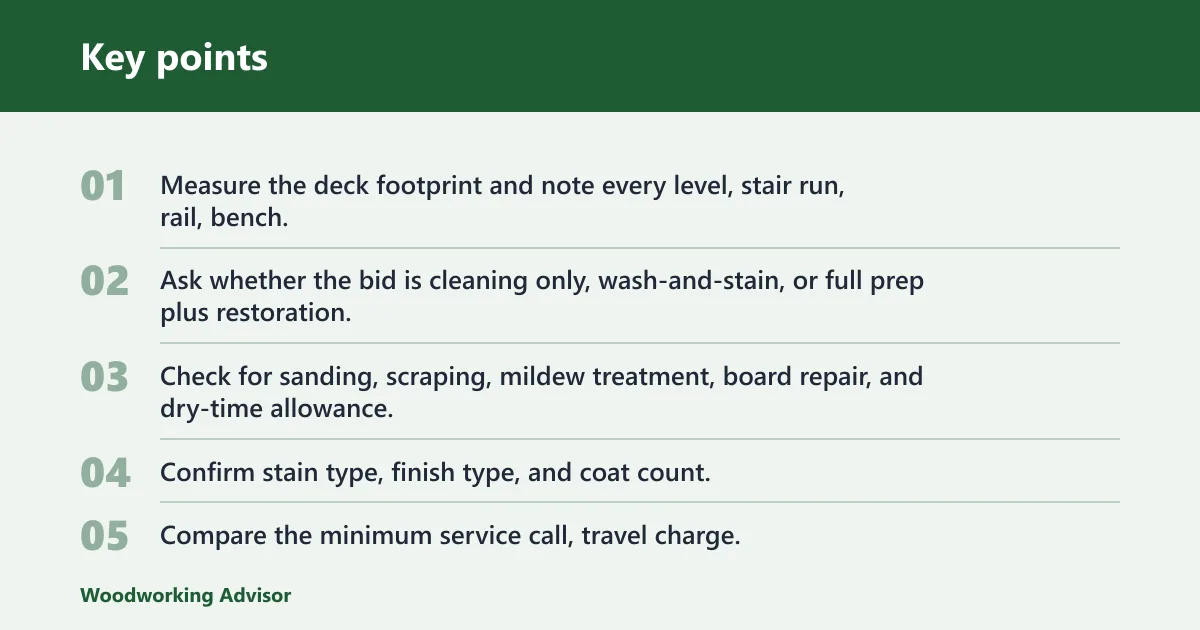
- Measure the deck footprint and note every level, stair run, rail, bench, and built-in feature.
- Ask whether the bid is cleaning only, wash-and-stain, or full prep plus restoration.
- Check for sanding, scraping, mildew treatment, board repair, and dry-time allowance.
- Confirm stain type, finish type, and coat count.
- Compare the minimum service call, travel charge, and cleanup items before choosing the lowest bid.
Frequently asked questions
How much does it cost to power wash and stain a deck?
Expect $1.50 to $5.50 per square foot for the combined job, with a 300-square-foot deck often landing around $450 to $1,650 depending on prep. The lower end fits light cleanup. Heavy sanding, scraping, or repairs push the total higher because labor, not stain alone, usually drives the bill.
How much to power wash and stain a deck?
For many decks, the total lands in the several-hundred to several-thousand-dollar range. A simple deck with easy access can sit near the low end, while a large or worn deck moves toward the high end. A bid should clearly separate washing, prep, stain, and any repairs so you can compare it fairly.
How much does it cost to get a deck pressure washed?
Cleaning alone often costs less than a full refinish. Small decks can look pricey because of the minimum service call, which may run $150 to $800.
What is the average cost per square foot to clean a deck?
Published figures vary widely. Homewyse lists $0.44 to $0.54 per square foot, while Current Cost uses $0.25 to $0.75 per square foot and LatestCost lists $0.20 to $1.50 per square foot. The right number depends on access, dirt level, and whether the surface needs finish removal.
How do stain type and prep work change the total price?
Oil-based stain, water-based stain, semi-transparent finish, and solid finish all affect material use and labor. Prep can add more than the finish choice if the deck needs sanding, scraping, mildew treatment, or repairs. A two-coat job also costs more because it adds drying time and application labor.
Is it cheaper to bundle deck washing and staining together?
Usually, yes. Bundling avoids duplicate mobilization, setup, and travel charges, and it can keep the contractor from charging a second minimum service call. Separate visits can cost more because the crew must return, reset protection, and re-evaluate the surface before staining.
How long does a typical deck washing and staining job take?
A standard two-person crew often completes a 350 square foot deck in 1 to 2 days, according to Current Cost. Smaller jobs may finish in less time if drying conditions are good. Heavy-prep work takes longer because sanding, scraping, repairs, and dry time can stretch the schedule well beyond a simple wash and coat.
Sponsored / affiliate links. As an Amazon Associate I earn from qualifying purchases. I may earn additional commission from eligible campaigns.