MDF vs HDF: What’s the Difference?
MDF is the better choice for painted furniture, cabinet fronts, and shaped trim. HDF is denser, harder, and better for thin panels, door skins, and high-wear surfaces. Use MDF for machining and a smoother paint finish. Use HDF when screw holding, edge toughness, or wear resistance matters more. Choose the wrong one and you get swollen edges, blown fasteners, or doors and panels that fail early; this guide explains the differences by finish, moisture, hardware stress, and use.
| Decision factor | MDF | HDF | Winner |
|---|---|---|---|
| Surface for paint and veneer | Smoother face, easier to get an even painted finish | Can be finished, but often needs more prep | MDF |
| Moisture behavior | Swells faster when edges or cutouts are exposed | Usually performs better, but standard grades are still not waterproof | HDF |
| Machining and shaping | Cuts and routes more easily | Harder on blades and bits | MDF |
| Fastener grip | Screws enter more easily, but pilot holes matter | Tighter grip on fasteners, with higher edge stress if overdriven | HDF |
| Thin, wear-prone parts | Works for some furniture parts, but can be less durable in thin sections | Better for thin panels, door skins, and other wear-prone parts | HDF |
What are MDF and HDF?
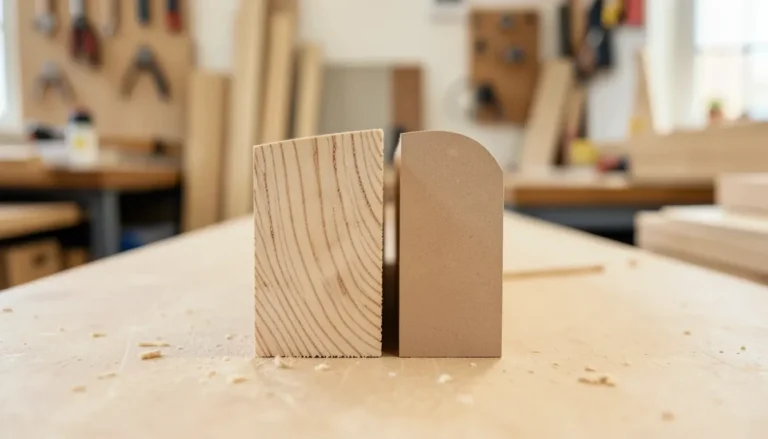
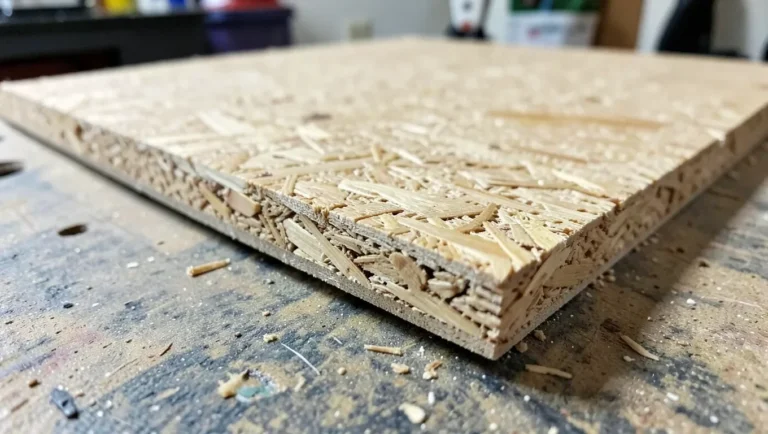
MDF and HDF are both fiberboard products made from wood fibers bonded with resin and pressed into panels. MDF typically falls in the 600–800 kg/m³ range, while HDF is usually above 800 kg/m³. That density shift changes hardness, stiffness, edge durability, and how each board behaves around fasteners and moisture.
How each board is made
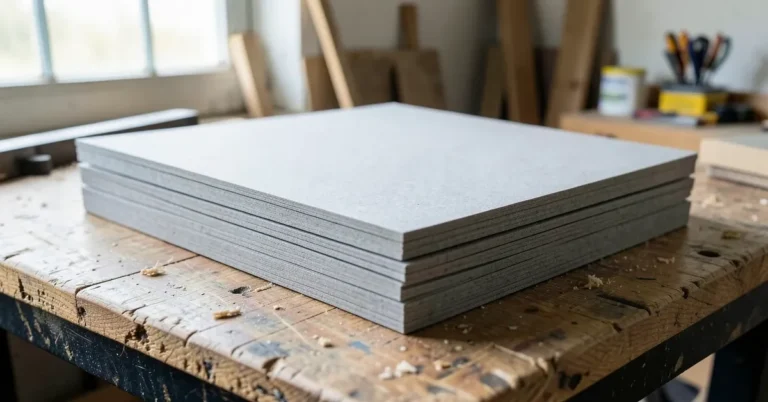
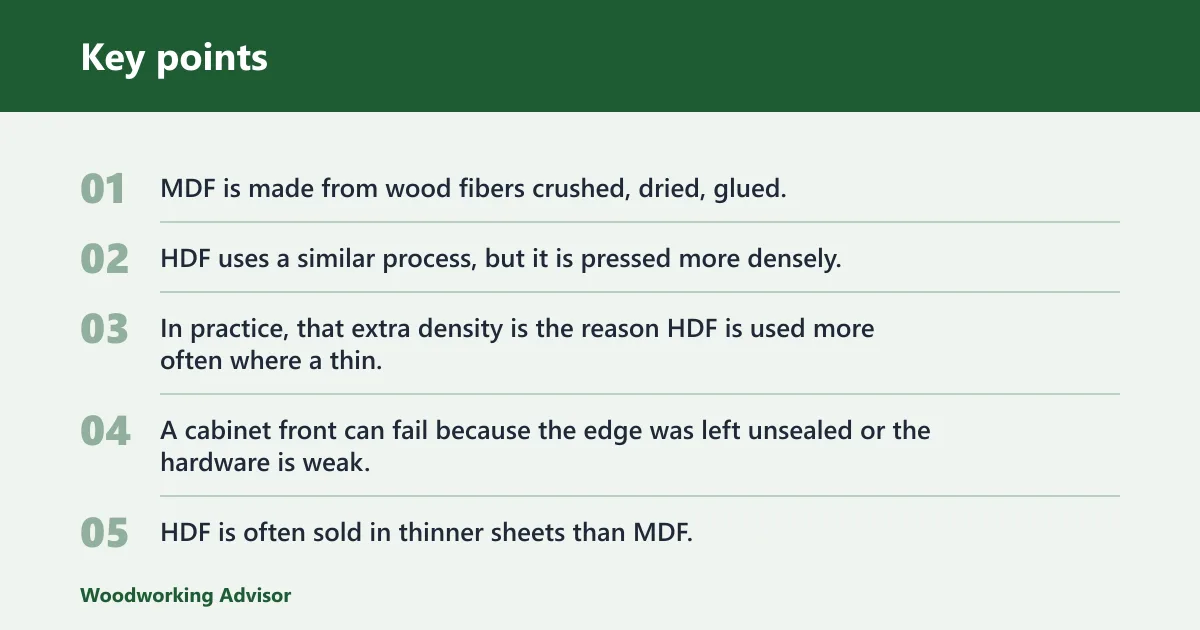
MDF is made from wood fibers crushed, dried, glued, and pressed under high temperature and pressure. HDF uses a similar process, but it is pressed more densely, which is why it ends up harder and stiffer than MDF. In practice, that extra density is the reason HDF is used more often where a thin, tough panel is needed.
Density alone does not decide success. A cabinet front can fail because the edge was left unsealed or the hardware is weak, even if the board grade itself is sound.
Typical thickness and format
HDF is often sold in thinner sheets than MDF. That makes sense for flooring layers, door skins, and wall panels where a slim, stiff panel is useful. MDF is more common in thicker furniture panels, shaped trim, and carved or routed parts.
A common first-timer mistake is choosing HDF for a bulky shelf simply because it is “stronger.” If the span is long, the better fix may be a thicker panel, added support, or a different sheet material altogether.
How do MDF and HDF compare at a glance?
The main trade-off is simple: MDF is easier to shape and paint, while HDF gives you greater stiffness, better edge toughness, and a firmer fastener bite. Neither board is waterproof, and both need sealing if they will see humidity or occasional wetting. For decorative parts, paint quality matters most. For load-bearing parts, stiffness and span matter more. For wear-prone parts, edge damage and surface wear decide the pick.
Density, stiffness, and durability
MDF density typically ranges from 600–800 kg/m³. HDF is usually above 800 kg/m³, and that added density is what gives it higher stiffness and a harder surface. Higher density can improve wear resistance, but it can also mean more tool wear during cutting and routing.
Surface finish and paint quality
MDF often provides a smoother starting surface for paint and veneer work. Its face is smooth and uniform, which helps with cabinet doors, moldings, and decorative panels. HDF can also take paint, but it often needs more prep to get the same finish quality.
Moisture resistance and swelling
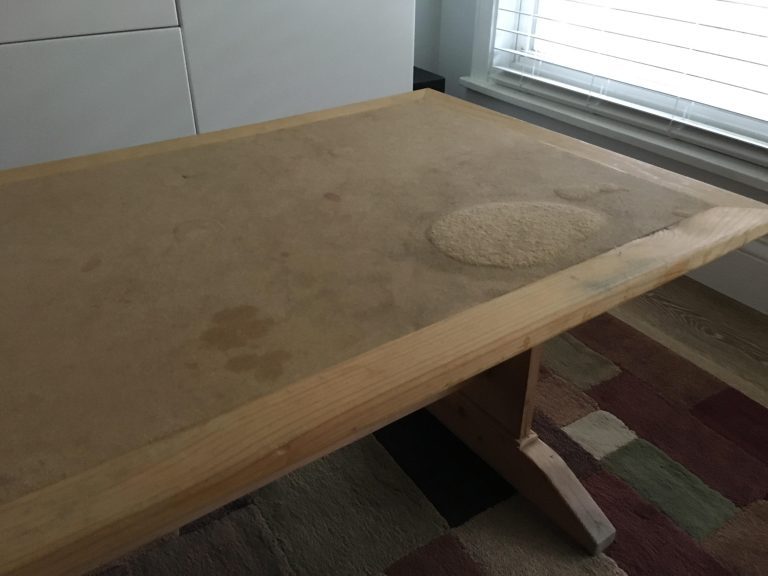
HDF generally handles moisture better than MDF, but standard boards in both categories can swell if water reaches cut edges, drilled holes, or damaged faces. Neither board should be called waterproof as a category. Edge sealing matters for both.
Machining, fastening, and tool wear
MDF is generally easier to cut, shape, and route, so it is often the friendlier material for profiles, grooves, and decorative edges. HDF is generally harder on blades and bits. On the fastening side, MDF accepts screws more easily but still needs pilot holes, while HDF tends to grip fasteners more tightly and can punish overdriven screws at the edge.
How do they handle moisture?
HDF usually resists moisture better than MDF, but that does not make it a wet-area board. Both materials can swell at edges, corners, and cutouts when the finish is breached. Sealing faces and especially exposed edges is still the basic rule for either one.
What happens at edges and cutouts
Edges are where trouble starts first. A sink cutout, hinge boring, or trimmed edge gives moisture a direct path into the fibers, and MDF tends to show damage sooner. HDF slows that failure better, but it still needs protection in humid rooms or anywhere cleaning water can reach the panel.
Suppose you are making a painted bath cabinet door with a routed panel profile. If the profile is left raw, the paint film may break at the sharpest corners first, and the board can swell there before the flat face shows much change.
Why sealing matters for both boards
Sealing is not optional just because a sheet feels dense. Primer, edge sealers, or compatible coating systems reduce the chance of swelling and finish breakdown. That is especially important for cut edges, screw holes, and routed grooves, where moisture enters fastest.
Which board machines better?
MDF machines more cleanly and with less strain on standard woodworking tools. HDF cuts more slowly and puts more wear on blades and router bits, especially on detailed profiles. If your project depends on shaped edges or repeated routing, MDF is usually the more forgiving panel.
Cutting and routing differences
MDF is easier to mill into bead profiles, grooves, and curved shapes. It is also less likely to chip at the edge during light-to-moderate routing. HDF can be machined, but the higher density makes the cut less forgiving and increases the chance of burning or dulling tools sooner.
Dust and edge quality
Both boards create fine dust, so extraction matters. MDF often leaves a smoother edge after cutting, which helps when the part will be painted. HDF edges can be harder and cleaner in some thin-panel applications, but that same hardness is part of what makes it tougher on tools.
How do MDF and HDF hold screws?
HDF usually gives a tighter fastener grip, while MDF is easier to penetrate but relies more on pilot holes and good screw placement. Neither board should be treated like solid wood. Edge distance, screw type, and panel thickness matter as much as the board label.
Pilot holes and edge distance
MDF needs pilot holes for predictable fastening, especially near corners or in thinner stock. Without them, screws can split the edge zone or strip the fibers. HDF holds fasteners more tightly, but the denser material can still fail at the edge if you drive hardware too close or too hard.
Fastener pullout and hardware stress
For hinges, catches, and repeated opening cycles, HDF has an advantage because its denser fiber structure gives screws more material to bite into. Even so, finished-door construction matters more than the board label alone. A one-piece door behaves differently from a door assembled from rails, stiles, and a center panel.
MDF HDF decision matrix
This matrix ties the board to the job, not to density alone. Use it to match failure risk with the part you are building. If the wrong material would swell, strip, chip, or wear through early, the safer choice is the one that resists that specific failure mode.
| Project type | Recommended board | Reason | Common failure risk |
|---|---|---|---|
| Painted cabinet doors | MDF | Smooth faces and clean routing suit painted fronts | Edge swelling if sealing is poor |
| Routed panels | MDF | Does not chip as easily when routed | Profile edges can drink moisture if left raw |
| Shelving | MDF | Works for furniture shelving when span and thickness are sized correctly | Sagging on long spans |
| Drawer bottoms | HDF | Thin, stiff sheet works well where a flat panel needs more toughness | Cracking if fasteners are placed too close to the edge |
| Laminate flooring | HDF | Ideal for high-quality laminate floors because it does not absorb moisture as quickly as MDF | Swelling if the product is not a moisture-resistant grade |
| Wall panels | HDF | Better for thin decorative panels that need stiffness | Tool wear during trimming and fitting |
| Trim | MDF | Paints well and is easy to shape into profiles | Corner damage during handling and installation |
| High-wear parts | HDF | Harder surface and better wear tolerance | Overdriven fasteners can crush the edge |
Choose MDF if… / Choose HDF if…
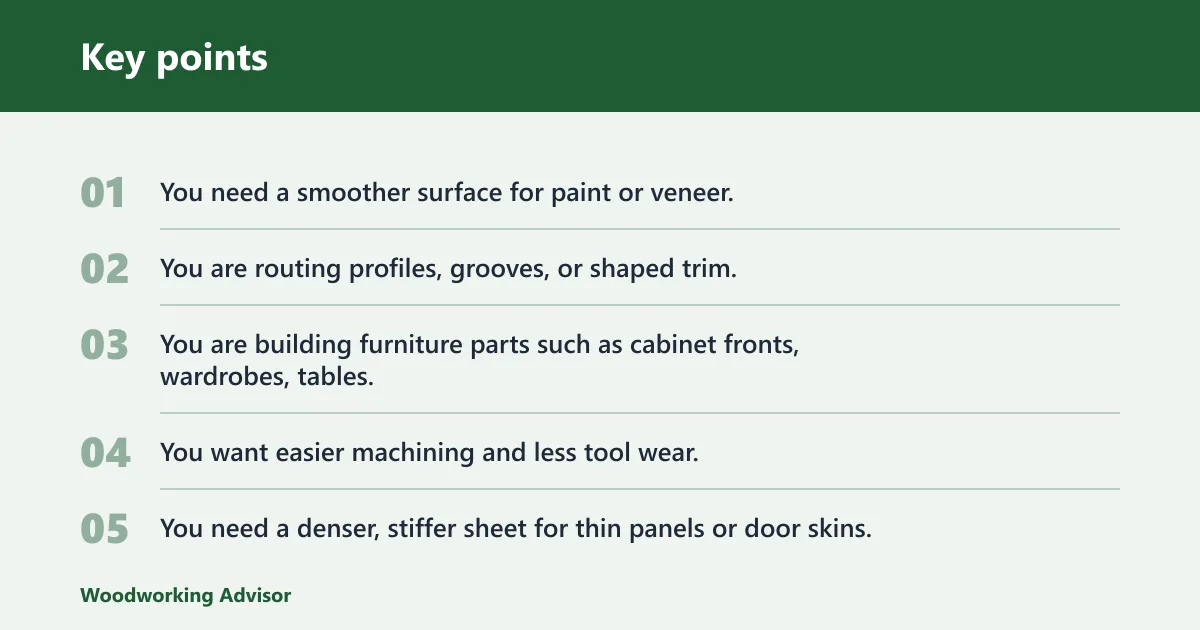
Choose MDF if the part will be painted, routed, or shaped into trim, cabinet fronts, or decorative furniture pieces. It is also a better fit when you want easier cutting and a smoother paint base. Choose HDF if the part is thin, sees more wear, or needs better edge toughness and screw grip.
Choose MDF if…
- You need a smoother surface for paint or veneer.
- You are routing profiles, grooves, or shaped trim.
- You are building furniture parts such as cabinet fronts, wardrobes, tables, or shelving with proper support.
- You want easier machining and less tool wear.
Choose HDF if…
- You need a denser, stiffer sheet for thin panels or door skins.
- You need better resistance to edge wear or repeated contact.
- You need stronger screw grip for hinges, hardware, or repeated fastening.
- You are choosing material for laminate flooring, wall panels, or other high-wear parts.
When neither board is the right choice
If the part will live in a wet zone, carry a heavy load over a long span, or take repeated structural stress, another material may fit better. Also check indoor air quality requirements. MDF and HDF are made with resin binders, and some products may use urea-formaldehyde or phenol-formaldehyde, so lower-emission ratings such as E1, E0, or CARB P2 can matter in enclosed rooms.
Picture a hallway bench top made from a 900 mm span panel with a heavy person sitting on the middle every day. Even HDF may be the wrong answer if the section is too thin or unsupported; a different panel thickness, a framed build, or another sheet material may be safer.
Frequently asked questions
What is the difference between MDF and HDF?
MDF is a medium-density fiberboard with a smooth face and a density typically in the 600–800 kg/m³ range. HDF is a higher-density panel, usually above 800 kg/m³, so it is harder, stiffer, and better for thin wear-prone parts. The practical difference shows up in finishing, moisture behavior, and tool wear.
Which is better, MDF or HDF?
Neither is better in every case. MDF is usually the better paint substrate and the easier board to route, while HDF is better when you need stiffness, thinner sections, or tougher edges. Choose by failure mode: paint quality, moisture, hardware stress, or wear.
What is HDF vs MDF?
HDF vs MDF is mainly a density and performance comparison within fiberboard. HDF is pressed more densely, which makes it harder and stiffer. MDF is easier to machine and usually gives a cleaner surface for paint, so it fits better in decorative furniture work.
Is HDF stronger than MDF?
In many uses, yes. HDF is denser and stiffer, so it usually handles edge stress and repeated contact better than MDF. That said, strength depends on the part design, thickness, and fastening method. A poorly built HDF panel can still fail early.
Is MDF or HDF better for painting?
MDF is usually better for painting because its surface is smoother and more uniform. It also routes cleanly, which helps on shaped cabinet fronts and trim. HDF can be painted too, but it often needs more prep to reach the same finish quality.
Does HDF resist moisture better than MDF?
Usually, yes, but only to a point. HDF generally performs better than MDF in humid conditions and at minor exposure points, yet standard grades are not waterproof. If the edge is cut, drilled, or left unsealed, both boards can swell and break down.
How do MDF and HDF compare in density and thickness?
MDF typically ranges from 600–800 kg/m³, while HDF is usually above 800 kg/m³. HDF is often sold in thinner sheets because its stiffness suits flooring layers, door skins, and wall panels. MDF is more common in thicker furniture panels and shaped parts.
Is MDF cheaper than HDF?
Often, yes, MDF is the lower-cost option in many markets because it is less dense and easier to process. But pricing varies by thickness, emissions class, and face quality. For a fair comparison, check the exact panel grade, not only the board name.
Ldf vs mdf vs hdf
LDF is not the standard comparison here; in most buying contexts, people mean MDF and HDF. If a supplier uses a different label, verify the actual density, thickness, and intended use on the sheet spec. For furniture and doors, the key question is still how the panel will fail in service.
Sponsored / affiliate links. As an Amazon Associate I earn from qualifying purchases. I may earn additional commission from eligible campaigns.