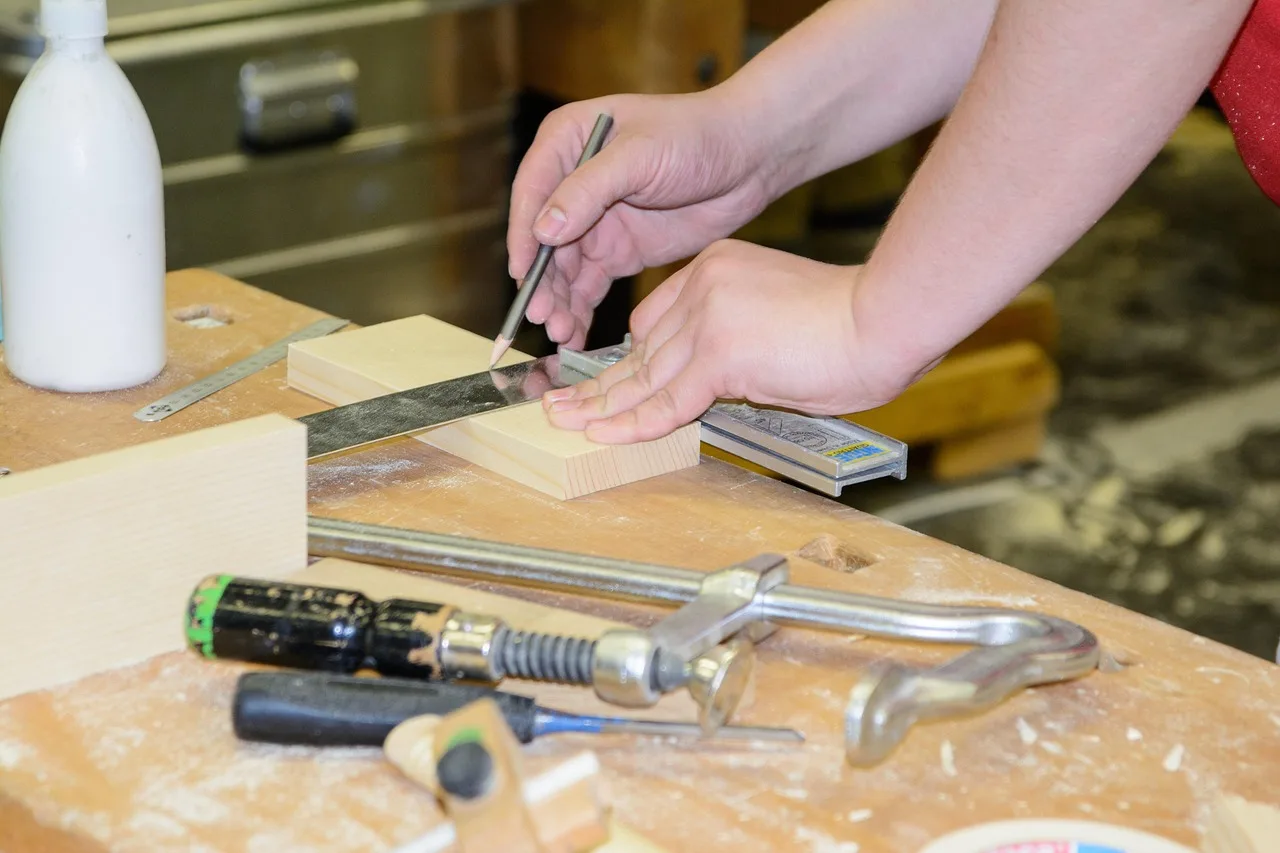
Pocket Hole Joinery vs Dowel Joinery for DIY Furniture
Pocket hole joinery is usually faster and better for face frames, aprons, and hidden stretchers; dowel joinery is cleaner and often better for visible edges, tabletops, and parts that need tighter alignment. Pick the wrong method and you can end up with weak joints, misalignment, or fasteners that show where you do not want them. This guide compares both methods in face frames, aprons, casework, tabletops, and hidden structural connections.
This guide is part of our Woodworking project ideas and plans series.
| Decision factor | Hole Joinery | Dowel Joinery | Winner |
|---|---|---|---|
| Speed and setup | Fast drilling and assembly with a pocket-hole jig, especially on repeat parts | Slower setup because drilling, spacing, and glue-up must all line up | Hole Joinery |
| Visibility | Fastener holes are usually hidden on the inside, but plugs or open holes can show on exposed edges | Hidden from the outside when drilled well; no screw heads | Dowel Joinery |
| Movement tolerance | Poor fit for solid-wood tabletops and other parts that move seasonally | Better for alignment and glue joints, but still not a cure for seasonal movement in a fixed panel | Dowel Joinery |
| Tool load | Jig, screws, and a face clamp | Dowel jig, drill stops, drill, glue, and clamps | Hole Joinery |
| Failure risk in furniture parts | Higher risk on end grain and on joints that need strong racking resistance | Higher risk if holes drift, spacing is off, or glue/clamping is poor | Tie |
What each joint is and how it works
Hole Joinery uses angled, pre-drilled guide holes and specialized screws. That angle lets the screw pull one part tight to another quickly, which is why it is common in fast assembly work.
Dowel Joinery uses cylindrical wooden pegs inserted into matching straight holes. The joint depends on accurate hole location, glue coverage, and clamping while the adhesive cures.
How the comparison breaks down
Speed and ease
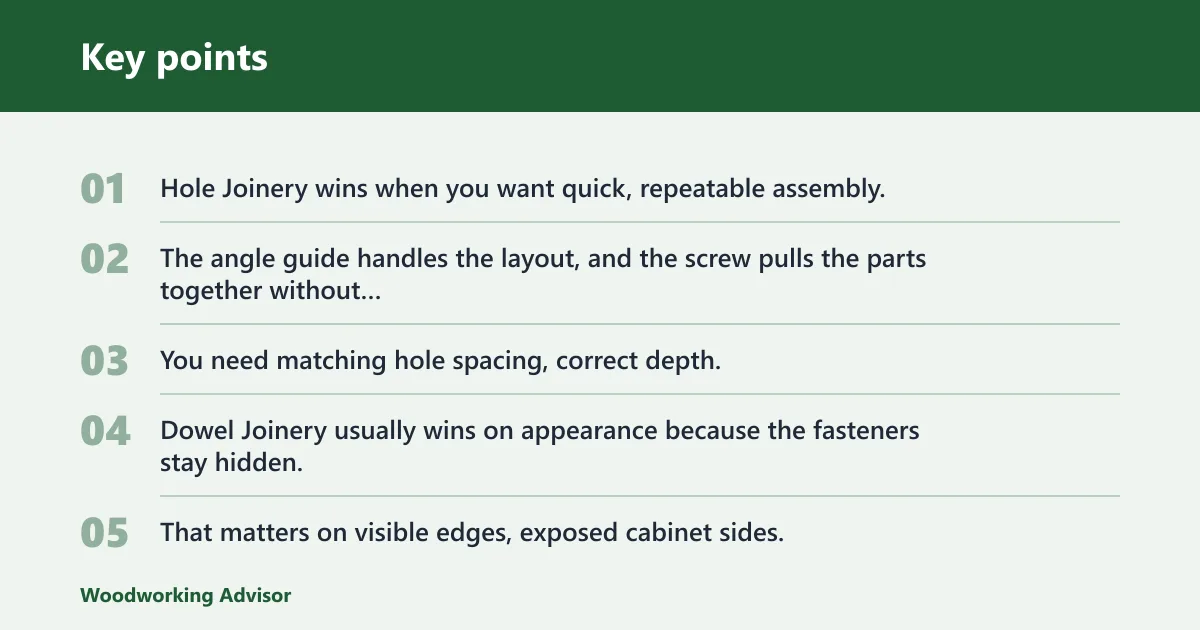
Hole Joinery wins when you want quick, repeatable assembly. The angle guide handles the layout, and the screw pulls the parts together without waiting for glue to carry all the load.
Dowel Joinery takes more setup. You need matching hole spacing, correct depth, and enough clamp pressure to close the joint cleanly while the glue sets.
Visibility and appearance
Dowel Joinery usually wins on appearance because the fasteners stay hidden. That matters on visible edges, exposed cabinet sides, and furniture with a cleaner outer face.
Hole Joinery is more utilitarian. It is often the better mechanical choice for hidden structure, but it can look out of place on fine visible work unless you are willing to plug and sand the holes.
Strength and failure risk
For pure glue-based joints, dowels usually compare well because the joint has more hidden bonding area than a screw-driven pocket connection. Woodgears reported average failure at 156 pounds for dowel joints and 99 pounds for pocket-hole joints in its test, which is a useful reminder that joint type and part geometry matter.
That does not mean dowels automatically win every furniture part. Hole Joinery can be very practical for aprons, face frames, and carcass parts, but end grain and screw pullout raise the failure risk when the design asks too much of the screw alone.
Movement and alignment
Dowel Joinery is better when you need tight alignment across a face, edge, or rail. The dowels locate the parts and help keep them flush while the glue sets.
Hole Joinery can clamp a joint fast, but it is a poor match for solid-wood tabletops that must expand and contract across the grain. A rigid screw attachment can fight that movement and create stress, splits, or seasonal distortion.
Which one fits each furniture part?
Legs, aprons, and rails
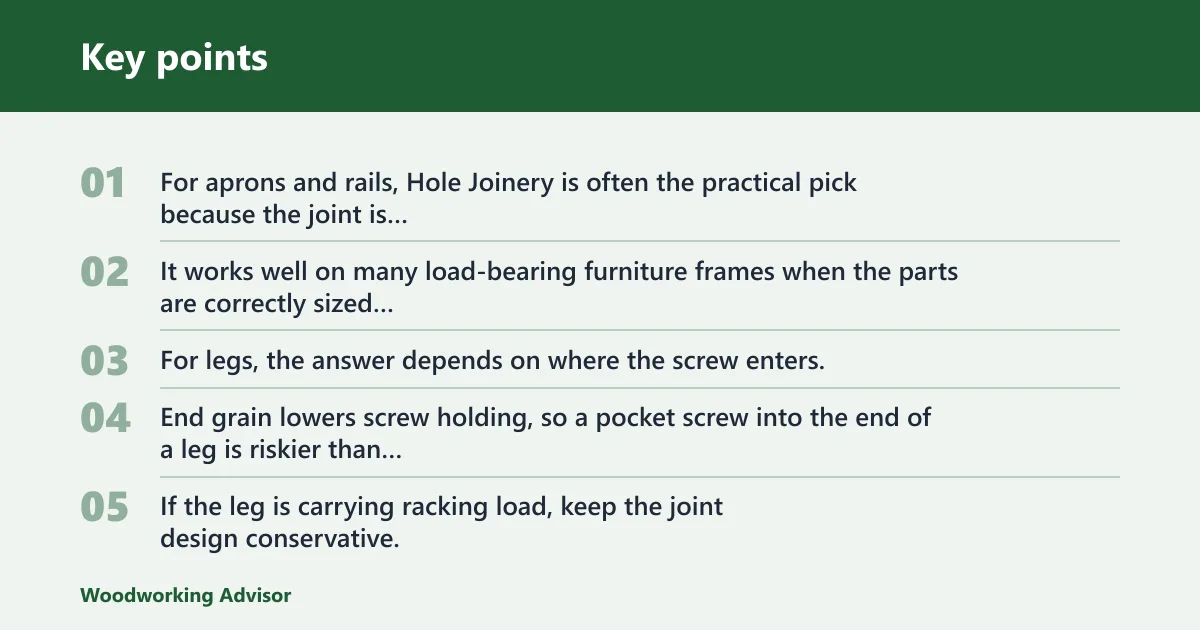
For aprons and rails, Hole Joinery is often the practical pick because the joint is usually hidden and speed matters. It works well on many load-bearing furniture frames when the parts are correctly sized and the screws are matched to thickness.
For legs, the answer depends on where the screw enters. End grain lowers screw holding, so a pocket screw into the end of a leg is riskier than a dowel joint or a different structural joint. If the leg is carrying racking load, keep the joint design conservative.
Face frames and cabinet carcasses
Will pocket holes work for face frames and cabinets? Yes. This is one of the classic uses for Hole Joinery, because the fasteners stay inside the build and the parts are often repetitive.
For plywood carcasses, Hole Joinery is often a strong fit for assembling stretchers, rails, and internal supports. Dowel Joinery can also work, but it takes more layout accuracy and more clamp discipline for a beginner to get consistent results.
Shelves, stretchers, and tabletops
Shelves and stretchers sit in the middle. Hole Joinery is fine for hidden shelf supports and internal stretchers when the load path is clear and the fasteners are not asked to resist big twisting forces on their own.
Tabletops are different. Classic Custom Wood Furniture calls tabletops a bad fit for pocket holes, and that matches the movement problem: solid wood needs room to move, so rigid screws are usually the wrong attachment method.
Pocket-hole tools and setup details
Jig setup and thickness settings
A pocket-hole jig is the main tool for pocket-hole joinery. Common consumer pocket-hole jig models include the 310, 320, K4, 520PRO, and 720PRO. Kreg also offers the Pocket-Hole Jig Micro for small projects and 1/2-inch material, and says it creates 33% smaller pocket holes.
Material thickness matters. Set the jig for the stock you are actually using, especially with common 3/4-inch furniture parts and 1/2-inch stock. If the setting is off, screw length and hole angle will be wrong too.
Screw type, length, and coating
Pocket-hole screws are not one-size-fits-all. Fine-thread screws are commonly used for hardwoods, while coarse-thread screws are commonly used for softwood and plywood.
Length must match stock thickness so the screw grabs the mating part without punching through. For corrosion resistance, zinc-plated screws are the basic option, Blue-Kote screws offer rust-resistance up to 400% greater than zinc-plated screws, and stainless pocket-hole screws suit maritime or highly corrosive environments.
Use interior-grade screws indoors and move to better corrosion resistance when the project will live outdoors or in a damp space. That choice matters more than brand color.
Why a face clamp matters
A face clamp keeps the parts flush during pocket-screw assembly. Without it, one board can slide higher than the other while the screw bites, leaving a step that is hard to fix later.
That clamp is not optional on visible edges or narrow frame parts. It helps control alignment while the screw pulls the joint tight.
Dowel tools and setup details
Self-centering jigs and drilling accuracy
A dowel jig is built to center the drill bit on the stock edge or face, which helps keep matching holes aligned. Straight-hole drilling is the point here, not angled entry.
Hole spacing accuracy matters as much as hole depth. If the spacing wanders, the joint may close with a gap or bind before the faces meet.
Why drill stops and spacing matter
Drill stops prevent holes from going too deep. That matters because a hole that bottoms out too shallow can starve the joint of glue space, while a hole that runs too deep can weaken the part.
Spacing errors also change the way the pieces register against each other. Dowel work rewards careful marking and repeatable drilling more than speed.
Glue, clamping, and cure time
Do dowel joints need glue to be strong? Yes. Glue is critical to the joint, and the dowels mainly help align the parts and add glued surface area.
Clamp the joint until the adhesive has had enough cure time to hold. Without that step, the parts can creep out of position before the glue has fully set.
Pocket hole and dowel joinery decision matrix
| Furniture part | Strength | Visibility | Movement tolerance | Tools required | Failure risk | Recommendation |
|---|---|---|---|---|---|---|
| Face frames | Good for hidden structural assembly | Low visibility on the inside | High enough for fixed frame work | Hole Joinery or Dowel Joinery tools | Low if clamped and sized correctly | Use pocket holes here |
| Cabinet carcasses | Good for assembly and squaring | Usually hidden | Moderate | Hole Joinery or Dowel Joinery tools | Low to moderate | Use pocket holes here |
| Visible side rails | Moderate | High | Moderate | Dowels need more layout precision | Moderate if holes show or misalign | Use dowels here |
| Solid-wood tabletops | Poor for rigid screw attachment | High if fasteners show | Poor for fixed attachment | Neither method is ideal as a rigid top attachment | High for split or seasonal movement | Avoid both here |
| End-grain leg connections | Risky for screw holding | Varies | Moderate | Dowels or a different joint system | High pullout risk | Avoid both here |
| Shelves and internal stretchers | Good when hidden and supported elsewhere | Low | Moderate | Hole Joinery or Dowel Joinery tools | Moderate if overloaded | Use pocket holes here |
Failure patterns to watch
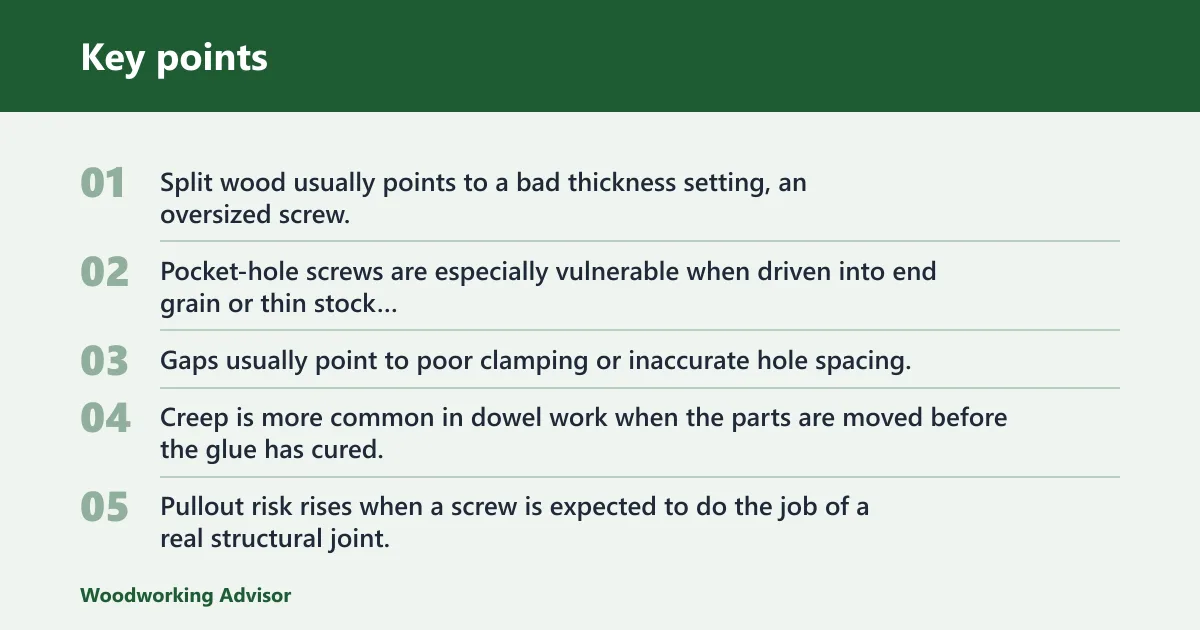
Split wood usually points to a bad thickness setting, an oversized screw, or a hole placed too close to an edge. Pocket-hole screws are especially vulnerable when driven into end grain or thin stock without enough margin.
Gaps usually point to poor clamping or inaccurate hole spacing. Creep is more common in dowel work when the parts are moved before the glue has cured. Pullout risk rises when a screw is expected to do the job of a real structural joint.
When should you choose pocket hole joinery instead of dowels?
Choose Hole Joinery when you want fast assembly, hidden fasteners, and repeatable work on face frames, aprons, cabinet parts, and internal stretchers. It is also the better beginner pick when you want fewer layout steps and less chance of misaligned drilling.
It fits mixed-material builds well, too. A plywood carcass with solid-wood face frames often benefits from a method that clamps quickly and does not demand a long glue setup.
Practical fit for beginners
A common first-timer mistake is using the same screw and jig setting on every board. That works poorly when the build mixes 1/2-inch stock, 3/4-inch parts, and different wood species.
For a beginner, Hole Joinery gives a shorter setup path, but only if the jig is set correctly and the screw length matches the stock thickness. A face clamp is part of that system, not an optional extra.
When should you choose dowel joinery instead of pocket holes?
Choose Dowel Joinery when the outside face matters, when you need strong hidden alignment, or when visible screw heads and plugs would spoil the look. It is a better fit for cleaner edges and for joints that depend on glue over fastener pull.
It also suits parts where careful drilling is already part of the plan. If you can control spacing, hole depth, and clamping, dowels give a neat and dependable glued joint.
Hidden joints with cleaner faces
Suppose you are building a small cabinet door frame from hardwood and want the outer faces clean. Dowel Joinery keeps the outside clear of screws, while still giving you a glued mechanical locator that helps the frame stay square.
That same part would look more utilitarian with pocket holes, especially if the holes are visible from the finished side.
Choose Hole Joinery if… / Choose Dowel Joinery if…
Choose Hole Joinery if you are building face frames, cabinet carcasses, aprons, or hidden internal stretchers; you want faster assembly; you are working with 3/4-inch furniture parts or similar stock; or you need a beginner-friendly method with fewer alignment steps.
Choose Dowel Joinery if you want cleaner outside faces; you are joining visible rails or edges; you can drill accurately and clamp well; or the joint depends more on glue and alignment than on fast screw pull.
Avoid both if the joint is a solid-wood tabletop attachment that needs room for seasonal movement, or if the connection depends on end grain holding a heavy load. In those cases, pick a joint designed for that job instead.

Frequently asked questions
Are pocket holes stronger than dowels for furniture?
Not as a blanket rule. Dowel joints often perform better in glue-based comparisons, while pocket holes can be plenty useful in hidden furniture structure. Strength depends on grain direction, part thickness, clamping, and whether the joint is carrying shear, alignment, or racking load.
Can I use pocket holes for table legs or tabletops?
Use caution with both. Pocket holes can work in leg assemblies only when the design keeps screws out of weak end grain, and tabletops are generally a bad fit for rigid pocket-screw attachment because solid wood moves seasonally across the grain.
Do dowel joints need glue to be strong?
Yes. Dowel joints rely on glue for real holding power, while the dowels mainly align the parts and add glued surface area. Accurate drilling and proper clamping matter because a dry dowel joint is far weaker than a glued one.
What tools do I need for pocket holes versus dowels?
For pocket holes, you need a pocket-hole jig, the right screws, and a face clamp. For dowels, you need a dowel jig, drill stops, glue, and clamps. The dowel setup asks for more layout accuracy, while the pocket-hole setup asks for careful thickness and screw matching.
Which joinery method is better for beginners?
Hole Joinery is usually easier for beginners because the jig sets the angle and the screw pulls the joint together fast. Dowel Joinery can turn out very well, but it demands more accuracy in drilling, spacing, and clamping to avoid gaps or misalignment.
Will pocket holes work for face frames and cabinets?
Yes. Face frames are a classic use case, and cabinet parts often suit pocket holes because the joints are hidden and quick to assemble. Use the right jig setting, clamp the parts flush, and match screw length to the stock thickness.
They can be, especially when the joint is glued correctly and the holes are drilled accurately. Dowel joints are a strong choice for hidden work that needs good alignment, but they are not a cure for poor design or for parts that should not be fixed rigidly, such as moving tabletops.
Sponsored / affiliate links. As an Amazon Associate I earn from qualifying purchases. I may earn additional commission from eligible campaigns.