1/4 Drill Bit In Mm: Exact Size Explained Clearly
Understanding Drill Bit Sizes


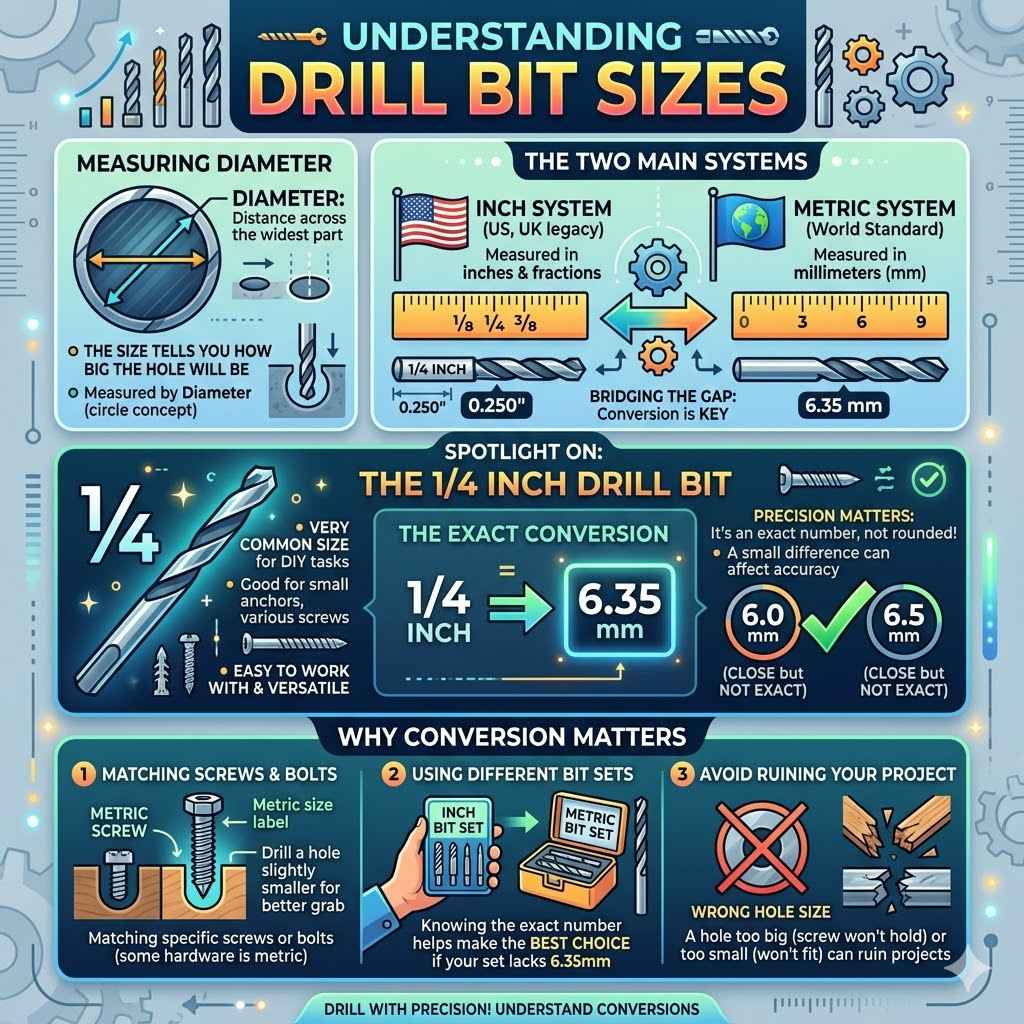
Drill bits come in many sizes. This is true for both inch and metric systems. The size tells you how big the hole will be.
It’s measured by the diameter. This is the distance across the widest part of the bit. Think of it like a circle.
The diameter goes through the center. It’s a very important measurement. Getting it wrong can cause problems.
A hole might be too big or too small. This can ruin your project. Or it might just not work right.
In the United States, we often use inches. This is a legacy of the past. Many other countries use millimeters.
This is part of the metric system. This system is very common worldwide. For most people, this is no big deal.
You use the tools you have. But sometimes, you need to bridge the gap. Maybe you bought tools from overseas.
Or you’re following instructions from a different country. That’s where knowing conversions becomes key.
The 1/4 drill bit is a very common size. It’s used for many DIY tasks. It’s a good general-purpose size.
You’ll find it in many tool kits. It’s perfect for many screws. It’s also good for small anchors.
This size is easy to work with. It’s not too big and not too small. This makes it very versatile.
But again, what does it mean in millimeters? Let’s get to that exact number.
The exact conversion of 1/4 inch to millimeters is 6.35mm. This is the number you need to remember. It’s a precise measurement.
It’s not a rounded number. So, a 1/4 inch drill bit is 6.35mm. This is important for accuracy.
When you’re drilling, even small differences matter. A bit that’s 6mm is close, but not the same. A bit that’s 6.5mm is also close, but not exact.
For many tasks, 6.35mm is the perfect fit.
Why is this conversion so important? Well, sometimes you need to match a specific screw or bolt. Some hardware is measured in millimeters.
If you need to drill a pilot hole for a metric screw, you need the right size. This screw might be labeled with its metric size. You need to drill a hole just slightly smaller than the screw’s threads.
This helps the screw grab well. If the hole is too big, the screw won’t hold. If it’s too small, you might not get the screw in at all.
Another reason is using different drill bit sets. You might have an inch set. You might also have a metric set.
If you need a 1/4 inch bit, and your metric set doesn’t have 6.35mm, what do you do? You might have to pick the closest size. But knowing the exact conversion helps you make the best choice.
You can see if 6mm or 7mm is closer. But ideally, you want that 6.35mm.
My First Encounter with Size Confusion
I remember working on a shelving unit for my garage. It was a pre-fab kit. The instructions were clear.
They listed the screw sizes. They even gave drill bit sizes. But the instructions were in metric.
I was more familiar with inch measurements back then. The instructions called for a 6mm drill bit. I looked through my drill bit set.
I had a lot of bits, but I only saw a 1/4 inch bit. I thought, “They’re pretty close, right? 1/4 inch is just a little bit bigger than 6mm.
It should be fine.”
So, I grabbed my 1/4 inch drill bit. I drilled the pilot holes. Then I started screwing in the shelves.
The screws went in, but they felt loose. They didn’t feel secure at all. I put some weight on the shelf.
It started to sag a bit. My heart sank. I realized my mistake.
The 1/4 inch bit was too large. It made the holes too big for the screws. The screws couldn’t grip the wood properly.
I had to take it all apart. I found a 6mm bit at a friend’s house. The new holes were perfect.
The screws were snug. The shelves were solid. That day taught me a valuable lesson about precise measurements.
It’s a common mistake, especially when you’re starting out. You see two numbers that look similar. You assume they are interchangeable.
But in precise work, they are not. Especially with things like pilot holes. The diameter of the hole really matters.
It affects how well fasteners hold. It can also affect how things fit together. Think about furniture assembly.
Or building anything that needs to be strong. Precision is key.
The experience with the shelves was frustrating. I had wasted time. I had also risked the whole unit falling apart.
It was a simple error. But the consequences felt big at the time. I learned to respect the numbers.
I started paying more attention to units of measure. I began to keep a small conversion chart handy. Especially for drill bits and screw sizes.
It saved me a lot of headaches later on. It’s about having the right tool for the job. And the right size tool is crucial.
Now, I always double-check. If instructions are in metric, I convert. If they are in inches, I convert.
This applies to everything from wood screws to machine bolts. It even applies to nails sometimes. Knowing that 1/4 inch equals 6.35mm is a fundamental piece of knowledge.
It’s a simple conversion. But it unlocks a lot of precision. It helps you avoid costly mistakes.
And it makes your projects turn out much better. It’s about working smarter, not harder.
Why Exact Size Matters: A Deeper Dive
Let’s talk more about why that 6.35mm is so important. Imagine you are building a cabinet. You need to attach the doors.
The hinges usually come with screws. These screws are often designed for a specific pilot hole. If the pilot hole is too large, the screw won’t have enough wood or material to grip.
This means the hinge could loosen over time. It might even fall off. This is a common problem in DIY projects.
And it often starts with the wrong drill bit size.
Conversely, if the pilot hole is too small, you might struggle to drive the screw. You could strip the head of the screw. Or you could break the screw itself.
This is especially true for smaller screws. You might even damage your drill. You’re putting too much stress on the motor.
This can shorten the life of your tool. So, the exact size really does matter. It’s not just about being picky.
It’s about making sure your work is strong and durable.
In the US, drill bit sizes are often in fractions of an inch. You’ll see sizes like 1/16, 3/32, 1/8, 3/16, 1/4, 5/16, 3/8, and 1/2 inch. These are standard sizes.
You’ll find them in most toolboxes. But they don’t always align perfectly with metric sizes. The metric system is based on powers of 10.
This makes conversions easier in theory. But when you’re dealing with tools made to imperial standards, you get these precise decimals.
Common Inch to MM Drill Bit Equivalents
Here’s a quick look at some common inch sizes and their millimeter equivalents. Notice how 1/4 inch is exactly 6.35mm.
- 1/16 inch: 1.59mm
- 3/32 inch: 2.38mm
- 1/8 inch: 3.18mm
- 5/32 inch: 3.97mm
- 3/16 inch: 4.76mm
- 7/32 inch: 5.56mm
- 1/4 inch: 6.35mm
- 9/32 inch: 7.14mm
- 5/16 inch: 7.94mm
- 11/32 inch: 8.73mm
- 3/8 inch: 9.53mm
The metric system is fantastic for science and engineering. It’s used by most of the world. This means if you’re reading plans or using hardware from outside the US, you’ll see metric sizes.
Even if you’re in the US, many specialized tools or components might be metric. Think about car repair. Or working with imported electronics.
You’ll encounter metric measurements.
So, when you see a 1/4 inch drill bit, think 6.35mm. This specific number is key. It’s not just “around 6mm” or “almost 6.5mm”.
It’s precisely 6.35mm. This is especially true for precision work. Things like woodworking, metalworking, or electronics often require this level of detail.
Even in home improvement, accuracy can make the difference between a good job and a great one.
What if you can’t find a 6.35mm bit? What’s the next best thing? Well, it depends on the application.
For general tasks where a little wiggle room is okay, you might use a 6mm bit or a 6.5mm bit. A 6mm bit is smaller. It will make a slightly tighter hole.
A 6.5mm bit is larger. It will make a slightly looser hole. For pilot holes for wood screws, a slightly tighter hole is often better than too loose.
However, for tasks where precision is paramount, like drilling for anchors or specific fasteners, you really want the 6.35mm. If you buy a set of drill bits, it’s worth checking if it includes fractional inch sizes. Or if it has a good range of metric sizes.
Many good quality sets will have both. Or they will have a comprehensive selection that covers the most common sizes in both systems. Investing in a good set of drill bits pays off.
It’s also worth noting that drill bit manufacturing can have tolerances. That means a bit labeled 6.35mm might not be exactly 6.35mm. But for most practical purposes, it will be very close.
Reputable brands usually have tight tolerances. This ensures consistency. When you’re buying tools, it’s generally a good idea to stick with well-known brands.
They tend to offer better quality and accuracy.
The Role of Standards in Tool Sizes
The reason we have these specific sizes is due to standards. Standards are agreements on how things should be made. They ensure that parts will fit together.
They also ensure consistency. For drill bits, there are international standards. These standards define the sizes.
They also define the materials and manufacturing processes. This is important for everyone who uses tools.
In the US, standards are often set by organizations like ANSI (American National Standards Institute). Internationally, the International Organization for Standardization (ISO) is very influential. These bodies help create the systems we use.
The fractional inch system is a long-standing standard in the US. The metric system is the international standard for most countries.
Understanding Drill Bit Markings
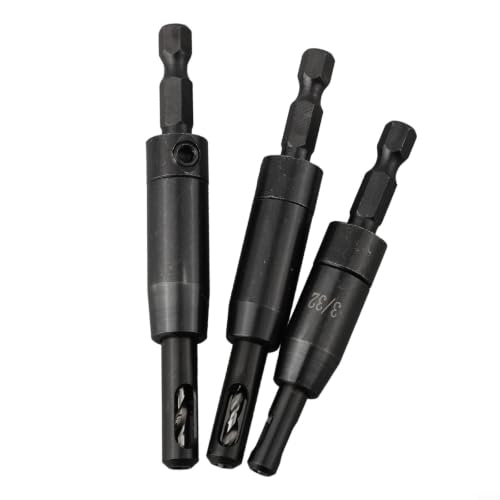
Most drill bits are marked with their size. Look closely at the shank (the part that goes into the drill chuck).
- Fractional Inch Bits: You’ll see markings like “1/4”, “3/8”, “1/16”.
- Metric Bits: You’ll see markings like “6mm”, “10mm”, “3.5mm”.
- Numbered Bits: Some sets use numbers (e.g., #1 through #80). These are also part of the US system.
- Lettered Bits: Some sets use letters (e.g., A through Z). These are also part of the US system.
Sometimes, you might see a decimal number with a fractional marking, like “1/4 (0.250)”. This is just the decimal equivalent of the fraction.
When you see a 1/4 drill bit, it’s usually part of the fractional inch system. The precise conversion to millimeters is 6.35mm. This isn’t an accident.
It’s how the system works. The metric system, on the other hand, is very logical. A 6mm drill bit is exactly 6 millimeters in diameter.
A 10mm drill bit is 10 millimeters. There’s no need for complex fractions or conversions.
This is why having conversion knowledge is so helpful. If you’re using a project plan that specifies metric sizes, you need to know how to translate that to your inch-based tools. Or if you’re buying hardware, and the screws are metric, you need to know what size pilot hole to drill.
You can’t just guess.
The US is one of the few countries that still heavily uses the imperial system. Many industries here have adopted metric for some applications. But for common tools and construction, inches are still prevalent.
This creates a constant need for conversion. It’s something most people learn to live with. But it can be a source of confusion.
Think about the different types of drill bits. There are twist bits, brad-point bits, spade bits, masonry bits, and more. They all come in standard sizes.
The size marking is always about the diameter of the hole it will create. So, regardless of the type of bit, a 1/4 inch bit will create a 1/4 inch (6.35mm) hole. The shape of the bit affects how it cuts.
But the diameter is always the stated size.
It’s always a good idea to have a reliable conversion chart or app handy. Especially if you work on projects that involve different measurement systems. Many smartphone apps can do these conversions instantly.
You can also find printed charts online or in hardware stores. Having this information readily available can save you a lot of time and frustration. It helps ensure your projects are built correctly and safely.
The standardization of tool sizes is a benefit to all users. It means that a 1/4 inch drill bit from one manufacturer should perform like a 1/4 inch drill bit from another. This allows for interchangeability.
It also allows for a predictable outcome. When you know the standard, you know what to expect. And knowing that 1/4 inch is precisely 6.35mm is part of understanding that standard.
Real-World Scenarios Where Size Matters
Let’s look at some practical examples. Imagine you’re hanging a heavy mirror. The mirror comes with mounting hardware.
This hardware might specify a particular drill bit size for the anchors. Often, the anchors are sized to fit snugly into the pre-drilled hole. If the instructions say to use a 1/4 inch drill bit, they mean that specific size.
Using a slightly larger bit could mean the anchor doesn’t hold. The mirror could fall.
Measuring Drill Bits Accurately
If you’re unsure about a drill bit’s size, you can measure it.
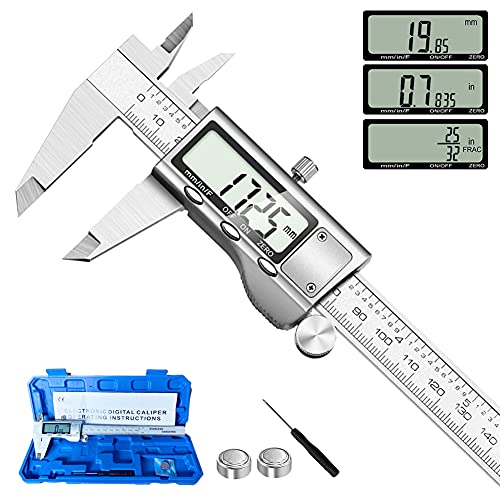
- Use a Caliper: A digital caliper is the most accurate tool. Measure the diameter across the widest part of the flutes (the cutting edges).
- Use a Ruler with Fine Markings: If you don’t have a caliper, use a ruler with millimeter markings. Be as precise as possible.
- Check the Packaging: If the bit is new, the size is usually printed on the packaging or the bit itself.
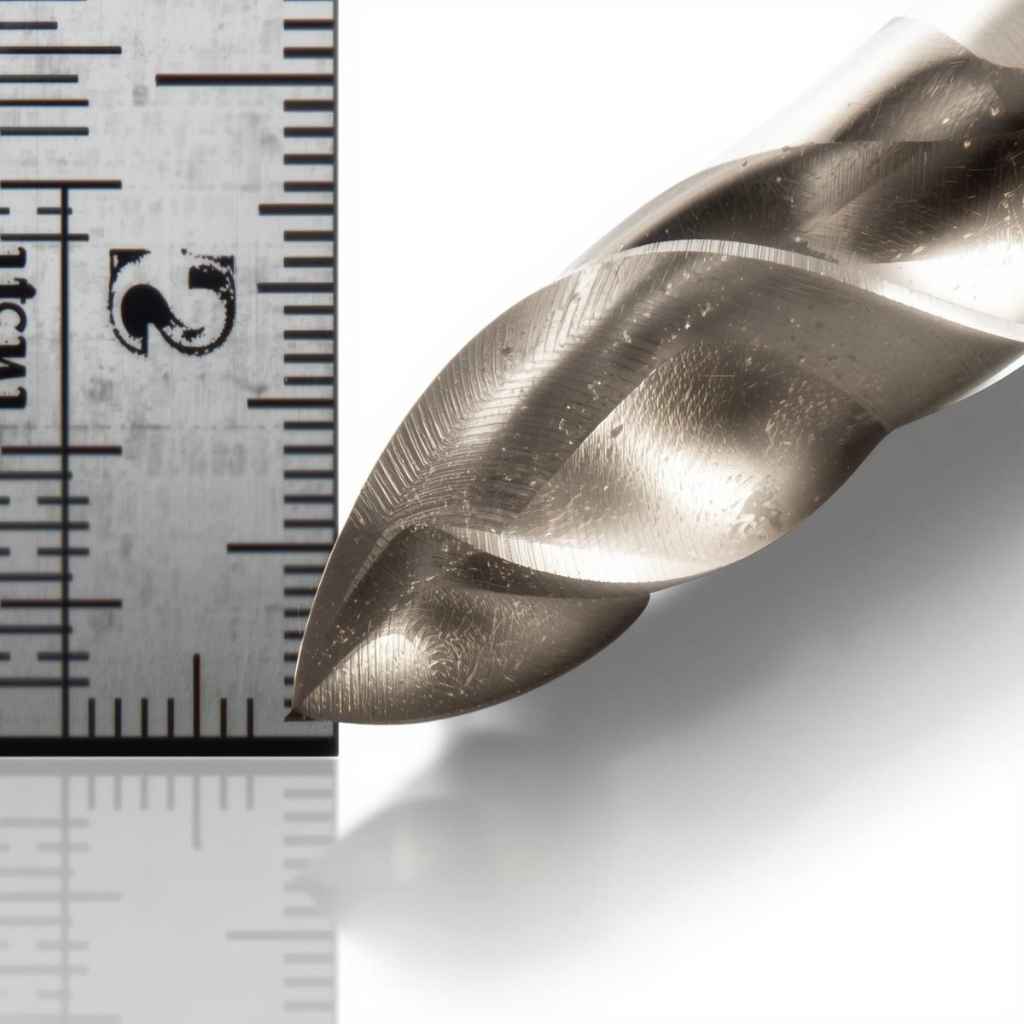
Remember that the tip of the drill bit might be slightly different from the shank. Measure the shank for the true diameter.
Another common scenario is assembling furniture. Many furniture kits, even those made in the US, might use metric hardware. You might find yourself needing to assemble something that requires a 6mm drill bit.
If your drill bit set only has fractional inch sizes, you’ll need to know that 1/4 inch is 6.35mm. A 6mm bit is slightly smaller. A 1/4 inch bit is slightly larger.
For many furniture assemblies, this difference can be significant. It affects how the pieces fit and how secure the final product is.
Consider building a deck. Deck screws are usually designed to be driven into pre-drilled pilot holes. The size of the pilot hole is crucial.
It helps prevent the wood from splitting. It also ensures the screw goes in straight. If the plans call for a 1/4 inch pilot hole for a specific type of screw, you need to use a 1/4 inch drill bit.
Using a 6mm or 6.5mm bit might lead to splitting or poor holding power.
What about electronics? In electronics, precision is often critical. Small components are mounted on circuit boards.
Sometimes, you need to drill small holes for mounting brackets or wires. These holes are often very precise. A 1/4 inch drill bit is quite large for most electronic applications.
But the principle is the same. If a specific size is called for, that’s the size you should use. The exact conversion from inches to millimeters is vital in these fields.
I once helped a friend build a custom computer case. He wanted to mount extra fans. The mounting holes for these fans were specified in millimeters.
We had to drill new holes in the case. I used my digital caliper to ensure the pilot holes were exactly the right size. We converted the fan screw size to its equivalent pilot hole size.
This attention to detail made the final build look professional. Everything fit perfectly. There was no wasted effort.
These examples show that the exact size of a drill bit is not just a detail. It’s a fundamental part of the construction and assembly process. Whether you’re building a shed or assembling a small gadget, using the correct drill bit size is essential for success.
The 1/4 inch to MM conversion (6.35mm) is a practical piece of knowledge for anyone who works with tools.
It’s also important to remember that drill bits wear down over time. The cutting edges can become dull. This can slightly change the effective diameter of the hole they create.
A dull bit might require more force to cut. It might also create a slightly larger hole than intended. This is another reason why maintaining your tools is important.
Sharp drill bits make for better, more accurate holes.
Choosing the Right Drill Bit Size
So, how do you know which drill bit size to choose? The first step is always to check your instructions or your hardware. If you’re using a specific screw or bolt, its packaging might tell you the recommended pilot hole size.
This is the most reliable way to determine the correct size.
If you’re drilling a pilot hole for a wood screw, there are general guidelines. The pilot hole should be slightly smaller than the screw’s minor diameter (the diameter at the bottom of the threads). This allows the wood fibers to be pushed aside by the screw.
This gives the screw good holding power. For most common wood screws, a 1/4 inch drill bit is a good size for screws that are around #10 or #12 in diameter.
Pilot Hole Size Chart (General Wood Screws)
This is a general guide. Always test on scrap wood if possible.
| Screw Diameter (Approx. US Gauge) | Recommended Pilot Hole Size (Fractional Inch) | Recommended Pilot Hole Size (Metric MM) |
|---|---|---|
| #6 | 3/32″ | 2.4mm |
| #8 | 7/64″ | 2.8mm |
| #10 | 5/32″ | 4.0mm |
| #12 | 3/16″ | 4.8mm |
| 1/4″ | 13/64″ to 7/32″ | 5.2mm to 5.6mm |
| 5/16″ | 7/32″ to 15/64″ | 5.6mm to 6.0mm |
Note: 1/4 inch drill bit (6.35mm) is often used for screws around #10 to #12, depending on the wood and desired hold. It’s slightly larger than ideal for a #10 but can work well for a #12 in softer woods.
If you’re drilling a hole for a bolt or a nut, the hole needs to be large enough for the bolt to pass through freely. Often, a hole the same size as the bolt’s diameter is recommended. So, if you’re using a 1/4 inch bolt, you might want a 1/4 inch (6.35mm) drill bit.
This allows the bolt to slide through without being too tight.
When using wall anchors, always check the anchor’s packaging. It will tell you the exact drill bit size required for installation. This is critical for the anchor to grip the wall securely.
Using the wrong size can lead to the anchor failing. For many common drywall anchors, a 1/4 inch (6.35mm) or 5/16 inch drill bit is used.
The key takeaway is to always refer to the specifications for the hardware you are using. If you are unsure, it’s better to err on the side of caution. You can always enlarge a hole if it’s too small, but you can’t easily make it smaller if it’s too big.
Testing on scrap material is also a very wise practice. This lets you see how the drill bit and fastener interact before committing to your main project.
Sometimes, you might need a size that’s not standard. For example, you might need a hole of exactly 6mm. If you only have fractional inch bits, you’ll need to find the closest equivalent.
In this case, 6mm is very close to 1/4 inch (6.35mm). However, if you need precisely 6mm, you’ll need a 6mm drill bit. This is where having a comprehensive set of both metric and imperial bits is really useful.
The system of drill bit sizes can seem a bit confusing at first. But once you understand the basic conversions and the reasons behind them, it becomes much clearer. Knowing that 1/4 drill bit in MM is 6.35mm is a fundamental piece of that understanding.
It opens the door to more accurate and successful projects. Don’t underestimate the importance of precise measurements in your work.
What This Means For You
So, what does all this mean for your projects? It means paying attention to detail. When you see a size, check the units.
Is it inches or millimeters? If you’re in the US, you’ll likely encounter both. If you see 1/4 inch, remember it’s 6.35mm.
This exact number can be crucial.
If you’re following instructions that use metric measurements, convert them to inches if you’re using inch tools. Or, if you have metric tools, use those. The goal is to match the specification as closely as possible.
For example, if a project calls for a 6mm hole, and you only have inch drill bits, you need to decide. A 1/4 inch bit (6.35mm) is slightly larger. A 7/32 inch bit (5.56mm) is smaller.
For many general purposes, the 1/4 inch bit might work, but it will make a slightly larger hole.
If a project calls for a 1/4 inch drill bit, and you only have metric drill bits, you’ll need to find the closest metric equivalent. 6mm is close, but smaller. 6.5mm is close, but larger.
For the most precise fit, you’d ideally want a 6.35mm bit. Many metric sets may not include this exact size. This highlights the value of having both types of drill bits available.
For most common DIY tasks, a slight difference might not matter. But for precision work, like attaching hardware where the fit is exact, or drilling pilot holes for specific fasteners, that 0.35mm difference can be significant. It’s the difference between a secure hold and a loose one.
It’s the difference between a perfectly aligned part and one that’s slightly off.
The key is to be aware. Be aware of the units you’re using. Be aware of the conversions.
And be aware of the purpose of the hole you’re drilling. Is it for a screw? A bolt?
An anchor? Each application has different requirements for precision. Don’t guess.
Always try to find the recommended size. If you can’t find the exact size, make an informed decision about the closest alternative. And always consider testing on scrap material.
This knowledge empowers you. It helps you avoid common pitfalls. It leads to better results.
And it makes your tool usage more efficient. So, the next time you see a 1/4 inch drill bit, you’ll know exactly what it means in millimeters: 6.35mm. This simple piece of information can make a big difference in your projects.
Quick Fixes and Tips
When you’re in a pinch and need a specific size, here are a few things to keep in mind:
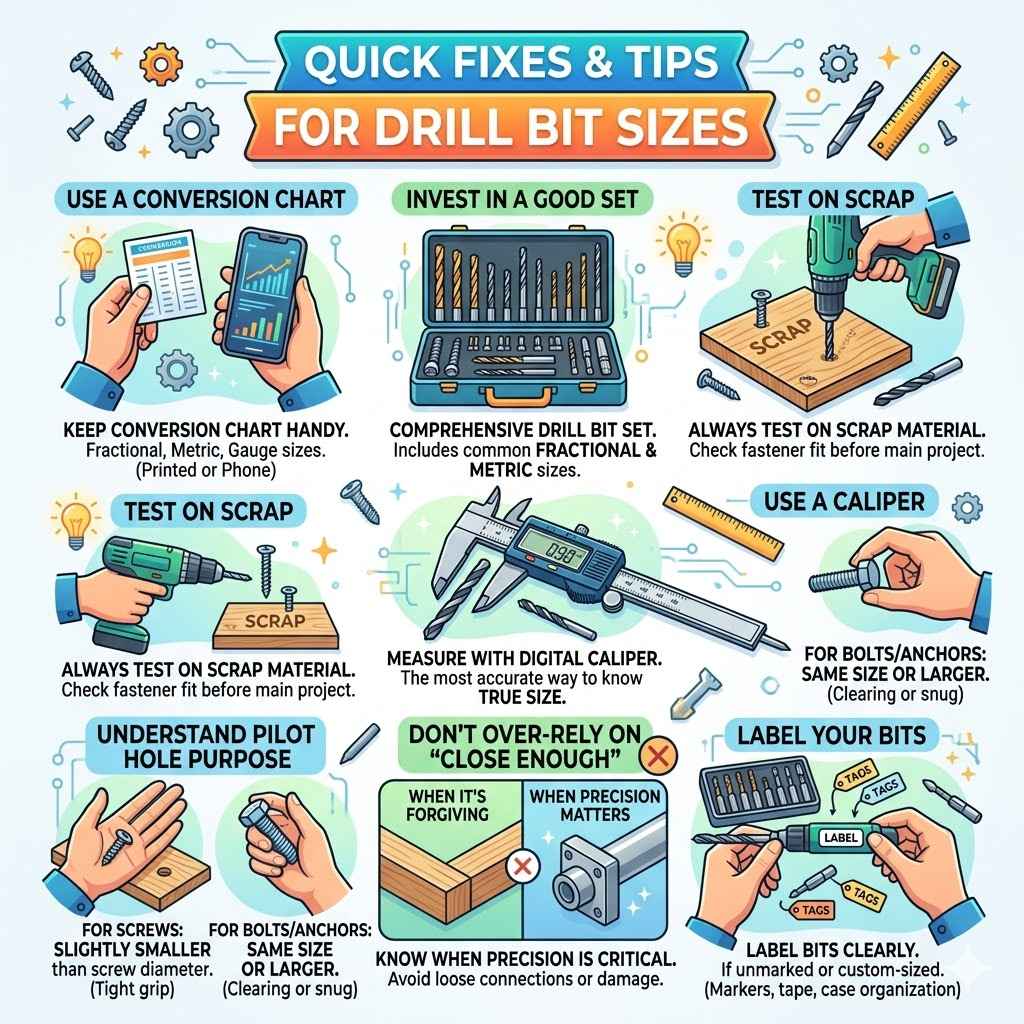
- Use a Conversion Chart: Keep a small conversion chart for drill bit sizes handy. This can be a printed card or a note on your phone.
- Invest in a Good Set: Consider getting a comprehensive drill bit set that includes both common fractional inch sizes and metric sizes.
- Test on Scrap: Before drilling into your main project, always test your drill bit size on a piece of scrap material. See how the fastener fits.
- Use a Caliper: If you have a digital caliper, use it to measure your drill bits. This is the most accurate way to know their true size.
- Understand Pilot Hole Purpose: Remember that pilot holes for screws are meant to be slightly smaller than the screw’s diameter. Holes for bolts or anchors might need to be the same size or even slightly larger.
- Don’t Over-Rely on “Close Enough”: While some applications are forgiving, others require precise measurements. Know when “close enough” is actually not good enough.
- Label Your Bits: If you have bits that aren’t clearly marked, or if you’ve created a custom size, label them clearly.
Frequently Asked Questions
What is the difference between 1/4 inch and 6mm drill bits?
The difference is small but can be important. A 1/4 inch drill bit is exactly 6.35mm. A 6mm drill bit is 6mm.
So, the 1/4 inch bit is 0.35mm larger than a 6mm bit.
Can I use a 1/4 inch drill bit instead of a 6mm drill bit?
For some applications, yes. It will make a slightly larger hole. This might be acceptable for general woodworking or pilot holes in softer materials.
However, for precision work, it’s best to use the exact size specified.
What is the millimeter equivalent of 1/4 inch drill bit?
The exact millimeter equivalent of a 1/4 inch drill bit is 6.35mm.
How do I measure a drill bit size if it’s not marked?
You can use a digital caliper for the most accurate measurement. Measure the diameter across the widest part of the cutting edge (flutes). A ruler with millimeter markings can also be used, but it’s less precise.
Why do drill bits come in so many sizes?
Different tasks require different hole sizes. From tiny pilot holes for small screws to large holes for bolts or pipes, a wide range of sizes is needed. This also accounts for both inch and metric measurement systems used worldwide.
Is 1/4 inch the same as 6.5mm?
No, 1/4 inch is 6.35mm. 6.5mm is slightly larger than 1/4 inch. The difference is 0.15mm.
Conclusion
Understanding drill bit sizes, especially the conversion between inches and millimeters, is essential for any DIYer or tradesperson. Knowing that a 1/4 drill bit is 6.35mm allows for greater precision in your projects. Whether you’re following plans, using specific hardware, or choosing a pilot hole size, accuracy matters.
This knowledge helps you avoid mistakes, ensure your work is strong and durable, and achieve professional-looking results.
Sponsored / affiliate links. As an Amazon Associate I earn from qualifying purchases. I may earn additional commission from eligible campaigns.