Redwood vs Fir for a Workbench: Which Lasts Longer?
Fir is often the better workbench choice for many builds because it tends to dent less, hold fasteners well, and be relatively stiff. Redwood can be a good choice for lightly loaded outdoor benches where moisture resistance matters more than screw strength. Poor lumber choice can lead to soft tops, loose joints, and a bench that racks or sags early. This guide compares redwood and fir for movement, dent resistance, fastener holding, and expected service life indoors, in a shed, and outside.
| Factor | Redwood | Fir For A Workbench | Winner |
|---|---|---|---|
| Rot resistance | Heartwood is naturally durable and better suited to moisture exposure; sapwood is less durable. | Needs protection from moisture; better chosen for dry, covered use. | Redwood |
| Dimensional stability | Commonly resists checking, cupping, warping, bowing, and sagging better in outdoor service. | Can be stable when dry and well sealed, but movement control depends more on build quality and moisture control. | Redwood |
| Dent resistance | Softer working surface; easier to mar under pounding, clamps, and sharp edges. | Generally better for impact, vise duty, and tool abuse. | Fir For A Workbench |
| Screw-holding | Acceptable in the right grade, but the softer wood can loosen sooner in heavily used joints. | Typically the better choice for legs, stretchers, and mechanical fastening. | Fir For A Workbench |
| Cost tier | Often higher for durable heartwood grades; sapwood grades are the lower-cost entry point. | Usually the value pick for structural bench parts. | Fir For A Workbench |
| Best-use scenario | Outdoor bench parts that need weather resistance more than abrasion resistance. | Indoor and shed benches, plus frames that need stiffness and strong fastener holding. | Depends on the part |
Redwood vs fir: the durability trade-off
For a workbench, the winning wood depends on which failure you want to delay. Redwood fights moisture better, especially in heartwood grades, while fir usually gives you a tougher surface and better fastening for frames, tops, and any joint that sees clamping or racking.
What fails first in a workbench: movement, dents, or fasteners?
The first failure is often part-specific. A top fails through dents and flattening; a frame fails through loosened joints or racking; a shelf fails through sagging or split fastener holes. Redwood helps most where weather and checking matter, while fir helps most where hardware and repeated impact matter.
Where redwood has the edge and where fir does
Humboldt Sawmill describes redwood fencing as a durable heartwood option and also offers economical sapwood grades. That split matters for benches because heartwood is the part you want in weather-exposed pieces, while sapwood belongs in lower-risk locations or covered builds. Fir is the safer default when the bench will take heavy pounding, repeated clamping, or vise mounting.
Workbench durability decision table
This table separates bench parts because each one fails differently. A frame needs stiffness and screw holding, a top needs dent resistance and flatness, and a shelf needs enough strength to avoid sagging under stored weight.
| Bench part | Redwood | Fir For A Workbench | Winner |
|---|---|---|---|
| Frame and legs | Best when moisture exposure is the main concern, especially with heartwood and protected joinery. | Better for stiff frames, tight joints, and mounting vises or stretchers. | Fir For A Workbench |
| Top and work surface | Good for a lighter-duty, weather-aware surface, but it marks more easily. | Better for pounding, clamping, and a surface that must stay serviceable longer. | Fir For A Workbench |
| Shelves and lower stretchers | Fine for protected storage parts, but not the first choice for heavily loaded spans. | Usually the better structural choice under stored tools and bins. | Fir For A Workbench |
| Outdoor exposure | Better natural decay resistance, especially in heartwood grades. | Needs a stronger finish and better moisture control. | Redwood |
| Long-term flatness | Can stay serviceable, but soft surfaces show wear sooner. | Usually holds up better where the bench sees repeated abuse. | Fir For A Workbench |
Frames and legs
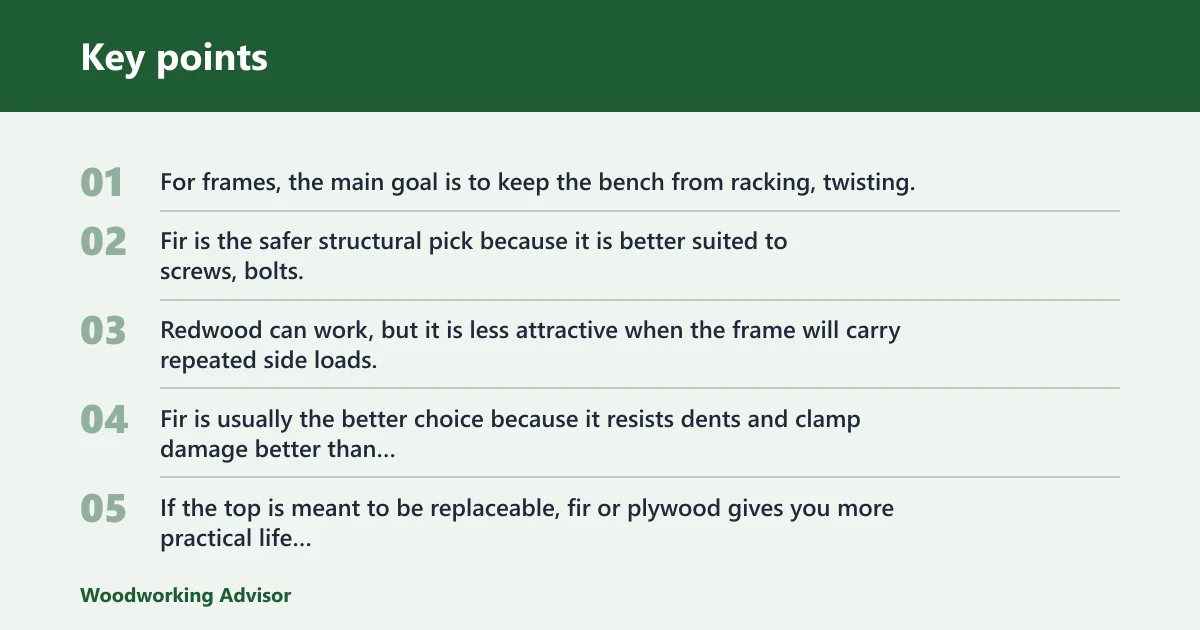
For frames, the main goal is to keep the bench from racking, twisting, or loosening at the joints. Fir is the safer structural pick because it is better suited to screws, bolts, and vise hardware. Redwood can work, but it is less attractive when the frame will carry repeated side loads.
Tops and work surfaces
The top sees the most abuse. Fir is usually the better choice because it resists dents and clamp damage better than redwood, which matters more than appearance on a bench top. If the top is meant to be replaceable, fir or plywood gives you more practical life before surface damage becomes annoying.
Shelves and lower stretchers
Lower shelves fail by sagging or by splitting around fasteners. Fir again has the edge because it handles structural loading better. Redwood is acceptable where the shelf is light duty and sheltered, but it is not the first pick for a storage-heavy bench.
Which wood moves less?
Redwood has the edge in dimensional stability, especially in heartwood grades, and that is why it is valued for fence boards, posts, and rails that need to resist checking, cupping, warping, bowing, and sagging. Fir can still be used in a stable bench, but it depends more on dry stock, good joinery, and a finish that limits moisture swings.
Redwood heartwood, sapwood, and grading
Heartwood is the grade you want when durability matters most. Redwood fencing is offered in heartwood grades, including Construction Common, Construction Heart, Clear Ridge & Valley, Premium, and Merch grades, and it is also sold in economical sapwood grades. For a bench, that means the better grades belong in exposed or load-sensitive parts, while sapwood is a weaker choice where wear and moisture are part of the job.
Douglas-fir and seasonal movement in bench parts
Douglas-fir is the relevant contrast species for structural bench decisions because it is used where stiffness and load support matter. In a dry shop or shed, that usually makes it the more practical choice for frames and tops. In a damp outdoor setting, however, fir needs more protection than redwood to stay flat and sound.
Which wood handles dents and clamps better?
Fir is the better pick when the bench top will take blows, bench dogs, vise pressure, and repeated clamping. Redwood’s softer surface is easier to mark, so it is a weaker choice for a top that will see heavy hand-tool work, machine setup, or constant hardware contact.
Bench tops, vise areas, and tool impact
A vise concentrates force in a small area, and that is where soft wood shows weakness first. Fir gives you better resistance around the jaws, edge banding, and dog holes. Redwood can still be used if you expect only light assembly work, but it is not the safer choice for pounding or hard clamping.
Screw-holding and fastener pullout in softwood
Fastener holding matters most in the joints that keep a bench square. Fir generally gives you a firmer bite for screws and bolts, so it is preferred for aprons, stretchers, and legs. Redwood can be adequate in low-stress joinery, but soft faces and repeated movement can loosen hardware sooner.
Say your 6-foot bench will hold a bench vise on one end and a bench dog row along the front edge. Fir is the safer top and frame choice because both features depend on strong screw holding and resistance to local crushing.
Can redwood work outdoors year-round?

Yes, but only in the right role. Redwood is the better natural option for weather exposure, especially when you choose heartwood grades and keep the bench off standing water. For year-round outdoor use, redwood is strongest as a moisture-resistant frame or shell, while the top still needs a realistic plan for wear and maintenance.
Rot resistance and weather exposure
Redwood’s advantage is decay resistance, not hardness. That makes it a sound choice for an outdoor bench that lives under a roof edge, in a yard, or beside a covered prep area. Fir can survive outdoors with protection, but it asks for more finish upkeep and more attention to end grain.
Pressure-treated Swedish redwood for frames
The indoor and outdoor wooden workbench is built from 94 x 44 mm pressure treated Swedish redwood and is stated at 950 kg load capacity. It is offered in 4ft, 5ft, 6ft, and 7ft lengths, with compact, standard, and large depths, and the height is listed at 90 cm on one product and 900mm on another. That combination shows redwood can be used in real bench frames when moisture resistance is part of the design.
When hardwood plywood is the better top
A hardwood ply top is often the better answer when you want a flatter, more replaceable working surface than a solid-wood top can provide. The separate workbench with hardwood ply worktop option points to that logic: use solid wood for the structure, then choose plywood for the surface if you care more about stability and easy renewal than a solid-wood look.
Suppose you are building an outdoor prep bench for a shed wall and you want it to stay usable after rain and seasonal changes. Redwood makes sense for the frame, but a replaceable hardwood ply top is the safer way to handle wear, spills, and future resurfacing.
What thickness of lumber is used for wooden workbenches?
Most wooden workbenches use lumber thick enough to resist racking, sagging, and fastener pullout, but the exact thickness depends on the design. The sourced bench example uses 94 x 44 mm pressure treated Swedish redwood, which is a practical frame size for a loaded bench rather than a thin decorative build.
Thickness by bench role
Frames and legs need more depth than shelves or skins because they carry the load. Tops often use thicker stock or a layered surface so they stay flat under clamping pressure. Shelves can be thinner, but only if the span is short and the stored load stays modest.
How much load can a wooden workbench support?
The stated capacity in the sourced example is 950 kg, and that figure is tied to the 94 x 44 mm pressure treated Swedish redwood workbench. That is a strong reminder that load rating depends on the full build, not only the species. Joinery, span length, depth, and moisture exposure all affect real-world durability.
Bench dimensions and configuration choices
The same bench family is offered in 4ft, 5ft, 6ft, and 7ft lengths, with compact, standard, and large depths. Those sizes matter because a longer or deeper bench needs better stiffness to stay square under load. A 900mm or 90 cm height is also common enough for general bench use, but the right height still depends on the task.
Choose Redwood if… / Choose Fir for a Workbench if…
Choose Redwood if your bench will live outdoors, under a roof edge, or in a damp shed and you care more about decay resistance than about surface toughness. Choose it for heartwood-heavy, weather-aware builds, and use it where movement control matters more than dent resistance.
Choose Fir For A Workbench if you need a bench that gets clamped hard, takes tool abuse, holds screws well, and stays rigid in daily shop use. It is often a better choice for frames, tops, and shelves in many indoor and garage builds, especially when the bench needs to support a vise or heavier loads.
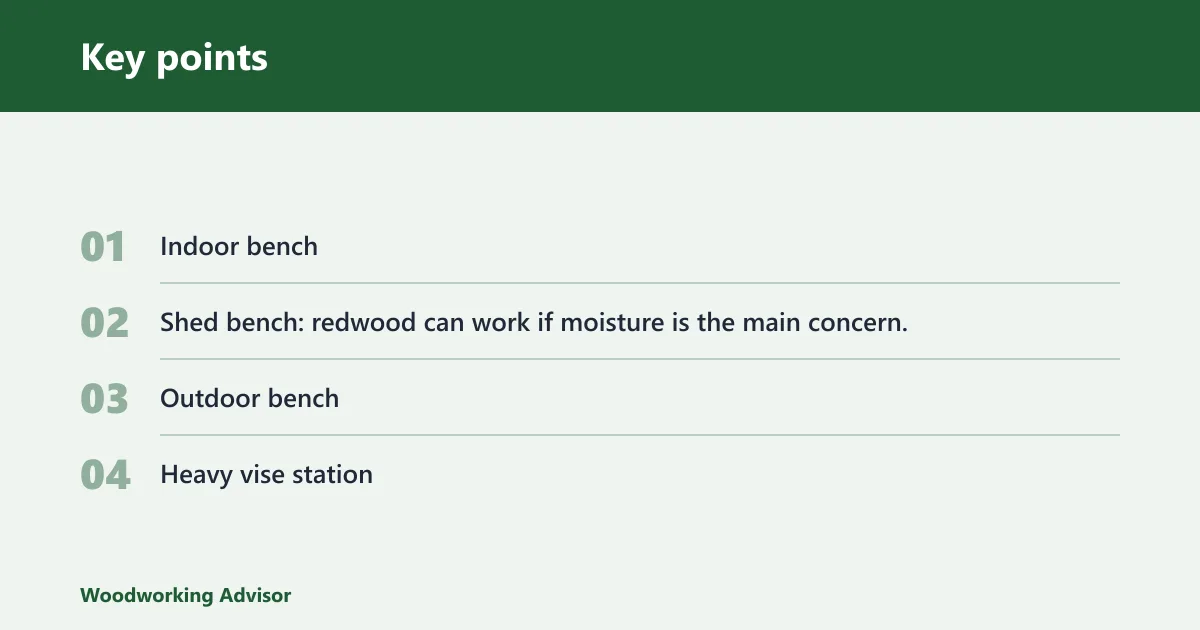
- Indoor bench: fir is usually the better pick for top, frame, and shelf because the main risks are dents, loosened joints, and rack.
- Shed bench: redwood can work if moisture is the main concern, but fir still wins for any part that takes hard use.
- Outdoor bench: redwood is the better body material, yet a hardwood ply top is often the more practical working surface.
- Heavy vise station: fir is the safer choice because fastener holding and crush resistance matter more than weather resistance.

Frequently asked questions
Is redwood or fir more durable for a workbench?
Fir is usually more durable for the parts that fail first under shop use: tops, frames, and joints. Redwood is more durable where moisture exposure is the main concern. For most workbenches, fir wins on service life because it handles dents, screw holding, and hardware loads better.
Will redwood resist warping better than fir on a bench top?
Usually yes, especially if you are using redwood heartwood. Redwood is known for resisting checking, cupping, and warping, and that helps in outdoor or damp settings. Fir can still stay flat if it is dry and well sealed, but it is not the better choice when moisture swings are severe.
Is pressure-treated redwood actually used for workbenches?
Yes. The sourced bench example uses 94 x 44 mm pressure treated Swedish redwood, which shows that treated redwood is a real bench material, not just a fence stock idea. It is most useful in frames for indoor-outdoor benches, BBQ tables, pizza tables, and potting tables where weather resistance matters.
Can a redwood workbench handle outdoor use year-round?
Yes, if you choose the right grade and protect the build details. Redwood heartwood is the better option for year-round exposure, and the bench should be kept off standing water and sealed at exposed ends. A hardwood ply top may still be a better service surface if you want easy replacement.
What wood is best for an indoor and outdoor workbench?
Fir is usually the best all-around answer for indoor and covered bench work because it is stronger for fastening and impact. Redwood is the better choice when the bench will see weather, especially in the frame. For many mixed-use builds, fir for structure and hardwood ply for the top is the practical split.
Should I choose a hardwood ply top instead of solid redwood or fir?
Choose hardwood ply when you want a flatter, more replaceable work surface. It is a strong option for a bench with a backboard or for any bench where wear, glue, and spills matter more than solid-wood appearance. Solid redwood or fir still makes sense for frames and edge parts.
Sponsored / affiliate links. As an Amazon Associate I earn from qualifying purchases. I may earn additional commission from eligible campaigns.