Gel Stain vs Traditional Stain: Which Is Better for Beginners?
For beginners, Gel Stain is usually better on cabinets, doors, trim, and any vertical or blotch-prone surface; choose Traditional Stain for open-pore, flat wood when you want faster color penetration. Using the wrong one can leave lap marks, blotches, uneven color, and extra sanding or stripping. This guide compares both stains by wood species, surface orientation, and finish condition, so you can match the product to a pine cabinet door, an oak tabletop, or a finished dresser before you open the can.
| Decision factor | Gel Stain | Traditional Stain | Winner |
|---|---|---|---|
| Application control | Thick, pudding-like consistency stays where you place it and is easier to manage on doors, rails, and profiles. | Watery, thin flow spreads quickly and can run or pool on vertical parts if you work too slowly. | Gel Stain |
| Grain reveal | Builds color on the surface, so grain reads more muted. | Soaks into wood fiber and usually shows more grain and figure. | Traditional Stain |
| Softwood blotch control | Better for pine, birch, maple, alder, and many cabinet doors with random density absorption. | More likely to blotch on the same woods unless prep is very careful. | Gel Stain |
| Drying and working time | Touch-dry time is listed at 8-12 hours, with a 24-hour recoat window, so you get more time to correct small errors. | Touch-dry time is listed at 1-4 hours, with a 2-4 hour recoat window, so you can finish faster but must avoid lap marks. | Traditional Stain |
| Coverage and small-project cost | Coverage is listed at 50-75 sq ft per pint, so it uses more product on the same surface. | Coverage is listed at 125-175 sq ft per pint, so it usually costs less per square foot. | Traditional Stain |
| Prep on existing finish | Can be used over an existing finish with proper preparation. | Usually needs raw wood or thorough sanding back to bare wood. | Gel Stain |
Gel stain vs traditional stain: the core trade-off
Gel Stain sits on the wood surface and is more forgiving, while Traditional Stain penetrates the wood fiber and usually shows more grain. That difference drives the choice: control and concealment on one side, speed and figure reveal on the other.
Beginners usually see the result before the chemistry. Gel gives you more working time on a vertical face, while liquid stain can make an oak top look more alive because it moves into the pores instead of lying on top.
One-sentence rule for choosing
If the project is vertical, blotch-prone, or already finished, start with Gel Stain; if the wood is raw, open-pored, and the goal is strong grain reveal, start with Traditional Stain.
Quick comparison table
This is the quickest way to separate the two. The table below focuses on the factors that matter most for a first project: control, look, prep, drying, and cost.
| Feature | Gel Stain | Traditional Stain |
|---|---|---|
| Consistency | Thick, pudding-like | Thin, watery |
| How it works | Sits on the surface | Soaks into wood fiber |
| Best grain result | More muted grain | Stronger grain and figure on open-pore hardwoods |
| Best surface condition | Previously finished wood, vertical parts, blotch-prone softwoods | Raw wood that has been sanded thoroughly |
| Drying | Slower, with more open working time | Faster, with a shorter working window |
| Coverage | 50-75 sq ft per pint | 125-175 sq ft per pint |
Application and control
Gel Stain is easier to place where you want it. That matters on cabinet doors, face frames, and furniture edges because the thicker body resists drips and runs better than a thin liquid.
Traditional Stain moves faster and demands a more even wipe-off. On a tabletop, that is manageable. On a door rail or a carved apron, it can become a race against lap marks.
Grain reveal and appearance
Traditional Stain wins when the wood itself should be the visual feature. On oak, walnut, cherry, and mahogany, the liquid can move into the pores and make the grain read more clearly.
Gel Stain can still look good, but it tends to mute the fiber pattern. That helps when the board looks uneven, and it gets in the way when the goal is to show figure.
Dry time, working time, and coverage
Gel Stain is slower. Its listed touch-dry time is 8-12 hours, and the recoat window is 24 hours. That slower pace gives beginners more time to correct uneven wipe-off on a door or trim piece.
Traditional Stain is quicker, with a listed touch-dry time of 1-4 hours and a recoat window of 2-4 hours. It also covers more area, at 125-175 sq ft per pint versus 50-75 sq ft per pint for gel, so small projects usually cost less per square foot with liquid stain.
Prep needs and finish compatibility
Traditional Stain wants raw wood or thorough sanding back to a bare surface. If the old finish stays in place, the stain cannot penetrate well, and the color often looks patchy or weak.
Gel Stain can go over an existing finish with proper preparation. That does not mean zero prep. The surface still needs cleaning, dulling, and enough tooth for the gel to hold evenly.
Which wood and surface type favors each stain?
Softwoods and many mixed-grain doors usually favor Gel Stain because the color sits more evenly on the surface. Open-pore hardwoods usually favor Traditional Stain because the pores accept pigment and give back more grain definition.
Surface condition matters as much as species. A previously finished dresser is a different job from a bare oak tabletop, and a laminate cabinet is a different job again.
Blotch-prone softwoods
Pine, birch, maple, and alder are commonly described as blotch-prone woods because they can absorb color at different rates across the same board. Many cabinet doors also behave this way because they combine panels, rails, and edges with different density patterns.
Gel Stain usually handles that uneven uptake better. Traditional Stain can still work, but it often needs a pre-stain wood conditioner and careful timing to reduce blotching.
Open-pore hardwoods
Oak, walnut, cherry, and mahogany are often described as classic Traditional Stain woods when the goal is to show deep grain and figure. Their open pores accept liquid stain well, which makes the final color read more naturally through the wood.
If the goal is a crisp, stained look with strong grain contrast, liquid usually has the advantage. If the goal is a more uniform color field, gel can still fit, but the grain effect will be softer.
Previously finished wood and non-wood substrates
Gel Stain is often the practical choice for previously finished wood, fiberglass doors, MDF, and laminate cabinetry when the right prep is possible. It can color over a sealed surface because it sits on top instead of relying on deep absorption.
Traditional Stain is usually the wrong choice on those surfaces unless you strip or sand to raw wood. On MDF and laminate, it generally has nowhere useful to go.
Why gel stain helps on cabinets and vertical surfaces
Gel Stain is usually easier on cabinet doors, face frames, and other vertical parts because it resists runs. Its thicker body gives you more control during wipe-off, which matters when the stain would otherwise drift into edges and corners.
It also helps on softwoods that absorb unevenly. That is why pine cabinet doors are a common first use case for gel instead of liquid.
Drip control on doors and face frames
On a vertical surface, gravity is part of the problem. Thin stain can slide into the bottom rail, sit in a profile, and darken one area more than the rest.
Gel Stain slows that process down. That makes it easier to get a consistent wipe and cleaner corner transitions.
Where gel still struggles on corners and profiles
Gel Stain is not magic. Deep profiles, sharp corners, and carved edges can still collect too much product and go darker than the flats.
It can also look too opaque if you apply it too heavily. The result may hide more grain than you wanted, especially on open-pore hardwoods where Traditional Stain would have read better.
Say your 30-inch cabinet door has raised edges and a center panel. If the door is pine and you want a more even brown tone, gel helps. If the same door is walnut and you want the figure to stand out, gel may flatten the look too much.
Does traditional stain show more grain?
Yes. Traditional Stain usually shows more wood grain because it penetrates the fiber instead of building mainly on the surface. On oak, walnut, cherry, and mahogany, that deeper uptake is often the reason people choose it.
That said, stronger grain reveal is not always the right outcome. If the board is softwood, uneven, or already finished, the same penetrating action can make the color look blotchy or weak.
When grain reveal matters more than easy application
Choose Traditional Stain when the project is a raw oak table top, a walnut shelf, or any other piece where the wood itself is the main feature. The stain helps the pores and figure read through the finish instead of hiding them.
If the surface is horizontal and raw, the faster dry time is usually an advantage rather than a problem.
When liquid stain looks uneven on softwoods
On pine, birch, maple, and alder, Traditional Stain can grab unevenly because the wood density changes from one area to the next. That creates dark spots, pale patches, and a less predictable result.
A pre-stain wood conditioner can reduce that problem, but it adds a step and does not guarantee uniform color. On very blotch-prone boards, Gel Stain is often the simpler first move.
Beginner decision matrix
This table gives the practical decision rule by project type, not just by species. Use it when you are choosing a first stain for furniture, cabinets, or trim.
| Project type | Wood or surface condition | Recommended stain | Why | Caution |
|---|---|---|---|---|
| Pine cabinet doors | Raw pine, vertical, blotch-prone | Gel Stain | Better control on doors and less blotching on softwood | Can go too opaque if applied too heavy |
| Oak table top | Raw, open-pore hardwood, horizontal | Traditional Stain | Shows grain and figure more clearly | Work in sections to avoid lap marks |
| Already-finished dresser | Sealed wood, scuffed but not stripped | Gel Stain | Can be used over an existing finish with proper preparation | Prep still matters; do not skip cleaning and dulling |
| MDF trim | Engineered surface with limited absorption | Gel Stain | Surface build works better than penetration | Test first; MDF can look uneven at cut edges |
| Stained furniture touch-up | Spot repair on previously finished wood | Gel Stain | Better for blending over existing color | Color matching is still tricky; test on hidden areas |
| Fiberglass door | Non-wood substrate | Gel Stain | Can color the surface with the right prep | Needs the manufacturer’s prep guidance; raw-wood rules do not apply |
| Laminate cabinetry | Very smooth, finished synthetic surface | Gel Stain | More suitable than liquid because it stays on the surface | Adhesion depends on cleaning and scuff sanding |
| Raw maple shelf | Blotch-prone hardwood, horizontal shelf | Gel Stain | Can reduce random absorption on a dense, tricky board | Traditional stain with conditioner is also possible if you want more grain |
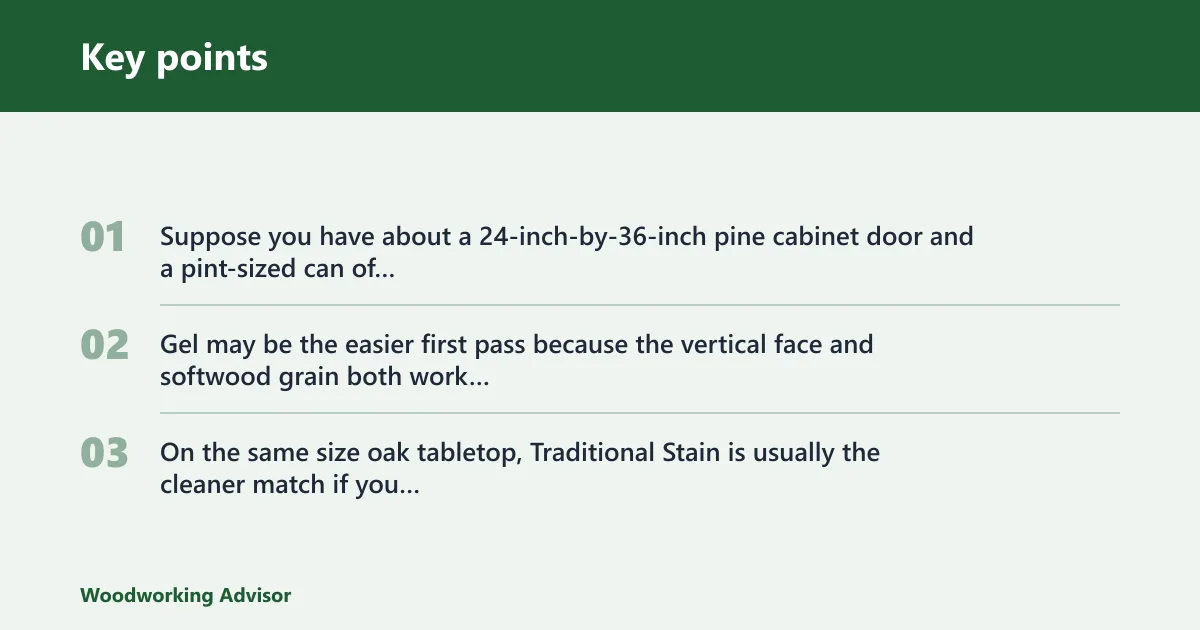
Suppose you have about a 24-inch-by-36-inch pine cabinet door and a pint-sized can of stain. Gel may be the easier first pass because the vertical face and softwood grain both work in its favor. On the same size oak tabletop, Traditional Stain is usually the cleaner match if you want the pores to stay visible.
Choose Gel Stain if… / Choose Traditional Stain if…
Choose Gel Stain if you are staining cabinet doors, trim, face frames, or any vertical surface; the wood is pine, birch, maple, or alder; the piece is already finished and you are not stripping to bare wood; or you want more control and less blotching than you get from a thin liquid stain.
Choose Traditional Stain if the wood is raw oak, walnut, cherry, or mahogany; you want maximum grain reveal; the surface is flat and easy to wipe evenly; or you want faster dry time and lower cost per square foot on a larger open-pore project.
If neither fit cleanly, stop and look at the substrate. A badly sanded board, a contaminated finish, or a laminate that will not hold prep is a prep problem first, not a stain-type problem.

Frequently asked questions
Is gel stain easier to use than traditional stain for beginners?
Usually yes, especially on vertical parts, softwoods, and previously finished furniture. The thicker body gives you more control and reduces run risk. Traditional Stain is still easy on flat, raw hardwood, but it asks for faster wipe-off and more attention to blotching on pine, birch, maple, and alder.
What is the difference between gel stain and regular stain?
Gel Stain sits on the wood surface instead of soaking in, while Traditional Stain soaks into the wood fiber. That difference changes nearly everything: grain reveal, blotch control, drying speed, and where each product works best. Gel is more forgiving on awkward surfaces; liquid usually looks more natural on open-pore hardwoods.
Can you use gel stain on pine or maple without blotching?
Often yes. Pine and maple are common gel-stain candidates because they can absorb liquid stain unevenly. Gel helps reduce that random uptake by sitting more on the surface. Prep still matters, though, and overly heavy application can make the result too opaque or muddy.
Can gel stain go over an existing finish?
Yes, but only with proper preparation. Clean the surface, dull the sheen, and make sure the finish is sound enough for the stain to grip. Gel Stain works well on previously finished wood, but it is not a fix for peeling coatings, wax contamination, or a damaged substrate.
Does traditional stain show more wood grain than gel stain?
Yes. Traditional Stain usually shows more grain because it penetrates the wood fiber and lets the pores and figure read through. That is why it is a strong match for oak, walnut, cherry, and mahogany. Gel Stain can still look good, but it typically mutes the grain more.
Do you need wood conditioner with gel stain or traditional stain?
Pre-stain wood conditioner is most useful with Traditional Stain on blotch-prone woods like pine, birch, maple, and alder. It can sometimes improve Gel Stain results too, but it adds a prep step and is not always necessary. Use it when the wood is likely to absorb color unevenly.
Which stain dries faster, gel or traditional?
Traditional Stain dries faster. Its listed touch-dry time is 1-4 hours, while Gel Stain is listed at 8-12 hours with a 24-hour recoat window. The faster dry time can help on large, open surfaces, but the slower gel working time is often easier for beginners on doors and trim.
Sponsored / affiliate links. As an Amazon Associate I earn from qualifying purchases. I may earn additional commission from eligible campaigns.