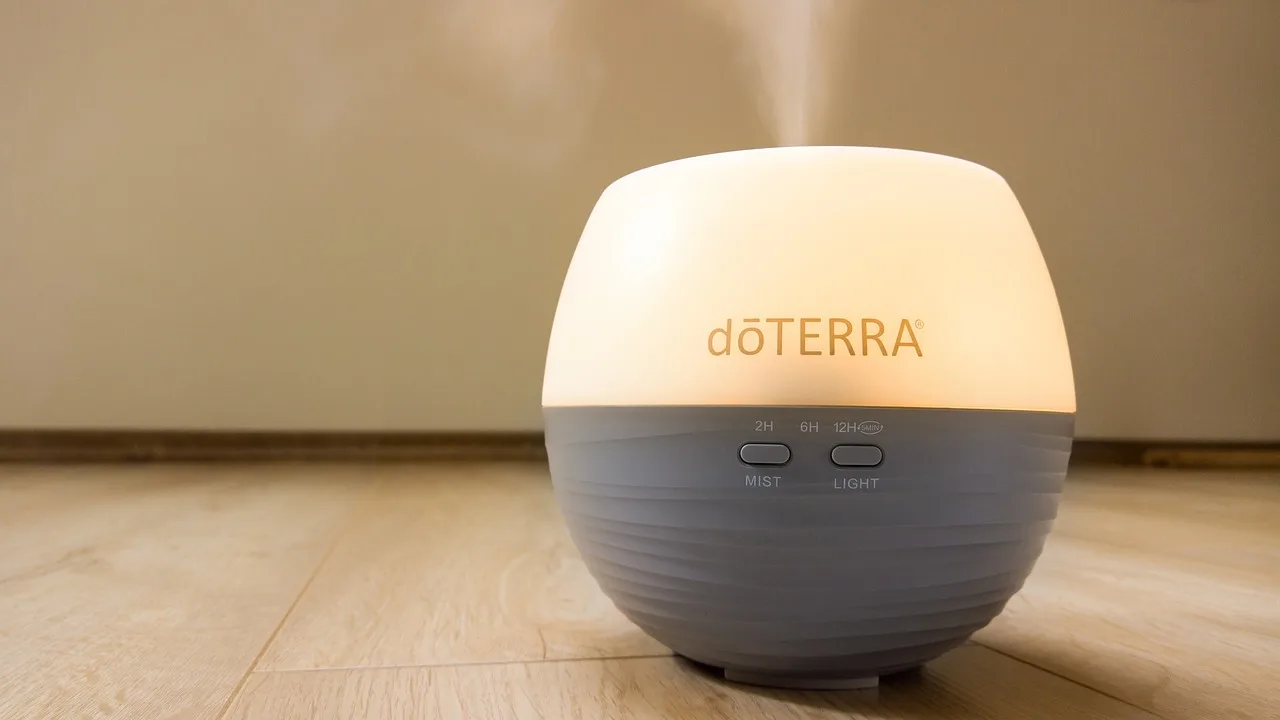
Humidifier on the Floor: Does It Damage Wood?
A humidifier on a wood floor usually will not damage the floor if it stays level, does not leak, and keeps indoor humidity in a moderate range, since damage usually comes from puddling, condensation, or air that stays too moist. Left alone, that can lead to cupping, swelling, staining, or ruined nearby furniture. This guide shows how to spot normal moisture, a leak, or over-humidification, and how to protect wood floors.
How mist and standing water damage wood floors

- Shows dry/comfort/wet air conditions
- Tracks humidity and temperature quickly
- Stores high and low readings
Why the floor is usually not the problem
A properly working humidifier will not damage wood floors on its own. The unit adds moisture to the air, and wood can handle normal indoor humidity swings. The floor becomes a problem when water collects in one place, the tank leaks, or the room stays damp long enough for the wood to absorb too much moisture.
That difference matters. Mist in the air is one thing. Standing water against wood is another. If the floor is dry and room humidity stays in range, the humidifier is usually not the cause of floor damage.
What changes when mist hits wood directly
Direct wetting is different from general humidity. When mist lands on the same patch of flooring over and over, or a unit blows toward trim or cabinets, the surface can stain, swell, or discolor. The risk is higher near seams, edges, and finish wear spots.
Cool mist and warm mist both add moisture. Cool mist units are often used in bedrooms and small rooms, while warm mist units add warm vapor that can condense if the unit sits too close to a cold surface. Neither type should be treated as safe simply because the mist is not liquid water.
Why standing water is a different risk
Standing water can soak into hardwood, veneer edges, baseboards, and trim far faster than ordinary room humidity. That is when cupping, warping, buckling, or staining becomes more likely. If you see a puddle under the unit, treat it as a leak or spill problem first.
What actually damages wood around a humidifier?
The main hazards are leaks, spills, condensation, and room humidity that stays too high. Those are the failure modes that can damage wood floors and wood furniture. A floor humidifier is not automatically the problem; the issue is whether water is collecting where wood can absorb it.
Leaks and spills
Reservoir leaks are the clearest risk. HomeSteady warns that problems can occur if the humidifier reservoir leaks, and HVACseer warns that the floor is too likely to spill. Fill method matters too. A tank that drips while refilling can wet the same spot every day, especially on hardwood.
Suppose a portable console unit is filled beside a living room oak floor and a small ring of water appears under the tank each morning. That is not normal mist damage. It is a leak or fill problem, and the floor needs to be protected or the unit moved.
Condensation on nearby surfaces
When humid air meets a cool wood surface, condensation can form. That matters near windows, exterior walls, cabinets, and furniture placed too close to the humidifier outlet. Repeated condensation can leave stains, encourage mildew, and cause finish failure before the wood itself looks swollen.
Over-humidification in the room
Too much moisture in the air can damage wood even without a visible spill. WoodThrive lists 30 to 50 percent as ideal indoor humidity, and HVACseer says about 40 percent is ideal. If humidity is above 60 percent, it is probably time to turn the humidifier off. A hygrometer tells you whether the room is actually too damp.
Humidifier floor placement and wood safety
Floor placement is sometimes acceptable, but it is not the best choice when you can avoid it. F1 says to avoid placing a humidifier near wood, including wood floors, furniture, trim, and cabinets. F3 recommends an elevated, non-wood surface like a side table or shelf, and F9 says to raise the humidifier at least 2 feet above the floor.
Cool mist vs warm mist
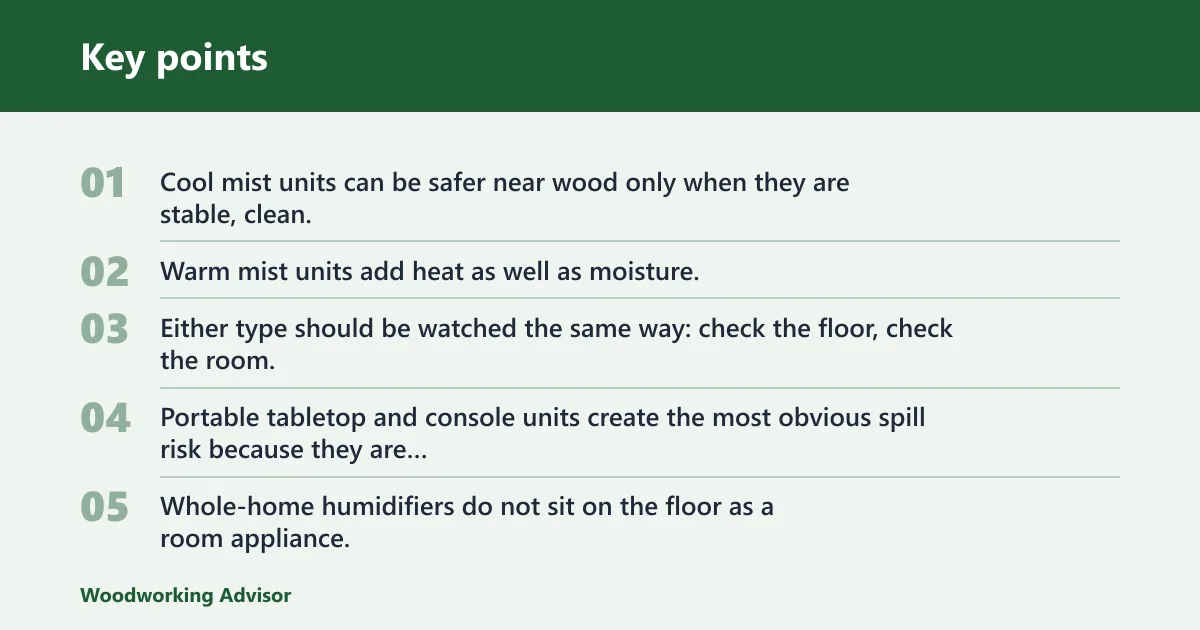
Cool mist units can be safer near wood only when they are stable, clean, and not aimed at surfaces. Warm mist units add heat as well as moisture, so nearby condensation can be more of a concern. Either type should be watched the same way: check the floor, check the room, and check the humidity.
Portable units vs whole-home systems
Portable tabletop and console units create the most obvious spill risk because they are refilled by hand. Whole-home humidifiers do not sit on the floor as a room appliance, but they can still over-humidify a space if they are set too high or if the system is not controlled well. The same wood damage modes apply: swelling, cupping, and mildew.
When a tray or barrier helps
If floor placement is unavoidable, use a plastic tray or drip tray with a raised edge under the unit. That barrier can contain small leaks and protect finished wood from short-term contact. HomeSteady suggests placing the humidifier on wood or a plastic tray as a barrier, but the tray should be large enough to catch drips and should stay dry under normal use.
When an elevated surface is better
An elevated, non-wood surface is safer when the unit has a history of leaking, when fill-ups are messy, or when you need better air circulation. A side table, shelf, or nightstand can reduce floor contact and can help spread mist away from the immediate wood surface. Avoid a wooden table if the unit can drip or sweat.
How humidity affects wood floors and furniture
Wood moves with moisture. Floors, furniture, and trim do not fail in the same way, but all can swell or distort if the air stays too damp. The safest target is usually 30 to 50 percent relative humidity, with about 40 percent as a practical aim. A hygrometer is what keeps that target from becoming guesswork.
Hardwood floor movement: cupping, warping, and buckling
Wood floors can cup when the edges rise higher than the center, warp when boards twist or bend, and buckle when moisture buildup pushes the flooring upward. These problems are more likely when humidity stays too high or when water enters from above. A single spill may only stain; repeated moisture can change the board shape.
Furniture risks: swelling, sticky drawers, and lifted veneer
Wood furniture reacts faster than many floors because it has joints, drawers, and thin finish layers. Swelling can make drawers stick. Veneers can lift at edges. Joints can loosen or split. Finish protection matters, but finish alone will not stop damage if moisture keeps entering from the air or from a nearby leak.
The same source recommends ideal indoor humidity at 30 to 50 percent, and F14 says about 40 percent is ideal. That range protects both hardwood floors and furniture better than a room that sits above 60 percent for long periods.
How to tell whether your humidifier is the problem
Start with the room, then the unit. A hygrometer tells you whether the air is actually too damp. Then check the humidifier itself for leaks, clogged parts, and tank seal failure. If the floor is wet, you need to know whether the source is the reservoir, the fill process, or the room humidity.
Use a hygrometer to check room humidity
A hygrometer measures relative humidity. Put it near the area of concern, not just across the room, so you can see whether humidity near the floor or near furniture is higher than expected. If the reading stays in the 30 to 50 percent range, the humidifier is less likely to be harming wood through airborne moisture alone.
Check for tank leaks, fill line overflow, and seal failure
Look under the tank, around the base, and along seams. Water at the same spot after every refill may point to a seal or fill issue. Mineral buildup can clog parts and make a unit spill or leak. If the unit has auto switch-off or a built-in humidistat, those features can help prevent overfilling or overuse, but they do not fix a bad seal.
Look for signs of condensation, residue, or mold
Moisture on the floor is one clue. Condensation on the unit, trim, or nearby furniture is another. White dust is usually a maintenance or mineral issue, not wood damage by itself, but it can leave residue where moisture settles. Musty odor, mildew, or visible mold means the room has stayed damp long enough to need attention.
Simple troubleshooting order
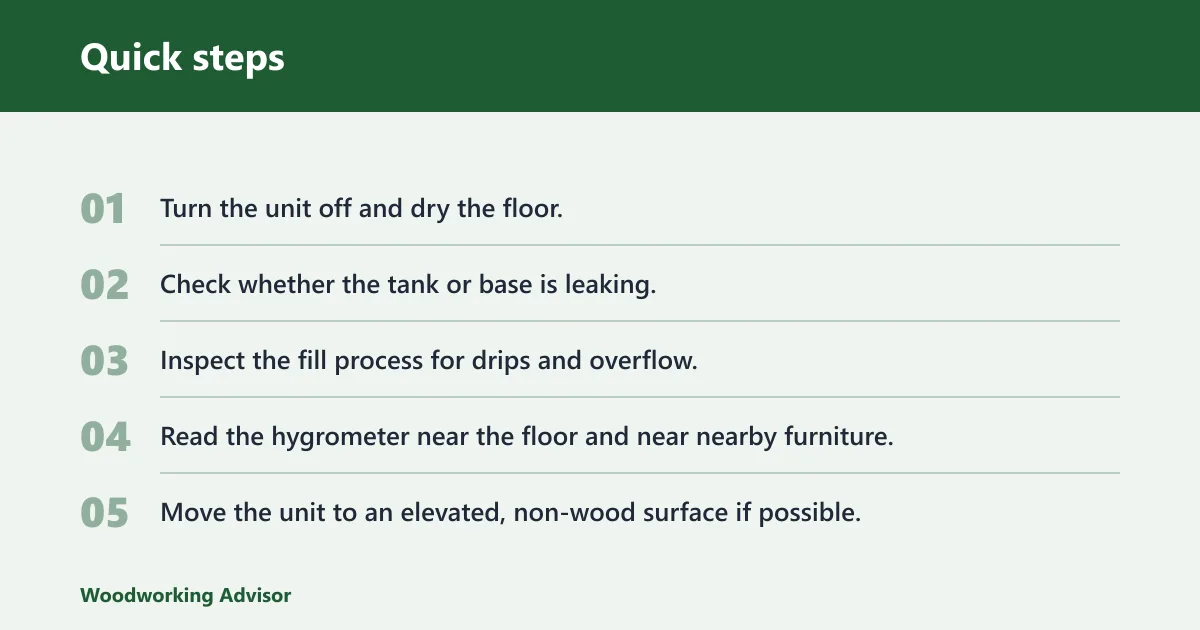
- Turn the unit off and dry the floor.
- Check whether the tank or base is leaking.
- Inspect the fill process for drips and overflow.
- Read the hygrometer near the floor and near nearby furniture.
- Move the unit to an elevated, non-wood surface if possible.
- Clean the humidifier and clear mineral buildup before restarting.
Moisture decision table
Is the humidifier harming wood or just wetting the floor?
| Symptom | Likely cause | Immediate fix | When to stop using the unit |
|---|---|---|---|
| Floor puddles after refilling | Fill spill, cracked tank, or base leak | Dry the area, refill more slowly, inspect seals and seams | Stop if water returns after each fill or the base stays wet |
| Cupped hardwood boards | Repeated moisture exposure from below or above | Lower humidity, stop direct wetting, dry the floor | Stop if cupping continues while the room stays damp |
| Musty smell near the unit | Standing moisture, mold, or mildew growth | Unplug, dry the area, clean the unit, check for hidden wet spots | Stop if odor returns after drying and cleaning |
| White dust on nearby surfaces | Mineral output or poor cleaning | Clean the humidifier, use the correct water type if recommended by the maker | Stop if residue is paired with wetness or visible buildup inside the unit |
| Sticky drawers in nearby furniture | High humidity or swelling in wood joints | Reduce humidity and move the unit away from furniture | Stop if drawers keep sticking at normal room use |
| Humidity above 60% | Over-humidification | Turn the humidifier off and recheck with a hygrometer | Stop until the room is back in the 30 to 50 percent range |
| Visible mold or mildew | Too much moisture in the air or on surfaces | Stop the unit, clean affected surfaces, dry the room | Stop immediately until the cause is fixed |
| Water beading under the tank | Condensation, tank crack, or seal failure | Check the base, gasket, and fill line; place on a tray if continued use is necessary | Stop if beading returns after inspection and drying |
| Floor finish looks stained but wood is still flat | Localized wetting or repeated condensation | Move the unit, dry the floor, protect the area with a tray | Stop if staining spreads or the wood begins to swell |
Frequently asked questions
Do humidifiers ruin wood furniture?
They can, but usually only if the room stays too damp or the unit leaks onto the furniture. Wood furniture is especially sensitive at joints, drawers, and veneer edges. Keep humidity near 30 to 50 percent, avoid direct mist, and place the unit away from tables, cabinets, and trim.
Can a humidifier on the floor damage wood floors?
Usually no, if the unit is level, leak-free, and the room stays in range. The risk comes from puddles, condensation, or humidity above 60 percent. A floor humidifier is safer with a tray under it, but an elevated non-wood surface is better when you have the option.
Can a humidifier cause wood to warp or cup?
Yes, if the moisture level stays too high or water repeatedly reaches the same spot. Hardwood can cup, warp, or buckle when it absorbs excess moisture. A hygrometer helps you catch the problem before the wood changes shape, especially near floors, trim, and furniture.
How far should a humidifier be from wood furniture?
A practical rule is to keep it far enough away that mist does not settle on the furniture. Avoid placing it near wood furniture, trim, or cabinets. F2 says a humidifier should sit about three feet from you for ideal circulation, and that spacing also helps keep mist off nearby surfaces.
What humidity level is safe for wood floors and furniture?
The same source lists 30 to 50 percent indoor humidity as ideal, and F14 says about 40 percent is ideal. A reading above 60 percent is a warning sign and usually means the humidifier should be turned off. A hygrometer is the easiest way to verify the room is still in range.
Should I use a tray under a humidifier on wood?
Yes, if the unit must sit on or near a wood floor. A plastic tray or drip tray with a raised edge can contain small leaks and protect the finish. It is a backup, though, not a cure. If the unit leaks often, move it or stop using it.
Sponsored / affiliate links. As an Amazon Associate I earn from qualifying purchases. I may earn additional commission from eligible campaigns.