Marine Plywood vs Pressure Treated Plywood: Rot Test
Marine plywood resists rot at the glue line and keeps its laminations intact under repeated wetting; pressure-treated plywood resists biological decay and insects better when the panel can dry and stay structurally sound. Pick the wrong one, and you can end up with swelling, delamination, soft panels, or early failure in a wet deck, dock, trailer, or shed floor. This guide compares both materials by exposure, fasteners, lifespan, and the service conditions where each one is the better buy.
| Factor | Marine Plywood | Pressure Treated Plywood | Winner |
|---|---|---|---|
| Rot mechanism covered best | Resists glue-line failure and panel breakdown under repeated wetting | Resists fungal decay and insect attack through preservative treatment | Tie |
| Water exposure behavior | Better at holding together during wet and dry cycles | Not automatically waterproof | Marine Plywood |
| Decay and insect resistance | Not chemically treated for decay resistance by default | Built for resistance to decay and insects | Pressure Treated Plywood |
| Fastener compatibility | Standard corrosion concerns only | Requires hardware compatible with preservative-treated wood | Marine Plywood |
| Best fit by exposure | Marine exposure, splash zones, repeated wetting | Above-ground outdoor exposure, ground contact, insect-prone locations | Depends on use |
| Need for sealing | Still needs sealing or a coating system in rot-prone service | Still needs finishing if the installation calls for it | Tie |
Why glue-line and decay failures differ in wet environments
The core trade-off is simple. Marine plywood is made to keep the panel intact when water reaches the glue lines; pressure-treated plywood is made to resist decay and insects when the panel faces a service environment that can still dry. Those are related problems, but they fail in different ways.
A panel can resist fungi and still come apart at the plies. It can also hold its bond and still decay if the wood is left unprotected in a wet, oxygen-rich environment.
How the two compare
Marine plywood usually wins when wetting and drying cycles threaten bond failure, swelling, or warp. Pressure-treated plywood usually wins when the main threat is biological decay or insect damage, especially in above-ground outdoor work or rated ground-contact applications.
Construction and bond quality
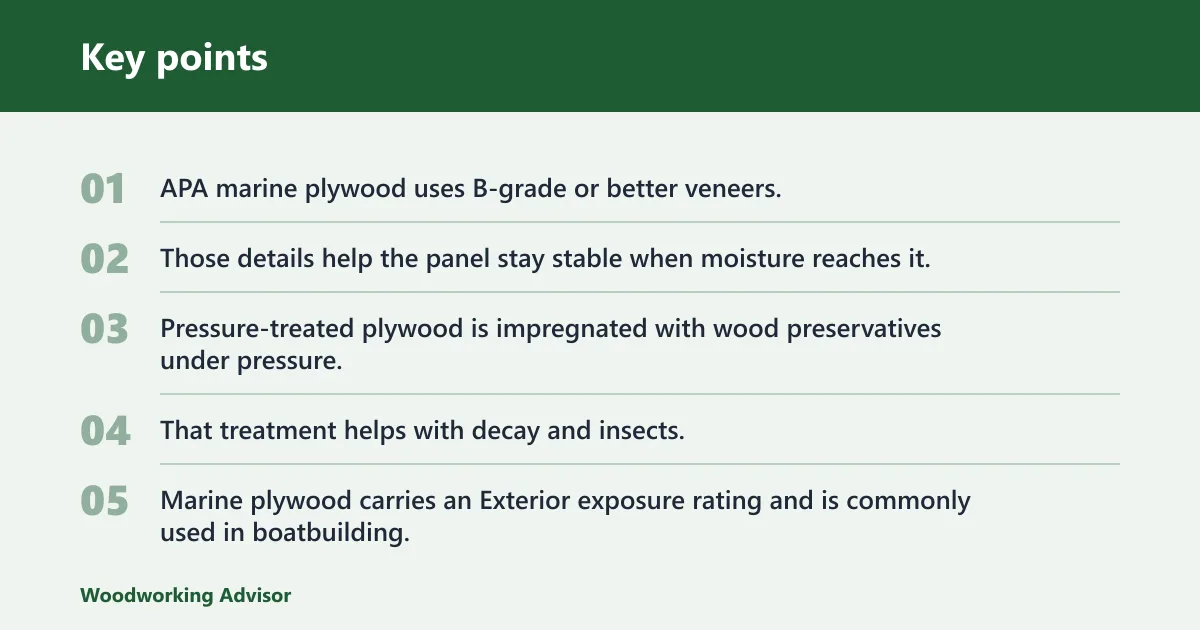
APA marine plywood uses B-grade or better veneers, a maximum permitted core gap of 1/8 inch, and a fully waterproof structural adhesive. It is also sanded on both faces. Those details help the panel stay stable when moisture reaches it.
Pressure-treated plywood is impregnated with wood preservatives under pressure. That treatment helps with decay and insects, but it does not guarantee the same glue-line durability or the same core quality that marine plywood is built around.
Exposure rating and end-use category
Marine plywood carries an Exterior exposure rating and is commonly used in boatbuilding. It is a panel choice for marine exposure and repeated wetting, not a promise that bare wood can sit wet forever.
Pressure-treated plywood is used where wood may face moisture, soil contact, insects, or marine environments. The treatment level depends on service conditions, so above-ground outdoor exposure and ground contact are not interchangeable categories.
Fasteners and corrosion risk
Pressure-treated plywood can be harder on fasteners and connectors because preservative chemistry can accelerate corrosion in the wrong hardware. Use compatible fasteners and connectors rated for treated wood, especially in damp locations or where the panel may stay wet.
Marine plywood does not create the same preservative-driven corrosion issue by default. That does not remove the need for good hardware, but it does remove one of the common complications of treated lumber assemblies.
Sealing and coating
Marine plywood still needs sealing or a full protective coating system in rot-prone service. Bare marine plywood can still decay if moisture is allowed to sit in the wood, end grain, or fastener penetrations.
Pressure-treated plywood is not waterproof just because it is treated. Paint or sealer can help slow moisture entry, but finishing does not turn an under-rated panel into the right choice for permanent wetting or boat-style exposure.
How marine plywood is built
Marine plywood is built for bond durability. APA marine plywood uses B-or-better veneers, a 1/8 inch maximum core gap, a fully waterproof structural adhesive, and a sanded face on both sides. Douglas-fir or Western Larch are commonly listed for APA marine plywood, which fits the need for harder woods with natural water resistance.
That construction helps the panel stay flat and stay bonded. It does not make the wood chemically decay-proof, and it does not mean the panel can be left bare in a rot-prone assembly without finish protection.
What APA marine plywood means
When you see APA marine plywood, check that it meets the veneer, core-gap, and exterior-rating requirements. The label is about construction quality and bond performance. It is not a substitute for proper coating, edge sealing, or smart detailing at joints and penetrations.
How pressure-treated plywood is built
Pressure-treated plywood is made by impregnating the panel with wood preservatives under pressure. That treatment improves resistance to decay and insects, which is why it is used in moisture-prone, insect-prone, and some ground-contact applications.
It is not automatically waterproof. It is also not a default solution for every outdoor assembly. The treatment level has to match the exposure category, or the panel can still fail early.
Above-ground and ground-contact treatment levels
Above-ground and ground-contact are different end-use categories. A panel rated for above-ground exposure should not be assumed suitable for direct ground contact. If the structure sits near soil, pooled water, or trapped moisture, the rating matters as much as the wood species.
That distinction is where many projects go wrong. A shed floor, dock substructure, or trailer deck may look similar on paper, but the service condition drives the correct panel choice.
Which resists rot better?
Pressure-treated plywood resists biological rot better when you mean fungal decay and insect attack. Marine plywood resists the kind of moisture-related failure that starts at the glue line and core, so it is better when repeated wetting threatens delamination, swelling, or warp. The better answer depends on which failure you are trying to prevent.
A common first-timer mistake is to treat “rot” and “water damage” as the same thing. They are not. A panel can stay bonded and still decay, or resist decay and still lose structural integrity at the plies.
Wet cycles versus biological attack
In splash zones and humid storage, the first problem may be glue-line breakdown. In soil-adjacent or insect-prone areas, the first problem may be decay or insect damage. That is why the right panel changes with exposure category, not just with the word “outdoor.”
Suppose a 4-by-8 utility rack is being built that gets sprayed by rain but is sheltered from soil. Marine plywood protects the bond better. If the same rack has feet sitting in wet gravel, pressure-treated plywood rated for that exposure is the better fit.
Which one should you use?
Use marine plywood for wet assemblies where the panel can get repeatedly damp but still needs to keep its bond and shape. Use pressure-treated plywood when decay and insect resistance are the main concern, especially in above-ground outdoor work or rated ground-contact work. For boat and dock parts, the exposure category decides the winner more than the label does.
Boat interiors and protected marine parts
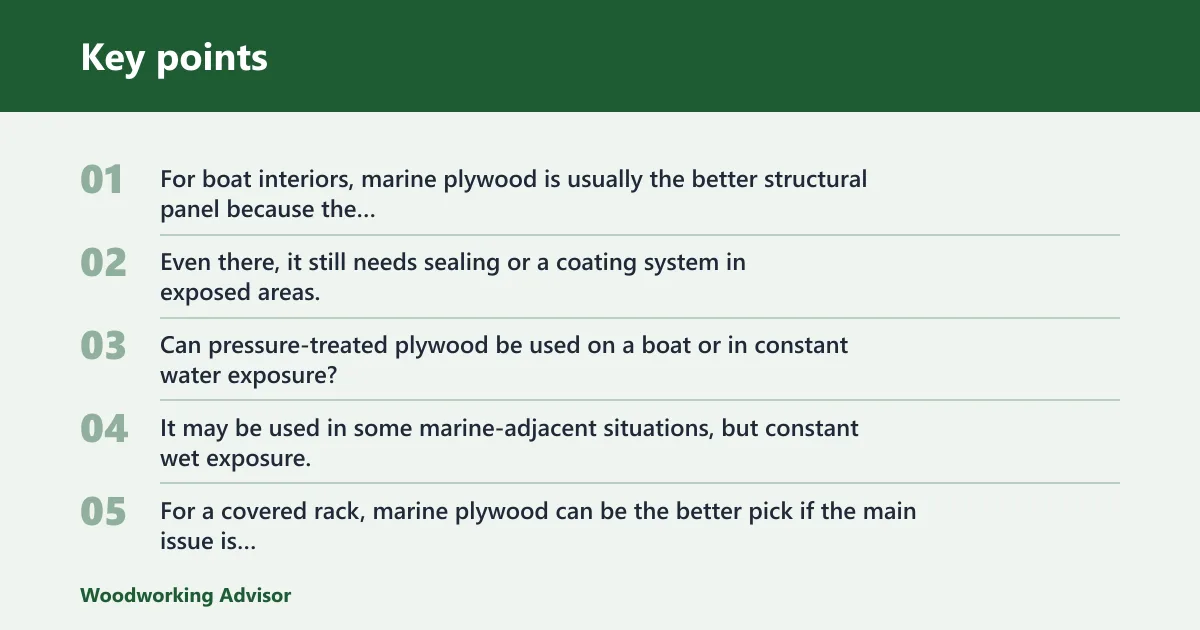
For boat interiors, marine plywood is usually the better structural panel because the bond quality and core control matter under repeated wetting and drying. Even there, it still needs sealing or a coating system in exposed areas, because bare plywood can still decay.
Can pressure-treated plywood be used on a boat or in constant water exposure? Not as a default answer. It may be used in some marine-adjacent situations, but constant wet exposure, poor drainage, and hardware compatibility make it a poor stand-in for proper marine detailing.
Covered outdoor racks and shed floors
For a covered rack, marine plywood can be the better pick if the main issue is intermittent wetting from wind-driven rain or condensation. For a shed floor or outdoor platform where the panel is more likely to face decay and insects than direct splash, pressure-treated plywood is often the more practical choice.
Will pressure-treated plywood work if it’s painted or sealed? Yes, if the finish matches the exposure and the panel is already rated for the service condition. Paint or sealer helps moisture control, but it does not replace the need for the right treatment level.
Dock framing and ground-contact framing
Which plywood is better for docks, decks, and outdoor framing? For framing and substructure, pressure-treated plywood usually has the edge when the panel is exposed to decay, insects, or ground contact. For deck skins, dock caps, or parts that see repeated wetting but not soil contact, marine plywood can be better at resisting bond failure.
Do not use a general outdoor panel where the service category calls for ground-contact treatment. If the assembly is near the ground, in contact with wet concrete, or subject to trapped moisture, the treatment rating must match the job.
Marine plywood decision matrix
This matrix turns the choice into six common service cases. The recommended material changes with rot mechanism, not with a generic “wet” label.
| Exposure scenario | Rot risk | Delamination risk | Fastener compatibility | Sealant requirement | Recommended material |
|---|---|---|---|---|---|
| Boat interior | Moderate if unsealed and poorly ventilated | High if repeated wetting reaches the panel | Marine-grade hardware preferred | Yes, seal and finish exposed edges | Marine Plywood |
| Splash zone | Moderate to high | High under wet-dry cycling | Corrosion-aware hardware needed either way | Yes | Marine Plywood |
| Covered outdoor rack | Moderate | Moderate if moisture gets trapped | Standard exterior hardware if kept dry | Recommended | Marine Plywood |
| Ground-contact framing | High | Moderate | Compatible treated-wood hardware required | Yes, but treatment rating matters more | Pressure Treated Plywood |
| Dock framing | High | High under repeated wetting | Corrosion-resistant connectors required | Yes | Depends on exposure rating |
| Humid storage area | Moderate | Moderate | Either can work with proper hardware | Recommended | Pressure Treated Plywood |
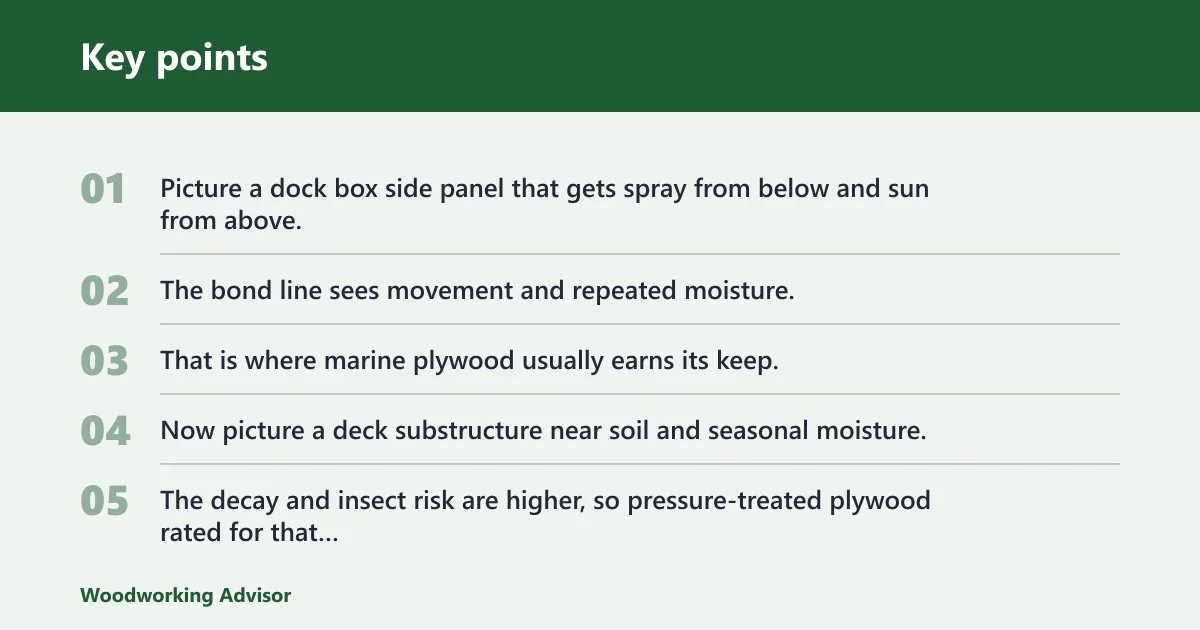
Picture a dock box side panel that gets spray from below and sun from above. The bond line sees movement and repeated moisture. That is where marine plywood usually earns its keep. Now picture a deck substructure near soil and seasonal moisture. The decay and insect risk are higher, so pressure-treated plywood rated for that exposure is the better buy.
Choose Marine Plywood if… / Choose Pressure Treated Plywood if…
Choose marine plywood if the panel will face repeated wetting, splash, or wet-dry cycling and better bond durability is needed. Choose it for boat interiors, splash-zone panels, covered marine parts, and any assembly where delamination is the failure you most want to avoid.
Choose pressure-treated plywood if the main threat is fungal decay or insects and the panel is rated for the intended exposure level. Choose it for above-ground outdoor framing, ground-contact work, humid storage areas, and places where preservative protection matters more than perfect glue-line durability.

Frequently asked questions
Is marine plywood better than pressure-treated plywood for rot resistance?
Not in every sense. Marine plywood is better at resisting bond failure and staying stable under repeated wetting. Pressure-treated plywood is better at resisting fungal decay and insects. If you mean biological rot alone, pressure-treated plywood usually has the edge. If you mean wet-service panel failure, marine plywood often wins.
Can pressure-treated plywood be used on a boat or in constant water exposure?
It should not be treated as a default boat panel or a constant-immersion panel. Pressure-treated plywood is not automatically waterproof, and treatment level has to match the service condition. For boat parts or continual wet exposure, the construction quality and finish system matter more than the treatment label alone.
Does marine plywood need sealing to resist rot?
Yes. Marine plywood is not chemically treated for decay resistance by default, so it still needs sealing or a full coating system in rot-prone service. The waterproof adhesive helps keep the plies bonded, but it does not stop wood decay if moisture stays in the panel.
Is pressure-treated plywood waterproof or just rot-resistant?
It is rot-resistant, not automatically waterproof. The preservative treatment improves resistance to decay and insects, but the panel can still absorb moisture and should be matched to the right exposure category. Paint or sealer can help, but it does not make the panel immune to wet-service problems.
Which plywood is better for docks, decks, and outdoor framing?
It depends on which part of the assembly you are building. For framing or ground-contact locations, pressure-treated plywood is usually the better fit if it is rated for that exposure. For dock skins, splash-zone parts, or repeated wetting, marine plywood often does better because it holds its bond more reliably.
What standards or grades should I look for when buying marine plywood?
Look for APA marine plywood with B-grade or better veneers, a maximum permitted core gap of 1/8 inch, an Exterior exposure rating, and a fully waterproof structural adhesive. Douglas-fir or Western Larch are commonly used. Those details matter more than a generic “marine” label on the shelf.
How much more does marine plywood cost than pressure-treated plywood?
There is no fixed ratio that holds everywhere. Price varies by thickness, species, panel quality, and market. The better way to compare cost is by use cycle: marine plywood may cost more up front, but it can be the better value where repeated wetting would otherwise shorten the life of a cheaper panel.
Will pressure-treated plywood work if it’s painted or sealed?
Yes, in the right exposure category. Paint or sealant can slow moisture entry and improve appearance, but it does not turn the panel into marine plywood or make an under-rated sheet suitable for every outdoor use. Match the treatment level first, then finish it for the environment.
Sponsored / affiliate links. As an Amazon Associate I earn from qualifying purchases. I may earn additional commission from eligible campaigns.