Best Wood for Wooden Cooking Utensils: 9 Species Ranked
The best wood for wooden cooking utensils is hard maple. It is dense, fine-grained and diffuse-porous, and hard maple (or an equivalently hard, close-grained wood) is the wood the FDA Food Code (2022 edition) names for utensils in food establishments. European beech matches maple on pore structure at a lower price, olive is the hardest wood in this comparison, and cherry is a good softer choice for spatulas. Skip softwoods such as pine and cedar, and open-pored woods such as oak and elm.
This guide ranks nine species using hardness, end-grain pore structure and toxicity data from The Wood Database, adds product picks that were checked for stock this week, and explains how to finish and care for your utensils. Two popular choices, teak and walnut, turn out to be less ideal for stirring than their reputation suggests. If you plan to finish raw wood yourself, start with our guide to making wood food safe.
Quick Answer
The best wood for wooden cooking utensils is hard maple, followed by European beech, olive and cherry. Walnut looks great but suits serving spoons better than stirring spoons, and teak, oak and elm are not recommended. Avoid softwoods like pine or cedar, and never use wood treated with paint, stain or varnish on the cooking end.
Utensil Wood Compared: Janka Hardness, Pore Structure & Food Safety
Hardness alone does not predict whether a wood is food-safe. Pore structure does the real work. A wood with small, diffuse (evenly scattered) vessels resists bacterial lodging even when it is relatively soft, while a harder wood with large, connected pores can actually be worse. Red oak makes the point physically: its earlywood pores are so open that if you blow into one end of a straight-grained piece, air comes out the other end. Every hardness, density and pore-structure figure below was pulled from The Wood Database‘s individual species pages on 2 August 2026, and the lumber prices are live per-board-foot quotes pulled the same day.
| Species | Janka Hardness | Pore Structure | Food-Safety Verdict | Toxicity / Allergen Note | Price / Board Ft¹ |
|---|---|---|---|---|---|
| Hard Maple | 1,450 lbf | Diffuse-porous, small-medium vessels | Best – industry standard | Sensitizer: skin irritation, runny nose and asthma-like effects reported (dust) | $6.00 |
| European Beech | 1,450 lbf | Diffuse-porous, small-medium vessels | Excellent – ties maple on pore size | Sensitizer – eye/skin/respiratory; rare nasopharyngeal cancer risk with unprotected occupational dust exposure | $12.25² |
| Olive | 2,710 lbf | Diffuse-porous, small-medium vessels | Excellent – hardest of the group | Sensitizer – eye/skin irritation | $37.00³ |
| Black Cherry | 950 lbf | Semi-ring-to-diffuse-porous, small-medium vessels | Good – softer, still closed enough | Sawdust linked to wheezing (dust exposure only) | $4.95 |
| Black Walnut | 1,010 lbf | Semi-ring-porous, large-to-very-large earlywood vessels | Caution – more open-pored than its reputation suggests | Sensitizer – eye/skin | $14.25⁴ |
| Teak | 1,070 lbf | Ring/semi-ring-porous, large-to-very-large earlywood vessels, up to 1.4% silica | Not recommended despite common praise | Sensitizer – eye/skin/respiratory; documented asthma-like symptoms | $25.00⁴ |
| Red Oak | 1,220 lbf | Ring-porous – very large earlywood pores run end to end | Avoid | Sensitizer – eye/skin/asthma-like | $4.50⁴ |
| American Elm | 830 lbf | Ring-porous, large-to-very-large earlywood vessels | Avoid | Sensitizer – eye/skin | $3.95⁴ |
| Eastern Red Cedar | 900 lbf | Softwood; aromatic, resinous, very fine texture | Avoid – not a hardwood | Skin/respiratory irritant; aromatic oils can taint food flavour | $7.50² |
Sources: Janka hardness, average dried weight, pore structure and toxicity notes from The Wood Database individual species pages (all accessed 2026-08-02), using its own end-grain vessel descriptions. ¹ Prices are live per-board-foot quotes in the under-10-board-foot retail tier, 4/4 thickness unless noted, from Bell Forest Products (accessed 2026-08-02). ² European beech and eastern red cedar are quoted from The Wood Yard’s published list; the beech figure is a 16/4 cut, a thicker and pricier grade than the 4/4 used elsewhere in this table, so treat it as directionally comparable rather than a like-for-like number. ³ Olive is 5/4 Italian live-edge rough – the 4/4 grade was out of stock at the time of the quote. ⁴ Walnut, teak, red oak and elm are quoted from published retail lists in the same under-10-board-foot tier. Lumber prices move with the market and vary 20-30% by region; verify before ordering.
The correction this table makes: most “best wood for utensils” guides rank by hardness, or repeat “hardwood equals safe” without ever checking pore structure. That rule breaks twice here. First, teak – recommended by several competing guides – is ring to semi-ring-porous with large-to-very-large earlywood vessels and up to 1.4% silica, which puts it structurally closer to oak than to maple. Second, black walnut‘s earlywood pores also run large to very large, which makes it a better fit for serving pieces and display spoons than for a spoon that sits in a simmering pot for twenty minutes. Maple and beech, neither of them the hardest wood on this list, are the two that actually close the door on bacteria.
Best Maple Utensil Pick
|
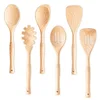
Gudamaye 6-Piece 12-Inch Hard Maple Wooden Spoon Set – $31.99 If you want the species the data backs most, start with a maple set like this one.
|
Benefits Of Wooden Cooking Utensils
Wooden utensils are gentle on cookware: wood is softer than metal, so a wooden spoon will not scratch nonstick or enamel the way a metal one can. Wood is also a poor conductor of heat, so the handle of a spoon left in a simmering pot stays far cooler than a metal handle would. With sensible care (hand washing, quick drying, occasional oiling) a good set lasts for years. Our guide to washing wooden utensils covers the routine in detail.
Wood is also non-reactive with acidic ingredients such as tomato sauce, unlike some bare metals. The catch is that the wood must be dense and tight-grained enough to wash and dry well, which is what the species comparison above is for.
Factors To Consider
Density matters because denser wood absorbs less water and resists dents. Hardwoods such as maple and beech fit the bill, while softwoods like pine dent easily and can carry resin.
Grain matters too. Maple and beech are fine, even-grained woods that wash clean easily, while coarse, open-grained woods can hold on to food residue and moisture (the pore-structure section below explains why).
If sustainability matters to you, buy utensils that name the species clearly and, where available, carry a responsible-forestry certification such as FSC.
Janka Hardness
Janka hardness measures the force needed to embed a steel ball halfway into a wood sample, so higher numbers mean more resistance to dents and wear. It matters for utensils, but less than most buying guides imply: beech at 1,450 lbf and cherry at 950 lbf are both perfectly serviceable despite the 500-point gap, because pore structure and finish matter as much as raw hardness for a tool that mostly touches soft food rather than stone.
Pore Structure And Grain
This is the buying criterion competing articles skip. Diffuse-porous woods – maple, beech, olive – have small, evenly scattered vessels that resist trapping food and moisture. Ring-porous and semi-ring-porous woods – oak, elm, and less obviously walnut and teak – have larger vessels concentrated in bands, which behaves structurally more like a sponge than a sealed surface. If a product listing does not name the species clearly enough for you to check this, that alone is a reason to skip it.
Food Safety And Bacteria Resistance
The counterintuitive finding from Dr. Dean O. Cliver’s UC Davis Food Safety Laboratory research is that bacteria applied to a wooden surface stop being recoverable within minutes – they are drawn down into the wood, where they do not multiply and gradually die. New plastic surfaces let bacteria persist on the surface, and once a plastic board is knife-scarred Cliver found it “impossible to clean and disinfect manually.” He also cites a case-control study of sporadic salmonellosis in which people who used wooden cutting boards were less than half as likely as average to contract it (odds ratio 0.42, 95% CI 0.22-0.81), while plastic-board users were about twice as likely (odds ratio 1.99, CI 1.03-3.85). That mechanism depends on the closed, absorbent structure of a diffuse-porous hardwood, which is exactly why the verdict column above tracks pore structure rather than simply “is it a hardwood.” We break the study down further in our guide to wood cutting boards and bacteria and our comparison of the most sanitary wood for cutting boards.
On the regulatory side, section 4-101.17 of the FDA Food Code (2022 edition) bars wood as a food-contact surface in food establishments, with one exception: hard maple or an equivalently hard, close-grained wood may be used for cutting boards, cutting blocks, bakers’ tables and utensils such as rolling pins, doughnut dowels, salad bowls and chopsticks. The Food Code governs food establishments rather than home kitchens, but it is the clearest published statement of which wood regulators treat as acceptable for utensils.
Toxicity And Allergen Risk
Every species in the table has some documented sensitizer or irritant note on The Wood Database, and the notes we read mostly describe dust and skin or eye contact while working the wood. That is a woodworking-dust issue: wear a mask when sanding or carving. We did not find a source that names any of the top-ranked species as unsafe in a finished, oiled utensil, but this guide is not medical advice for anyone with a known wood allergy. The one genuine exception is eastern red cedar, whose strongly aromatic oils can transfer flavour into food, on top of its skin and respiratory irritant profile, which is why it is excluded here as a utensil wood and not merely for its softness.
Moisture Resistance And Warping
Closed-grain woods absorb less water per exposure, so they swell and warp less over repeated wash cycles. This is where oak and elm fail hardest in practice: their open pores pull in water quickly, then release it unevenly, which is the actual mechanical cause of the cracking and warping that “avoid oak for utensils” advice describes without ever explaining.
Weight And Feel
Density tracks Janka hardness closely across this group: olive at 61.2 lbs/ft³ feels noticeably heavier in hand than cherry or elm, both around 35 lbs/ft³, with maple at 44.0 and beech at 44.3. For a spoon used for extended stirring, a lighter wood such as cherry or beech reduces wrist fatigue; for a serving piece picked up briefly, the extra heft of olive or maple is not a downside.
Price Per Board Foot
Raw lumber prices in this comparison span roughly 9x, from elm near $3.95 per board foot to olive at $37.00. If you are making your own utensils, the wood cost is nearly irrelevant next to the tool investment – a single spoon uses a fraction of a board foot, so even maple at $6.00 per board foot works out to well under a dollar of material per spoon. For finished purchases, as of 7 October 2026 the sets above work out to roughly $2.50 to $5.50 per piece for beech, maple or cherry and roughly $6.50 to $10.50 per piece for walnut or olive.
Carving Difficulty If Making Your Own
Softer, more consistently grained woods carve more easily. Cherry and basswood are the standard beginner choices for spoon carving, while the density of maple and olive makes them slower going and harder on tool edges. If you are carving your first utensil, start with cherry and move up to maple once your hook-knife technique is solid.
Popular Wood Types
Hard maple is the standard utensil wood: light in colour, fine-grained and dense, at 1,450 lbf Janka hardness per The Wood Database. It is also the species the Food Code names for wooden utensils in food establishments.
Black cherry is softer at 950 lbf and deepens to a reddish-brown with age and oiling. It is gentle on cookware but dents sooner than maple. See our cherry wood safety guide for the dust-versus-kitchen distinction.
European beech matches maple at 1,450 lbf and shares its small-to-medium, diffuse pore structure, and beech sets are usually the cheapest of the three. If you are weighing it against a similar pale wood, our birch vs beech comparison helps.
Olive is the hardest wood in this comparison at 2,710 lbf and has a distinctive swirling grain, but it is also the most expensive per board foot. For a budget utensil wood that is not ranked here, see our guide to whether acacia is good for cooking utensils.
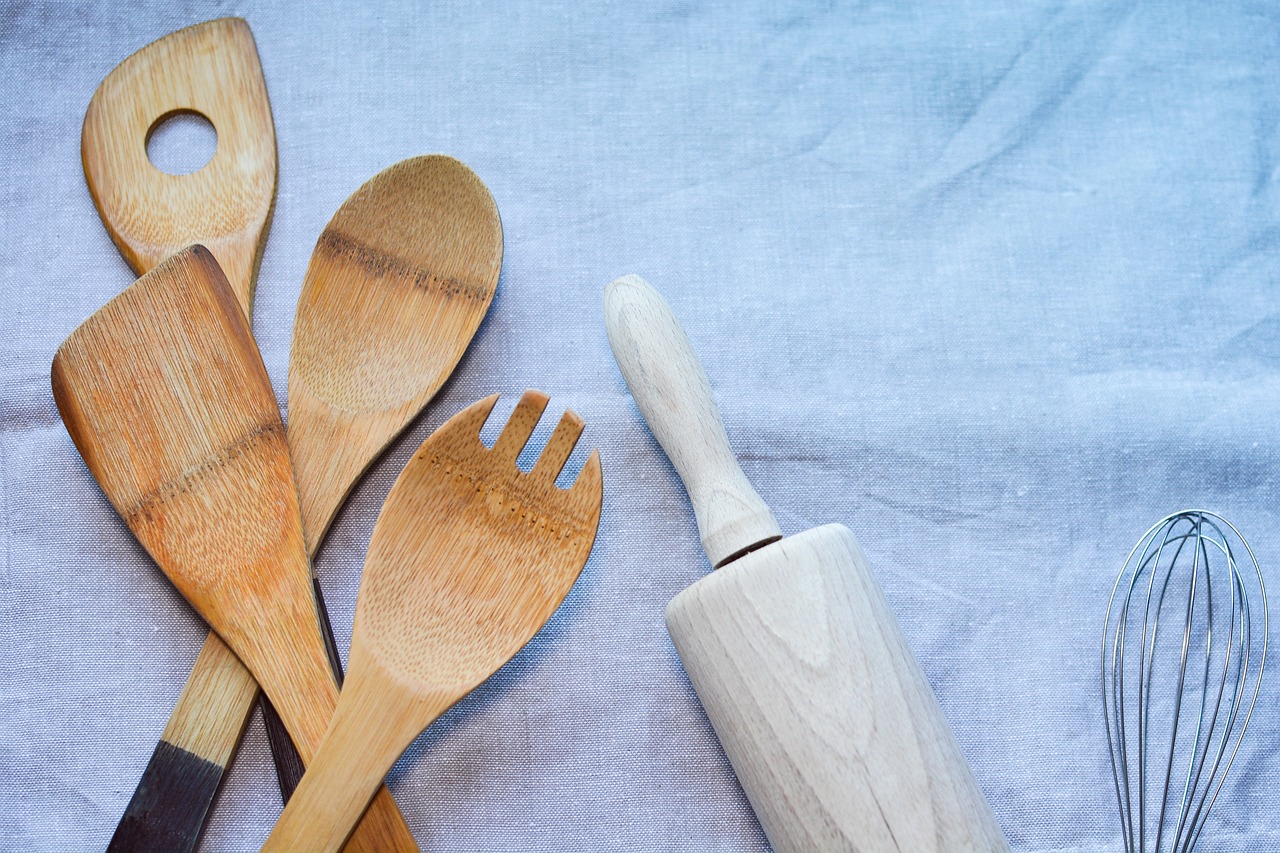
Best Wooden Utensil Sets: 7 Compared By Species
Each pick below is a real, currently available product covering the material’s actual range of use – five species plus the two adjacent purchases (a food-safe finish and a carving kit) that matter as much as the wood itself. Every ASIN, price and stock status below was re-checked against the Amazon Creators API on 7 October 2026.
1. Gudamaye Hard Maple Wooden Spoon Set (6-Piece) – #1 Best Overall
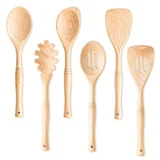
$31.99 – View on Amazon
- Species: Hard maple, Janka 1,450 lbf
- Pore structure: Diffuse-porous, small-medium vessels
- Set: 6 pieces, 12 inch (cooking spoon, corner spoon, slotted spoon, spaghetti spoon, spatula, slotted spatula)
- Care: the seller recommends coating with oil before use; the species is as stated in the seller’s listing
Maple is the default recommendation across nearly every competing guide, and here the pore-structure data backs the popular pick rather than contradicting it – a rare case where the crowd and the mechanism agree. Tight, evenly distributed vessels mean food particles and moisture sit on the surface instead of soaking into open channels, which fits the Food Code language that names hard maple, or an equivalently hard close-grained wood, as acceptable for utensils. It is dense enough to resist knife nicks and stirring dents, light enough in colour that stains show clearly so you notice when it needs re-oiling, and cheap relative to its performance at $6.00 per board foot as raw lumber.
Main drawback: maple’s density makes it harder to hand-carve than cherry or basswood, so it is a better buy-finished pick than a first carving project. It also has almost no visual character – if you want figure or colour, this is not it. If you are finishing raw maple yourself, our guide to finishing maple covers the food-safe options in more depth.
2. Salt & York Olive Wood Utensil Set (5-Piece) – Strongest Wood For Wooden Utensils
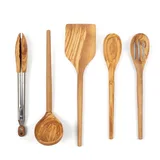
$51.84 – View on Amazon
- Species: Olive, Janka 2,710 lbf – hardest wood in the table
- Density: 61.2 lbs/ft³, the heaviest of the group
- Pore structure: Diffuse-porous, small-medium vessels, numerous to very numerous
- Set: 5 pieces (tongs, ladle, turner, spoon, slotted spoon)
Olive answers the "strongest wood for wooden utensils" question directly, and the Janka number backs it up at nearly double maple’s hardness. What makes it more than a hardness flex is that the extra density arrives together with diffuse, small-to-medium vessel pore structure, so the food-safety benefit comes along with the durability instead of trading against it. The Wood Database also notes yellowish deposits in those vessels, which is part of why olive shrugs off moisture better than its density alone would predict.
Main drawback: price. At $37.00 per board foot as raw lumber – and that is the 5/4 live-edge grade, because 4/4 was out of stock at the time of quoting – and roughly $10 per piece in this finished set, olive costs six times maple per board foot for a durability gain most home cooks will never notice. It is the pick for someone who specifically wants the hardest option, not the best value.
3. HANSGO European Beech Mixing Spoons (3-Piece) – Best Value
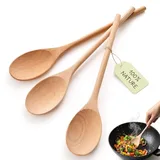
$7.59 – View on Amazon
- Species: European beech, Janka 1,450 lbf – ties hard maple exactly
- Pore structure: Diffuse-porous, small-medium, numerous vessels
- Set: 3 pieces, 10-inch mixing spoons
- Cost: under $3 per spoon
Beech is the clearest underrated pick in the dataset. It matches hard maple’s exact Janka figure of 1,450 lbf and sits in the same diffuse-porous, small-to-medium-vessel category, which means it should be just as food-safe by the mechanism that actually decides food safety – yet it is rarely the headline recommendation in competing articles. At under $3 per spoon finished, against roughly $5 per piece for the maple set above, it is the cheapest way to get the top-tier pore structure. It is also more uniform in texture than maple, which some cooks prefer against cast iron and non-stick alike.
Main drawback: beech is a documented sensitizer with a rare but real association with nasopharyngeal cancer under unprotected occupational dust exposure. The sourced risk relates to unprotected occupational dust exposure, so it matters mostly if you are the one turning the blanks. Note too that beech is not automatically cheaper than maple as raw lumber – the $12.25 per board foot quoted in the table is a 16/4 cut and is not directly comparable to maple’s 4/4 price; beech’s value advantage here is in the finished product, not the board.
4. Riveira Cherry Wooden Spoon Set (6-Piece) – Best Wood For A Spatula
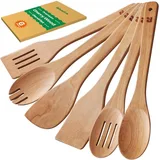
$27.99 – View on Amazon
- Species: Black cherry, Janka 950 lbf
- Pore structure: Semi-ring-to-diffuse-porous, small-medium earlywood vessels
- Set: 6 pieces including slotted and solid spatulas
- Colour: deepens from pale pink to reddish-brown with age and oiling
Cherry is the softest wood in the table that still earns a "good" verdict, and that softness is precisely the point for a spatula: it will not scratch non-stick or enamelled cast iron the way a harder edge can. Its structure sits between fully diffuse-porous, like maple and beech, and semi-ring-porous, with earlywood vessels the Wood Database describes as medium to small and numerous – still tight enough for normal kitchen contact. So to the common question of whether cherry is good for making a spatula: yes, and the softness is a feature there rather than a flaw.
Main drawback: that same softness means cherry dents and shows wear – spoon-bowl thinning, edge rounding – faster than maple, beech or olive under heavy daily use. Cherry sawdust has also been associated with wheezing in exposed woodworkers, which is a shop-dust issue for people who work the wood.
5. Gudamaye Black Walnut Wooden Spoon Set (6-Piece) – Best For Serving, Not Stirring
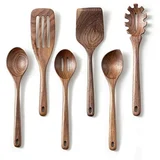
$39.99 – View on Amazon
- Species: Black walnut, Janka 1,010 lbf
- Pore structure: Semi-ring-porous, large-to-very-large earlywood vessels
- Set: 6 pieces, 12 inch, dark chocolate-brown throughout
- Best use: serving, plating and display pieces
Walnut earns its place for looks and for carrying the dataset’s most useful correction: structurally it is not in the same closed-grain tier as maple, beech or olive. The Wood Database describes its earlywood vessels as large to very large, grading down to medium in the latewood – closer to a moderate ring-porous wood than to a true diffuse-porous one. That does not make it unsafe with normal care and oiling, but it does mean walnut suits serving spoons and salad tossers, where food contact is brief and the piece dries immediately, better than a stirring spoon that sits in a simmering pot.
Main drawback: those open earlywood pores are exactly the structure the maple, beech and olive group avoids, so walnut needs more frequent oiling and faster drying after washing to keep up in practice. The same trade-off shows up in our teak vs walnut cutting board comparison, and if you are curious how the finished wood smells in daily kitchen use, see our walnut wood scent guide.
6. Thirteen Chefs Food-Grade Mineral Oil (8 oz) – Best Food-Safe Finish
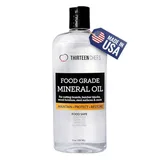
$7.99 – View on Amazon
- Type: USP food-grade mineral oil, unscented
- Volume: 8 fl oz (about $1.00 per fl oz)
- Use: cutting boards, utensils, butcher block, countertops
- Cure: none – wipe on, let it soak, wipe off the excess
None of the wood in this comparison performs as the data suggests without a food-safe finish, and mineral oil is the baseline finish. FDA allows white mineral oil that meets the specification in 21 CFR 172.878 as a component of nonfood articles intended for contact with food (21 CFR 178.3620), so look for a bottle labelled food grade or USP; the listing for this one states it is NSF certified food grade. It does not harden or cure like a varnish, so it needs reapplication – every two to four weeks for a utensil in daily use – but it never leaves a film that could flake into food, and it is odourless and tasteless once absorbed. Our food-safe finish guide covers the alternatives and where each one is appropriate.
Main drawback: mineral oil alone does not block water absorption as well as a beeswax and mineral-oil blend. If you are finishing an open-pore wood such as walnut, pairing it with a beeswax and mineral oil conditioner closes more of the surface than oil on its own.
7. BeaverCraft Spoon Wood Carving Kit (S13X) – Best Kit For Carving Your Own
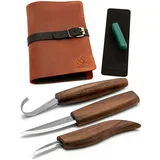
$69.99 – View on Amazon
- Includes: hook knife, sloyd knife, chip/detail knife, leather strop, leather case
- Steel: high-carbon tool steel, sharpened and stropped ready to use
- Purpose-built for spoon and utensil carving, not general whittling
- Best starter wood: cherry or basswood, then maple once comfortable
This is the honest answer to "best wood for making wooden cooking utensils": the wood matters less than the tool, because a dull or wrong-shaped knife will ruin a $6 maple blank faster than any species choice will. The hook knife in this set is the tool that carves the bowl of a spoon; a general whittling knife cannot make that cut cleanly. It arrives pre-sharpened with a strop for maintenance, which matters more in a beginner’s first six months than the species decision does.
Main drawback: at $69.99 it is a real commitment for someone who has never carved and is not sure they will stick with it. The 21-piece beginner kits under $30 are a reasonable lower-cost entry point, just without a true hook knife for spoon bowls. If you would rather buy a board and cut your own blanks, our butcher block wood comparison covers the same maple-versus-walnut-versus-oak trade-offs at board scale.
How We Picked These
This is a compared-and-sourced roundup, not a hands-on test. No first-person testing claim, hours-of-use figure or wear-test result appears anywhere on this page. Here is exactly what went into it:
- Wood science: Janka hardness, average dried weight, end-grain pore structure and toxicity data for all nine species pulled directly from The Wood Database’s individual species pages on 2026-08-02.
- Food-safety mechanism: the wood-versus-plastic bacteria findings and the salmonellosis odds ratios quoted above come from Dr. Dean O. Cliver’s UC Davis Food Safety Laboratory write-up, Bacteria and Various Cutting Board Materials, retrieved 2026-08-02.
- Regulatory guidance: the hard-maple-or-equivalent close-grained wood language for cutting boards, cutting blocks and utensils comes from section 4-101.17 of the FDA Food Code (2022 edition), which applies to food establishments.
- Lumber pricing: live per-board-foot quotes in the under-10-board-foot tier from Bell Forest Products and other published retail lists, pulled 2026-08-02. Thickness grades and exceptions are footnoted under the table rather than smoothed over.
- Products and prices: ASINs, buy-box prices and stock status re-checked against the Amazon Creators API on 2026-10-07. Two picks were replaced in that check because one listing was no longer accessible and one was out of stock; prices move often, so confirm on Amazon before buying.
- Search demand: the award labels and FAQ questions come from this page’s own Bing Webmaster Tools query data, so “strongest wood for wooden utensils” and “best wood for a spatula” reflect what people actually type.
Limits: we have not carved, boiled or long-term wear-tested these specific products. The hardness and pore-structure data is species-level science, not per-product lab testing, and normal manufacturing variation in grain orientation and finish quality will shift real-world durability within any one species.
Care And Maintenance
Wash wooden utensils by hand in warm soapy water, wipe them dry straight away and stand them upright to air out. Do not soak them or run them through a dishwasher: prolonged water and heat swell and shrink the wood and are the usual cause of cracks and warping. The routine is the same one you would use to clean a wooden cutting board.
To condition the wood, rub on food-grade mineral oil, let it soak in for a few hours and wipe off the excess. Mineral oil is the standard choice because white mineral oil meeting the FDA specification in 21 CFR 172.878 is permitted under 21 CFR 178.3620 as a component of nonfood articles intended for contact with food. It never cures into a hard film, so reapply it whenever the wood starts to look dry and pale. For a stronger water barrier, see our guide to beeswax and mineral oil. Avoid varnish or lacquer on the cooking end of any utensil.
Where To Buy
Wooden utensils are sold in kitchenware stores and online. Whichever route you choose, look for a listing that names the species and says whether the wood is unfinished or oiled, so you know what you are putting in a hot pot.
Online Retailers
Amazon carries sets in maple, beech, olive and walnut, including the picks above. Check the product description for the wood type and for any coating: for cooking ends, uncoated wood or a food-grade oil finish is what you want.
Local Artisan Shops
Craft fairs and local woodworkers let you see and handle the grain and weight of a piece before you buy. Ask which species it is and what finish was used; many makers use regional hardwoods such as maple or cherry.
Frequently Asked Questions
What Wood Is Safest For Cooking Utensils?
Hard maple and European beech are the best-supported choices, with cherry a good third. All three are dense, fine-grained hardwoods; maple and beech share the small-to-medium, diffuse pore structure that resists trapping food and moisture. The FDA Food Code names hard maple or an equivalently hard, close-grained wood as acceptable for utensils in food establishments. Avoid open-pored woods like oak and elm, which draw moisture and residue into large vessels, never use softwoods like pine that may carry resin, and avoid any wood with stain, lacquer or varnish on the cooking surfaces.
Are Teak Or Bamboo Cooking Utensils Better?
For utensils specifically, neither tops the table, and teak is the more overrated of the two. Teak is genuinely water-resistant thanks to its natural oils, which is why it earns its reputation outdoors, but its end grain is ring to semi-ring-porous with large-to-very-large earlywood vessels and up to 1.4% silica per The Wood Database, putting it structurally closer to oak than to maple. Bamboo is technically a grass rather than a hardwood, and bamboo utensils are light and inexpensive. Against maple, beech or olive, neither is the better-supported pick for a spoon in regular wet contact with food. Our guide to whether teak is safe for cooking utensils covers teak in more detail.
Do Professional Chefs Use Wooden Spoons?
Yes, wooden spoons are a staple in professional and home kitchens. Wood is a poor conductor of heat, so the handle stays cooler than metal during long simmers. It is non-reactive with acidic ingredients like tomato sauce, and it is gentle on nonstick and stainless cookware, so it will not scratch the way a metal spoon can. Maple and beech are the species with the best pore-structure case behind them.
What Is The Best Wood Utensils To Use For Cooking?
Hard maple, European beech and olive are the best all-round woods for cooking utensils: dense, diffuse-porous and durable. Cherry is a good softer choice for spatulas, and walnut is better kept for serving pieces than for stirring.
Is Beechwood Safe For Cooking Utensils?
Yes, it is a well-supported choice. European beech is diffuse-porous with small-to-medium vessels, the same structural category as hard maple, and matches maple’s 1,450 lbf Janka hardness exactly. The Wood Database lists beech as a sensitizer and notes a rare association with nasopharyngeal cancer under prolonged, unprotected occupational dust exposure, so wear a dust mask if you make your own utensils. That makes beech the best-value way to get top-tier pore structure.
Is Walnut Wood Good For Cooking Utensils?
Walnut is good for serving pieces and only adequate for stirring. Despite its premium reputation, black walnut is semi-ring-porous with large-to-very-large earlywood vessels, so it is structurally more open than maple, beech or olive. Used for salad servers, plating spoons and display pieces – brief contact, dried immediately – it performs well and looks superb. For a spoon that sits in a simmering pot, it needs more frequent oiling and faster drying than the closed-grain woods to keep up.
Is Elm Wood Good For Kitchen Utensils?
No. American elm is ring-porous with large-to-very-large earlywood vessels arranged in continuous rows – structurally similar to red oak – so it draws moisture and food residue into open channels rather than resisting them. At 830 lbf it is also the softest wood in the comparison, which makes for a poor combination of open pores and low dent resistance in a utensil.
Is Cedar Wood Good For Wooden Utensils?
No. Eastern red cedar is a softwood at 900 lbf, and its defining property – strong aromatic oils, the same ones that make it a classic closet and chest lining – is exactly the wrong feature for something that touches food, because those oils can transfer scent and flavour into whatever is being stirred or served. It is also a documented skin and respiratory irritant. Excellent wood, wrong job.
What Is The Strongest Wood For Wooden Utensils?
Olive, at 2,710 lbf Janka hardness and 61.2 lbs/ft³ density – nearly double hard maple’s hardness and the highest of the nine species compared above. Crucially, olive is also diffuse-porous with small-to-medium vessels, so the extra hardness does not come at the cost of food safety the way it would with a harder ring-porous wood. The trade-off is cost: roughly six times maple’s price per board foot.
Conclusion
Pick by pore structure first and hardness second. Hard maple is the best-supported choice and the one the Food Code names, European beech gives you the same structure for less money, and olive is the strongest if you are willing to pay for it. Keep walnut for serving, treat teak, oak and elm as poor choices for stirring spoons, and finish whatever you buy with food-grade mineral oil.
Wash by hand, dry straight away, and re-oil when the wood looks dry: that routine will do more for the life of your utensils than the choice between two good species.
Sponsored / affiliate links. As an Amazon Associate I earn from qualifying purchases. I may earn additional commission from eligible campaigns.