Douglas Fir Firewood: BTU and Burn Quality
Douglas fir is a strong softwood firewood choice. It lights faster than many hardwoods and usually gives useful heat before denser species are fully engaged, though moisture content changes the result a lot. One competitor cites 26.5 million BTUs per cord, yet usable heat still depends on how dry the splits are and how they are burned.
This guide is part of our Firewood and Wood Stoves: Drying, Storing and Burning Guide series.
Douglas fir is a softwood, not a hardwood, and it is a conifer. It is also a medium-density firewood with straight grain, so it splits easily and seasons in a predictable way. One competitor also describes it as red colored firewood, which usually refers to its heartwood tone rather than a heating advantage. (Wikipedia)
Quick answer
That mix changes how it burns compared with dense hardwoods. You get quicker ignition, a more active flame, and a shorter coal bed than oak or hickory. For short burns, shoulder-season fires, and kindling, that can be an advantage. For overnight heat, it usually is not enough by itself.
Douglas fir BTU and burn quality
Douglas fir gives useful heat for a softwood, but BTU ratings only matter after seasoning is handled well. Dry Douglas fir can be a practical midrange firewood; wet splits put out more smoke than heat and can turn a decent load into a poor one. Heat output, smoke, spark production, aroma, and burn time all shift with moisture content.
Heat output in practical terms
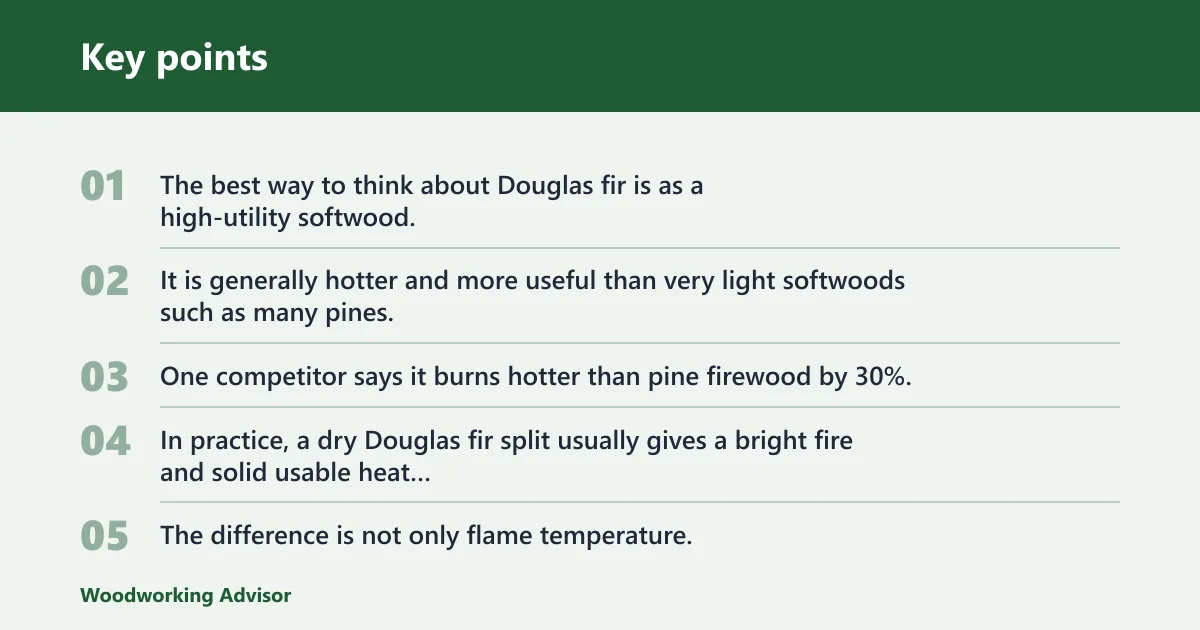
The best way to think about Douglas fir is as a high-utility softwood. It is generally hotter and more useful than very light softwoods such as many pines, but it does not match the staying power of dense hardwoods. One competitor says it burns hotter than pine firewood by 30%, but that number varies with the pine species and the moisture in both woods.
In practice, a dry Douglas fir split usually gives a bright fire and solid usable heat for a firewood load that is meant to warm a room quickly. The difference is not only flame temperature. It is also how long the fire keeps delivering steady heat after the kindling stage ends.
Spark, smoke, and aroma behavior
Douglas fir produces a moderate amount of sparks. That matters in open fireplaces and outdoor fire pits. It is not a reason to avoid the wood, but it does mean a fireplace screen is the better choice than an open hearth with no spark protection.
It also gives a nice and distinctive aroma. The scent is one reason many homeowners like it for indoor fires. Smoke stays reasonable only when the wood is seasoned well. If the splits are damp, smoke rises fast and the aroma turns harsh instead of pleasant.
Burn time compared with pine and hardwoods
Douglas fir is commonly reported to burn longer than many very light pines, but it usually burns out sooner than medium and denser hardwoods. That is why it fits best as a fast-starting, usable-heat wood rather than an all-night wood. It can help build a coal base, but it does not hold one like oak, hickory, or maple.
Douglas fir firewood comparison table
| Wood species | Approximate burn role | Expected user experience | Best use case |
|---|---|---|---|
| Douglas fir | High-utility softwood | Fast ignition, good flame, moderate sparks, pleasant aroma, shorter coal life than hardwoods | Fireplaces, shoulder-season heat, kindling, quick warm-up fires |
| Pine | Light softwood | Easy to light, often faster to burn down, usually less coaling and less heat per split than Douglas fir | Kindling, quick starter loads, small fires when speed matters more than duration |
| Oak | Dense hardwood | Slower start, longer burn, stronger coal bed, better overnight heat | Main heat load, long fires, overnight burning |
| Maple | Medium hardwood | Balanced ignition and burn time, steadier coal life than Douglas fir | General-purpose stove or fireplace fuel |
| Juniper | Aromatic softwood or small-diameter fuelwood | Fast flame, noticeable scent, often sparkier and less steady than fir or hardwood | Short fires, scent, outdoor burning where local rules allow |
Can you burn Douglas fir in a fireplace?
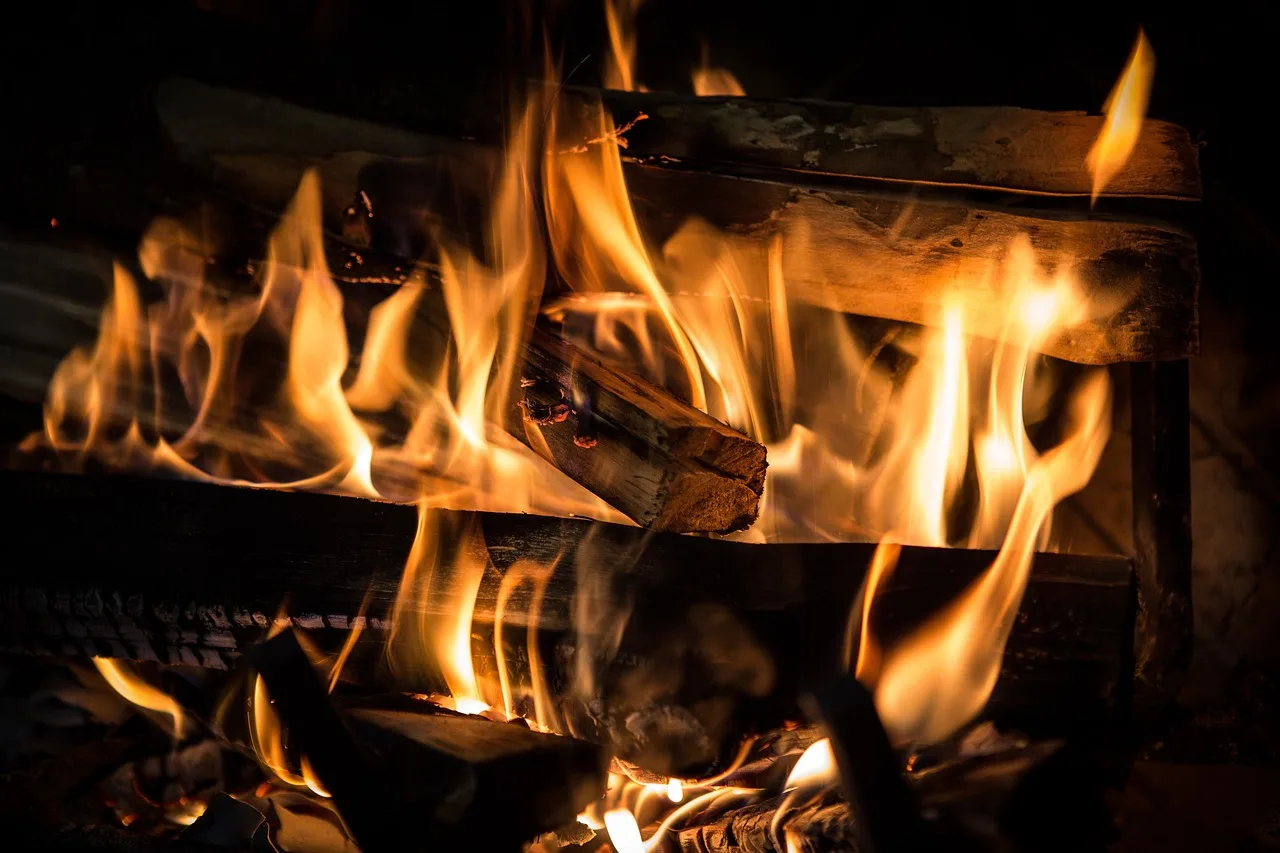
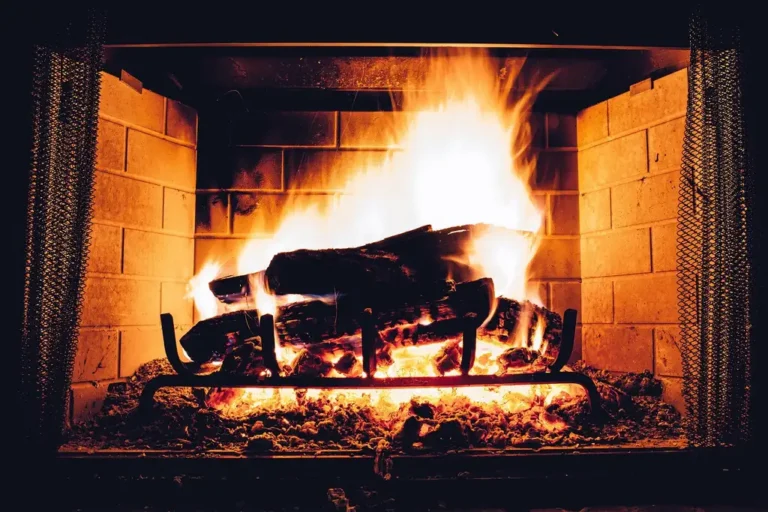
Yes, Douglas fir can be a good choice for a wood-burning fireplace if it is properly seasoned and burned with the right expectations. It lights quickly, gives useful heat, and is often pleasant indoors. The main limit is not the species itself; it is moisture content and how long you need the fire to last.
Because Douglas fir is described as a good choice for wood burning fireplaces, it fits common indoor use well. Keep the wood dry, use a screen if sparks are an issue, and avoid loading damp splits into a closed fireplace and hoping the draft will fix them.
Creosote risk and wet wood
Creosote risk rises when the wood is wet or only partly seasoned. That is true for Douglas fir as it is for almost every firewood species. Wet wood spends more heat evaporating water, so flue gases cool and deposits form more readily. The result is extra smoke, weaker heat, and more buildup in the chimney path.
Suppose a homeowner loads a fireplace with dry Douglas fir kindling and one damp split from the pile. The kindling will catch fast, but the wet piece will smolder longer, put out more smoke, and drag down the whole fire. That is the sort of small mistake that changes performance more than species does.
When to avoid certain splits
Avoid resin-heavy or obviously wet splits if the goal is a clean indoor fire. Douglas fir is workable firewood, but poor seasoning can make even a good species act like a bad one. If the end grain feels cool and the split is heavy for its size, it likely needs more drying time before indoor use.
Moisture content and seasoning
Moisture content is the main factor that separates good Douglas fir firewood from disappointing Douglas fir. Dry wood gives more heat, less smoke, easier lighting, and cleaner chimneys. Wet wood lowers efficiency because part of the fire’s energy goes into boiling off water instead of heating the room.
How dry should it?
For burning, a common target is wood around 20% moisture content or less. That level is dry enough for much cleaner combustion in most fireplaces and stoves. The exact reading depends on where you measure it, so a fresh split face gives a better picture than the outside of a sun-baked log.
A common first-timer mistake is stacking Douglas fir logs in a place where the bark stays damp and then judging dryness from the outside. Straight-grained fir can look ready before the core is dry. Split a piece and check the fresh face if you want a better read.
How long it takes to season
How long Douglas fir takes to season depends on split size, airflow, and stack layout. Smaller splits dry faster because they expose more surface area. Since Douglas fir has straight grain and splits easily, you can season it more efficiently by splitting it to a manageable size before stacking it under cover with open sides.
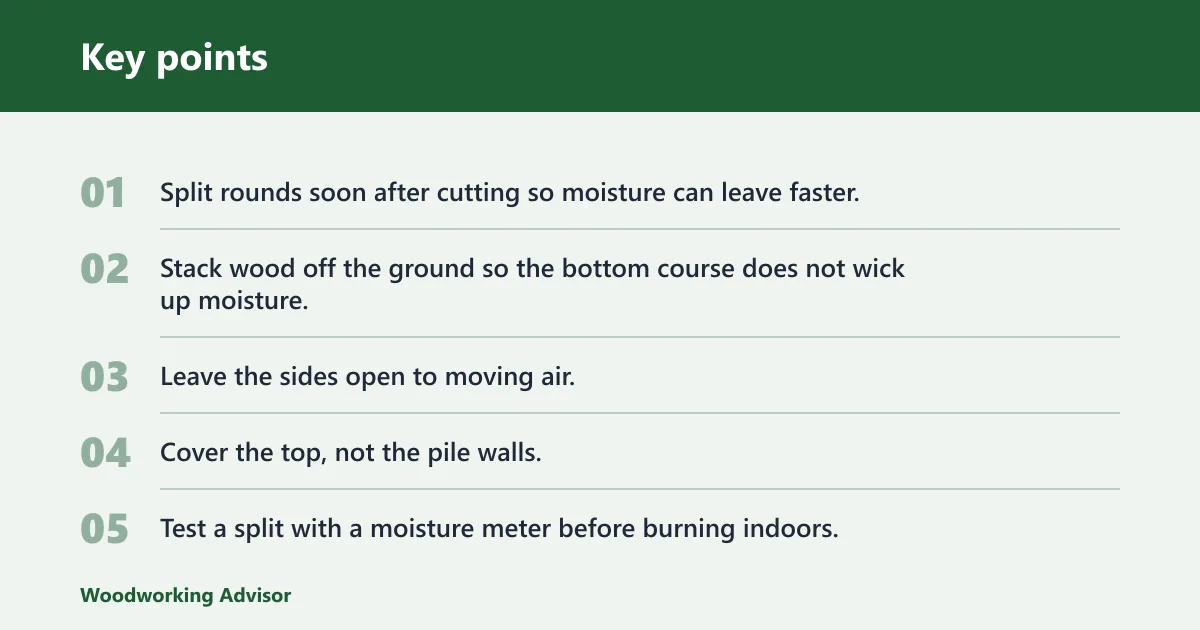
- Split rounds soon after cutting so moisture can leave faster.
- Stack wood off the ground so the bottom course does not wick up moisture.
- Leave the sides open to moving air.
- Cover the top, not the pile walls.
- Test a split with a moisture meter before burning indoors.
Douglas fir vs pine, hardwoods, and juniper
Douglas fir beats pine when you want more usable heat, a steadier fire, and less of the quick flash-burn behavior common in lighter pine species. It loses to dense hardwoods when the goal is long burn time, a deep coal bed, or overnight heat. Juniper sits in a different lane because its scent and spark behavior often make it better suited to short, selective burns.
When Douglas fir is the smarter buy
Choose Douglas fir when you want easy splitting, fast light-up, and good heat without paying for dense hardwood when you do not need overnight burn time. It is especially practical for fireplaces used in short sessions, shoulder-season fires, or homes that need a quick warm-up after the heating system has been idle.
When a dense hardwood is worth paying
If the goal is a long, steady burn with fewer reloads, a denser hardwood is usually worth the extra cost. Oak, hickory, and similar woods hold heat longer and build a better coal bed. Douglas fir is not a replacement for that role. It is better seen as a faster, lighter-burning option.
Where juniper fits
Juniper is often valued for aroma and quick flame, but it is not the same kind of everyday heat wood as Douglas fir. It can be useful where fast ignition and scent matter more than burn duration. For routine indoor heating, Douglas fir is usually the more balanced choice.
What are the best uses for Douglas fir firewood?
The best uses for Douglas fir firewood are quick-start fires, wood-burning fireplaces, shoulder-season heating, and kindling support. It is also useful when you want a clean, bright flame without committing to a heavy hardwood load. It is less suited to long overnight burns or any setup that depends on a deep coal bed.
Picture a small living room fireplace on a cool fall evening. Douglas fir can get the fire going fast, give the room usable heat, and leave a pleasant scent. In a larger stove that needs an all-night load, the same wood may burn down too fast unless it is paired with a denser species.
Frequently asked questions
Is Douglas fir good firewood?
Yes, Douglas fir is good firewood when you want fast ignition, useful heat, and easy splitting. It is not the best choice for long overnight burns, but it is a strong everyday option for fireplaces, shoulder-season fires, and quick warm-ups. Dryness matters more here than many buyers expect.
How many BTUs does Douglas fir firewood produce?
One competitor cites 26.5 million BTUs per cord, but that number should not be treated as a fixed result in every stack. Usable heat changes with moisture content, split size, and burn setup. Dry Douglas fir generally performs much better than wet Douglas fir, even if both came from the same tree.
Does Douglas fir burn hotter than pine?
Often, yes, but not by a fixed percentage in every case. Douglas fir usually gives more usable heat than many common pines, especially when both woods are properly seasoned. The exact result depends on the pine species, the dryness of both woods, and whether the fire is in a fireplace or stove.
Is Douglas fir softwood or hardwood?
Douglas fir is a softwood and a conifer. It is also straight-grained and medium-density, which is why it splits easily and burns differently from dense hardwoods. Those traits make it practical for fast light-up fires, but they also limit how long it can hold heat compared with oak or hickory.
Does Douglas fir make a lot of sparks?
Douglas fir produces a moderate amount of sparks. That is enough to matter in open fireplaces and outdoor fire use, so a screen is a smart idea. Sparks are more noticeable when the wood is dry and burning actively, and they can be worse if the firebox has poor airflow.
Does Douglas fir smell good when burned?
Douglas fir gives a nice and distinctive aroma when burned, especially when it is dry. The scent is one of its common selling points for indoor fires. If the wood is wet, the smell changes quickly for the worse because smoke rises and the fire burns less cleanly.
Douglas fir vs pressure treated lumber
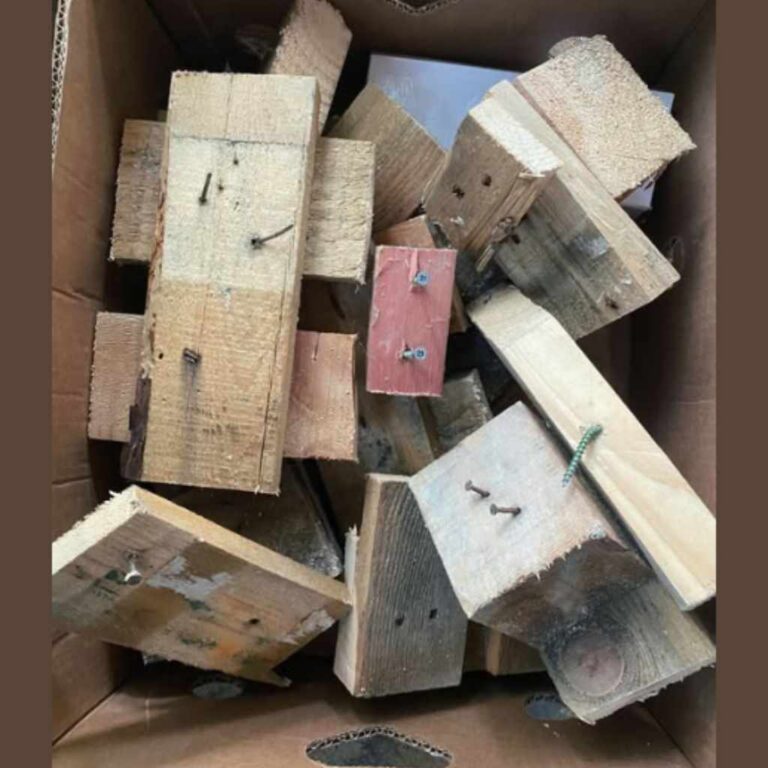
Never burn pressure-treated lumber. It is not a firewood substitute, and the chemical treatment is a safety problem indoors and outdoors. Douglas fir firewood is a natural softwood that can be burned safely when it is properly seasoned and used in a normal fireplace or stove setup.
Sponsored / affiliate links. As an Amazon Associate I earn from qualifying purchases. I may earn additional commission from eligible campaigns.