How Much Does MDF Trim Cost Installed?
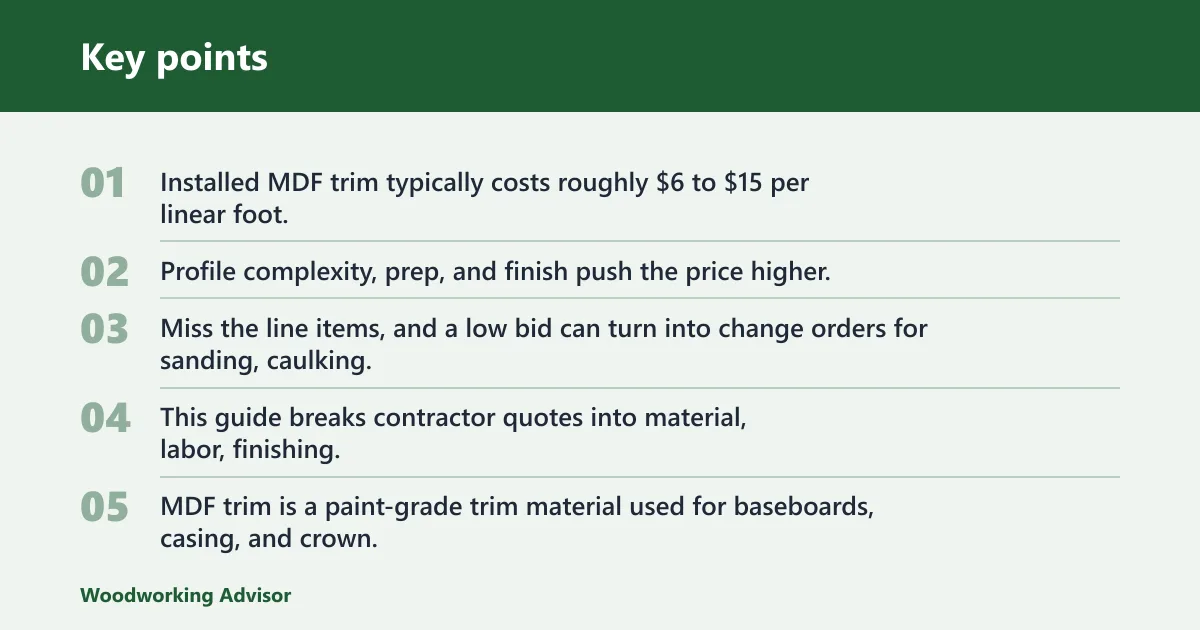
Installed MDF trim typically costs roughly $6 to $15 per linear foot, with painted baseboard or casing often landing around $8 to $12. Profile complexity, prep, and finish push the price higher. Miss the line items, and a low bid can turn into change orders for sanding, caulking, primer, or repairs. This guide breaks contractor quotes into material, labor, finishing, and failure-case add-ons so you can compare bids line by line.
MDF trim is a paint-grade trim material used for baseboards, casing, and crown. It is often sold primed or paint-ready, and it usually costs less than solid wood before labor is added. The installed price is not one number. It is a per-linear-foot total built from material, labor, caulk, primer or paint, cleanup, and sometimes removal of old trim.
What installed MDF trim includes


What contractors usually price
A trim installation quote should cover measuring, cutting, miter joints, coping ends, fastening, finish nailing, caulking, patching nail holes, and cleanup. Homewyse also lists removal and disposal options for old trim and debris, which matters because tear-out can change both labor time and dump fees. When a bid leaves those out, the price can look lower than the final invoice.
Baseboard, casing, and crown do not cost the same to install. Baseboard is usually the simplest. Casing needs cleaner corner work around doors and windows. Crown takes more layout time, more careful cuts, and often more ladder work, so labor rises with ceiling height and profile complexity.
What quotes often leave out
Some bids omit caulk, primer, paint, and corner repair. Others omit wet-area sealing, damaged-edge replacement, or disposal of the old trim. Those items matter most with MDF because the material is paint-grade, so the visible finish work often determines whether the job looks clean or unfinished.
Homewyse says the national average to install trim molding starts at $8.25–$12.37 per linear foot. It also uses 132 linear feet in its MDF trim example estimate and includes measurement, cutting, finish nailing, patching, and caulking in basic trim labor. That is the kind of scope you want spelled out in writing.
MDF trim cost worksheet
This worksheet shows how job size, trim profile, and finish level change installed price per linear foot. Use it to compare bids that include the same scope. If a contractor’s quote lands outside these bands, ask which line item changed: material, labor, finish, removal, or repair.
| Room size | Trim profile | Finish level | Material | Labor | Caulk / primer | Removal | Total per linear foot |
|---|---|---|---|---|---|---|---|
| Small room | Baseboard | Preprimed | $1.25–$2.00 | $3.50–$5.00 | $0.75–$1.25 | $0.00–$1.00 | $5.50–$9.25 |
| Small room | Casing | Paint-ready | $1.50–$2.25 | $4.00–$5.75 | $0.90–$1.50 | $0.00–$1.00 | $6.40–$10.50 |
| Small room | Crown | Moisture-resistant | $2.00–$3.25 | $5.50–$7.50 | $1.00–$1.75 | $0.50–$1.50 | $9.00–$14.00 |
| Medium room | Baseboard | Preprimed | $1.10–$1.75 | $3.00–$4.50 | $0.65–$1.10 | $0.00–$0.75 | $4.75–$8.10 |
| Medium room | Casing | Paint-ready | $1.35–$2.10 | $3.75–$5.25 | $0.80–$1.30 | $0.00–$0.75 | $5.90–$9.40 |
| Medium room | Crown | Moisture-resistant | $1.85–$3.00 | $5.00–$7.00 | $0.95–$1.50 | $0.25–$1.25 | $8.05–$12.75 |
| Whole-house | Baseboard | Preprimed | $0.95–$1.50 | $2.75–$4.00 | $0.55–$0.95 | $0.00–$0.50 | $4.25–$6.95 |
| Whole-house | Casing | Paint-ready | $1.20–$1.90 | $3.25–$4.75 | $0.70–$1.15 | $0.00–$0.50 | $5.15–$8.30 |
| Whole-house | Crown | Moisture-resistant | $1.75–$2.75 | $4.50–$6.50 | $0.90–$1.40 | $0.25–$1.00 | $7.40–$11.65 |
How much mdf trim checklist
- Ask for a written, itemized estimate with material, labor, finish, and removal separated.
- Confirm whether primed MDF casing is listed as paint-ready or as an extra charge.
- Check whether the quote includes caulk, filler, primer, and touch-up painting.
- Ask whether old trim tear-out, hauling, and site cleanup are included.
- Confirm the profile: baseboard, casing, crown, or wainscot.
- Ask what happens at wet areas, damaged corners, or out-of-square walls.
- Check whether the contractor added a general contractor markup for supervision.
- Compare bids only when the linear footage and scope are the same.
Why the installed price changes

Installed cost changes most with job size, profile choice, and finish scope. Small jobs often carry a minimum charge per trip, while whole-house work usually lowers the per-foot rate. Crown molding, tall ceilings, and corner-heavy layouts increase labor because they require more layout, more cuts, and more time on site.
Room size and linear footage
Homewyse uses 160 linear feet for its trim molding example and 132 linear feet in its MDF trim example estimate. That matters because a small room may be priced with a minimum charge, while a larger project spreads setup time over more feet. A contractor may quote a small room at a higher per-foot rate even when the material is the same.
Regional labor rates and markup
Labor rates vary by region. Coastal markets often run higher than inland ones, and the Northeast commonly prices above the South. Urban projects can also cost more than rural ones because travel time, overhead, and local wage pressure are different. The same source notes that general contractor supervision can add 13% to 22%.
That markup is easy to miss. If a GC coordinates the carpenter, painter, and disposal crew, the bid may include supervision on top of the trade labor. Ask whether the quote already includes that charge or whether it appears later as a separate line.
Complexity, cuts, and ceiling height
Baseboard on square walls is simpler than crown in a room with multiple inside and outside corners. Miter cuts, coping, and wall scribing all take time. So do patching bad drywall corners and fitting around uneven floors. A straight room can price well below a room full of offsets, bump-outs, and built-ins.
Say your 12-by-14 bedroom needs new MDF baseboard and four door casings. The same linear footage installed in a room with a bowed floor and damaged plaster corners will cost more, because the carpenter has to fit, fill, and seal more problems before paint can hide them.
How much does MDF trim cost per linear foot?
MDF trim installed often lands in the middle of the broader trim market. LatestCost says MDF trim installed costs run $0.90–$2.50 per foot, labor commonly runs $1.50–$3.50 per linear foot, and total installed trim can be $2.60–$12.00 per foot. A practical bid for paint-ready MDF usually lands higher once caulk, cleanup, and finish work are included.
Current Cost says trim installation material cost ranges from $1.50 to $6.50 per linear foot, and labor to install trim ranges from $2.50 to $9.50 per linear foot. Homewyse’s national average to install trim molding starts at $8.25–$12.37 per linear foot. Those ranges do not conflict; they show how scope and finish can move the total.
How the total splits
For many MDF jobs, material is the smaller slice. Labor usually drives the total because a proper install includes measuring, cutting, finish nailing, caulking, and patching. If the quote adds painting, cleanup, or old-trim disposal, the labor side grows again. That is why two bids for the same room can differ by several dollars per foot.
When minimum charges apply
Small jobs often trigger a minimum service charge. A five-foot repair or one-room casing swap can cost more per foot than a whole-house job because the crew still has to set up tools, unload material, and make a trip. Ask whether the contractor has a minimum labor charge before you compare the per-foot line alone.
What adds to the final bill?
The final bill rises when the job includes removal, sealing, painting, or repairs. MDF is paint-grade, so the finish stage matters more than many homeowners expect. Wet areas, damaged edges, and old adhesive can add time and materials even when the trim profile itself is inexpensive.
Removal and disposal
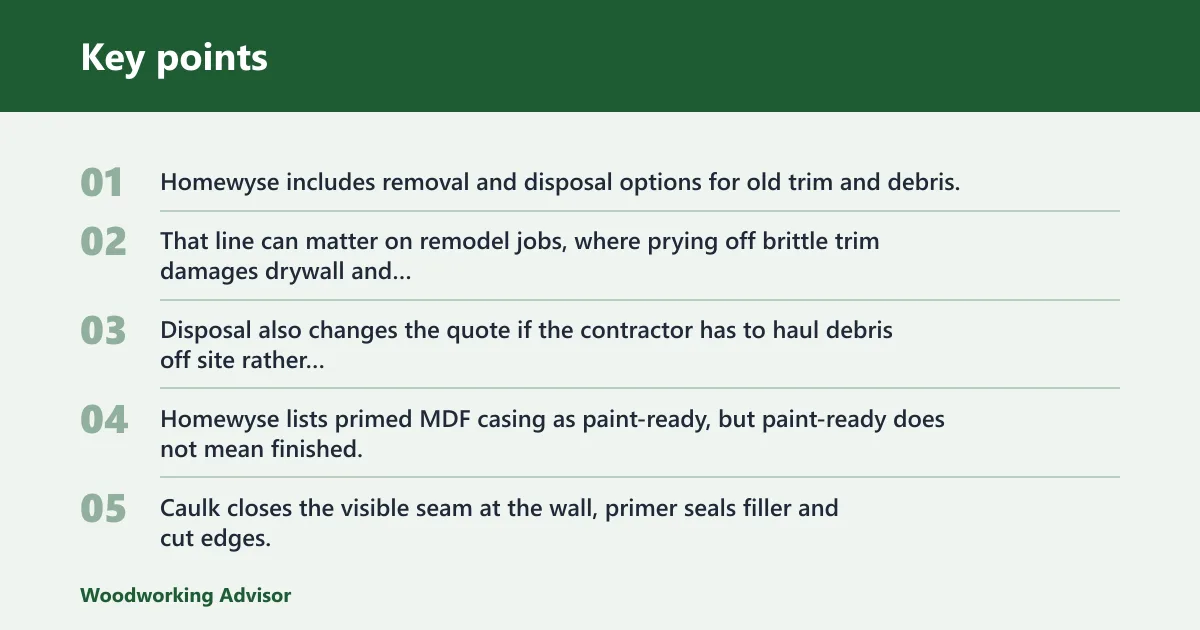
Homewyse includes removal and disposal options for old trim and debris. That line can matter on remodel jobs, where prying off brittle trim damages drywall and adds patching. Disposal also changes the quote if the contractor has to haul debris off site rather than leave it for the homeowner.
Caulk, primer, and paint
The same source lists primed MDF casing as paint-ready, but paint-ready does not mean finished. Caulk closes the visible seam at the wall, primer seals filler and cut edges, and paint gives the final color. If the bid includes only install, you may still need a painter or a separate paint line.
Moisture-resistant upgrades and repair work
MDF can swell at floors, bathrooms, laundry rooms, and other damp areas if edges are not sealed well. Moisture-resistant MDF costs more than standard preprimed stock, and edge sealing can add labor. Damaged corners, soft drywall, or uneven floors also add repair time because the trim has to fit the surface, not just the wall drawing.
Picture a hallway baseboard run where one corner has chipped drywall and the floor slopes slightly. The installer may need extra filler, a tighter caulk bead, and a return trip for touch-up. That is why failure-case add-ons belong in the quote before the work starts.
When MDF is cheaper than wood
MDF is usually cheaper than solid wood on material alone, but the gap narrows once you add paint, repair, or moisture-resistant stock. MDF still makes sense for painted interiors, especially simple baseboard and standard casing. For stained work, wet areas, or very high-end profiles, solid wood can make more sense despite the higher material price.
MDF vs pine trim
Pine trim is a common solid-wood comparison point. It can cost less than hardwoods, but it often brings more grain, more knots, and more prep for a painted finish. MDF usually gives a smoother paint surface, which can save finishing time. If the job is painted and dry, MDF often stays ahead on installed price.
MDF vs solid wood trim
Solid wood usually costs more at the material stage, and the labor can rise if the boards move, cup, or need extra sanding. MDF’s flatter stock and factory-primed options can reduce prep. Once the job calls for premium paint, more coats, or wet-area sealing, however, the installed gap can shrink fast.
When MDF stops being the cheapest option
MDF stops being the lowest-cost choice when repair work, waterproof sealing, or heavier finish labor take over the quote. If the room needs extensive patching, if the trim sits near moisture, or if the homeowner wants a painter to finish everything, the total can move close to a better wood option.
How to compare trim quotes
Compare trim quotes only after you line up the same scope. The best bid is not always the lowest number. It is the one that lists the same material, the same finish, and the same disposal terms. Written, itemized estimates make it easier to spot a missing caulk line or a hidden GC markup.
Questions to ask contractors
- Is this quote for MDF baseboard, casing, crown, or another profile?
- Does the price include measuring, cutting, fastening, caulking, and patching?
- Is primed MDF casing included as paint-ready, or is primer extra?
- Does the bid include old trim removal, debris haul-away, and cleanup?
- Are wet-area sealing and edge repair included where needed?
- Does the total include general contractor supervision markup?
Red flags in itemized estimates
Watch for vague lines such as “miscellaneous labor” or “finish work as needed.” Those phrases make it hard to compare bids. A quote that leaves out caulk, primer, or disposal may look cheaper up front and end up more expensive after add-ons. If the contractor will not separate labor from materials, ask for a revised estimate.
Frequently asked questions
How much does mdf cost?
MDF trim itself is usually priced below solid wood, but installed cost is what matters for a real budget. For MDF trim, LatestCost says installed costs run $0.90–$2.50 per foot, while total installed trim can reach $2.60–$12.00 per foot once labor and finish work are included.
What is mdf trim?
MDF trim is a paint-grade trim material used for baseboards, casing, and crown. It is often sold primed or paint-ready, which helps it accept paint evenly. It is common in interiors where a smooth painted finish matters more than visible wood grain.
How much does mdf cost per metre?
Per metre pricing is just the linear-foot price converted to metric. Since 1 metre equals about 3.28 feet, a $6 to $15 per-foot installed range works out to roughly $19.70 to $49.20 per metre installed. Always check whether the quote includes removal, primer, and caulk.
Mdf vs wood trim
MDF usually wins on paint-ready material cost, while wood can win on durability in some settings and on stain-grade projects. Installed price depends on prep, labor, and finish. Once a bid adds more painting or repairs, the MDF advantage can shrink faster than many homeowners expect.
How much is mdf board?
MDF board prices vary by thickness, size, and finish grade, and trim stock is not priced the same as sheet goods. For trim decisions, the installed linear-foot quote matters more than the board price alone because labor, caulk, and finishing usually drive the total.
Mdf vs pine trim: mDF often gives a smoother
MDF often gives a smoother painted finish, while pine brings natural wood grain and can be a better fit for stain or a more traditional look. On painted interiors, MDF often comes out cheaper installed. If the project needs more sanding or patching, the price gap can narrow.
How expensive is mdf
MDF is usually considered a lower-cost trim option, but the installed bill depends on profile, room size, and finish level. A small paint-ready baseboard job can stay near the low end of the range, while crown, removal, and wet-area sealing can move the total much higher.
Sponsored / affiliate links. As an Amazon Associate I earn from qualifying purchases. I may earn additional commission from eligible campaigns.