How to Tell What Type of Hardwood Floor You Have: 5 Tests
To tell what type of hardwood floor you have, run five checks in order: look at a plank edge to see whether the board is solid or engineered, note the plank width and pattern, find a patch of raw wood to see the true color, match the grain and pores to a species, and ignore the tests that do not work. Most homeowners can finish the first three in ten minutes with a flashlight and a screwdriver.
One myth is worth clearing up before you start. The popular water-drop test does not identify wood. A bead of water tells you whether the finish is intact, nothing more, and a moisture meter reads moisture content, not species. The reliable clues are the board edge, the width, the unfinished color and the grain, and they are covered below.
Getting this right matters before you sand, patch or recoat. Solid planks can usually be sanded several times, while an engineered board with a thin wear layer can be ruined by one aggressive pass. If you only need to match a few replacement boards, the species and plank width are what count.
Step 1: Is It Solid or Engineered? Check a Plank Edge
Best Wood ID Loupe Pick
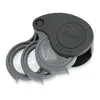 |
Carson TriView 5x/10x/15x Folding Loupe (about $12) A pocket loupe lets you read the pores and layers on a cut board edge, which is how you separate look-alike species and spot a thin veneer.
|
Find a place where the side or end of a board is exposed. Good spots are the opening of a floor heat register (lift the metal grille), a doorway transition strip, a stair nosing, the gap behind a removable baseboard or shoe molding, and the area under a threshold. Shine a flashlight along the edge.
- Solid hardwood: one piece of wood, with the same grain pattern from the top surface down to the bottom, usually with a tongue and groove on the edges.
- Engineered hardwood: a real wood veneer on top of stacked plies (like plywood) or a fiberboard core, so you see a distinct line or layers on the edge.
- Not hardwood: laminate has a printed photo layer over a brown fiberboard core. Luxury vinyl plank is flexible and shows no wood fibers at all.
From a basement or crawl space you can sometimes see the underside of the subfloor and nail heads or staples driven at an angle, which points to nail-down installation of solid or engineered strips. Glued-down and floating floors leave no such marks.
| Feature | Solid hardwood | Engineered hardwood |
|---|---|---|
| Typical thickness | 3/4 in (19 mm) is most common, thinner 5/16 and 1/2 in profiles also exist | About 3/8 to 3/4 in, with a wood wear layer roughly 0.6 mm to 6 mm thick |
| Plank edge | One piece, grain runs top to bottom | Visible layers or core under a thin top layer |
| Refinishing | Can often be sanded several times over its life | Limited by the wear layer: thin layers may allow only a screen and recoat |
| Board width | Usually narrower, since wide solid boards move more with humidity | Often wider, since layered construction is more stable |
If you cannot see an edge anywhere, a small removable section at a vent usually settles it. Do not pry up a board just to find out.
Step 2: Measure the Plank Width and Pattern
Measure one board across its face, excluding the groove. Width and pattern narrow down both the style and the likely age of the floor.
| Format | Typical width | Where you usually see it |
|---|---|---|
| Strip | 1-1/2 to 2-1/4 in | Traditional oak floors, very common in mid-century homes |
| Plank | 3 to 8 in | Older pine and fir houses, modern engineered floors |
| Parquet | Small slats arranged in squares, herringbone or chevron | Mid-century oak tiles, older formal rooms |

Narrow, uniform strips in a house built between roughly 1920 and 1970 are very often oak. Wide, softer-looking boards with knots in an older farmhouse are often pine or fir. Square parquet tiles are usually oak too.
Safety note for parquet: older parquet tiles were often glued down with black asphalt-type adhesive, and some old flooring products contained asbestos. Do not sand, scrape or dry-sweep suspect adhesive or old resilient tiles under a wood floor. Have a sample tested by a lab before any demolition. Older homes may also have lead paint on adjacent trim, so keep dust down when you work near baseboards.
For species typical of older homes, see our guide to colonial hardwood flooring, and for how plank types compare overall, see the wood flooring guide.
Step 3: Find Raw Wood to See the True Color
The color you see on the surface is a mix of species, stain, finish and years of light. To judge the species, look for a spot where the floor was never exposed to the same conditions. Under a heat register frame, inside a closet, beneath a long-standing rug or behind a baseboard are good places. A cut edge at a threshold also shows the unstained wood color.
A few color behaviors help you interpret what you see. Oil-based finishes amber over time, so an old floor can look more orange than the species really is. Cherry tends to darken and redden with light, while walnut tends to fade slightly lighter. Maple is pale cream and tight-grained, and ash looks like oak but with straighter, plainer grain.
Skip the sanding test unless you are already refinishing. If you do want to peek under the finish, use a hidden spot such as the inside of a closet and a fine abrasive pad, and stop as soon as you see bare wood.
Step 4: Match Grain and Pores to a Species
Once you know the board is real wood and have seen its unfinished color, compare the grain pattern. The Janka number in the table below is how hard the wood is, which also affects dents and refinishing. It comes from the Janka test, which measures the force needed to push a steel ball halfway into the wood.
| Species | Grain and look | Janka hardness (lbf) |
|---|---|---|
| Red oak | Bold, open grain with a warm reddish-pink tone | 1,290 |
| White oak | Open grain, straighter, golden-brown with gray undertones | 1,360 |
| Hard maple | Tight, subtle grain, pale cream, sometimes curly | 1,450 |
| Hickory/pecan | Strong color contrast, bold irregular grain | 1,820 |
| White ash | Looks like oak but plainer, straight grain | 1,320 |
| American walnut | Dark chocolate brown, can have purple tones | 1,010 |
| Black cherry | Reddish-brown, smooth, darkens with age | 950 |
| Yellow birch | Pale yellow, fine grain, can resemble maple | 1,260 |
| Longleaf pine / heart pine | Amber to orange, tight rings, visible knots | 870 |
| Loblolly/shortleaf pine | Light yellow, wide rings, many knots | 690 |
| Douglas fir | Orange-pink with sharp growth rings | 660 |
| Brazilian cherry (jatoba) | Orange-red, darkens to deep red-brown | 2,350 |
The pore test that separates red oak from white oak
End grain is the quickest tell. Red oak has large open pores, so air can pass through a short length of end grain, while white oak plugs its pores with tyloses and does not. You do not need to blow through your floor. Use your loupe on a cut edge and compare the pores: large, open ones point to red oak, smaller and often filled ones point to white oak.
Maple and hickory are the other pair people mix up. Maple has a fine, pale, subtle figure, while hickory almost always shows dramatic light and dark streaks in the same board. For a closer look at maple, read how to identify maple wood. For a broader overview of species, see the types of wood guide.
Step 5: Skip the Tests That Do Not Work
- The water-drop test: beading means the finish is intact. It does not separate hardwood from softwood and it does not identify species.
- The coin scratch test: a coin scratches the finish first, so you are testing the coating, not the wood.
- A moisture meter: it reads moisture content. Species cannot be read from it, and a reading through a finish is unreliable.
- Assuming hardwood means hard: hardwood and softwood are botanical terms based on the type of tree, not on how hard the wood is. Balsa is technically a hardwood, and some pines are harder than some hardwoods. A pine floor is a softwood floor even though people call it a hardwood floor.
If none of the visual clues settle it, a flooring shop or lumberyard can often identify a small sample or a clear photo of a cut edge. A certified inspector from the National Wood Flooring Association can also help when the floor type affects a refinishing or warranty decision.
What Your Floor Type Means for Care and Refinishing
Once you know your floor type, care is simple. Sweep or vacuum with a soft head, wipe spills fast and use a barely damp mop on a finished floor. Felt pads under furniture prevent most dents, and our guide to non-slip furniture pads for wood floors covers options.
| Floor type | Care and refinishing note |
|---|---|
| Solid oak or maple | Can usually be sanded and refinished several times, so hire a pro or rent a proper floor sander |
| Thin-veneer engineered | Avoid heavy sanding, use a screen and recoat instead |
| Pine or fir | Softest of the group, dents easily, expect visible wear in high-traffic areas |
| Parquet | Sand carefully since the grain direction changes from tile to tile |
If your floor needs sanding, see how belt sanders compare for floors before you rent anything. Budgeting a repair or replacement? Our hardwood flooring installation cost guide gives per-square-foot ranges.
Frequently Asked Questions
How Can I Identify My Hardwood Floor Type?
Work in order: first decide whether the boards are solid or engineered by looking at a plank edge at a vent or threshold, then check plank width and installation pattern, then look at a patch of unfinished or protected wood to judge the true color, and finally match the grain and pores against a species chart. A 10x loupe on a cut edge helps separate oak, ash, maple and hickory.
How Do I Tell If My Floor Is Solid Or Engineered?
Look at the edge of a board where it is exposed, such as inside a floor vent opening, at a doorway transition or on a stair nosing. Solid hardwood shows the same grain from top to bottom in one piece. Engineered flooring shows a thin hardwood layer on top of plywood-style plies or a fiberboard core. From a basement or crawl space you can sometimes read the underside of the boards too.
Can I Use Water To Test My Hardwood Floor?
Water only tells you about the finish, not the wood. Beading means the surface coating is intact, and soaking in means the coating is worn or missing. It does not separate hardwood from softwood, and it does not identify species. Use only a few drops, wipe them off quickly, and never leave standing water on any wood floor.
What Are The Most Common Hardwood Floor Species?
Red oak and white oak are the most common in American homes, followed by maple, hickory, walnut, cherry and ash. Older houses often have pine or fir, and some mid-century homes have oak parquet. If your floor has bold, open grain and narrow strips in a mid-century house, oak is the most likely answer.
How Can I Tell Hardwood From Laminate?
Real hardwood grain never repeats exactly, while laminate and vinyl plank use a printed image that repeats every few boards. On a cut edge or at a vent opening, laminate shows a brown fiberboard core under a thin printed layer, and vinyl plank is flexible and shows no wood fibers at all.
Conclusion
You can identify most hardwood floors with a plank edge, a tape measure and a loupe. Decide solid versus engineered first, because that controls how much sanding is safe, then narrow the species by plank width, raw color, grain and pores. If you suspect laminate, our laminate floor guide explains how that material behaves. When in doubt, a flooring shop can identify a sample before you commit to a refinishing plan.
Sponsored / affiliate links. As an Amazon Associate I earn from qualifying purchases. I may earn additional commission from eligible campaigns.