Titebond Wood Glue Clamp Time
For Titebond Original, keep clamps on about 30 minutes at 70°F; in a cold shop, hold longer and do not trust the clock alone. Too little clamp time can let joints creep, open, or starve during later machining. This guide shows how temperature changes Titebond clamp time, when to wait longer, when to choose a longer-open-time formula, and when to check the joint instead of guessing.
Titebond clamp time basics
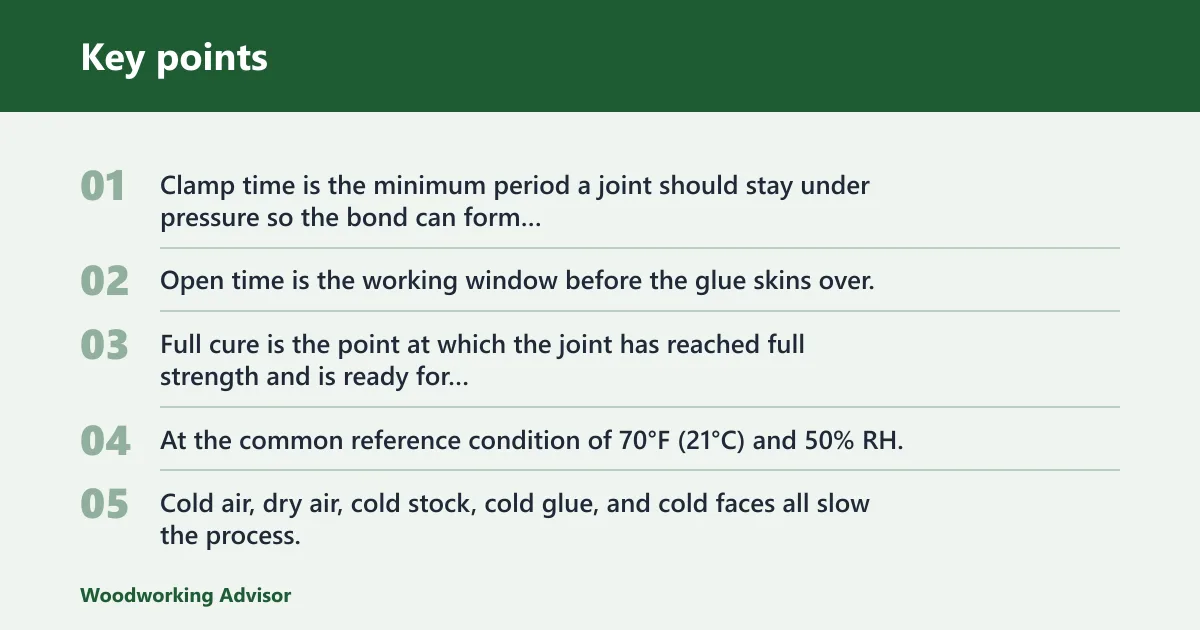


Clamp time is the minimum period a joint should stay under pressure so the bond can form without movement. Open time is the working window before the glue skins over. Full cure is the point at which the joint has reached full strength and is ready for sanding, routing, planing, or stress.
At the common reference condition of 70°F (21°C) and 50% RH, PVA glue behaves close to the printed chart values. Cold air, dry air, cold stock, cold glue, and cold faces all slow the process. Surface temperature matters as much as room temperature.
Clamp time vs. open time
Open time is the assembly window. Clamp time is the minimum clamping period after the parts are aligned and tightened. A glue may still be workable for placement, yet the joint can already be too far along to tolerate shifting or extra handling. That is why a long glue-up needs a longer-open-time product, not just more clamps.
Clamp time vs. full cure
Clamp time is not full cure time. For the Titebond PVA products covered here, full cure is 24 hours. Wait that long before stressing the joint, and treat planing, sanding, and routing as full-cure tasks rather than clamp-release tasks.
Why temperature changes the clock
Warm, dry, or breezy conditions shorten open time because the glue loses water faster. Cold conditions slow bonding and can leave the glue too sluggish to grab the wood fibers cleanly. If the glue, the stock, or the faces are below the minimum use temperature, the clock is no longer the right guide.
Which Titebond glue fits your glue-up?
Pick the glue for the assembly, not only for the label on the bottle. Titebond Original fits interior work with short, straightforward assemblies. Titebond II Premium adds ANSI Type II water resistance and suits standard shop timing. Titebond III Ultimate gives more open time and ANSI Type I water resistance. Titebond Extend is the slower choice for longer, more complex glue-ups.
Titebond Original wood glue
Use Titebond Original for interior-only work when the glue-up is simple and you can close the joint quickly. Its open time is about 4–6 minutes, its minimum clamp time is 30 min–1 hr, its full cure is 24 hours, and its minimum use temperature is 50°F.
Use Titebond II Premium when you want standard timing plus ANSI Type II water resistance. Its open time is 3–5 minutes, its minimum clamp time is 30 min–1 hr, its full cure is 24 hours, and its minimum use temperature is 55°F.
Titebond III ultimate wood glue
Use Titebond III Ultimate when you need more assembly time or ANSI Type I water resistance. Its open time is 8–10 minutes, its minimum clamp time is 30 min–1 hr, its full cure is 24 hours, and its minimum use temperature is 47°F.
Titebond Extend wood glue
Use Titebond Extend when the glue-up is slow, large, or complex. It has a 15-minute open time and a 40°F minimum use temperature. In this comparison chart, it belongs in interior-use planning for long glue-ups where the extra working time matters more than a short clamp window.
Cold-shop clamp-time decision table
This table gives a practical decision rule, not a single number. Use the temperature band, glue type, glue line thickness, and assembly complexity together. If the row says to hold longer, do not trust the clock alone; check squeeze-out, alignment, and joint behavior before unclamping.
| Ambient temperature band | Glue type | Glue line thickness | Assembly complexity | Recommended minimum clamp window | Do not disturb yet |
|---|---|---|---|---|---|
| 68°F to 72°F | Original or II | Thin, well-fit joint | Simple edge joint, face frame, or single panel edge | 30 minutes to 1 hour | Do not move, twist, or machine the joint yet. |
| 68°F to 72°F | III | Thin, well-fit joint | Longer or slightly fussy assembly | 30 minutes to 1 hour | Do not release clamps early just because the glue feels set. |
| 60°F to 67°F | Original or II | Thin to moderate | Average cabinet, frame, or trim glue-up | Hold to the long end of the printed range | Do not assume room-temperature timing still applies. |
| 60°F to 67°F | III or Extend | Moderate | Large face frame, wide panel, or multi-part assembly | Use the longer-open-time glue and keep clamps on longer than the minimum | Do not unclamp just because squeeze-out looks dry. |
| 50°F to 59°F | Original, II, or III only if all surfaces are above minimum use temperature | Thin only | Small, simple, tightly fitting joint | Extend the clamp window beyond the minimum; use the long end of the range at minimum | Do not trust the printed minimum if the stock feels cold. |
| 40°F to 49°F | III or Extend where allowed by minimum use temperature | Thin to moderate | Simple only; avoid rushed multi-part work | Use a longer-open-time glue and expect extra hold time | Do not proceed if the glue or wood is below the product’s minimum use temperature. |
| Any band | Any PVA | Thick glue line, starved fit, or excessive squeeze-out | Large panel glue-up, bent lamination, or multi-part assembly | Hold longer than the printed minimum; verify alignment before unclamping | Do not disturb yet if the panel is moving, springing, or gap-filling in a visible way. |
Cold-shop risk flags
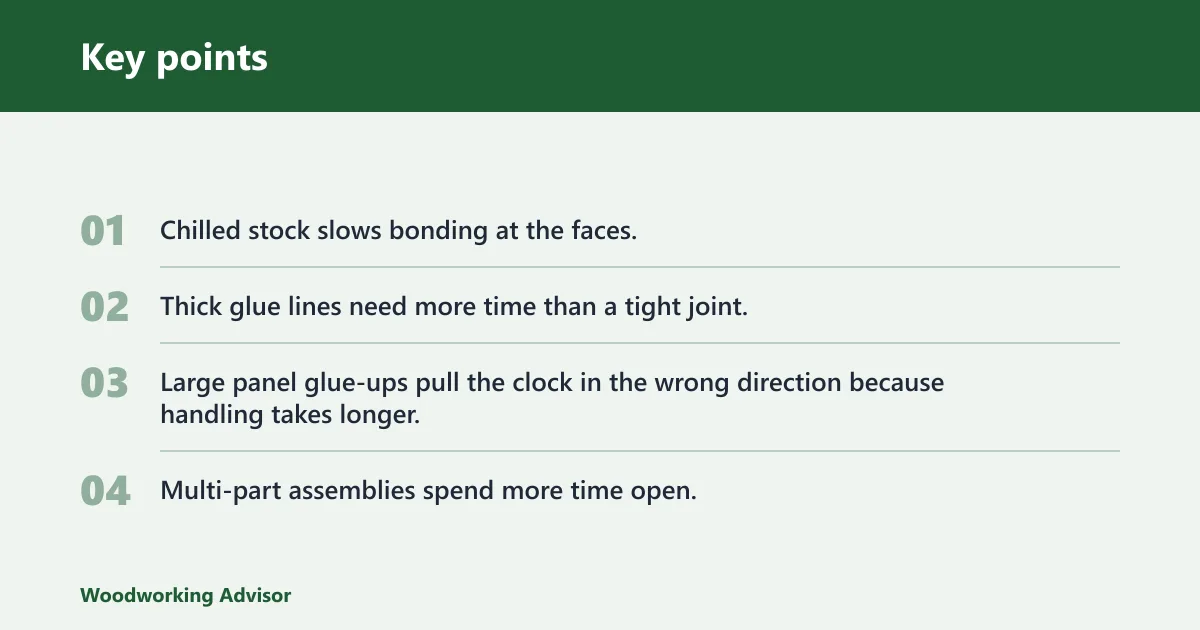
- Chilled stock slows bonding at the faces.
- Thick glue lines need more time than a tight joint.
- Large panel glue-ups pull the clock in the wrong direction because handling takes longer.
- Multi-part assemblies spend more time open, so the last joints may not be as fresh as the first.
How long to clamp Titebond in normal conditions
In normal shop conditions, the common PVA guidance is 30 minutes to 1 hour of clamping, then 24 hours before stressing the joint. That fits the product data for Titebond Original and Titebond III Ultimate, and it is a useful starting point for Titebond II Premium as well. When the joint is large, cold, or awkward, move to the long end of the range.
When to stay on the long end of the range
Hold longer when the joint line is not perfectly tight, when the room is cool, or when you can see the assembly still moving under clamp pressure. A face frame with several stiles and rails often needs more patience than a short edge joint, even if the glue bottle says the same minimum clamp time.
When 24 hours still matters
Even after clamp removal, the joint is still gaining strength. Wait 24 hours before heavy sanding, planing, routing, or load-bearing use. That rule applies even when the squeeze-out feels hard on the surface.
Picture a 24-inch panel glue-up done with cold stock pulled from an unheated room. The clamps can come off after the minimum only if the joint is stable and aligned, but machining should still wait until full cure. The cold stock slows the early stage, even when the room itself seems acceptable.
How cold changes Titebond open time and cure
Cold air is only part of the problem. Cold glue and cold wood shorten the useful window and slow the bond at the same time. Dry air and a breeze can skin the glue early, which makes the outside look ready while the joint inside is not.
Chilled stock and chilled glue
Wood pulled from a cold shed or truck can rob heat from the glue line. That is a real issue when the stock is near the product’s minimum use temperature. If the glue bottle is also cold, the working window gets tighter fast.
Dry air, breezy shops, and skinning
Open time shrinks in warm, dry, or breezy shops. That matters most for long rails, wide panels, and assemblies that take extra clamp setup. A glue-up that starts well can still fail late if the first joints begin to skin before the last ones are closed.
Suppose you are assembling a cabinet face frame with eight parts in a garage at 55°F and a fan moving air across the bench. Titebond II Premium may still fit the project, but the open time is short enough that the last joint can start to lose wetting before clamps are on. In that case, switch to Titebond III Ultimate or Titebond Extend rather than racing the clock.
Why surface temperature matters as much as air temperature
The air may read one temperature while the wood faces are colder. That difference can slow the glue line and make the joint behave as if the shop were colder than the thermometer suggests. Check the material, not only the room.
How do you know when to hold longer?
Hold longer when the joint is cold, thick, large, or hard to close evenly. A tight, simple joint in a warm shop can follow the printed minimum closely. A cold or complex assembly cannot. The safe choice is to extend clamp time any time the joint gives you a reason to doubt the clock.
Thick glue lines
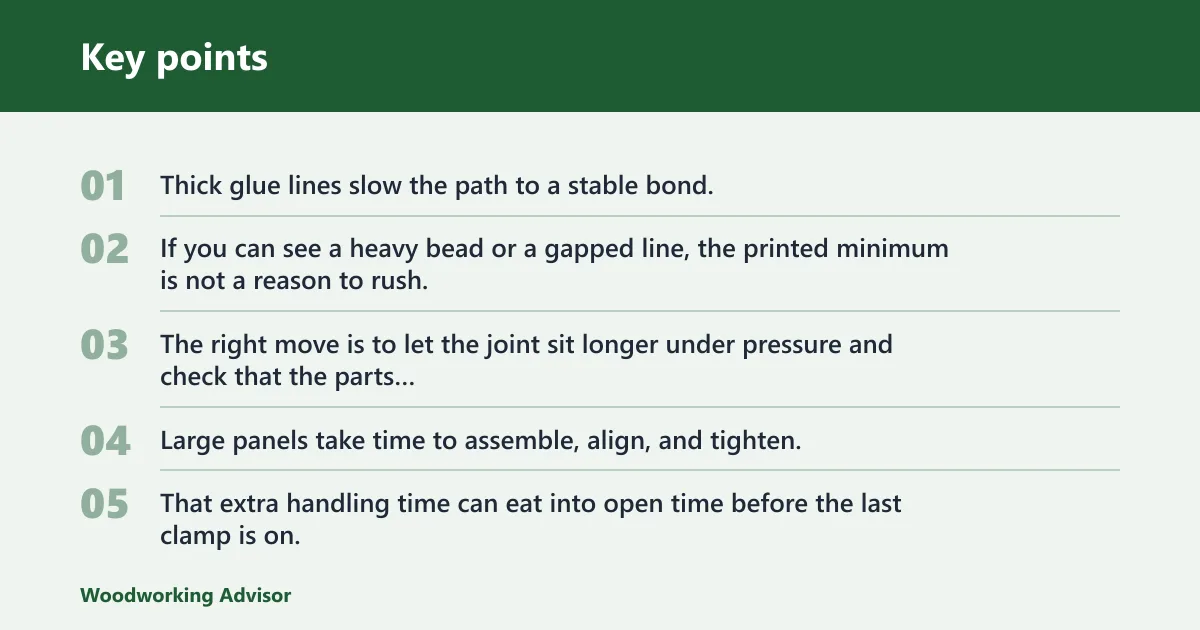
Thick glue lines slow the path to a stable bond. If you can see a heavy bead or a gapped line, the printed minimum is not a reason to rush. The right move is to let the joint sit longer under pressure and check that the parts are still aligned.
Large panel glue-ups
Large panels take time to assemble, align, and tighten. That extra handling time can eat into open time before the last clamp is on. For that reason, large panels often benefit from Titebond III Ultimate or Titebond Extend rather than Original or II.
Multi-part assemblies and poor fit
When many parts close at once, one clamp may shift another. If the fit is loose, the glue line may be thicker than intended and the joint may need more time before it can be left alone. Do not unclamp early just because the assembly looks tidy from a distance.
Common glue-up mistakes that shorten working time
These mistakes matter because they can make a normal clamp schedule fail. They also explain why a joint can seem fine at unclamp time and still fail later under sanding or routing.
Starved joints
A starved joint has too little adhesive left in the bond line. Excess clamp pressure can force too much glue out, especially on a tight-fitting joint. Use firm, even pressure, not brute force.
Squeeze-out on the bonding faces
Glue on the surfaces that should bond can block contact. Clean the mating faces before assembly, and protect stainable areas with masking tape where squeeze-out could land. Titebond advises masking tape for stainable areas that need protection from squeeze-out.
Premature unclamping and shifting
Removing clamps early, or moving the assembly before the bond has stabilized, can open the joint or leave a hairline shift that appears later during sanding. If the glue line still feels soft or the assembly springs when pressure is released, re-clamp and give it more time.
- Check the product’s minimum use temperature before you start.
- Make sure the wood, glue, and air are all above that minimum.
- Match the glue to the assembly speed and complexity.
- Apply even clamp pressure and close the joint fully.
- Leave the joint clamped for the long end of the printed range if the shop is cold or the fit is not ideal.
- Wait 24 hours before machining or stressing the joint.
Frequently asked questions
How long does it take for wood glue to bond?
For a standard PVA wood glue, the minimum clamp window is commonly 30 minutes to 1 hour, but that is not full cure. The joint can begin bonding sooner, yet it should stay clamped until the adhesive has set enough to resist movement. Full strength usually waits for 24 hours.
How long to clamp Titebond
For Titebond Original and Titebond III Ultimate, the listed minimum clamp time is 30 min–1 hr. Titebond II Premium uses the same minimum clamp window in the comparison chart. In a cold shop, stay on the long end or beyond it if the joint is large, thick, or hard to keep aligned.
How long to clamp wood glue
General wood glue guidance is 30 minutes to 1 hour under clamp pressure for a normal PVA joint at typical shop conditions. That answer changes with temperature, assembly size, and glue line thickness. If the shop is cold or the assembly is complex, hold longer and do not guess.
How long to clamp wood glued together
Wood glued together should stay clamped for the minimum time the glue maker gives, then longer if the joint is cold or awkward. For the Titebond products covered here, the safe working assumption is 30 minutes to 1 hour, followed by 24 hours before stress or machining.
How long for wood glue to set
Wood glue may feel set before it is fully cured. The clamp window gets you to a stable bond, but the joint is not ready for sanding, routing, or heavy load until full cure. For the Titebond PVA products here, that means about 24 hours.
Titebond wood glue cure time
Titebond PVA products in this guide reach full cure in 24 hours. That includes Titebond Original, Titebond II Premium, and Titebond III Ultimate. Clamp removal can happen sooner within the minimum clamp window, but the joint should not be stressed or machined as if it were finished curing.
Titebond wood glue open time
Open time varies by product. Titebond Original is about 4–6 minutes, Titebond II Premium is 3–5 minutes, Titebond III Ultimate is 8–10 minutes, and Titebond Extend is 15 minutes. Use that number to judge assembly speed, especially for multi-part glue-ups in a cold shop.
Clamp time for Titebond wood glue
For most Titebond PVA glue-ups, the minimum clamp time is 30 min–1 hr, with longer holds in cold conditions or on thick glue lines. The right choice depends on product, temperature, and assembly complexity. If you need more working time, switch to a longer-open-time formula instead of rushing the layout.
Sponsored / affiliate links. As an Amazon Associate I earn from qualifying purchases. I may earn additional commission from eligible campaigns.