7 Wood Lathe Tool Sharpening Systems: Real Cost to Start (2026)
The Oneway Wolverine Grinding Jig ($114.99) is the best wood lathe tool sharpening system for most turners — but the real number to budget is $290.20, once you add the $57.95 Vari-Grind attachment for fingernail gouges and a $117.26 slow-speed grinder, since the base kit ships with neither. Below: real total cost, angle repeatability, and gouge/skew/scraper compatibility for 7 systems — jig-based add-ons and self-contained machines — priced and verified this week.
Wood Lathe Tool Sharpening Systems Compared
Every price below was pulled live from Amazon this week. “Total cost to sharpening-ready” is a computed figure, not a listing price: it adds whatever a jig-based system needs to actually reprofile a fingernail bowl gouge (a grinder, and in the Wolverine’s case a separate Vari-Grind attachment), or whatever a self-contained machine needs beyond its base unit. The formula for each row is shown in its own review below so you can check the arithmetic yourself.
| System | Type | Base Price | Needed for Gouges (Cost) | Total Cost to Sharpening-Ready | Verdict |
|---|---|---|---|---|---|
| Oneway Wolverine Grinding Jig | Jig (add-on) | $114.99 | Vari-Grind attachment $57.95 + 8" grinder $117.26 | $290.20 | #1 Best Overall |
| Peachtree Pro Grind Sharpening System | Jig (add-on) | $145.15 | Fingernail jig included; 8" grinder $117.26 | $262.41 | Best for Multiple Tool Types |
| VEVOR Pro Grind Sharpening System | Jig (add-on) | $69.90 | Fingernail jig included; 8" grinder $117.26 | $187.16 | Cheapest Way to Start |
| BMWOOD BG-GRIND4 | Jig (add-on) | $84.95 | Fingernail capability claimed by mfr., unverified; 8" grinder $117.26 | $202.21 | Best Budget Complete Jig Set |
| Robert Sorby ProEdge, Large | Self-contained | $618.94 | Woodturning Accessory Kit ($759.94 bundle beats buying separately) | $759.94 | Best Self-Contained for Skews & Scrapers |
| Tormek T-8 Original | Self-contained | $959.40 | TNT-808 Woodturner’s Kit $523.96 (cheaper bought separately than the bundle) | $1,483.36 | Best for Beginners (No Overheat Risk) |
| WEN 8" Water-Cooled System (BG4108) | Self-contained | $111.64 | No gouge jig confirmed — flat tools only | $111.64* | Best Budget Self-Contained System |
One sentence version: the cheapest real path to a fingernail-gouge-capable setup is the VEVOR at $187.16 all-in, the most future-proof is the Wolverine at $290.20, and the most forgiving for a beginner is the Tormek at $1,483.36 — over 5x the Wolverine’s true cost, entirely because it can’t overheat an edge.
Best Wood Lathe Tool Sharpening Systems
1. Oneway Wolverine Grinding Jig — #1 Best Overall
Price: $114.99 · See current price on Amazon
- 27" V-arm attachment for gouges, plus a 3"×5" platform jig with quick-release ratchet handles
- Two locking mounting bases and a quad setting jig included
- Ball-bearing gouge hold-down (not a bolt-and-spring-steel clamp — more on why that matters below)
- Does not include the Vari-Grind attachment needed for fingernail bowl/spindle gouge grinds
The Wolverine is the closest thing woodturning has to an industry standard — it’s the jig most club demonstrations, forum threads and turning schools default to, and the accessory ecosystem built around it (Vari-Grind, Vari-Grind 2, skew jig, flat-tool platform kit) is bigger than any other system in this list. The base kit’s V-arm and platform cover straight bevels, skews and scrapers out of the box.
The catch is the advertised $114.99 is the least representative price in this entire roundup. To actually shape a fingernail-profile bowl or spindle gouge — the grind most turners buy a jig for in the first place — you need the Vari-Grind attachment ($57.95) on top. Add a slow-speed 8" grinder if you don’t already own one and the real number is $290.20, not $114.99. In a hands-on comparison against budget clones, woodturner Carl Ford (carlford.us) found the Wolverine’s ball-bearing gouge hold-down “just works better” than the bolt-and-spring-steel mechanism used on cheaper alternatives — a real, checkable design difference, not marketing copy.
Main drawback: budget for the Vari-Grind and a grinder before you buy — the sticker price undersells the real cost by 60%. Who it’s for: turners who want the de facto standard and plan to build the jig ecosystem out over time.
2. Peachtree Woodworking Supply Pro Grind Sharpening System — Best for Multiple Tool Types
Price: $145.15 · See current price on Amazon
- Multi-Grind Jig shapes fingernail, side (Ellsworth/Irish) and standard grinds on tools up to 1.125" diameter
- Tool Rest Bar attachment for curved, even bevels on spindle and roughing gouges
- 3"×5" slotted platform with tool holder for skews, chisels and plane irons
- Built-in projection gauge plus a Magnetic Micro Bevel setup block for repeatable angles
- Dimensions: 30" H × 4" W × 9" L; sold in black only
This is the widest single-box tool coverage of any jig-based system here: the fingernail-grind jig ships included, so unlike the Wolverine there’s no separate Vari-Grind purchase to make it gouge-capable. Between the Multi-Grind Jig, the Tool Rest Bar and the slotted platform, one box handles bowl gouges, spindle gouges, skews, chisels and plane irons.
It still needs an 8" grinder ($117.26 for a slow-speed model like the WEN BG4286), which puts the real total at $262.41 — the most expensive jig-based option in this table before you even add a grinder to any of the others. Some buyers report the initial setup takes longer than expected getting every jig dialed in.
Main drawback: the priciest jig-based base kit here, and only available in black. Who it’s for: turners who want one box that covers gouges, skews and plane irons without buying a separate fingernail jig afterward.
3. VEVOR Pro Grind Sharpening System — Cheapest Way to Start
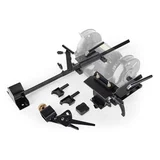
Price: $69.90 · See current price on Amazon
- Fits both 6" and 8" bench grinders
- Multi-grind jig and long support arm for standard, long, short or fingernail grinds
- Micro bevel block with four sizes (1/2", 5/8", 3/4", 1")
- Platform jig with dual miter slides (flat + pivoting) and a ratchet handle
At $69.90, this is the least expensive base kit in the roundup, and the fingernail-grind jig is included — no $57.95 add-on required like the Wolverine it’s cloned from. Add the same $117.26 slow-speed grinder and the total is $187.16, which is $103.04 less than reaching the same gouge-sharpening capability with the Wolverine.
The savings come with real fit issues. In a hands-on teardown comparing the VEVOR, an Easy Grind clone and the Oneway original, woodturner Carl Ford (carlford.us) found the VEVOR’s clamping bolt “too short” to properly seat a 1/2" or 5/8" gouge as shipped, and that its spring steel “traps” the gouge in the jig, making removal difficult. Both are fixable with a longer bolt and some patience, but it’s not a drop-in match for the Oneway’s ball-bearing mechanism.
Main drawback: plan on 20-30 minutes of bench-fitting before this one behaves like the $114.99 jig it’s cloned from. Who it’s for: turners on a tight budget who don’t mind some fettling on day one.
4. BMWOOD BG-GRIND4 4PCS Complete Grinding Jig System — Best Budget Complete Jig Set
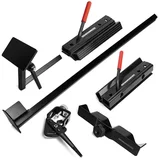
Price: $84.95 · See current price on Amazon
- Two locking bases mount under each grinding wheel
- V-arm holder supports gouges and chisels at a constant angle
- Adjustable-angle platform table with a repositioning lock lever
- Manufacturer markets a fingernail-grind capability as part of the 4-piece set
The BG-GRIND4 undercuts the Peachtree by $60.20 while covering the same basic V-arm-plus-platform layout, and it was one of two picks already on this page before this update (alongside the Peachtree). With the same $117.26 grinder added, the real total is $202.21.
One honest gap: the listing markets a fingernail-grind capability as part of the “4pcs set,” but no standalone BMWOOD fingernail jig turned up for sale on Amazon to independently confirm what’s actually in the box beyond the two bases, V-arm and platform. That’s not a red flag by itself — a brand simply not selling a separate accessory can mean it’s already bundled — but it’s the least independently documented accessory breakdown of the jig-based group here, so verify the exact grind types you need on arrival rather than assuming.
Main drawback: take the fingernail-grind claim on trust until it’s in your hands. Who it’s for: budget buyers who mainly need flat-tool sharpening (chisels, skews) and are comfortable verifying gouge capability themselves.
5. Robert Sorby ProEdge Sharpening System, Large — Best Self-Contained for Skews & Scrapers
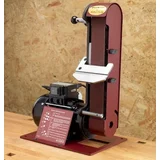
Price: $618.94 · See current price on Amazon
- Sharpens with an abrasive belt, not a grinding wheel — 1/2 hp motor, belt speed 1,440 ft/min (440 m/min)
- 9 factory-indexed preset angles: 15°, 20°, 25°, 30°, 35°, 45°, 60°, 80°, 90°
- Ships with one 120-grit aluminum oxide belt; additional grits (up to 3,000-grit Trizact) sold separately
- Self-contained — no separate grinder needed
The ProEdge is the odd one out in this table: it’s the only belt-based system, and the only one whose angle setting is a hard mechanical index rather than a friction-locked arm. Nine factory presets from 15° to 90° means the angle can’t creep between sharpening sessions the way a set-screw jig can — arguably the most repeatable angle mechanism in this entire roundup. Belts also remove less material per pass than a wheel, which makes it harder to accidentally grind away too much steel on a skew or scraper edge.
The base $618.94 unit doesn’t include a woodturning gouge jig. Robert Sorby sells the Woodturning Sharpening Accessory Kit ($159.94) separately, but the bundled ProEdge + Woodturning Accessory Kit ($759.94) actually beats buying the two pieces apart ($778.88) by $18.94 — a small but real saving for choosing the bundle over piecing it together yourself. Either way, the real total to be gouge-ready is $759.94. Belts also wear out (roughly $20-30 to replace) and are a running cost the wheel-based systems in this table don’t have.
Main drawback: at $759.94 to be gouge-ready, it costs nearly 3x the priciest jig-based option (Peachtree, $262.41) before you’ve turned a single bowl. Who it’s for: turners whose main frustration is skew and scraper edges, where the belt’s lighter material removal and locked-in presets pay off most.
6. Tormek T-8 Original — Best for Beginners (No Overheating Risk)
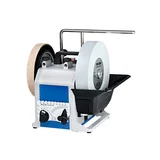
Price: $959.40 · See current price on Amazon
- 10" 220-grit water-cooled aluminum oxide stone, gradable to roughly 1000-grit with the included stone grader
- Runs at approximately 90-100 RPM — the slowest wheel speed of any system in this table
- 200W continuous-duty motor rated for shop use, not hobby-cycle use
- Base unit does not include a turning-tool jig
The water bath is the whole pitch: it is functionally very difficult to overheat or blue an edge on a Tormek, because the stone is constantly wet and spinning at roughly a tenth the speed of a dry bench grinder. For context, the woodturning community’s standard advice to buy a “slow-speed” 1750 RPM dry grinder instead of a 3450 RPM one actually traces back to protecting plain carbon-steel tools; most modern lathe gouges are high-speed steel (HSS), which tolerates far more heat before losing its temper — discussion on the American Association of Woodturners forum notes it’s “almost impossible” to overheat HSS in normal use, though the very thin cutting tip can still discolor with a heavy dwell on a fast dry wheel. A water-cooled system like the Tormek sidesteps the question entirely, which is exactly why it’s the most forgiving choice here for a first-timer who isn’t confident about dwell time yet.
That forgiveness is expensive. The base T-8 doesn’t ship with a turning-tool jig — you need the TNT-808 Woodturner's Kit ($523.96) on top, which includes the SVD-186 gouge jig, SVS-50 multi jig and a leather honing wheel. Buying the T-8 and the TNT-808 separately comes to $1,483.36 — and that is actually $87.64 cheaper than buying the pre-bundled "T-8 Woodturner's Kit" bundle ($1,571.00), which is worth checking before you click “buy” on the bundle by reflex. Either way, it’s over 5x the Wolverine’s real total cost, and the slow wheel speed means reprofiling a badly damaged edge takes noticeably longer than on a dry grinder.
Main drawback: the most expensive way into lathe-tool sharpening in this roundup by a wide margin, and buy the T-8 and TNT-808 separately — not as the bundle. Who it’s for: beginners with the budget who are more worried about ruining a tool’s temper than about spending extra time at the wheel.
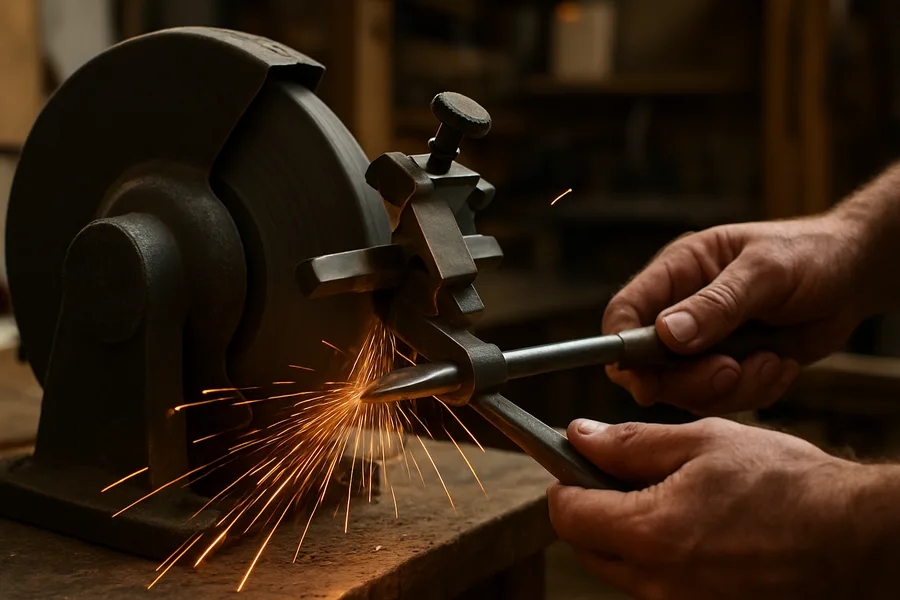
7. WEN 8-Inch Water-Cooled Wet/Dry Sharpening System (BG4108) — Best Budget Self-Contained System
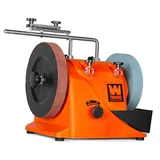
Price: $111.64 · See current price on Amazon
- 8" 220-grit sharpening stone plus an 8-3/4" leather stropping wheel
- 120 RPM, water-cooled — the same basic principle as the Tormek at a fraction of the price
- Adjustable-height water reservoir repositions as the stone wears
- Universal jig support compatible with the WEN 42704B and 42703 accessory kits
At $111.64, this is the cheapest self-contained (motorized, no separate grinder needed) system in this table by more than $500, and it uses the same water-cooled principle as the Tormek. If the appeal of the Tormek is “impossible to overheat an edge,” the WEN gets you most of that reassurance for about 12% of the T-8’s price.
The gap is jig coverage. The stock jig is built for chisels and plane irons, and no WEN-branded fingernail bowl-gouge jig turned up for sale to confirm compatibility with turning gouges the way the Tormek’s TNT-808 or the Wolverine’s Vari-Grind are confirmed. Until that’s independently verified, treat this as a flat-tool system — skews, scrapers, chisels, plane irons — rather than a full lathe-tool replacement for the jig-based picks above.
Main drawback: don’t buy this one expecting to reprofile a fingernail bowl gouge out of the box. Who it’s for: turners who mainly sharpen skews, scrapers and flat chisels and want a self-contained wet system without Tormek money.
How We Picked These
We have not physically owned and tested all seven of these systems side by side, so we won’t claim we did. What this article is: every price, spec and included-accessory claim was pulled from the manufacturer’s own Amazon listing or product page and verified live this week via the Amazon Creators API. Every “total cost” figure is arithmetic you can check yourself — the base price plus whatever accessory is needed for gouge sharpening, cited by ASIN and price. Where a claim (like BMWOOD’s fingernail-grind capability) couldn’t be independently confirmed, we said so instead of presenting it as fact. Two specific comparisons — the VEVOR’s clamping-bolt fit and the Wolverine’s ball-bearing hold-down — are cited from woodturner Carl Ford’s published hands-on teardown at carlford.us, not our own use. No star ratings appear anywhere in this article: Amazon’s review data was not reliably available for these ASINs at research time, and we’d rather publish nothing than invent a number.
The seven systems here were chosen to span the actual axis turners choose between, not to pad a list: two budget jigs (VEVOR, BMWOOD), two mid-range jigs (Wolverine, Peachtree), and three self-contained machines spanning budget to premium (WEN, ProEdge, Tormek). We excluded jigs and machines with no verifiable current Amazon listing, and excluded dealer-exclusive-only brands where a real live buy-box price couldn’t be confirmed. Every ASIN linked in this article was checked for a live buy-box price the same day the prices above were recorded — not carried over from a previous update.
What to Consider When Buying a Lathe Tool Sharpening System
Jig-Based vs. Self-Contained Systems
A jig-based system (Wolverine, Peachtree, VEVOR, BMWOOD) is a set of brackets and arms that clamps onto the tool rest of a bench grinder you already own, or buy separately. A self-contained system (Tormek, WEN wet systems, Robert Sorby ProEdge) has its own motor built in and needs nothing else. Jig-based systems are almost always cheaper to start with if you already own a grinder; self-contained systems cost more up front but remove the guesswork of matching a jig to a compatible grinder.
The jig-based route also scales differently once you already have a shop grinder set up for other tools. A grinder that’s already dedicated to lawnmower blades or metalworking isn’t a good candidate to also carry a fine woodturning wheel — grit contamination between rough metal grinding and fine tool sharpening is a real problem, so most turners who go the jig route end up buying a second, dedicated 8" grinder anyway. That’s exactly why every “total cost” figure in this article includes one, even for readers who technically already own a grinder of some kind.
The Real Cost to Get Started (Why the Sticker Price Lies)
Every jig-based system in this table is sold without a grinder, and the Wolverine specifically is sold without the gouge-shaping attachment most buyers actually want. Add both before comparing prices — the gap between a jig’s sticker price and its real “sharpening-ready” cost ranged from $0 (VEVOR and Peachtree, whose fingernail jigs are included) to $175.21 (Wolverine, once the grinder and Vari-Grind are added). The same principle applies to the self-contained systems, just at a different scale: the ProEdge and Tormek both look like single-purchase systems on their product pages, but neither ships gouge-ready, and the gap between their sticker price and their real cost is measured in hundreds of dollars, not tens.
Angle Repeatability: What "Set and Forget" Really Means
Repeatability isn’t about how sharp a system gets a tool on the first pass — it’s about whether the same setting reproduces the same bevel angle six months later. Hard mechanical presets (ProEdge’s nine indexed angles) are the most repeatable by design, since there’s no friction lock to creep. Projection-gauge jigs (Wolverine, Peachtree) are repeatable once dialed in and left alone, but a bumped setscrew resets your reference point. Write down or mark your settings regardless of which system you buy.
Tool Compatibility: Gouges vs. Skews vs. Scrapers
Fingernail-profile bowl and spindle gouges need a jig that can sweep the tool through an arc while rotating it — that’s what the Vari-Grind, Multi-Grind, and Tormek’s SVD-186 are built for. Skews, scrapers, chisels and plane irons only need a flat platform holding the tool at a fixed angle, which is why every system in this table (even the WEN, whose gouge capability is unconfirmed) handles flat tools out of the box.
Match the jig to the tools you actually own before you match it to price. A turner whose rack is mostly roughing gouges, skews and a parting tool doesn’t need the Vari-Grind attachment at all — the Wolverine’s base kit already covers that with its V-arm and flat platform, which drops the real Wolverine total back down to $232.25 (just the grinder, no Vari-Grind). It’s only bowl-turners chasing a fingernail or Ellsworth-style grind on their gouges who need the full $290.20 build-out. Check your own tool rack against the “Tool Compatibility” notes in each review above before assuming you need the most expensive configuration of any given system.
Grinder Speed and the 1750 RPM Myth
The advice to pair a jig with a “slow-speed” 1750 RPM grinder instead of a standard 3450 RPM one is repeated everywhere in woodturning circles, and it’s not wrong — but it’s worth knowing where it comes from. The concern originated with plain carbon-steel tools, which lose their temper at relatively low heat. Most modern lathe gouges are HSS, which is far more heat-tolerant; forum discussion among woodturners on the American Association of Woodturners forum concludes it’s technique (light touches, not dwelling in one spot) that prevents overheating an HSS edge more than the grinder’s RPM does. A slow-speed grinder is still the safer default, especially for a beginner who hasn’t built that touch yet — it just isn’t the hard requirement the received wisdom implies.
Wheel Grit and Wet vs. Dry Grinding
Dry grinders in this table pair with 60-120 grit wheels for shaping and a finer wheel for honing. Wet systems (Tormek, WEN BG4108) use a single 220-grit stone that can be dressed to a finer effective grit with an included grader, plus a leather stropping wheel for a final polish. Wet systems cut slower but never risk heat damage; dry systems cut faster but put more responsibility on the user’s technique.
For a new gouge that’s badly out of profile — a common situation buying secondhand tools — the speed difference is not trivial. A coarse dry wheel can reshape a damaged edge in a couple of minutes; the same job on a 90-100 RPM water-cooled stone can take ten times as long. If you regularly buy used or damaged turning tools and need to reprofile them from scratch, that’s a real point in favor of a dry system (Wolverine, Peachtree, VEVOR, BMWOOD) even before price enters the comparison. If your tools mostly just need a quick touch-up between turning sessions, the speed gap barely matters.
Consumables scale with grinding speed too. A dry wheel wears down (and needs dressing with a diamond wheel-dresser) faster than a slow-turning wet stone, so the faster jig-based systems trade a lower purchase price for slightly more upkeep over a full season of turning.
Build Quality: What Cheap Jig Clones Get Wrong
The failure mode isn’t usually the grinding surface — it’s the clamping mechanism that holds the tool still. Carl Ford’s comparison found the budget VEVOR jig’s clamping bolt too short for common gouge sizes and its spring steel prone to trapping the tool, versus the Oneway original’s ball-bearing hold-down. Neither issue is disqualifying, but budget an extra 20-30 minutes of fitting on a budget clone before your first sharpening session.
Budgeting for Belts, Wheels and Replacement Parts
Grinding wheels, belts and stones all wear out. A ProEdge belt runs roughly $20-30 to replace; dry grinding wheels are typically $15-25 each; a Tormek stone lasts years but the honing compound and leather wheel are consumables too. None of these recurring costs are included in the “total cost to sharpening-ready” figures above, which only cover getting to your first sharpened edge.
How to Set Up and Use a Lathe Tool Sharpening Jig
- Mount the jig. Bolt or clamp the jig’s base(s) to your grinder’s tool rest posts or bench, following the setup block or gauge included with your kit.
- Set tool projection. Slide the gouge or chisel into the jig until it extends the manufacturer’s specified distance — the Wolverine’s reference is a fixed 2" from the jig face, and it shouldn’t change between sessions.
- Dial in the bevel angle. Use the jig’s protractor, projection gauge, or (on the ProEdge) its indexed preset, then lock the setting.
- Make light, even passes. Rotate a gouge through its full arc for a fingernail grind; keep flat tools moving side to side on the platform. Don’t dwell in one spot, especially on a fast dry wheel.
- Check the bevel against an angle gauge or by eye, and repeat the identical jig setting for the opposite flute or edge.
- Strop or hone the edge on a leather wheel or hand strop to remove the burr before returning to the lathe.
- Record your settings. Mark the projection and angle you used so your next session starts from the same reference instead of re-guessing it.
If you’re sharpening carving tools or hand-honing without a jig at all, our full guide to sharpening gouges covers technique the jig doesn’t handle for you. And if the tool you’re sharpening is a bench chisel rather than a lathe tool, see our separate guide on how to sharpen wood chisels.
Frequently Asked Questions
What is the best wood lathe tool sharpening system?
For most turners it’s the Oneway Wolverine Grinding Jig, but budget $290.20 total once you add the $57.95 Vari-Grind attachment for fingernail gouges and a $117.26 slow-speed grinder — the base $114.99 kit alone can’t shape a bowl gouge.
Do I need a slow-speed grinder for a jig-based sharpening system?
A 1750 RPM slow-speed grinder is the safer default, especially for beginners, but it isn’t a hard requirement for modern HSS turning tools — the "must be slow-speed" rule traces back to protecting older carbon-steel tools, which overheat at much lower temperatures than HSS.
What’s the cheapest way to sharpen wood lathe tools?
The VEVOR Pro Grind Sharpening System is the cheapest complete path at $187.16 total (system plus a slow-speed 8-inch grinder), about $103 less than reaching the same gouge-sharpening capability with the Oneway Wolverine.
Is the Tormek T-8 worth it for woodturning tools?
Only if budget isn’t the deciding factor. A gouge-ready Tormek setup (T-8 Original plus the TNT-808 Woodturner’s Kit) runs $1,483.36 — over 5x the Wolverine’s real cost — but its water-cooled wheel makes it very difficult to overheat an edge, which is valuable for a beginner still learning dwell time.
What’s the difference between the Wolverine jig and its Vari-Grind attachment?
The Wolverine Grinding Jig ($114.99) is the base mounting system — two bases, a V-arm and a flat platform for skews and chisels. The Vari-Grind ($57.95) is a separate attachment that clamps onto the V-arm specifically to shape fingernail-profile bowl and spindle gouges; you need both to sharpen that grind.
Can beginners use a budget jig like the BMWOOD or VEVOR?
Yes — both are functional out of the box for flat-tool sharpening, and the VEVOR’s fingernail jig is included. Expect some initial fitting: a hands-on comparison found the VEVOR’s stock clamping bolt too short for 1/2"-5/8" gouges as shipped, which is a 20-30 minute fix, not a dealbreaker.
How much does a complete lathe tool sharpening setup actually cost?
Anywhere from $111.64 (WEN’s self-contained system, flat tools only) to $187.16 (VEVOR jig plus a grinder, gouge-capable) at the budget end, up to $1,483.36 for a gouge-ready Tormek. The three most balanced options — BMWOOD, Peachtree and the Wolverine — land between $202 and $290 once a grinder is included.
How does a quad setting jig help with sharpening?
A quad setting jig holds a tool at four pre-marked reference points so the same bevel angle and projection come back every time you clamp a tool in, instead of re-measuring from scratch. The Wolverine, Peachtree and BMWOOD systems in this table all ship with one; it’s the mechanical reason jig-based sharpening is repeatable at all, separate from whichever gouge- or flat-tool attachment you pair it with.
Final Thoughts
The Oneway Wolverine Grinding Jig is still the best overall pick — it’s the system the accessory ecosystem is built around, and its ball-bearing hold-down is a genuine, checkable design advantage over the clones. Just budget the real number, $290.20, not the $114.99 sticker price. If cost is the deciding factor, the VEVOR gets you gouge-capable for $187.16; if avoiding an overheated edge matters more than cost, the Tormek is the only system here built around that guarantee.
Once your tools are sharp, dialing in the right lathe speed matters just as much as the edge itself — our wood lathe speed calculator and guide to using a wood lathe chuck cover the rest of the setup. And if you’re still shopping for the lathe itself, see our unbiased review of Grizzly wood lathes or our breakdown of the JET wood lathe lineup, plus our guide to the best wood species for turning.
Sponsored / affiliate links. As an Amazon Associate I earn from qualifying purchases. I may earn additional commission from eligible campaigns.