How Much Does a Custom Wood Accent Wall Cost?
A custom wood accent wall is often estimated at about $20 to $80 per square foot installed, with simpler painted slat walls near the lower end and site-finished hardwood paneling or more complex layouts near the higher end. Cost shifts with material, size, labor, and design complexity, so a quote for shiplap, board and batten, tongue and groove, slat walls, herringbone, or beadboard can land very differently. Underbid walls often end up with visible seams, uneven reveals, or finish changes that add expensive rework. This guide breaks pricing into material grade, layout waste, site prep, and finish level so you can estimate a real custom quote.
Price each cost line before adding the total


Use this worksheet to turn a quote into a real installed cost. The biggest mistake is treating the wall as one number when it is really a stack of separate charges: material, waste, backing, finish, prep, labor, and cleanup. Once you price each line, overruns are easier to spot.
| Line item | How to price it | Typical input range | Notes |
|---|---|---|---|
| Wall area | Width × height in square feet | Project-specific | Measure only the finished wall face |
| Board species | MDF, pine, cedar, white oak, walnut | Paint-grade to premium hardwood | Higher species grade raises both material and labor cost |
| Pattern multiplier | Base layout factor for cuts and complexity | 1.00 to 1.40+ | Shiplap and board and batten stay near the low end; herringbone trends higher |
| Waste percentage | Extra material for cuts and layout loss | 5% to 30% | Herringbone and angled layouts need the most waste allowance |
| Substrate/backing | Plywood, furring, or existing drywall condition | None to added backing cost | Slat walls often need a clean, flat plywood substrate |
| Finish type | Paint, stain, sealant, polyurethane | Paint-grade to site-finished | Clear finish and multiple coats raise labor time |
| Prep allowance | Drywall repair, outlet cuts, baseboard removal, transitions | Light to heavy repair scope | Out-of-square walls and ceiling edges create extra layout time |
| Labor hours | Wall area × labor rate factor | 0.05 to 0.28 hours per square foot | Board and batten is faster than slat walls; herringbone is slowest |
| Hourly rate | Installer charge per hour | Market-specific | Use your local carpenter or finish carpenter rate |
| Total installed range | Materials + labor + prep + finish + delivery/disposal | Calculated result | Ask for each component separately |
Wall area and size assumptions
Start with square footage, not room name. A 60-square-foot feature wall, a 100-square-foot living room wall, and a 180-square-foot tall wall do not price the same way because waste, transitions, and labor grow with size. Tight spaces also increase the odds of outlet cuts and trim adjustments.
For planning, small accent walls often fall under about 60 square feet, standard living room walls often land around about 80 to 120 square feet, and large media walls can be larger when built around a TV niche, shelves, or a fireplace surround.
Species, pattern, and waste inputs
Species changes the quote twice. First, the lumber itself costs more. Second, harder or pricier material usually takes more careful milling and fitting. Pattern choice matters just as much. A straight horizontal run wastes far less material than a 45-degree herringbone layout.
A common first-timer mistake is comparing a painted pine shiplap quote with a walnut slat wall quote and treating them as the same project. They are not. One is a paint-grade assembly. The other is a finish carpentry build with tighter tolerances and a much higher material bill.
Labor, finish, and prep line items
Labor often determines whether a quote stays close to budget. Board and batten installation runs 0.05 to 0.09 hours per square foot, wood slat wall installation runs 0.12 to 0.20 hours per square foot, and herringbone and chevron installation runs 0.18 to 0.28 hours per square foot. That spread is what turns a simple wall into a premium job.
Finish also matters. Paint is faster than stain plus clear coats, while polyurethane and sealant add drying time and at least one more step. Delivery, disposal, and site protection are easy to overlook, but they belong in the installed total.
How much does a custom wood accent wall cost installed?
A custom wood accent wall usually lands between $20 and $80 per square foot installed, but the real number depends on size, species, pattern waste, prep, and finish level. Simple painted layouts can sit near the low end, while white oak, walnut, or herringbone work moves the price much higher.
Broad benchmark pricing helps, but it does not replace a line-item estimate. For comparison, board and batten on 100 sqft is priced at $650 to $1,200, shiplap on 100 sqft is priced at $750 to $1,500, white oak shiplap on 100 sqft is priced at $2,000 to $4,000, wood slat wall on 100 sqft is priced at $3,000 to $6,000, and herringbone and chevron on 100 sqft is priced at $5,500 to $12,000.
Typical installed range by project size
Small walls usually cost more per square foot because fixed labor does not shrink much with size. A compact wall still needs layout, trim checks, outlet cuts, and cleanup. Larger walls spread setup time over more square footage, though premium species and complex patterns can erase that advantage fast.
Per-square-foot pricing benchmarks
Accent wall installation can start around $7.01 per square foot before custom material, finish, and specialty layout work are added. Shiplap typically costs between $2.50 and $7.00 per square foot, not including installation. Hardwoods may range from $5 to $10 per sq. ft. Those figures help separate material cost from the installed total.
What a quote should include
Ask for separate numbers for material, backing, labor, finish, prep, delivery, and disposal. If the installer only gives one lump sum, you cannot tell whether the quote assumes paint-grade pine, solid white oak, or a site-finished hardwood build. That is where budget surprises start.
- Measure the finished wall area in square feet.
- Choose the species or grade: MDF, pine, cedar, white oak, or walnut.
- Select the pattern: shiplap, board and batten, tongue and groove, slat wall, beadboard, or herringbone.
- Add waste for cuts and layout losses.
- Price backing, finish, prep, labor, delivery, and disposal separately.
- Compare at least two quotes using the same assumptions.
What affects the price the most?
The biggest cost drivers are material grade, pattern complexity, and wall condition. Those three items change both the material bill and the labor hours. A simple pine wall with clean drywall is a different job from a walnut herringbone feature wall that needs leveling, outlet adjustments, and a flawless finish.
Material grade and wood species
MDF and paint-grade pine sit at the budget end because they are cheaper to buy and easier to finish. Cedar adds more cost, especially if you want a natural finish. White oak and walnut sit at the premium end because the lumber itself is more expensive and the finish work needs more care.
That difference comes from both material grade and the labor required to produce a cleaner finished surface.
Layout waste and cut count
More cuts mean more waste. Herringbone and chevron patterns need 25 to 30 percent waste because board ends do not land in a straight run. Straight horizontal shiplap wastes far less, and board and batten usually sits between the two because battens cover joints rather than forcing angled cuts.
Suppose a 100-square-foot wall uses a herringbone layout. The material order should be larger than the wall face because angled cuts create offcuts that cannot be reused easily. If the installer forgets that allowance, the quote can balloon after the first layout dry-fit.
Prep work and wall condition
Drywall defects, bowed studs, and uneven corners all add time. Out-of-square walls take extra layout work so the pattern still reads straight. Baseboard removal, ceiling transitions, and outlet cuts also raise labor because they interrupt the flow of the build.
Picture a 90-square-foot wall with a low-voltage box, a thermostat, and a ceiling line that is not level. The carpentry is still possible, but the installer must spend more time scribing, trimming, and rechecking spacing. That added time belongs in the quote.
Wood species and finish tiers
Species choice affects appearance, durability, and the final bill. Paint-grade materials are the cheapest route. Clear-finished hardwoods cost more because the face quality has to be cleaner, the joints tighter, and the finish application more careful. The finish system itself also changes labor time.
MDF and paint-grade pine
MDF and paint-grade pine are the cheapest custom options for a wood accent wall. They are common for board and batten, beadboard, and painted shiplap because they take paint well and keep material costs down. They also allow a faster finish schedule when the wall will be painted rather than stained.
Beadboard often comes as pre-assembled panel options, which can reduce labor on a wainscot height wall. That makes it a practical budget choice when you want texture without a complex pattern.
Cedar, white oak, and walnut
Cedar works well when you want a natural finish and some moisture resistance. White oak suits a more refined, durable look, while walnut sits at the high end for color and material cost. These species usually need better substrate prep and more careful finishing than paint-grade boards.
Wood slat wall pricing is a good example of the jump to premium material and labor. That type of wall typically uses vertical slats over a plywood substrate, which adds both material and installation steps.
Stain, sealant, and polyurethane
Paint is usually the simplest finish. Stain needs cleaner sanding and more visible face quality. Sealant and polyurethane are common when you want more protection or a clearer finish on cedar, white oak, or walnut. Each extra coat adds labor and waiting time.
Which accent wall style costs less?
Board and batten is usually the cheapest custom style because it uses a simple vertical board layout and installs quickly. Shiplap is still relatively affordable, while tongue and groove, beadboard, slat walls, and herringbone move upward as finish quality, substrate needs, and labor hours increase.
Shiplap and board and batten
Shiplap uses a horizontal layout and often creates a clean shadow line gap. Painted pine is the budget-friendly version. White oak shiplap is far pricier and belongs in a higher finish tier. Board and batten uses vertical boards with battens and is usually the fastest path to a custom look.
Board and batten installation runs 0.05 to 0.09 hours per square foot, which is one reason it stays economical. Shiplap is also accessible, with a broad installed range that is easier to control when the wall is square and the finish is simple.
Tongue and groove and beadboard
Tongue and groove creates a tight seam profile and a cleaner continuous surface. It is often used with cedar for a natural finish and better moisture resistance. Beadboard has a rounded bead detail and works well at wainscot height or across a full wall.
These styles can look simple, but the cleaner the seam line, the more careful the fit. Full-wall beadboard can be economical, yet custom trim and transitions still add cost when the room has multiple openings or a high ceiling.
Wood slat walls and herringbone
Wood slat walls are usually more expensive because they rely on vertical slats, careful spacing, and a plywood substrate. Herringbone costs the most of the common custom styles because the boards are cut at 45-degree angles, the waste is higher, and the layout takes longer.
Is herringbone more expensive than shiplap for a wall? Yes. The difference comes from cut count, waste, and labor intensity, not just the board species.
How much does labor and prep add?
Labor and prep can add a modest amount on a clean wall or a large amount on a difficult one. The final price rises when the installer must repair drywall, remove baseboards, work around outlets, or manage ceiling transitions. Delivery and disposal are small compared with labor, but they still belong in the total.
Installer hourly rates and labor hours
Labor is often priced by the hour or embedded in a per-square-foot rate. To estimate it, multiply wall area by labor hours per square foot, then multiply by the installer’s hourly rate. A faster style like board and batten uses fewer hours than a slat wall or herringbone layout.
How long does a custom wood accent wall take to install? A simple painted wall can take a day or less, while a larger patterned wall can take longer once layout, cutting, fastening, and finishing are included. Herringbone and chevron usually take the most time because the layout is less forgiving.
Drywall repair, outlet cuts, and transitions
Drywall patching, skim coating, and sanding may be needed before any boards go up. Outlet cuts and switch locations interrupt the pattern. Baseboard removal can be necessary if the new layout needs a cleaner bottom edge, and ceiling transitions matter when the wall height is not consistent.
Delivery, disposal, and finish allowances
Delivery charges can rise if the material is heavy or specialty ordered. Disposal matters if old trim or panels need to be removed. Finish allowances should include sanding, primer if needed, stain, and clear coat or paint. If these are missing, the quote is incomplete.
How much should I budget for prep, finish, and delivery? Budget more when the wall has defects, trim changes, or a premium finish. A clean, square wall with paint-grade material needs less than a tall wall with stain, polyurethane, and cleanup, so ask for each allowance as a separate line.
Three custom wall cost examples
These examples show how the same wall area can price very differently depending on species, pattern, waste, and finish. They are not fixed market rates. They are quote-building examples meant to help you compare bids with the same assumptions.
Small wall example
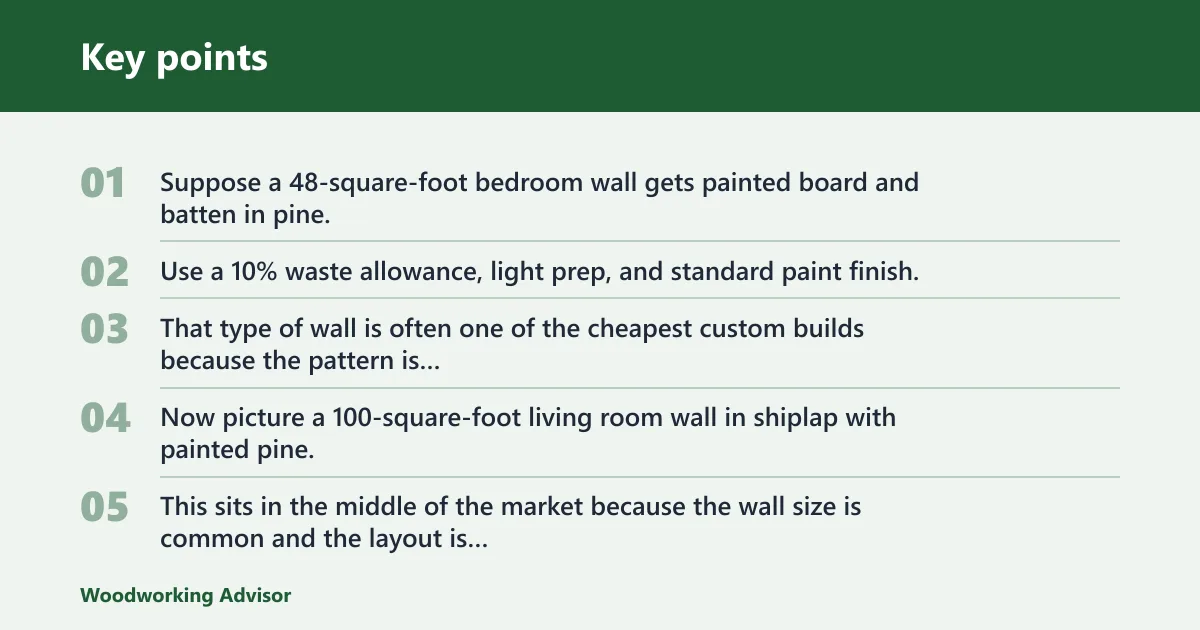
Suppose a 48-square-foot bedroom wall gets painted board and batten in pine. Use a 10% waste allowance, light prep, and standard paint finish. That type of wall is often one of the cheapest custom builds because the pattern is simple and the labor hours stay low.
| Input | Value |
|---|---|
| Wall area | 48 sq. ft. |
| Board species | Paint-grade pine |
| Pattern multiplier | 1.05 |
| Waste percentage | 10% |
| Substrate/backing | Existing drywall |
| Finish type | Paint |
| Prep allowance | Light patching and outlet cuts |
| Labor hours | 48 × 0.07 = 3.36 hours |
| Hourly rate | Local carpenter rate |
| Total installed range | Typically in the lower custom tier |
Standard living room wall example
Now picture a 100-square-foot living room wall in shiplap with painted pine, moderate prep, and a higher-end painted finish. This sits in the middle of the market because the wall size is common and the layout is still straightforward. The quote should still separate material from labor.
| Input | Value |
|---|---|
| Wall area | 100 sq. ft. |
| Board species | Pine |
| Pattern multiplier | 1.10 |
| Waste percentage | 12% |
| Substrate/backing | Existing drywall with minor leveling |
| Finish type | Paint |
| Prep allowance | Minor drywall repair and trim adjustment |
| Labor hours | 100 × 0.08 = 8 hours |
| Hourly rate | Local carpenter rate |
| Total installed range | Middle custom tier |
Premium herringbone wall example
Consider a 120-square-foot media wall in white oak herringbone with stain, sealant, and polyurethane. Use a 28% waste allowance and extra prep for outlet cuts and ceiling transitions. This is the kind of wall that moves into premium pricing because every part of the build takes longer and costs more.
| Input | Value |
|---|---|
| Wall area | 120 sq. ft. |
| Board species | White oak |
| Pattern multiplier | 1.30 |
| Waste percentage | 28% |
| Substrate/backing | Plywood substrate |
| Finish type | Stain, sealant, polyurethane |
| Prep allowance | Wall leveling, outlet cuts, transition work |
| Labor hours | 120 × 0.24 = 28.8 hours |
| Hourly rate | Local finish carpenter rate |
| Total installed range | Premium custom tier |
Frequently asked questions
How much does an accent wall cost?
A custom wood accent wall usually sits in the $20 to $80 per square foot installed range, but style and finish matter more than the room label. Painted board and batten can stay near the lower end, while white oak, walnut, and herringbone push the price much higher.
What affects the price of a wood accent wall the most?
The biggest drivers are species, pattern complexity, and wall condition. A clean, square wall with paint-grade material is far cheaper than a tall wall with white oak, added waste, outlet cuts, and finish coats. Those items change both the materials bill and the labor total.
How much does a wood slat accent wall cost per square foot?
Wood slat wall pricing is commonly higher than shiplap or board and batten because it uses more labor and usually needs a plywood substrate.
Is herringbone more expensive than shiplap for a wall?
Yes. The gap comes from angled cuts, 25 to 30 percent waste, and much slower layout and installation time.
What is the cheapest custom wood accent wall style?
Board and batten is usually the cheapest custom style because it uses a straightforward layout and faster installation. Painted pine or MDF keeps the material bill low. If you want the lowest installed cost, choose a simple pattern and avoid premium hardwoods and site-finished clear coats.
Should I choose MDF, pine, oak, or walnut for an accent wall?
Choose MDF for paint-grade budget work, pine for a low-cost wood look, white oak for a durable mid-to-high finish, and walnut for a premium appearance. The right choice depends on whether you want paint, stain, or a natural finish, and how much labor you want to pay for.
How long does a custom wood accent wall take to install?
Installation time depends on the layout and the wall condition. Board and batten is fastest, shiplap is still efficient, and herringbone takes the longest because it needs more cuts and more layout checks. Prep, finish drying, and trim adjustments can stretch the schedule beyond the carpentry itself.
Sponsored / affiliate links. As an Amazon Associate I earn from qualifying purchases. I may earn additional commission from eligible campaigns.